Sling Bag vs Daypack for Sightseeing
Sling Bag vs Daypack for Sightseeing
Start with your phone, water, food and layers, then choose the bag that makes the whole day easier.
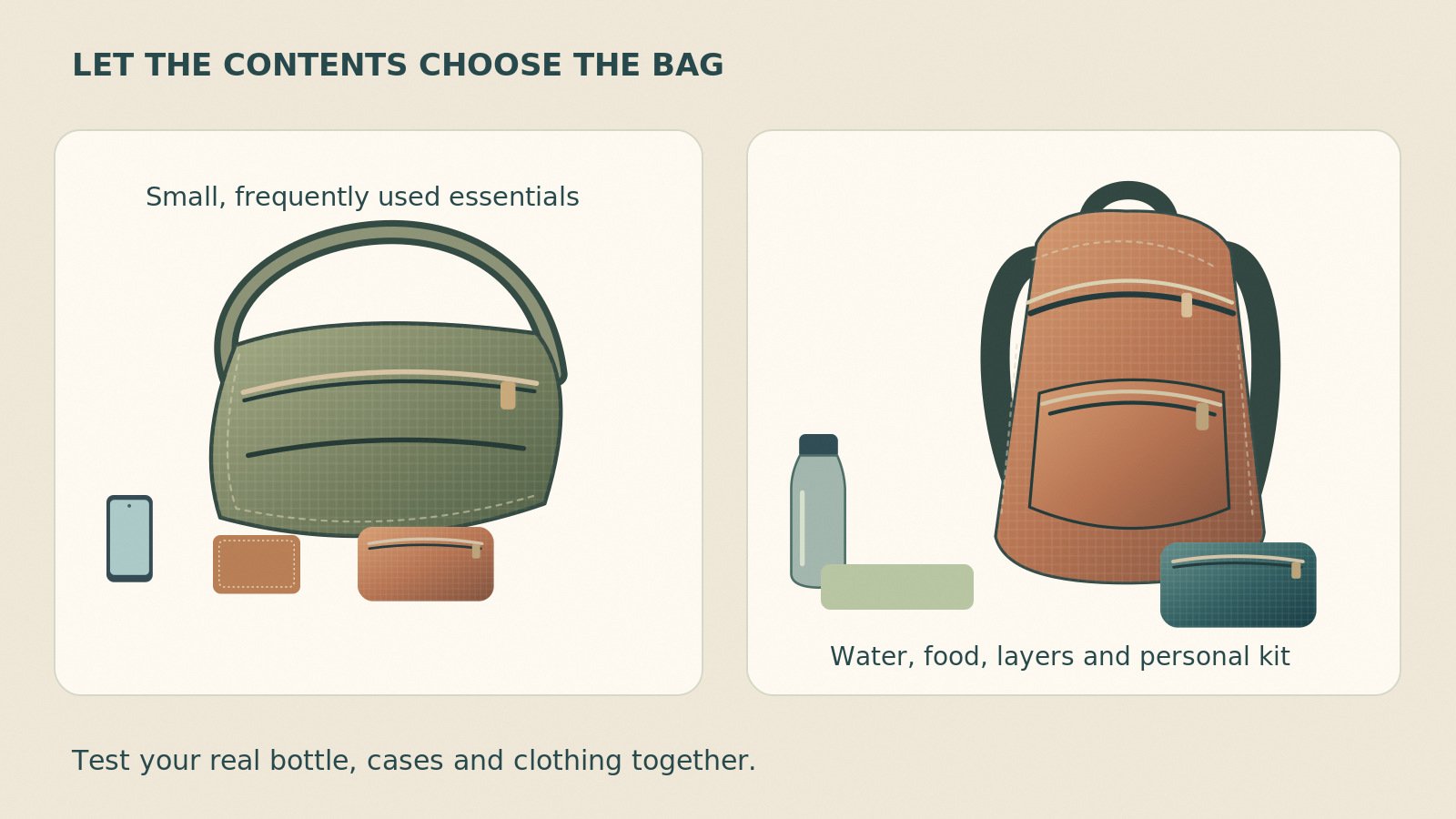
Sling bag vs daypack for sightseeing is a choice about the contents of your day, not just the look of the bag. A small sling can keep a phone, wallet and other frequently used items close at hand. A daypack becomes more useful when water, food, a spare layer or larger equipment need their own space. The difficult cases sit between those extremes, where a sling technically closes but no longer carries the load comfortably.
My starting recommendation is a compact sling for genuinely minimal outings and a comfortable daypack for a fuller sightseeing load. Do not choose a sling only because it seems smaller, or a backpack only because you might buy something later. Lay out the actual items first, including the ones that are awkward to fit, and let that list decide how much bag you need.
This research-led comparison uses manufacturer specifications and practical packing scenarios. It does not claim that the bags have been worn, tested for theft resistance or assessed clinically for comfort. The examples show different sizes and constructions rather than a ranked list of interchangeable products. The aim is to make the trade-offs visible, including occasions when the most sensible choice is a bag you already own.
A compact sling
Useful when the whole load stays small and accessible.
A suitable daypack
Give water, lunch and removable layers enough space.
Smaller means lighter
Compare the exact empty bag and the complete contents.
Your actual kit
The real bottle and protective cases matter more than a style label.
Sling bag vs daypack for sightseeing: match the bag to the contents
A sling works best when the load stays deliberately small
A compact sling is appealing when you repeatedly need a few small items and do not want to remove a backpack each time. It can provide a defined place for a phone, payment items, keys and perhaps a small charging accessory. However, useful access depends on the pocket layout and the way the bag sits, not simply on the fact that it has one strap.
Start by removing anything included only because it might be handy. Then check whether the remaining objects fit without stacking every item on top of the next one you need. A sling that opens into an orderly arrangement is doing its job. One that becomes a tightly packed container requiring repeated unpacking has probably reached the limit of its useful capacity for that day.
A daypack earns its size when the contents are bulkier
A bottle, lunch box and weather layer can change the decision quickly. They need usable shape as well as nominal volume. A daypack may provide room to separate those items and keep the frequently used essentials accessible without compressing everything into one narrow compartment.
That does not mean buying the largest backpack available. Choose enough space for the real load and a little practical flexibility, rather than enough space to justify a collection of unnecessary extras. A smaller comfortable daypack can be a better sightseeing tool than a large travel backpack carried half empty simply because you already brought it on the flight.
Start with a contents-first sizing exercise
Lay out the least flexible objects first
Put the rigid items on a table: the bottle you use, sunglasses case, camera, power bank or food container. These are more informative than a general statement that you travel light. A bag may have enough total space but the wrong shape for one object, particularly a tall bottle or a broad rigid case.
Next, add softer items such as a light layer. Try the complete load in the candidate bag rather than measuring each object separately and assuming the volumes add neatly. Real packing includes awkward gaps, access space and the thickness of the bag's own internal divisions. The test should end with an opening that closes without strain.
Do not treat every advertised litre as equally accessible
A narrow sling can have a useful internal layout while still being unsuitable for bulky contents. Conversely, a larger backpack can lose convenience if everything drops into a deep undivided main compartment. Useful capacity means space you can access and manage, not simply a number that appears generous on the specification page.
For a suggested first comparison, separate a minimal essentials load from a full-day load containing food, water and a layer. You do not need universal litre rules to see that these are different jobs. Once you know which load resembles your day, the appropriate size range becomes much easier to investigate.
| Your actual load | A sling may work well when… | A daypack is worth trying when… |
|---|---|---|
| Small essentials | Everything fits accessibly without tight stacking. | A preferred existing bag already carries the load comfortably. |
| Bottle and lunch | The real shapes fit without making the rest awkward. | Bulky items need their own space or a bottle pocket. |
| Spare clothing | The layer remains genuinely compact. | The bag must accommodate clothing removed during the day. |
| Camera or tablet | Suitable protection fits alongside the everyday items. | Larger equipment needs separation and usable access. |
| Shared equipment | Each person still has access to essential personal items. | A clearly agreed shared load needs additional room. |
| Transfers | The sling works with your larger bag and allowance. | The daypack can travel conveniently inside or alongside main luggage. |
Compare access without forgetting what happens after you open the bag
Front access can be convenient, but the bag still needs closing
A sling worn towards the front may let you retrieve small items without taking the bag off. Check whether the zip orientation supports that position and whether the contents remain contained when it is opened. A pocket that looks tidy on a table can behave differently when tilted against your body.
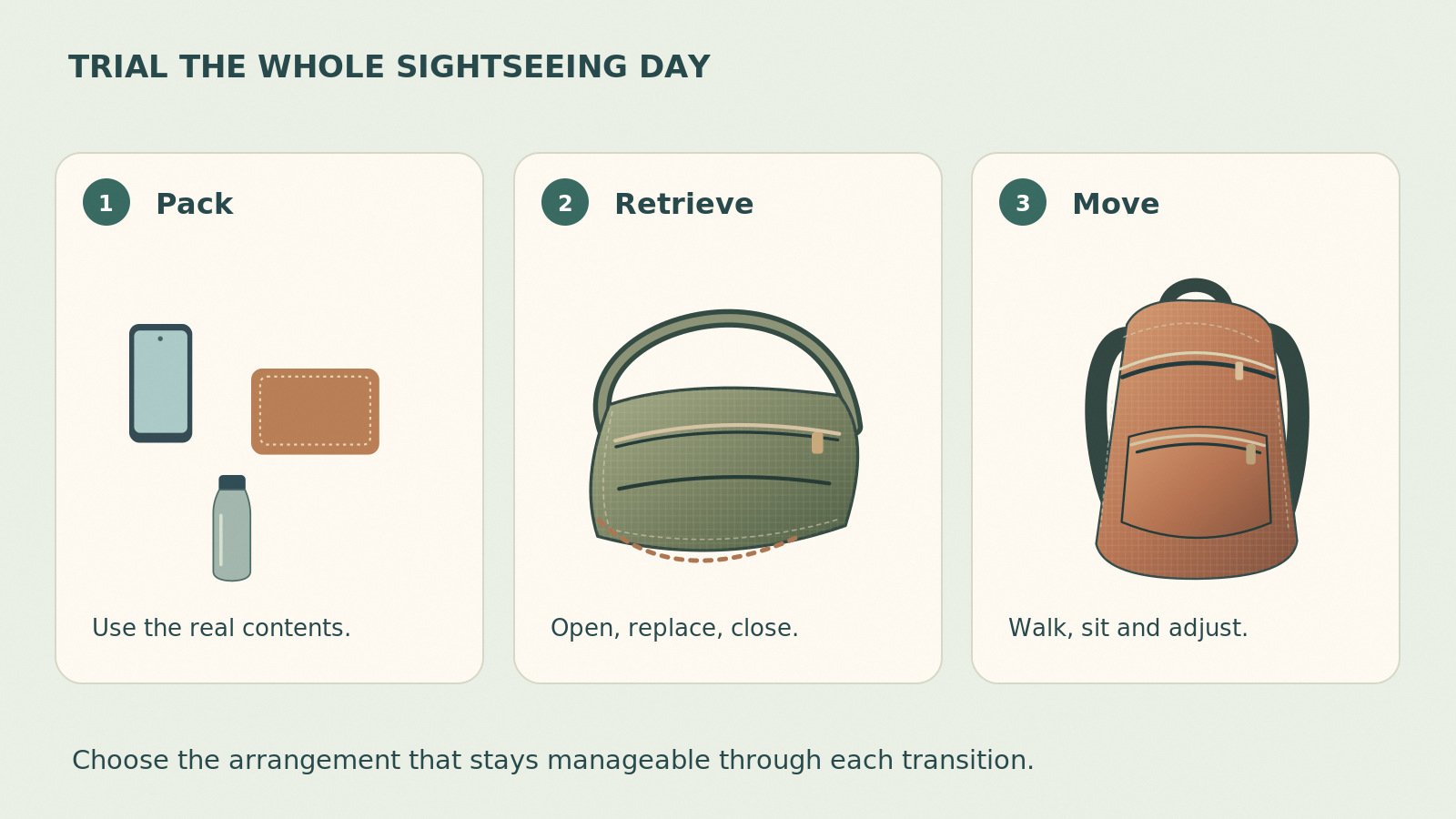
Practise the whole sequence: open, retrieve, replace and close. If using the phone requires leaving the wallet loose on a counter, the layout needs improvement. Likewise, a bag that lets you reach everything quickly is not particularly helpful if the opening is routinely left unsecured after each stop.
A daypack can have a sensible quick-access zone
A backpack does not have to mean unpacking the main compartment for every small task. A suitable pocket or a small internal pouch can keep the essentials together. The important distinction is between convenient access and a pocket chosen only because it is the easiest place to drop everything at the last minute.
Decide which items need to be reached repeatedly, then allocate a specific place for them. Keep the arrangement stable through the day so you do not have to search every compartment at each stop. This simple access plan can make a conventional daypack more practical than buying another bag purely to move the phone closer to the front.
One strap or two: assess comfort with the real load
The strap arrangement changes how the bag is carried
A sling concentrates its carrying arrangement around one strap, while a daypack normally offers two shoulder straps. That difference is relevant, but it does not provide a universal comfort result. Strap width, shape, adjustment, bag position and the actual load all affect the experience, so avoid assuming that every sling becomes uncomfortable or every backpack fits well.
Wear the bag with your normal sightseeing clothing and the intended contents. Check whether it slides, presses into an awkward place or requires repeated adjustment. These are practical fit observations, not medical measurements. A bag that is pleasant empty can behave differently after adding a bottle or a dense power bank.
Check sitting, bending and changing layers
Sightseeing involves more than walking in a straight line. Sit in a chair, bend to reach something and try putting on or removing an outer layer. Notice whether the strap tangles, the bag shifts into the way or the contents press against you. If a sling can be worn on either side, test the configuration you prefer rather than assuming all adjustment options feel equivalent.
For a backpack, adjust both straps and check that the load does not hang awkwardly low. Then take it off and put it back on while keeping the small items contained. A comfortable day bag should support these ordinary movements without turning each stop into an equipment-management task.
Four examples show why the category name is not enough
BAGSMART Faro 2.5L Sling: a lightweight essentials example
BAGSMART lists the Faro Sling at 2.5 litres, 0.2 kg and 29 × 7.5 × 13 cm. Its product description includes internal mesh organisation and a hidden rear pocket. Those features make it a useful candidate for a small essentials load, not a substitute for a daypack carrying a lunch box and several bulky layers.[1]
Check the shape of your actual phone case, sunglasses and charging items together. Small compartments can be useful while still competing for the same overall space. The reason to investigate this sling is its compact job description; the reason to choose something larger is an actual packing need, not a failure to squeeze in one more item.
TORRO Leather Crossbody Sling: a heavier design reference
TORRO lists its leather sling at 685 g, with dimensions of 39 × 19.4 × 5.5 cm and two main zipped compartments. That makes it a useful reminder that a sling is not automatically lighter than a daypack. The selected black option was shown as sold out when checked on 12 October 2026, so it is included as a design comparison rather than an immediately available recommendation.[2]
Its material and organisation may appeal to a reader looking for a particular style, but they should not be described as weight savings by default. Compare the empty weight and usable shape with your own needs. The listing can be checked for future availability, without assuming a restock date or treating the manufacturer's comfort description as a result from this article.
Osprey Daylite Plus: a conventional 20-litre daypack
The Daylite Plus is listed by Osprey at 20 litres and 590 g. It has side bottle pockets and a front organisation pocket, offering a useful comparison with the smaller sling examples. Its published size is 48 × 28 × 24 cm; this article does not interpret that as automatic acceptance under any particular airline's personal-item allowance.[3]
Consider it when water, food and a layer are part of the actual daytime load. However, check the fit and whether the organisation helps you rather than simply adding room to overpack. A named product is a candidate for a trial, not proof that its harness or pocket arrangement suits every reader.
BAGSMART Faro Light: another everyday carrying option
The Faro Light specification lists 20 litres and 430 g, with a removable back panel described by the manufacturer. That makes it another option to inspect when a full day requires a daypack but you still want to watch empty weight. Use the current product specification, because some earlier descriptions differ slightly in dimensions and rounded weight.[4]
Do not choose it solely because it is lighter than one comparison bag. Pocket usability, back contact and the shape of the contents still matter. The product's role here is to show that there are several ways to move beyond a sling without assuming every daypack must be bulky, heavy or intended for an expedition.
Water, food and spare clothing often settle the decision
Check your actual bottle, not an imagined smaller one
A bottle can consume much of a compact sling's usable space. Even when it fits, it may leave the rest of the contents compressed against it. Try the real bottle you intend to use, with the amount of water appropriate to your plan, rather than choosing a bag around an unrealistically small substitute.
An external bottle pocket can help, but test retention and access while the backpack is fully packed. Make sure the bottle does not interfere with the zip or sit so awkwardly that you constantly adjust it. The practical advantage comes from the working arrangement, not from simply ticking bottle pocket on a feature list.
Food packaging can be bulkier than the food itself
A rigid lunch container may determine the bag shape more than several small personal items combined. Put it in first during the trial, then check what happens when you remove it later. A soft bag can change shape when the rigid object comes out, while a structured one may keep its shape but leave a large empty compartment.
Think about where wrappers or used containers will go after eating. A small separation pouch can help where needed, but do not add one automatically if an existing compartment works. The aim is to keep the bag manageable throughout the day, including after lunch, rather than only at the moment you leave your accommodation.
An extra layer needs somewhere to live when it is not worn
A sling chosen while you are wearing a jacket may not accommodate it once the day warms up. Include that transition in the packing trial. The same applies to a compact umbrella or an extra item carried for another person. A bag that works only while the bulky items remain on your body may be too small for the whole day.
A daypack usually gives more flexibility for these changes, but there is still no need to carry unnecessary bulk. Choose the clothing and protection appropriate to the activity, then select a bag that accommodates it. Do not omit something genuinely needed merely to preserve a preference for a smaller-looking bag.
Cameras, tablets and charging items need their own fit check
A protective case changes the packing problem
Check the device in the case or sleeve you will actually use. A camera that fits a sling on its own may no longer fit accessibly with suitable protection, a spare battery and the other contents. Similarly, a tablet's screen-size label does not describe its complete external dimensions once a case is fitted.
Leave enough space to retrieve the device without scraping it past keys or repeatedly emptying the bag. The protection should be appropriate to the equipment and activity, not improvised because the preferred bag is slightly too small. A larger bag or a different carrying arrangement can be a more sensible decision than forcing an expensive object into a tight compartment.
Do not let charging accessories take over the day bag
A power bank, cable and charger can be useful, but choose the combination actually needed for the day's use. Avoid carrying several redundant adapters simply because they remain in a travel organiser from the flight. Small dense accessories can make a compact sling feel much more substantial than its size suggests.
Keep the items organised so a loose cable does not catch in the zip or pull another object out when retrieved. Also keep batteries and devices protected from loose conductive objects and follow their manufacturers' instructions.[5] A bag's built-in port or technical appearance is not itself a reason to carry more electrical equipment.
Think about queues, museums and crowded transport
A small profile is useful only when it remains controlled
Compact bags can be easier to manoeuvre through a busy indoor space, but their position still matters. A sling hanging away from the body or a backpack worn without awareness can both become awkward around other people. Adjust the bag to suit the situation and keep its contents contained while moving through tight areas.
Do not assume a sling is exempt from a venue's bag rules. Museums, attractions and other sites may set their own restrictions on size, storage or how a bag is carried. Check the exact venue before leaving with equipment that cannot be stored conveniently, rather than relying on a general claim that a particular bag type is always allowed.
Consider the point at which the bag comes off
At a café, screening point or seat, you will eventually remove the bag. Plan where it goes and how you keep track of it. A sling that was conveniently against your front is no longer in that position when laid beside a chair. A backpack's hidden rear pocket may also become exposed when the bag is set down differently.
Make returning the bag to its intended position part of the stop-and-start routine. Avoid leaving belongings in a temporary place while distracted by a ticket or purchase. This is a practical handling consideration that applies to either category and cannot be resolved by the bag's size alone.
Security depends on the details, not the strap count
Front carrying is not a guarantee
Police advice includes keeping bags closed and carrying them in front or diagonally across the chest where appropriate. That is a useful handling principle, but it does not establish that every sling is safer than every backpack. The openings, carrying position and your attention to the bag still matter.[6]
Inspect which pocket gives access to the important items and whether you can close it completely after use. A hidden pocket, a lockable opening and reinforced fabric are separate features. Do not assume that one is present because a product uses the general term travel security, and do not treat a small front-carried bag as theft-proof.
Separate everyday access from reserve belongings
A practical approach is to decide what needs repeated access and what can remain stored until a quieter moment. The everyday zone might hold a phone and a limited set of payment items, while reserve belongings stay in a more controlled compartment. This is a packing principle, not a requirement to carry all important documents on every outing.
Avoid moving everything into the easiest pocket just because another opening is inconvenient. If the layout repeatedly encourages that habit, choose a simpler arrangement. The goal is a system you can maintain through a busy day rather than one that looks secure only when arranged carefully at home.
Compare empty weight without assuming the smaller bag wins
Use numbers for the exact models
The published examples show why the label can mislead. TORRO's leather sling is listed at 685 g, while Osprey's Daylite Plus is listed at 590 g. In that particular comparison, the sling is 95 g heavier before adding contents. This is not a like-for-like capacity comparison, but it clearly shows that sling does not automatically mean lighter.[2][3]
Material, hardware and internal division all influence the total. A compact fabric sling may be very light, while a larger leather design has a different purpose. Compare the actual candidates, then include any extra sleeves or organisers that your intended load requires.
The contents still dominate the practical decision
A lighter empty bag can be worthwhile, but it will not make an unnecessarily heavy load disappear. Remove items that do not serve the planned day before spending time chasing small differences between products. That can also reveal that an existing bag is sufficient once it is no longer carrying leftover travel-day equipment.
However, do not minimise the load by pretending you will not need water, food or protection appropriate to the activity. The right comparison uses a realistic list for both bags. The purpose is to find a manageable arrangement, not to make a preferred style win through different assumptions.
Three sightseeing scenarios to try before ordering
A short urban outing with minimal essentials
For a suggested trial, pack a phone, compact wallet, keys and the small personal items you actually use. Include the protective cases and charging accessory you would really bring. A small sling may handle this neatly, especially when you want repeated access without removing a backpack.
Now check what happens when you add the one item often forgotten in the trial, such as a sunglasses case. If that small addition turns the bag into an awkward puzzle, choose a more suitable shape or slightly more room. Minimal should mean deliberately selected contents, not repeated frustration each time something is taken out.
A long day with weather changes and lunch
Pack the water, food container and layer appropriate to the plan, then add the same personal essentials. This often becomes a daypack task because the bulky objects need separation and accessible space. Nevertheless, the actual packing trial matters more than the duration written on the itinerary.
Check the bag after removing lunch and putting the layer back inside. The shape and balance may change during use. A design that handles those transitions well is more useful than one that only just accommodates the morning load with careful arrangement and a tightly stretched zip.
Two people sharing some equipment
A shared bottle, umbrella or small camera kit can make a larger daypack sensible, but decide who carries it and how the personal items remain accessible. Do not assume the same person will be comfortable carrying the shared load for the entire day. Try the bag on each intended wearer where appropriate.
Sometimes a daypack for shared bulky items plus an existing small personal bag is convenient. In other cases, that simply creates too many straps and pockets to manage. Compare the whole arrangement before buying another accessory. The best system is the one that keeps responsibilities and access clear without multiplying equipment unnecessarily.
Run a realistic fitting and retrieval test
Use your normal clothes and the real packing list
Try the bag over the clothing you expect to wear, including a jacket when relevant. Strap adjustment that works over a thin shirt may be less suitable with thicker layers. Check where the buckle and strap ends sit, and whether the opening remains reachable in the position you intend to use.
Keep the trial clean and within the seller's return conditions. Walk around indoors, sit down and retrieve the items used most often. There is no need to claim a universal ideal carrying weight: your observations about stability, pressure and access are more useful for deciding whether this particular bag works for you.
Check both the beginning and the end of the day
Remove the items that will be used or consumed, then add anything likely to be carried later, such as the layer you take off. This reveals whether the bag only works for one carefully arranged configuration. Also test putting the bag down and picking it up without leaving a small item behind.
The site's home backpack fitting guide provides further checks for a daypack, while lightweight daypack comparisons help identify different designs. Use those resources to refine the shortlist, not to replace your own trial with an assumption that a recommended bag must fit everyone.
Check the sling or daypack alongside your travel luggage
Straps can compete even when each bag fits well alone
A sling worn across the chest can overlap with the shoulder straps of a larger travel backpack. That may be acceptable for a short transfer, or it may make removing either bag awkward. Try the combination with your normal clothing before deciding the sling is the perfect companion to your flight bag.
Likewise, a daypack carried with a suitcase needs a manageable place for its straps and a clear plan for the moments when you lift the case. A luggage sleeve can help when the bag and handle are compatible, but it is not permission to stack an unstable load. Check the whole arrangement rather than evaluating the day bag in isolation.
Give the small bag a place when it is not being worn
Decide whether it packs inside the main luggage, sits in a suitable accessible compartment or remains a separate item within your allowance. A sling that cannot flatten around its hardware may occupy more space than expected. A lightly structured daypack may pack adequately flat if its construction allows, without forcing its back panel.
This final check can favour a different candidate from the one that looked best for a single outing. The right bag should make the transfers manageable as well as the sightseeing itself. Keep the system simple enough that you are not constantly rearranging straps, contents and responsibilities between bags.
Rain, cleaning and care can change the practical choice
Match protection to the contents
Read the bag's exact water-protection claim instead of assuming that leather, thick fabric or a hidden zip makes it waterproof. A treated exterior may help with light exposure while seams and openings remain relevant. Protect vulnerable contents appropriately for the activity and expected conditions rather than relying on the category name.
A small sling can be awkward when you need to isolate a damp umbrella or wet layer from electronics. A daypack may provide more options, but it still needs a planned separation method. Dry the bag and contents when practical, following the manufacturer's instructions rather than packing everything away damp because the outing has ended.
Keep the purchase useful after the holiday
Consider where the bag will be used at home. A sling may suit short errands, while a daypack may become a regular walking or commuting bag. That additional role can improve the value of a purchase, provided it is a role you actually have rather than another imagined reason to buy more equipment.
Check cleaning instructions, replaceable parts and after-sales support before ordering. Avoid assuming a product warranty covers every damaged zip, accident or loss of contents. A clear answer about normal repair and care is more useful than a broad promise that the bag is designed for travel.
Pros and cons of each approach
Where a sling is a good fit
A well-chosen sling can make a genuinely small load easy to keep organised and reach repeatedly. Its compact shape may be convenient during short outings, and it can complement a larger travel bag that remains at the accommodation. Those benefits are strongest when the contents stay within the bag's practical capacity rather than expanding throughout the day.
The compromises are limited space for bulky objects and a carrying arrangement that may become less pleasant as weight increases. A sling can also be surprisingly heavy in some materials. Assess the actual loaded product instead of assuming that one strap, a small silhouette or an urban style automatically makes it the lighter and easier option.
Where a daypack is a good fit
A daypack provides more scope for separating water, food, clothing and personal items. A suitable harness and pocket layout can make it a more practical choice for a fuller day. It may also remove the temptation to hang bulky items outside a smaller bag simply because they do not fit inside.
Its drawbacks include extra bulk, the need to take it off for some access and the possibility of overpacking. None of those problems is solved by buying the largest or most technical design. Choose an appropriate size, create a clear access zone and leave unnecessary travel-day items out of the sightseeing load.
Common mistakes that make either bag frustrating
Confusing a small bag with a small load
A sling can look compact while carrying a dense collection of electronics, keys and accessories. Its appearance does not tell you how it will feel. Weigh or at least handle the complete packed arrangement before assuming that the smaller bag must be easier to carry than a backpack with the same essentials.
Conversely, a daypack does not have to be filled. An appropriate amount of empty space can make access and clothing changes easier. The mistake is adding contents simply because space exists, not choosing a bag with enough flexibility for a realistic day.
Choosing around one photograph of the bag
A front view may hide how thick a sling becomes when filled or how a backpack opening works against your body. Look at the back, inside and strap arrangement, then confirm the dimensions. Where possible, try the actual item instead of treating a carefully styled image as evidence that your equipment will fit.
Also pay attention to the model name. A Mini, Plus, Pro or revised version can have a different layout despite looking familiar. Save the details of the exact candidate you are comparing so a later purchase does not quietly become a different product with different assumptions.
Forgetting the next part of the journey
The bag may need to fit inside your main luggage, meet a venue's storage rules or count within an airline allowance. A good sightseeing bag can still be awkward if it creates a separate-item problem during transfers. Trial that part of the journey as well as the walk around the destination.
Do not assume a sling is automatically excluded from baggage counts because it is worn across the body. Check the relevant operator's current rules for your booking. Planning how the smaller bag travels between outings can be just as useful as deciding which one feels better while sightseeing.
Frequently asked questions
Is a sling bag better than a backpack for sightseeing?
A sling is often more convenient for a genuinely small essentials load, while a daypack is usually more practical when water, food and layers need space. The right answer depends on the actual contents, fit and access pattern. Try the complete packed arrangement rather than choosing from the category name or the appearance of an empty bag.
Can I carry a water bottle in a small sling?
Possibly, but check the actual bottle with the rest of the contents. A bottle may fit while leaving little accessible room for anything else, or it may make the bag uncomfortable to carry. Do not rely on a capacity number alone. A daypack with a suitable bottle pocket may be the more useful choice for that particular load.
Are slings always lighter than daypacks?
No. Materials, hardware and organisation vary substantially. The examples in this guide include a leather sling with a higher published empty weight than a conventional 20-litre daypack. Compare exact models and include any additional cases or organisers. The complete load matters more than the assumption that a smaller silhouette must mean less weight.
Is wearing a sling at the front enough to prevent theft?
No. Position can help you keep track of the bag, but closures and handling still matter. Keep important compartments closed and do not treat the bag as theft-proof. A hidden pocket, lockable zip and reinforced construction are different features, none of which should be assumed simply because a product is described as a travel sling.
Will a sling be allowed where backpacks are restricted?
Check the venue's exact rules. Restrictions may concern dimensions, storage or how a bag is carried rather than the product category alone. Do not rely on a universal exemption for slings. Before leaving with equipment that needs to stay with you, confirm the policy for the place you are visiting and plan an appropriate carrying arrangement.
Should I bring both a sling and a daypack?
Only when they have distinct useful roles. One may hold shared bulky items while the other keeps a small personal essentials set accessible. However, two bags can also create extra straps, pockets and responsibility. Try the complete system first and use existing bags where possible rather than assuming that more equipment automatically makes the day easier.
What is the best option for a camera?
Start with the camera, its appropriate protective case and the accessories you genuinely use. Check fit and retrieval alongside the rest of the sightseeing contents. A compact camera may work in a suitable sling, while a larger kit may need a daypack or purpose-designed carrying arrangement. Do not sacrifice necessary protection to make a preferred bag size work.
Does a daypack need to be full to sit properly?
No. A sensible amount of spare space can make access easier, although the bag should remain manageable with the contents positioned appropriately. Use any intended adjustment features and check how the load settles. Avoid filling unused capacity with unnecessary items merely to make the bag look full or justify its advertised volume.
What should I choose when I am unsure?
Trial two loads using bags you already own: a minimal essentials set and a fuller day with the real bottle, food container and layer. Whichever resembles your planned outings should guide the shortlist. Then compare fit, access and how the bag travels inside your main luggage. This usually reveals more than debating sling versus daypack in the abstract.
Final recommendation: keep the essentials small, give bulky kit enough room
Choose a sling when the day's contents are genuinely compact and the bag remains comfortable through repeated use. Choose a daypack when the realistic load includes bulkier necessities or when two-strap carrying and a more defined layout suit you better. Neither category wins every sightseeing day, and there is no reason to replace an existing bag that already performs the job well.
Let the actual bottle, food, clothing and equipment settle the question. Then practise the whole routine, including retrieval, re-closing, sitting down and travelling between outings. A bag that supports those ordinary tasks is more valuable than one chosen because it looks smaller in a photograph or promises to be the perfect travel companion for everyone.
Sources and fact-checking notes
Source review: 12 October 2026. Manufacturer pages support the stated product features and specifications; the comparisons and suggested home trials are editorial judgement. Products, variants and stock can change. Check the selected item and seller terms before ordering.
Use the current Faro Light specification table when comparing that model; earlier descriptions can differ. Product capacity does not establish airline acceptance, equipment fit or a comfortable load for an individual wearer.
- BAGSMART UK: Faro 2.5L Sling dimensions and layout
- TORRO: Leather Crossbody Sling specifications and availability
- Osprey UK: Daylite Plus specifications and pocket layout
- BAGSMART UK: Faro Light Backpack current specification
- FAA PackSafe: protecting portable and spare lithium batteries
- Metropolitan Police: keeping belongings closed and under control
Illustrations in this article were created for Taylor’s Trailblazing Travel Gear. Third-party photographs, where used, are credited beside the image or in the source list.