

Samsonite S'Cure Spinner Review: Research-Led Durability and Weight Check
Samsonite S'Cure Spinner Review: Research-Led Durability and Weight Check
A practical look at the latch-closing suitcase: where the weight earns its keep and where it does not.
Original editorial concept of a latch-closing suitcase; not a photograph or an exact Samsonite product rendering.
A Samsonite S’Cure Spinner review needs to start with the closure, not the colour. This is the case to investigate when you would rather close three latches than pull a zip around a packed shell. That preference can be perfectly sensible, but it does not automatically make the suitcase lighter, safer or longer-lasting than every zipped alternative.
The useful buying question is narrower: does the S’Cure’s construction suit the weight allowance, packing style and surfaces on your usual trips? This guide separates the 55cm cabin case from the 69cm and 75cm checked versions, because a favourable comment about one size is not a specification for the others.
The assessment is research-led. Published product details, retailer listings and official baggage and warranty policies provide the factual baseline; packing examples and recommendations are editorial judgement. There has been no drop test, ownership trial or measured wheel comparison behind this article. Where a listing is inconsistent or availability unclear, that uncertainty stays visible.
Three-point closure
Choose it for the closure layout, not an unproven claim that it cannot break.
2.9kg / 34L
The 55cm case leaves 7.1kg for contents under a 10kg total limit.
4.2-4.6kg empty
The medium and large cases spend more of the allowance before packing.
Exact size and support
Read the seller, model number and warranty documents together.
Samsonite S'Cure Spinner review: the specification that matters
Three sizes, three different jobs
The 55cm model is listed at 55 x 40 x 20cm, 34 litres and 2.9kg. The 69cm model increases to 69 x 49 x 29cm, 79 litres and 4.2kg; the 75cm version is 75 x 52 x 31cm, 102 litres and 4.6kg. These are published figures, not measurements taken for this review. [1][14][15]
On smaller screens, scroll this table sideways for all columns.
| Version | Exterior | Capacity / empty weight | Practical role |
|---|---|---|---|
| 55cm / 49539 | 55 x 40 x 20cm | 34L / 2.9kg | Cabin-sized option; check the selected variant. View 55cm listing |
| 69cm / 49307 | 69 x 49 x 29cm | 79L / 4.2kg | Medium checked luggage, not cabin luggage. |
| 75cm / 49308 | 75 x 52 x 31cm | 102L / 4.6kg | Large checked luggage; 158cm combined listed dimensions. |
Treat those dimensions as three separate measurements rather than one headline height. A suitcase can be the correct height yet too wide or deep for an airline’s limit. Similarly, litres describe packing volume, not the mass you may load into that space.
Identify the actual case before comparing offers
Use the model numbers as a second check: the researched listings identify 49539 for the cabin case, 49307 for the medium and 49308 for the large. Colours add further identifiers. A familiar product photograph or the word Spinner is not enough to establish which size a seller will deliver. [1][14][15]
The linked Amazon listing identifies a 55cm case, but its returned title and colour metadata were inconsistent. Confirm the selected colour, size, seller and offer on the live page. It is not a route to an assumed 69cm or 75cm variant. [13]
What the three-point closure changes
A different packing habit, not a security guarantee
The S’Cure uses a polypropylene shell and a three-point closure with a combination lock. Retail descriptions refer to Samsonite’s Flowlite material and a seal intended to limit moisture entry. Those are construction details, not evidence that the case is waterproof or impossible to force open. [1][16]
The practical advantage is that you can check the closing points individually. After packing, bring the two halves together without forcing them, close each latch and inspect the meeting edge. When clothing is caught in the rim, resolve the obstruction rather than using a latch to compress an overloaded case.
A perimeter zip distributes the closing process around the case; latches make alignment more obvious. Neither arrangement eliminates the need to pack within the available shape. For someone who dislikes wrestling with a long zip, the S’Cure’s approach may be the main reason to buy it.
What a lock cannot do
Think of the lock as a closure feature, not insurance for a laptop, jewellery or essential medication. Keep irreplaceable items with you where airline rules permit, and retain a separate record of the contents you would need to describe after a loss.
The reviewed retailer’s feature list says the lock is TSA-compatible, while one specification field says otherwise. That inconsistency is a reason to confirm the actual lock and model with the seller, not to repeat both claims as though they agree. The manufacturer’s instructions supplied with the case should guide operation. [1][16]
Empty weight: what remains for your belongings?
Work backwards from the allowance
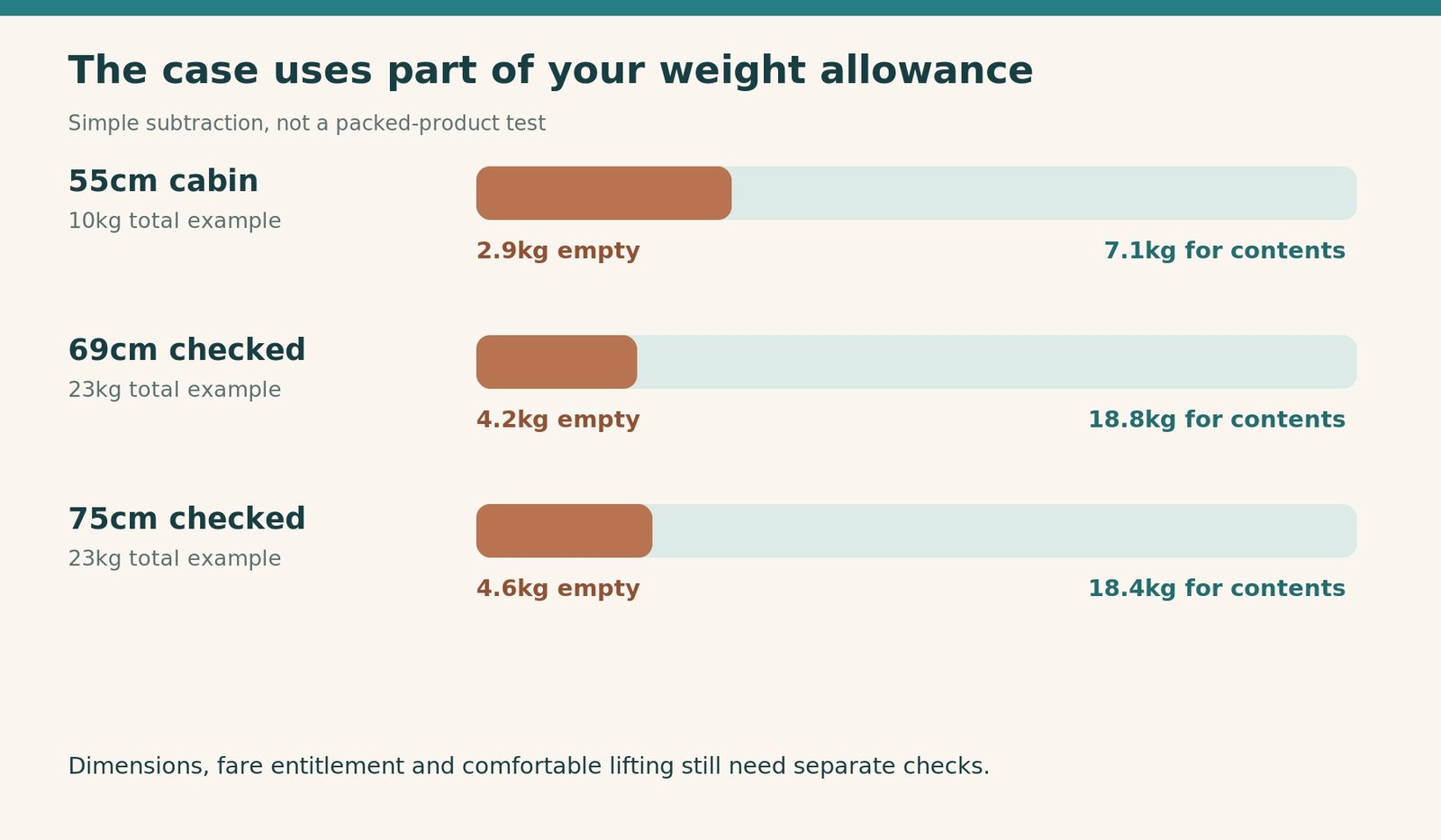
For the cabin model, a 10kg total limit leaves 7.1kg for everything packed inside or attached to the case. Under an 8kg limit, that falls to 5.1kg. These are subtraction examples using the listed 2.9kg empty weight; they are not promises that a particular airline accepts the dimensions.
The same calculation matters for checked luggage. A 4.2kg medium case leaves 18.8kg under a 23kg allowance. The large leaves 18.4kg. Under a 20kg allowance, the available contents budgets become 15.8kg and 15.4kg respectively. Allow a little practical margin rather than aiming at the exact ceiling.
Weigh a realistic load, not an optimistic one
Put your toiletries, footwear, chargers, packing organisers and any luggage strap into the calculation. A neat pile of clothing on the bed can look modest while the finished case becomes unexpectedly heavy. Conversely, a bulky fleece can consume considerable space without using much of the weight allowance.
A domestic scale or a borrowed luggage scale may be sufficient. A dedicated model becomes useful when you frequently repack before a return flight; the Go Travel Digital Pro Scale is one current retail example, not a guarantee against differences between scales. [10]
Judge the weight against a useful alternative
The relevant comparison is with a case you would actually buy. A much lighter model that costs more than your budget or lacks your preferred closure is not an automatic winner. Nevertheless, do not call 2.9kg exceptionally light when a current C-Lite cabin version is listed at 2.1kg. The difference is 800g before either is packed. [7]
Cabin fit: the 55cm case is not a free personal item
Compare the published box, then the fare
Ryanair publishes 55 x 40 x 20cm for its 10kg overhead cabin bag under Priority and Two Cabin Bags. The S’Cure 55cm matches those listed dimensions, but does not match the smaller 40 x 30 x 20cm personal-item allowance included with all fares. Buying the correct bag and having the correct entitlement are separate checks. [2]
For easyJet, the corresponding comparison is with the large cabin bag, not its free underseat bag. British Airways also publishes a larger cabin-bag box. The table uses airline policies checked on 11 October 2026 and applies only to the 55cm S’Cure. [3][4]
On smaller screens, scroll this table sideways for all columns.
| Airline / bag category | Maximum exterior size | Research-led fit judgement |
|---|---|---|
| Ryanair larger cabin bag | 55 x 40 x 20cm; 10kg | Listed size matches; requires the appropriate entitlement. [2] |
| easyJet large cabin bag | 56 x 45 x 25cm | Listed size fits; not the free small bag. [3] |
| British Airways cabin bag | 56 x 45 x 25cm | Listed size fits; check the booking and packed weight. [4] |
| Qatar cabin bag | 50 x 37 x 25cm | Too long and wide by the published figures. [5] |
A different route can change the answer
Qatar Airways publishes a 50 x 37 x 25cm cabin maximum. The 55cm S’Cure exceeds its stated length and width. An internet report that somebody carried a similar case aboard does not change the written policy or remove your risk on a later flight. [5]
Measure the delivered case, including its protrusions, and check the operating carrier for every sector. Connecting through an airport does not make all airlines on the booking use one physical sizer. When the margin is tight, leave time to choose a genuinely smaller case rather than relying on a sympathetic gate decision.
Does the construction establish durability?
Material is only one part of the system
A suitcase is a collection of parts: shell, rim, latches, wheel assemblies, handles, fixings and internal fittings. The published polypropylene construction explains what the S’Cure is made from. It does not give a reliable number of flights before a repair, and this review cannot turn that material description into a measured impact result. [1]
Consider which parts your trips stress most. Repeated overhead lifting challenges handles and your ability to control a loaded case. Long walks put sustained use into wheels. Overpacking places unnecessary pressure on the closure. A traveller taking direct flights and taxis creates a different pattern of wear from someone changing trains with several staircases.
Cosmetic marks and functional faults are different
A scuff that leaves the shell usable is not the same problem as a cracked wheel mounting or a latch that will not hold. Decide how much cosmetic wear will bother you before choosing a pale colour or paying extra for a pristine appearance. No colour should be described here as scratch-proof.
Inspection also matters more than a dramatic demonstration video. Check that the two halves meet evenly, each latch operates consistently and the case stands without an obvious lean. A unit that arrives with a defect should be discussed with the seller promptly rather than accepted because the range has a strong reputation.
Wheels, handles and the journey beyond the terminal
Smooth floors are the easy part
The researched S’Cure listings describe double spinner wheels and a dual-tube telescopic handle. That layout offers the option of steering the case upright on suitable floors, but no independent rolling-resistance or noise measurement was made for this article. Avoid treating the presence of four wheels as proof of comfort on every surface. [1][14]
Map the awkward part of your normal route: the steep station approach, uneven pavement, narrow bus aisle or hotel staircase. A spinner may remain the right choice, but the decision should include those moments rather than only the broad airport concourse.
Lifting changes the balance
Lift with the intended carry handle and a manageable load, not by using an extended trolley handle as a lifting hook. Test whether you can move the packed case safely into the spaces your trip requires. A larger shell does not solve a lifting limitation; it may simply encourage a heavier load.
A two-wheel alternative is worth comparing when your preference is to pull rather than steer upright. The Osprey Ozone 40L example offers a different layout and a listed 2.1kg weight, but its 23cm depth brings a different airline-fit limitation. It is not a universal upgrade. [9]
Packing the S'Cure without fighting the rim
Use the actual internal shape
The reviewed descriptions identify internal holding straps, a divider and a side pocket. These provide basic separation rather than a specialist office organiser. Plan around the shaped shell and handle-channel area rather than assuming that every litre is a perfect rectangular drawer. [1][15]
Start with bulky items positioned so the case remains balanced. Then use softer clothing to fill awkward spaces. Keep hard chargers away from delicate surfaces, contain shoes and place toiletries where a leak would be easier to isolate. These are packing suggestions, not a claim that the case provides protective compartments for every item.
Cubes should organise, not justify overfilling
Packing cubes can make a simple interior easier to manage, particularly when you will open the case several times on one trip. However, their usefulness depends on packed dimensions. A set advertised for suitcases is not automatically a tailored fit for the S’Cure.
The BAGSMART six-piece compression set is a relevant option to compare. Measure the sizes you will actually use; you do not have to pack every piece. Compression changes how soft contents occupy space, not what those contents weigh. [11]
Leave the closing edge clear
Before closing, run your eye around the rim for straps, sleeves and loose fabric. A successful packing arrangement lets the case close with controlled hand pressure. If one section bulges while another is empty, redistribute the load before deciding that a bigger case is necessary.
Choosing between cabin, medium and large
A short trip with one main outfit per day
For a three-night city break, the cabin size is a sensible starting point for a trial pack. Put the actual shoes and layers you intend to take beside it; a summer outfit count is not transferable to winter clothing or a work trip requiring formal shoes.
Try a clean packing rehearsal while preserving the return condition. If the essentials fit with modest spare space, moving up a size may only add bulk. If a rigid item prevents closure, removing one soft shirt will not necessarily solve the shape problem.
A checked case for a mixed itinerary
The medium makes sense to investigate when you need more clothing or footwear but still want to resist filling the largest available case. Its listed 79 litres is a substantial step from the cabin model. Whether it is enough for ten days depends on laundry, outfit reuse and the weather, not a universal manufacturer-style day count. [14]
The 102-litre large version offers further room for bulkier loads. Before choosing it, check the boot, train storage and home storage space as carefully as the airline allowance. Buying the largest size because the price gap is small can leave you carrying an inconvenient amount of unused shell. [15]
Accessories: solve an identified problem first
Weight checks and contact details
The S’Cure has an identification provision in the researched specifications. An additional tag is therefore optional rather than an essential upgrade. A covered tag may suit someone who wants a larger or more accessible contact card, but it should not be sold as a way of preventing loss. [1]
TORRO’s leather tag is one such design to compare. The checked listing showed limited or sold-out availability for the displayed colour, so do not depend on it for an imminent departure. An existing durable tag with current contact details does the basic job. [12]
The same restraint applies to weighing equipment. Buy a luggage scale when repeated return-flight checks justify it, not because a new suitcase somehow requires a matching gadget. Test its operation before packing day and keep a margin below the allowance.
Organisation for shared packing
When two people share a checked case, different coloured cubes or simple cloth bags can separate clothing without adding a second suitcase. Decide who owns each packing zone before loading toiletries and shoes, and keep items needed first at the more accessible side.
A compression set offers one way to implement that plan, but a small number of organisers is often easier to handle than a tightly interlocked collection. Check the case can still close without using the latches to force the final millimetres. [11]
Warranty and repair: read the coverage, not just the duration
The listed term is not an all-damage promise
The researched S’Cure retailer pages describe a limited five-year warranty. Samsonite’s own warranty guidance says the exact term belongs to the model’s product information or supplied warranty documents. It focuses on manufacturing and material defects, while excluding ordinary wear, cosmetic change and carrier damage. [1][15][6]
A broken part after a trip is therefore not automatically a free warranty replacement. The reason for the failure and the policy terms matter. Preserve the receipt, product identification and any correspondence about an initial defect so that a later conversation does not start with an unidentified case.
Ask about the route to a repair
Before purchase, ask who handles claims, whether you must send the case away and who pays each shipping leg. Samsonite’s UK guidance says the customer normally pays to send a product to a service centre, while covered repair or replacement and return delivery are handled at Samsonite’s expense. [6]
Think about timing as well as price. A good repair policy can still leave you needing another bag for next week’s departure. Do not assume a particular wheel, latch or colour will remain immediately available throughout ownership; request model-specific advice when a component needs attention.
UK buying judgement: compare the whole transaction
Price is only useful beside the correct specification
For this review, UK retail pages displayed different offers for the 55cm model, including around £146-£159 on 11 October 2026. Those are observed page prices for particular listings, not guaranteed checkout prices or proof that all colours are available. Delivery location and the chosen variant can change the result. [1][16]
Compare the delivered price, return conditions, seller identity and warranty paperwork together. A lower headline amount is less appealing when the model is unclear or the return process is awkward. Similarly, a familiar marketplace name does not identify the individual seller supplying the product.
Avoid buying a set before checking one case
A matching set can look convenient, but three sizes do not create three needs. First establish which size you use most and whether you like the closure. A traveller who never checks luggage gains little from storing a large matching case solely because a bundle appeared economical.
For occasional travel, compare total likely use rather than inventing an exact cost per flight. You cannot know the case’s service life from this research, and a low purchase price divided by an assumed hundred journeys produces an attractive but unsupported figure.
Alternatives when weight or access matters more
A lighter spinner, with a different closure
The C-Lite 55cm expandable model 159482 is listed at 2.1kg, with a 55 x 40 x 20cm unexpanded exterior and 23cm expanded depth. It is a useful comparison for a traveller who would exchange the S’Cure’s latch arrangement for lower empty weight. Expansion does not preserve compatibility with a 20cm limit. [7]
On smaller screens, scroll this table sideways for all columns.
| Alternative | Published baseline | Reason to compare | Current listing |
|---|---|---|---|
| Samsonite C-Lite 159482 | 55 x 40 x 20cm / 2.1kg | Lighter spinner; expanded depth is 23cm. [7] | Compare C-Lite |
| Osprey Ozone 40L | 55 x 35 x 23cm / 2.1kg | Lighter two-wheel option; not a 20cm-deep case. [9] | Compare Ozone |
The key question is whether saving 800g solves a real problem for your packing. It can matter greatly under a tight allowance, but less on a lightly packed trip. Check current model and colour availability rather than assuming that a heavily discounted older C-Lite listing is identical to the current version. [8]
A lighter two-wheel case
The Ozone comparison changes more than weight: the pulling style, soft outer construction and pocket layout differ. Its published 55 x 35 x 23cm size should be checked against your airlines independently. Someone seeking the S’Cure specifically to avoid a perimeter zip is solving a different problem from someone seeking the lightest manageable roller. [9]
A useful at-home acceptance check
Confirm what arrived before removing everything
Check the label, size and colour against the order. Photograph any transport damage to the packaging and case, and contact the seller before attempting a repair. Keep protective packaging and follow the specific seller’s return conditions while deciding whether the purchase is suitable.
Measure the exterior on a level floor, including wheels, fixed handles and protruding parts. Use two straight surfaces when a flexible tape gives an uncertain reading. Weigh the empty case with removable packaging taken out, then compare the result with the listed weight without expecting consumer scales to resolve tiny differences perfectly.
Rehearse the inconvenient moment
Operate the latches, raise and lower the handle, turn the wheels and trial-pack clean belongings. Check the case closes evenly and that you can reach the items you will need in transit. If you routinely work at the airport, include the problem of retrieving a laptop without unpacking in a crowded seating area.
Use the supplied lock instructions and avoid experimenting with a new combination while the case is full and locked. Any obvious mechanical fault is a seller conversation, not a reason to add lubricant, bend a fitting or modify the case yourself.
Care without making unsupported repair promises
Inspect the moving parts after a difficult journey
Remove visible grit or loose debris gently and inspect wheels, handles and closing points for changes in movement. A wheel that suddenly drags or a latch that has become difficult deserves attention before the next departure. Continuing to force a damaged mechanism can make a manageable fault harder to diagnose.
Start with the care guidance supplied for the exact case. For a new cleaning product, check suitability and try an inconspicuous area rather than assuming that every cleaner safe for a household plastic is suitable for luggage. Keep the case dry before closing it for storage.
Keep the paperwork with the model record
Store the receipt and a photograph of the identifying label somewhere separate from the suitcase. Record a repair when it happens, including the part involved and who completed the work. Those ordinary records are more useful than relying on memory of the colour name several years later.
A case that remains functional does not need replacing solely because it looks travelled. Conversely, a shell that still looks tidy is not a reason to ignore a compromised wheel or closure. Judge condition by how reliably the case performs its job.
A worked packing audit before the first trip
Build a contents budget you can change
Suppose your trial load contains 4kg of clothing, 1.2kg of shoes, 600g of toiletries, 600g of electronics and 300g of organisers. Those are deliberately constructed planning figures, not a measured packing test or a promise about what will fit. The contents total 6.7kg; adding the listed cabin-case weight produces 9.6kg.
Under a 10kg allowance, the example leaves only 400g of headroom. Under an 8kg allowance, it is already too heavy. This is why the same suitcase can be convenient on one journey and frustrating on another without anything about the suitcase changing.
Work through your own categories rather than copying the example. If footwear is the large contribution, wearing your heavier pair may help. If electronics dominate, smaller clothing cubes will not remove that weight. Keep the dimensions check separate throughout: a light suitcase can still be oversized.
Test access as well as capacity
Now take out the item you expect to need first at the destination. If reaching it disrupts the entire case, change the packing sequence while you still have a clean floor and time. One useful advantage of a simple interior is that you can arrange it around your habits rather than a fixed collection of specialist pockets.
For people sharing a case, agree on an accessible first-night section. It can contain a change of clothing and basic toiletries without forcing both travellers to unpack on arrival. This is an organisation exercise, not a reason to fill every remaining gap.
The checked-case dimension check people miss
Add the dimensions only when the airline asks you to
Some routes use a combined length, width and height limit for checked luggage. Qatar’s published rules, for example, include a 158cm total on flights to or from Africa or the Americas. The researched 69cm S’Cure adds to 147cm; the 75cm version adds to exactly 158cm. These are calculations from the listed dimensions, not a guarantee about a particular booking. [5][14][15]
A case at the stated ceiling leaves no nominal dimensional margin. Confirm how the airline measures protrusions and measure your actual case rather than assuming that a size label is precise enough. Do not apply a combined-dimension rule where the carrier instead publishes separate maximum sides.
Check ground transport at the same time
A checked suitcase still has to fit somewhere before and after the flight. Measure the relevant car boot opening, not merely the quoted boot volume. Consider whether two packed cases can sit together without blocking passengers or forcing fragile belongings beneath them.
At home, check where the case will dry and be stored. A larger model that is difficult to access from its storage space can become an inconvenience even on infrequent trips. These are reasons to choose the appropriate size, not arguments against checked luggage itself.
Buying used or discounted older stock
A familiar name does not date the individual case
An older S’Cure may look similar to a newer listing. Ask for the label, photographs of the closing points and wheel mounts, and a clear account of any repairs. Do not infer remaining warranty from how clean the shell looks or from a claim that it was used only once.
Samsonite’s UK guidance applies its warranty to the original purchaser or gift recipient with suitable proof. A second-hand transaction should therefore be assessed on its own terms rather than priced as though full new-purchase cover necessarily transfers. Confirm any support directly before relying on it. [6]
Compare repair uncertainty with the saving
A used case with a dragging wheel may still be repairable, but that possibility is not a costed repair quotation. Ask the service provider about the exact component before assuming that a cheap purchase will remain cheap. Equally, minor cosmetic marks alone do not establish poor mechanical condition.
For discounted new stock, the questions are different: is it genuinely unused, who supplies the warranty documents, and which return policy applies? A reduction is useful when the case already fits your requirements. It is not a reason to accept the wrong size or an unclear model description.
Advantages and drawbacks in proportion
Advantages
- A three-point closure for travellers who prefer latches to a perimeter zip.
- The 55cm version has a useful published 20cm depth.
- Medium and large options make the size choice explicit.
Drawbacks
- The empty weight is not class-leading for ultralight packing.
- Basic internal access may be inconvenient for frequent laptop retrieval.
- Moisture-limiting construction and warranty language have important limits.
Who benefits most from the design?
The strongest candidate is a traveller who actively prefers latches, packs within a fixed volume and values a straightforward hard-shell layout. Someone choosing checked luggage may also find the medium and large sizes a practical way to match different loads, provided the empty-weight budget is acceptable.
The weaker candidate is the ultralight cabin traveller who needs every gram, or the frequent airport worker who wants easy external access to a laptop. Those priorities point towards different case designs. A positive recommendation should identify the person it suits rather than declaring it the best suitcase for everybody.
Common mistakes that make the purchase less useful
Comparing the wrong size or allowing the brand to decide
Do not compare a cabin case’s weight with a large checked case and use the result to rank brands. Put matching sizes and the features you actually need alongside each other. Also check that a retailer’s size selector has not silently moved away from the variant you intended to buy.
Treating capacity as permission to pack heavily
A large empty space can be tempting. However, adding another pair of shoes changes the weight even when the case still closes easily. Reweigh after final additions and after shopping during the trip, not only at the beginning of your packing session.
Expecting the closure to solve every other problem
Latches do not make the shell a dry bag, prevent airline mishandling or replace a sensible plan for valuables. They solve a narrower closure preference. Buy for that useful distinction, then manage weight, access and aftercare as separate decisions.
Frequently asked questions
Is the Samsonite S’Cure a good suitcase?
It is a reasonable research-led shortlist choice for travellers who want its three-point closure and accept the listed weight. The useful evidence is the model’s construction and dimensions, not a claim that it has been proved indestructible. This review does not establish a measured lifespan or a failure rate. Your preferred packing layout and normal surfaces should carry more weight than a general brand reputation.
Does the 55cm S’Cure fit Ryanair?
Its published 55 x 40 x 20cm dimensions match Ryanair’s larger cabin-bag allowance under Priority and Two Cabin Bags, not the free personal-item allowance. The packed bag must still remain within the dimensions and 10kg limit, and the booking must include the correct entitlement. Check the delivered case and current operating-carrier policy before travelling. [2][1]
Is the S’Cure waterproof?
No waterproof or immersion rating was verified for the researched versions. A seal intended to limit moisture penetration is not the same thing as a certified waterproof enclosure. Protect sensitive belongings separately and do not assume the case can be left in heavy rain or standing water without consequences. [1]
How much heavier is the 75cm version than the 69cm?
The reviewed published figures are 4.6kg and 4.2kg, a difference of 400g. The larger case also has greater listed volume. That does not make the larger version the better purchase: consider the size of the load, the allowance and how comfortably you can move it. The calculation describes the researched models, not every special edition. [14][15]
Are packing cubes necessary?
No. The existing straps and divider may be enough, particularly on a short trip. Cubes become more useful when sharing a checked case or moving between several hotels. Choose them by the packed shape they create and use only the pieces that help. They should reduce rummaging, not become another reason to carry extra belongings.
Does the warranty cover airline damage?
Samsonite’s standard UK warranty guidance excludes carrier damage and normal wear while covering qualifying manufacturing or material defects. The exact term belongs to the model’s documents. Report apparent airline damage promptly through the airline’s process and seek manufacturer advice when the cause is unclear; do not assume every broken part falls into the same category. [6]
Can I use the S’Cure as my only bag?
Possibly, if the size fits your transport allowance and your load. However, a separate permitted small bag can make documents and essentials easier to reach. A hard-shell case opened in the middle is less convenient for repeatedly taking things out during a journey. Check both the airline’s piece allowance and your actual access needs rather than buying an additional bag automatically.
Which size should I choose first?
Start with the smallest size that holds the belongings you genuinely need for your usual trip, then test the weight. The cabin case suits a different transport role from the medium and large versions. For checked travel, the medium is worth trial-packing before moving to the large. Neither litres nor suggested trip lengths replace a rehearsal with your own clothing and shoes.
Final recommendation: choose the closure deliberately
The S’Cure’s most persuasive reason to exist in your travel kit is its latch-closing layout. It is worth considering when that solves a frustration you already have and the published dimensions suit your routes. The cabin model provides a useful 20cm-deep baseline; the checked versions trade more empty weight for substantially more packing space.
Do not buy it on an invented durability score, an assumption that all Samsonite warranties cover every accident, or a seller’s broad airline-compatible label. Match the exact model, trial-pack it, check your lifting ability and retain the paperwork. Those checks turn a research-led shortlist into a sensible purchase.
For a UK traveller weighing this against a lighter zipped case, put the S’Cure’s closure preference on one side and the alternative’s saved weight on the other. Neither has to win for everyone. The right choice is the one whose ordinary daily compromises you will be happy to live with.
Sources and fact-checking
Research scope
The S'Cure model facts are taken from identified UK retailer listings because a current model-specific Samsonite UK page was not available in the research results. Samsonite's own UK guidance is used for warranty interpretation. The 55cm lock field and Amazon colour metadata contain inconsistencies, which are flagged above. No lifespan, failure rate or hands-on durability score has been inferred.
Sources reviewed on 11 October 2026. Specifications and policies are attributed above; calculations and practical packing examples are editorial analysis. Prices, selected colours and availability can change.
- Luggage Superstore: S'Cure 49539, 55cm specifications.
- Ryanair: current bag policy.
- easyJet: cabin bags and entitlements.
- British Airways: baggage essentials.
- Qatar Airways: baggage allowance.
- Samsonite UK: warranty scope, exclusions and claims.
- Samsonite UK: C-Lite 159482, 55cm expandable.
- Case Luggage: C-Lite 159482 retail listing.
- Case Luggage: Osprey Ozone 10006935, 40L two-wheel case.
- Case Luggage: Go Travel Digital Pro Scale.
- BAGSMART UK: six-piece compression packing cubes.
- TORRO: leather luggage tag and availability.
- Amazon UK: S'Cure 55cm listing; selected colour and offer require confirmation.
- Luggage Superstore: S'Cure 49307, 69cm specifications.
- Go Places: S'Cure 49308, 75cm specifications.
- Baggage Factory: S'Cure 55cm construction and retail listing.
Illustrations in this article were created for Taylor’s Trailblazing Travel Gear. Third-party photographs, where used, are credited beside the image or in the source list.