
Best Waterproof Daypacks for Rainy Trips
Best Waterproof Daypacks for Rainy Trips
Choose protection for the whole bag, not just a promising fabric description.
The best waterproof daypacks for rainy trips solve a specific problem: keeping your things dry while you move, open the bag and carry a realistic load. Waterproof fabric alone does not do that. Seams, zips, top closures and even the pocket holding your phone can have different limits.
A city traveller might reasonably favour quick laptop access and a substantial back panel. Someone carrying a spare pack inside a suitcase could prefer a much lighter roll-top. Meanwhile, a walker with an otherwise comfortable backpack may need an internal dry bag rather than a complete replacement.
This is a research-led comparison of five designs, not a laboratory test or a claim that every model tolerates immersion. The recommendations distinguish the makers' stated protection from my planning judgement about access, packing and comfort. That distinction matters most when your valuables are worth far more than the bag.
1Best waterproof daypacks for rainy trips: compare the whole design
A rain-ready bag is a system of fabric, joins and closures. Start with the main compartment, then check each pocket separately. A water-resistant front zip is not equivalent to a sealed roll-top, and an outside bottle pocket is not expected to keep its contents dry. The comparison below makes those boundaries visible rather than placing every bag under one unqualified waterproof label.
Swipe or scroll the table sideways on a small screen.
| Daypack | Capacity / weight | Stated dimensions | Protection / main distinction | Details |
|---|---|---|---|---|
| Matador Freerain22[1] | 22L / 300g | 50 x 27 x 18cm | Sealed main compartment; at least three rolls; no submersion | View listing |
| ORTLIEB Velocity 23L[3] | 23L / 840g | 50 x 30 x 16cm | IP64; current R4027 generation, not an immersion rating | View maker |
| OverBoard Urban 20L[4] | 20L / 900g | 48 x 32 x 14cm | IP65; city pockets and 16-inch laptop compartment | View listing |
| Alpkit Gourdon 20[5] | 20L / 460g | 52cm stated height | Roll-top and taped seams; 5,000mm fabric claim is not a bag IP rating | View maker |
| Aquapac Heavyweight 28L[6] | 28L / 886g | 43 x 28 x 18cm | IPX6; welded construction for rain and spray | View maker |
How this shortlist was assembled
I prioritised clear manufacturer information, practical day-bag capacities, different carrying structures and meaningful differences in access. The order reflects use cases, not a common laboratory trial. None of these packs has been personally tested for this article, and the quoted specifications remain manufacturer claims. A recommendation explains why a design may suit a task; it does not certify its performance.
The specifications were reviewed on 11 October 2026. Use the exact model names when comparing retailers. In particular, older ORTLIEB Velocity listings may quote a different weight from the current R4027 technical sheet. A familiar product name can remain while construction or included components change. Marketplace availability was not consistently visible, so check the seller, version and delivery position before ordering. [2][3]
2Water protection without the misleading shortcuts
Water-repellent is a surface description
A surface treatment may help water bead and run off, but it does not establish that seams, zips and openings are sealed. Similarly, a waterproof fabric can be sewn into a bag that allows water through its construction. Look for an explanation of the completed compartment, not just a material adjective.
When a page provides only a fabric water-column figure, treat that as evidence about the material under a particular test rather than a rating for the entire backpack. Alpkit's published 5,000mm fabric claim, for example, should not be rewritten as an immersion depth for the Gourdon. Its closure and taped construction are separate parts of the product description. [5]
IP ratings answer different questions
The first numeral in an IP code concerns solids; the second concerns water. IP64 therefore describes dust-tight construction and protection against splashing water, while IP65 and IPX6 address different water-jet conditions. The X means no solid-particle numeral is stated in that code; it does not mean a bag has passed a dust-tightness test. [7]
Temporary immersion belongs to a different water-test category from splashes and jets. Do not turn the Velocity's IP64, the Urban's IP65 or Aquapac's IPX6 into a promise that the bag can be submerged. Equally, do not assume a higher-looking product label removes the need to close it correctly. The conditions and configuration of the test matter. [3][4][6][7]
Rain protection is not an insurance policy
A bag can perform its intended job and still fail to protect contents left in an open pocket, packed wet or exposed while the top is unrolled. For expensive equipment, consider whether a dedicated internal barrier is proportionate. That is not an instruction to buy endless layers; it is a way to separate the consequences of a small packing mistake from the value of what is inside.
3Matador Freerain22: the packable rain-travel choice
Why it earns a place
The Freerain22 is appealing when the bag must spend part of the trip folded inside another bag. Matador lists 22L, 300g and a packed size of 15 x 10 x 10cm. Its unfolded dimensions are 50 x 27 x 18cm. The main compartment uses sealed seams and a roll-top; the front pocket is described as water-resistant rather than equivalent to that protected main space. [1]
That separation is central to how I would use it. Dry spare clothing and vulnerable belongings belong in the main compartment, while an outside pocket should hold only items suited to its stated protection. A rain jacket can be accessible without treating the front zip as the safest home for an unprotected phone.
The packing discipline it requires
Matador specifies at least three rolls and says the Freerain22 is not intended for submersion. Leave enough neck space to make those rolls properly. If the packed contents push into the closing area, remove something or redistribute the load rather than treating a barely engaged buckle as an adequate seal. [1]
This matters on travel days because the load rarely stays static. You remove a layer, add food or put a damp jacket inside. Allow room for those changes before leaving shelter. The most water-resistant bag in a shortlist cannot compensate for a closure that is no longer being used as intended.
Who should choose a more substantial bag?
Someone carrying a laptop and dense work equipment every day may prefer more structure and organisation. The Freerain22's attraction is portability with a protected main compartment, not a claim that a 300g pack will feel the same as a heavier commuter bag. Compare the actual load and the frequency of access before accepting the trade-off.
Its carrying layout includes bottle pockets and removable stabilising straps, but comfort remains a fitting question. A rain-focused feature list cannot tell you whether the shoulder straps suit your body. Keep that distinction clear, especially when buying remotely.
4ORTLIEB Velocity 23L: a structured daily-workhorse option
Use the current generation's specifications
The current Velocity R4027 technical sheet specifies 23L, 840g and dimensions of 50 x 30 x 16cm. It gives an IP64 rating and a maximum load of 10kg. Those numbers are not a reason to load the bag to its limit for an ordinary day out; they identify the version and its stated design envelope. Older 880g listings should not be silently treated as the same specification. [2][3]
My reason for considering the Velocity is the more substantial daily-carry approach. A traveller who will use one bag throughout the trip and continue using it at home may value a dependable, repeatable layout more than the ability to compress it into a tiny bundle. However, check the included interior organisation for the exact version before assuming it replaces a dedicated laptop case.
The rating has a clear boundary
IP64 is a rain-and-splash proposition, not an immersion rating. Keep the closure clean and follow ORTLIEB's method rather than improvising a roll that merely looks tidy. The appeal is a purpose-designed weather-protective bag with published technical information, not a claim that it can accompany every water activity. [3][7]
A structured bag also takes up space even when it is not full. Think about train seats, cafe chairs and where it will sit while you work. If you mainly need a secondary bag after unpacking at a hotel, the lighter Matador may be easier to justify. If the pack itself is your main daily carry, the balance can shift towards the Velocity.
A buying decision beyond the first trip
ORTLIEB highlights replaceable components and its repairable approach. That is useful to investigate when you expect years of regular use, but confirm the parts and support available for the exact model in your location. Repairability is a practical question about access to the right service, not just a reassuring word on a product page. [2]
5OverBoard Urban 20L: organisation for a wet city day
Designed around frequent access
The Urban 20L is the most explicitly city-oriented option here. OverBoard specifies 900g, sealed dimensions of 48 x 32 x 14cm, an IP65 rating and a padded compartment intended for a 16-inch laptop. The roll-top uses a G-hook system, while separate weatherproof zipped access and organisational features distinguish it from a simple single-compartment dry backpack. [4]
That arrangement may suit someone moving between a station, accommodation and work appointments. Instead of unrolling the top for every item, you have separate access points. The important qualification is that each compartment should be used within its own stated protection, and a screen-size description is not an exact laptop fit measurement.
Convenience adds weight and complexity
At 900g before contents, this is not the obvious choice for a minimal spare bag. You are paying a weight and volume penalty for a more organised carry system. That can be sensible when it prevents repeated unpacking in the rain, but it is less persuasive when the day's contents are only a compact jacket and a drink.
The waterproof fabric description and IP65 rain-and-spray rating do not establish immersion suitability. OverBoard describes the exterior pocket and laptop access as weatherproof. I would therefore avoid using this model as a substitute for a purpose-rated submersible case around open water. [4][7]
Check the laptop rather than the label
Measure the actual computer, including any protective shell, and compare it with the compartment information from the seller. Then consider how easily it can be removed without stretching the opening. A nominal 16-inch sleeve is a useful category label, but laptops with the same screen diagonal can have different exterior dimensions.
The luggage sleeve may be useful on transfer days. Still, make sure the full pack sits securely with your own suitcase handle and does not create an unstable load. Features that sound convenient on paper are worth checking together, not one at a time.
6Alpkit Gourdon 20: a simpler roll-top arrangement
Less organisation can be an advantage
Alpkit's Gourdon 20 offers a straightforward 20L roll-top layout with taped seams, external mesh pockets and a removable back pad. The current page lists 460g and a 52cm height. It also quotes a 5,000mm fabric water-column figure. That material measurement must not be interpreted as a completed-bag immersion rating. [5]
The appeal is simplicity. A small number of well-chosen internal groups can be easier to manage than many built-in compartments, especially when the contents change from day to day. Clothing, lunch and a compact waterproof can share a main space without every object needing a dedicated sleeve.
Supply your own internal order
The trade-off is that smaller things need a sensible home. Use a modest pouch for keys and similar items rather than letting them settle beneath the load. Put soft contents where they will cushion hard edges, and test whether removing the back pad genuinely helps your packing arrangement or merely makes the contents more noticeable against your back.
A roll-top also needs unused closing space. Test the bag with the clothing you may remove during the day and the food containers you plan to carry home. The neat morning load is not always the largest or least cooperative version of the day's contents.
When I would choose it
The Gourdon makes sense for someone who wants a relatively uncomplicated day bag and does not need frequent laptop access. It is less attractive when every stop involves retrieving different small objects from a packed main compartment. Choose based on that working pattern, rather than assuming that either more pockets or fewer pockets is automatically better.
Use Alpkit's current product page and care guidance when assessing the exact model. Confirm the supplied components as well as the capacity, particularly when comparing a current model with older stock.
7Aquapac Heavyweight 28L: room for a bulkier shared load
More volume, with an appropriate weight trade-off
Aquapac lists its Heavyweight Waterproof Backpack at 28L and 886g, with metric dimensions of 43 x 28 x 18cm. It uses welded construction and a roll-down opening, with an IPX6 rating. The checked specification names a 500D polyester-reinforced vinyl material. These are the current product-page figures, not values transferred from another Aquapac backpack. [6]
The extra volume is the reason to consider it. A shared dry change of clothes, larger lunch containers or bulkier layers can make a 20L daypack feel restrictive. However, capacity is not permission to keep adding dense equipment. Pack the likely load and judge how the straps and back feel before assuming that the larger bag solves every carrying problem.
Understand what IPX6 does not say
The X leaves solid-particle protection unstated in that code, while the water numeral addresses powerful water jets under test conditions. It is not an immersion category. Marketing photographs of waterside activities do not change that distinction, and the bag should not be treated as a universal swimming companion. [6][7]
A larger roll-top can also encourage untidy overpacking. Leave the neck clear and organise the inside so that you are not searching through the entire load in the rain. A simple bag benefits from an intentional packing pattern precisely because the opening exposes a large shared space.
Who may find it unnecessarily large?
A solo city traveller carrying a phone, compact layer and water bottle may not use the volume. In that case, the larger shell adds another object to manage on public transport without solving a pressing problem. For a bulkier group load, though, it is a useful alternative to forcing an overfilled smaller pack to close.
8Add only the internal protection you need
Three accessories with different jobs
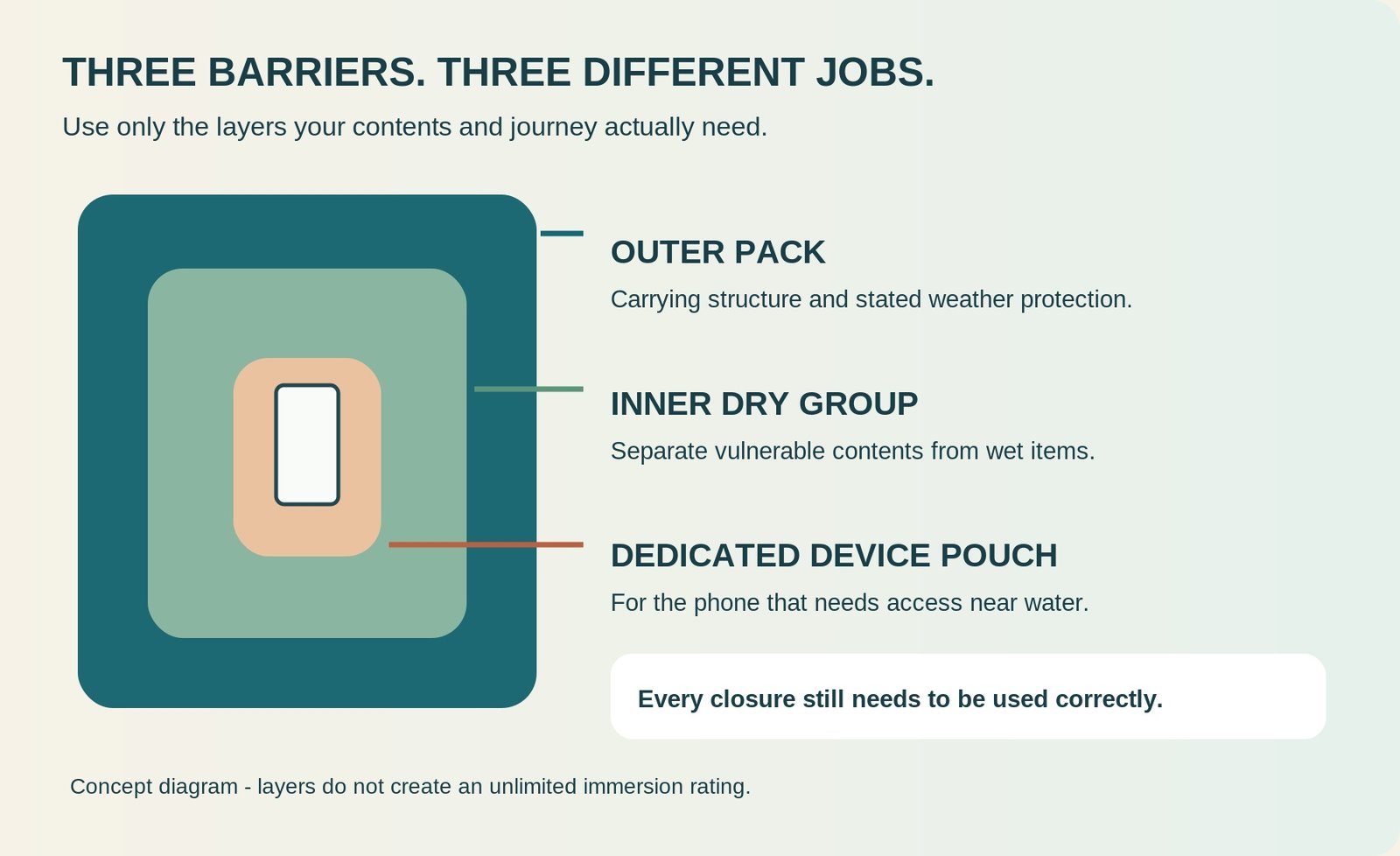
The following are optional additions, not a shopping list every traveller should buy. Choose the item that protects a vulnerable part of your load. A fabric dry bag is useful inside a backpack; a phone pouch serves a different purpose when you need the phone accessible near water.
Swipe or scroll the table sideways on a small screen.
| Optional item | Main purpose | Check before use | Details |
|---|---|---|---|
| Sea to Summit Lightweight Dry Bag 5L[8] | An internal group of dry clothing | 5L variant; allow room for the roll-top | View listing |
| Sea to Summit Ultra-Sil Dry Bag 5L[9] | Light internal organisation | Thin fabric: protect it from sharp contents | View listing |
| Aquapac Plus Plus / Large[10] | Phone access near water | Plus Plus / Large: confirm actual phone fit | View listing |
Lightweight Dry Bag: an internal clothing group
Sea to Summit's Lightweight Dry Bag is the more substantial of the two small internal bags compared here. The current 5L version offers a roll-top format for organising a modest group of items. Its intended role in this article is inside your daypack, not dragged over rough ground or used as a guarantee of deep-water protection. Follow the maker's closure and use guidance. [8]
Before buying, put the intended contents together and estimate their actual volume. A spare top and small essentials need a different amount of space from a bulky fleece. Buying a very small dry bag and then compromising the closure to fit more inside defeats the reason for carrying it.
Ultra-Sil Dry Bag: reduce the organiser's bulk
The Ultra-Sil Dry Bag is a separate product from Sea to Summit's Ultra-Sil Day Pack. It is intended as lightweight waterproof storage and organisation; the daypack's unsealed zip and seams should not be confused with this roll-top design. Check the exact product name when ordering and keep the thin organiser away from sharp contents. [9]
I would favour this approach when the internal group is light, contained within another bag and unlikely to be handled roughly. It is not necessary to buy both dry-bag types for the same small collection of belongings. Decide whether lower bulk or a more substantial fabric is the better match for your own handling habits.
A dedicated pouch for an accessible phone
A phone stored in the middle of a closed backpack is protected differently from one repeatedly taken out beside water. Aquapac's Plus Plus / Large has a published phone-height limit of 19cm and a combined width-and-depth limit of 10.5cm. Check those measurements with your actual phone and case, and follow the sealing instructions rather than relying on the large-size label. [10]
That pouch is optional when the phone can simply stay protected inside the bag. It becomes more relevant when access itself is the exposure point. Do not attach it in a way that creates an entanglement hazard, and do not assume a phone or pouch replaces appropriate activity-specific safety equipment.
9Build a packing system that survives opening the bag
Put the dry group somewhere deliberate
Choose one protected group for the things that must remain dry. Place it where you can retrieve it without spreading the rest of the contents on a wet surface. Then decide which items can tolerate exposure and can remain in external pockets. This reduces the number of times you must disturb the most vulnerable belongings.
Avoid packing a damp waterproof jacket against unprotected spare clothing. The outer bag may successfully keep rain out while moisture already inside affects the dry group. Separate those jobs: outside weather protection, internal organisation and wet-item containment are related, but they are not interchangeable.
Make access a sheltered operation
Before opening a roll-top, look for a sensible place to stop. A doorway where you obstruct others is not ideal; neither is a spot where water drains directly onto the opening. Plan frequent-use items so that you are not unrolling the whole bag every few minutes while walking.
If you must open it in rain, minimise the time the protected space is exposed and close it properly afterwards. Rushing a closure because you are getting wet is understandable, but it changes the protection. A few seconds spent arranging the load before leaving shelter can be more useful than buying another accessory.
Keep the closure independent of the contents
Do not use the roll-top neck as spare storage for soft items that almost fit. Move clothing below the closing area and remove hard objects that press into the fold. Buckles should engage without the contents forcing the closure apart. Follow the product's specific number of rolls or folding method; there is no single instruction that automatically fits every bag.
10Separate water protection from impact protection
A sealed compartment is not necessarily a padded case
A waterproof or weather-protected pack can solve one exposure problem while offering little cushioning around a camera or computer. Conversely, a generously padded compartment can still have openings with limited water protection. Assess those properties separately. A bag does not inherit comprehensive equipment protection merely because its product title includes both laptop and waterproof.
For fragile equipment, consider a suitable fitted protective case inside the carrying system. Check that the extra case does not consume the space needed to close the roll-top or strain a zipped opening. Re-measure the protected object rather than continuing to compare the dimensions of the bare device with the bag's advertised compartment.
Avoid hard objects sharing unprotected space
A bottle, lunch container or charger can press against other contents when the bag is set down. Arrange the load so that fragile items are not left next to sharp corners or heavy loose objects. Use the bag's intended sleeves or a suitable separate organiser where appropriate, while keeping the most vulnerable group within the correct water-protected compartment.
This does not require filling every available gap with padding. Start with the actual risk created by your load: a laptop carried alone needs a different arrangement from a camera beside several dense items. The goal is a coherent package that handles ordinary movement without compromising the closures you are relying on for rain protection.
Make the compromise explicit
Before choosing between two packs, identify whether the unresolved problem is outside rain, internal spills, knocks, access or carrying comfort. Those problems can require different solutions. A lighter sealed shell may be excellent with one carefully protected device, while a more organised bag may suit a mixed daily load. Buying the highest-sounding water claim will not automatically settle the other questions.
11Fit, load and daily access
A weatherproof shell still needs a comfortable harness
Compare the intended load, not only empty weights. The difference between a 300g pack and a 900g pack is noticeable in luggage planning, but the way either carries your equipment depends on its structure and fit. A heavier design may be worthwhile when it suits a regular laptop load, while a minimal daypack may be better for light, occasional use.
Walk with the bag indoors where a return remains possible under the seller's terms. Check straps with your likely rain jacket, and try reaching for a bottle without twisting awkwardly. Inspect where hard objects rest against your back. The goal is a workable arrangement that you can repeat on a damp morning, not a perfect product photograph.
Avoid a pocket system you cannot remember
More compartments can speed up access only when you use them consistently. If you regularly search three similar pockets for the same item, simplify the arrangement. Likewise, a single-compartment bag needs enough organisation that keys and tickets do not vanish beneath clothing. The best layout is the one that matches how you actually retrieve things.
A useful exercise is to name the five items you reach for most often. Give each a deliberate place and check whether you can reach it while the bag is resting securely. This practical test usually tells you more than comparing the total number of pockets across product pages.
12Match the bag to a realistic rainy journey
A wet city break with occasional work
For a journey involving trains, cafes and a laptop, compare the Urban's access against the Velocity's more straightforward structure. Think about where you will remove the computer, where wet outer clothing will go and whether the bag fits comfortably beside you. The right answer depends on those routines, not on which maker publishes the largest water-related number.
Check airline allowances separately when the bag is carried as an additional item. The dimensions above are manufacturer measurements, not an endorsement for every airline or fare. A padded sleeve or exterior pocket may make a soft bag less compressible than you expect when fully packed.
A light day bag after unpacking at a hotel
The Freerain22 is the most natural comparison point when packed size is a major constraint. If you already have a comfortable small backpack, though, consider whether an internal dry bag solves the trip's problem more economically and with less duplication. Replacing a bag is justified by a gap in function, not simply by the forecast containing rain.
A walking day with a shared load
The Gourdon and Aquapac represent simpler layouts at different capacities. Pack bulkier items and shared water first, then check the closing room and fit. Distribute group supplies sensibly rather than making one person carry everything because their backpack has the highest advertised capacity. A practical shared load is more useful than an overloaded large bag.
13Check the specification before committing to a replacement
Identify which compartment the claim covers
When a listing says waterproof laptop backpack, look for the sentence explaining the actual laptop opening. It may refer to fabric around the compartment, a weatherproof zip or a separate sealed space. Those descriptions are not interchangeable. The OverBoard Urban, for example, publishes information about its laptop access separately from the roll-top, so read both rather than relying on the product title alone. [4]
Do the same for the front pocket. A small outside pocket can be very convenient for tickets, but convenience should not make it the default place for unprotected electronics. Write down where the most vulnerable item will live and how you will retrieve it. If that practical sequence is unclear, another product image is unlikely to resolve the decision.
Compare a stated weight with what you will actually carry
Published weights can include different combinations of removable components. The figures in the table identify the checked versions, but your own configuration may differ after you remove a belt or add an organiser. Avoid treating a tiny apparent weight advantage as decisive until the products provide the same functions you need.
For example, a lighter bag that needs several extra pouches to work for you may not produce the saving you expected. Conversely, a slightly heavier all-in-one layout can be unnecessary if the contents are only a light jacket and a drink. Compare the complete carried system, including the items added to compensate for missing structure or organisation.
Ask a concrete question when information is incomplete
A useful enquiry names the exact model and the uncertainty: whether a specific compartment has the published rating, whether the dimensions are measured closed, or whether a laptop of stated exterior dimensions fits. Asking simply whether a bag is good in rain invites a broad answer that may not address your situation.
Keep the response with the order details when it materially affects the purchase. If a seller cannot establish the version or the maker's claim, do not fill the gap with a more reassuring interpretation. Choose a better-documented alternative or keep the valuable contents separately protected until you have a clear answer.
14Arriving indoors without wetting the things you protected
Give the wet exterior somewhere to go
A rain-protected bag may arrive with a wet outer surface even when the inside is dry. Before putting it on a bed, desk or fabric seat, choose an appropriate place and deal with surface water. Keep the opening away from drips while retrieving belongings. This is a practical handling step, not evidence that the bag failed to protect the main compartment.
For a hotel-to-train journey, consider where the bag will sit during the next stage. Do not place a wet shell directly against unprotected spare clothes in a larger suitcase. Allow drying where practical, or separate it appropriately for the immediate transfer and unpack it again promptly. Temporary separation should not become an excuse to leave damp equipment sealed away for days.
Repack for the next stage rather than preserving the morning layout
After you have used a jacket or another item in rain, it no longer belongs automatically with the dry clothing group. Move it to an appropriate separate place before packing for the return journey. Likewise, check a bottle that has been refilled or a food container that has been opened. Internal spills are a different failure route from outside weather.
A brief repacking pause can prevent the frustrating situation where a good external barrier successfully kept rain out, only for wet items inside to defeat the plan. The benefit comes from keeping each group in the right place as the day changes, not from continually adding more waterproof accessories.
15Care, checks and reasons to stop using a damaged bag
Inspect the points that actually seal
Check the neck, folds, seam areas and relevant zips before a trip. Look for trapped grit, obvious damage or deterioration rather than judging only the appearance of the front panel. Follow each manufacturer's cleaning and maintenance instructions, particularly where coatings or specialist closures are involved.
An informal check at home can expose an obvious fault, but it does not recreate a certified laboratory test. Do not use valuable electronics as the test load. When damage or unexpected wetness leaves you uncertain, obtain advice from the maker and use another suitable barrier until the issue is resolved.
Dry storage is part of the routine
Empty the pack after wet use and allow the relevant surfaces and pockets to dry as directed. Store it without wet clothing forgotten inside. Avoid improvising high heat, harsh chemicals or repairs that the manufacturer has not recommended, since a tidy-looking repair is not necessarily a restored waterproof seal.
Keep the model information and proof of purchase. If a closure or component needs attention later, those details make it easier to identify the right support. Check the actual warranty conditions rather than assuming that damage to the bag and damage to its contents are covered in the same way.
16Pros, cons and avoidable buying mistakes
What a dedicated wet-weather pack adds
A purpose-designed closure and clearly described construction can make protection more predictable than an ordinary backpack with an unspecified treatment. It also gives you a repeatable packing routine for days when shelter is limited. That benefit is strongest when you use the bag regularly and understand the limits of each compartment.
The disadvantages are possible extra weight, slower access and a less flexible fit for some contents. A waterproof shell does not remove the need for ventilation, sensible load distribution or wet-item separation. The whole carrying experience matters, not only the barrier against outside rain.
Common errors that undermine the purchase
Do not rank every IP code as if it were a single outdoor toughness score. Avoid transferring specifications from an older generation or assuming a laptop will fit because its screen size matches a label. Finally, do not buy a tightly sized roll-top without trying the largest likely load: protection depends on leaving room to close it correctly.
Buying several overlapping internal bags is another easy mistake. Start with the items whose getting wet would matter most and protect those first. Then decide whether anything remains unsolved. A small, understandable system is easier to use reliably than a complicated one assembled from reassuring product descriptions.
17Frequently asked questions
Is a waterproof backpack better than a rain cover?
It can provide a more integrated solution, but the answer depends on the bag and the exposure. A cover protects the surfaces it covers; openings and the back area can remain separate questions. A sealed pack also has closure limits. For an existing comfortable backpack, an appropriate internal dry bag may be the simplest way to protect selected contents without replacing the whole carrying system.
Does IP65 mean the bag can be submerged?
No. IP65 describes dust-tight protection and a specified water-jet test, not an immersion test. This matters for the OverBoard Urban: its rain-and-spray purpose should not be expanded into a swimming claim. Always read the exact manufacturer's conditions and the meaning of the code, rather than interpreting the word waterproof on its own. [4][7]
Why are some roll-top bags not fully waterproof?
A roll-top is an opening style, not proof of sealed construction. Fabric, seams, attachment points and pockets may have different properties. The closure must also be used correctly. A bag with a fold-over zip can resemble a waterproof roll-top in a photograph while having a very different water-protection design. Look for a statement about the completed compartment and its limitations.
Which bag is easiest to pack inside a suitcase?
The Matador Freerain22 is the packable option in this comparison, with a stated packed size of 15 x 10 x 10cm and a 300g weight. However, make sure its carrying layout suits the load you will use after arrival. A smaller packed size is valuable only when the unpacked bag also does the job you need. [1]
Can I trust the capacity and dimensions to predict fit?
Use them as an initial filter, not a guarantee. Makers measure capacity and external size differently, and a roll-top needs space for closure. Try the actual contents, including a laptop in its case or a bulky layer. If the bag closes only when everything is compressed perfectly, it may be too tightly sized for normal travel use.
Do I need an inner dry bag inside a waterproof backpack?
Not for every item or every journey. An extra barrier can be proportionate for valuable or especially vulnerable contents, and it can separate wet items from dry ones. It also adds weight and another closure to manage. Choose it to solve an identified problem rather than assuming that stacking more bags always creates a better system.
Can a bag keep a laptop safe in every kind of rain?
No product description can remove all handling and closure risks. Check the compartment's stated protection, close it correctly and avoid exposing the computer while opening the bag in rain. A separate suitable sleeve or barrier may be sensible, but it also needs to fit without straining the compartment. Never treat the laptop's value as a reason to ignore a poorly fitting or damaged bag.
What should I do if moisture appears inside?
Move to a suitable dry place, protect the contents and inspect the likely source. Consider wet clothing, a leaking bottle, an incompletely closed top and external leakage rather than assuming only one cause. Follow the manufacturer's care and support guidance. Until the reason is clear, do not keep relying on that compartment for unprotected valuables.
18Choose the protection you can use consistently
For a compact secondary day bag, the Freerain22 is my starting point. For city travel with frequent access, compare the OverBoard Urban with the current ORTLIEB Velocity. The Gourdon and Aquapac make more sense when you prefer a simple main compartment, with the latter offering additional volume for bulkier contents.
The decisive step is to pack the bag as you would on a rainy morning. Close it, retrieve your frequently used items, add the layer you might remove and close it again. A design that works through that sequence is more useful than a higher-sounding specification that requires compromises every time you use it.
A comfortable existing backpack with a suitable internal dry group remains a valid answer. Buy a dedicated wet-weather pack when it solves a real protection or access problem, and keep its limits visible in your routine. Clear expectations are part of keeping belongings dry, not an optional footnote after purchase.
19Sources and fact-checking notes
Research reviewed on 11 October 2026. Manufacturer pages supply the specifications and stated test limits; recommendations and packing examples are editorial judgement. Listings, versions and stock can change. No independent hands-on product testing was performed for this guide.
- Matador UK: Freerain22 construction, dimensions and limitations
- ORTLIEB UK: current Velocity 23L
- ORTLIEB: Velocity R4027 technical sheet
- OverBoard UK: Urban Waterproof Backpack 20L
- Alpkit: Gourdon 20 waterproof backpack
- Aquapac: Heavyweight Waterproof Backpack 28L
- IEC: ingress-protection ratings explained
- Sea to Summit UK: Lightweight Dry Bag
- Sea to Summit UK: Ultra-Sil Dry Bag
- Aquapac: Plus Plus / Large phone-case sizing and sealing
Illustrations in this article were created for Taylor’s Trailblazing Travel Gear. Third-party photographs, where used, are credited beside the image or in the source list.


