Best Lightweight Travel Backpacks Under 1kg
Six research-led choices, weighed against the realities of packing, carrying and cabin-bag limits.
Choosing lightweight travel backpacks under 1kg is less about finding the thinnest bag and more about deciding which features earn their place. A simple pack can leave more of a strict baggage allowance for your belongings. However, a lighter shell stops being a useful saving if you immediately add a heavy sleeve, several organisers and a second bag to make it work.
This guide compares six options for different kinds of packing: a straightforward clothing carrier, a compact personal-item candidate, two everyday alternatives and travel-focused designs with more organisation. The recommendations are research-led rather than hands-on test results. Published specifications are separated from our practical judgement, so you can see why a bag makes the shortlist without being asked to trust an invented airport trial.
Start with the allowance on your booking and the things you genuinely need to carry. Then compare the whole packed system, not just the headline backpack weight. That order prevents the common disappointment of buying a wonderfully light bag that is the wrong shape for your laptop, body or flight.
CabinZero Classic 36L
700g; useful when clothing space matters more than a complex harness.
CabinZero Classic 28L
600g and 39 x 29.5 x 20cm on the current specification.
BAGSMART Blast 28L
900g; select the fixed 28L model, not the heavier expandable version.
Packed dimensions
A low empty weight does not make a backpack compliant with every airline.
How these lightweight travel backpacks under 1kg were chosen
A useful shortlist, not a race to the lowest number
Every main recommendation below has a published empty weight below 1,000g. That is the entry condition, not the whole ranking. The comparison then considers the shape of the bag, its opening, laptop provision and whether the design makes sense for travel rather than only as an emergency spare. A tiny packable day bag can weigh very little without being a sensible replacement for your main luggage.
The order reflects different jobs rather than a numerical score. CabinZero's Classic 36L is the simplest starting point for clothing-led packing. The smaller Classic 28L suits a stricter footprint, while the other options introduce different compromises in organisation and everyday use. No durability score has been invented from photographs, and customer review averages are not treated as controlled testing.
Read the dimensions before the capacity
The figures are manufacturer-stated unless a source note says otherwise. Capacity labels are not independently measured here, so a claimed litre figure should identify the model rather than promise a particular number of outfits. Rounded shells, pockets and measurement methods make a simple comparison less exact than the labels suggest. Your own packing test is the deciding check.
| Backpack / exact model | Empty weight | Stated dimensions (H x W x D) | Useful distinction | Main caveat |
|---|---|---|---|---|
| CabinZero Classic 36L [1] | 700g | 45 x 31 x 20cm | Simple front-opening clothing carrier | No equivalent adjustable torso-length fit |
| CabinZero Classic 28L [2] | 600g | 39 x 29.5 x 20cm | Compact footprint | Smaller packing list needed |
| Patagonia Black Hole Pack 25L [5] | 640g | 48 x 30 x 15cm | Everyday layout and laptop sleeve | Tall for some underseat limits |
| Osprey Daylite 35 [4] | 920g | 49 x 37 x 26cm | Separate laptop access | 26cm stated depth |
| BAGSMART fixed Blast 28L [3] | 900g | 42 x 31 x 20.5cm | Clamshell layout; 15.6-inch laptop claim | Not the expandable 38L; 20.5cm is not 20cm |
| Quechua Escape 500 23L [6] | 900g | 46 x 28 x 22cm in feature text | Everyday organisation | The same page also gives 26cm width; confirm |
Published specifications checked 9 October 2026. Scroll inside the table on a smaller screen.
The table is a starting filter, not an airline approval chart. For example, BAGSMART's 20.5cm depth is already slightly above a 20cm limit, and the Daylite 35's 26cm depth exceeds a 25cm allowance. A soft bag might compress, but that needs checking with the actual contents rather than assuming a tolerance at the gate. [3] [4]
CabinZero Classic 36L: a straightforward clothing carrier
Why it belongs on the shortlist
CabinZero lists the Classic 36L at 700g with dimensions of 45 x 31 x 20cm. Its front-opening layout and uncomplicated main space make it a useful starting point for travellers who prefer choosing their own organisers rather than filling a prescribed set of compartments. Check the precise version when buying, because the Classic, Classic Tech and other ranges are not interchangeable. [1]
The main attraction is the balance between a relatively low empty weight and a broad packing opening. For a clothing-focused city break, you can separate a clean-clothes cube, toiletries and a light layer without paying a large weight penalty for a built-in office organiser. However, an open compartment also leaves you responsible for stopping harder objects migrating against your back.
The packing habit it rewards
Use one or two soft organisers rather than a rigid block that fills every corner. Leave the upper part accessible for the layer you remove during the journey. Then place any dense pouch centrally, so it does not turn the front pocket into a heavy lump pulling away from your shoulders.
This is not the obvious choice for someone seeking a substantial load-bearing hipbelt or a carefully adjustable trekking harness. Its value is simplicity. Try it with your expected load and judge the straps, not just the litres. A larger empty space is not a reason to add items until the bag becomes uncomfortable.
CabinZero Classic 28L: the smaller-footprint option
Less room can be a useful constraint
The current Classic 28L listing gives an empty weight of 600g and dimensions of 39 x 29.5 x 20cm. It also describes a suspended laptop sleeve, but that does not remove the need to compare your device with the actual pocket and opening. The shorter external body is the feature that most clearly separates it from the 36L model in this guide. [2]
For a light weekend away, that smaller rectangle can be more useful than extra capacity. It encourages you to keep footwear simple and stop packing a second version of every essential. Nevertheless, the discipline needs to happen before departure: a spare jumper strapped outside is still part of the bag's overall footprint.
A realistic use case
Picture a traveller carrying a few interchangeable clothes, a compact wash kit and a small charger, with the heavier outfit worn during travel. The Classic 28L is a sensible candidate for that list. Add substantial camera equipment, a large work laptop and a second pair of shoes, and the same bag becomes a different proposition.
Treat a modest packing list as the reason to choose it, rather than assuming the bag will somehow make a bulky list disappear. Also check whether the lower edge rests comfortably above your hips when loaded. A compact bag can still have shoulder-strap spacing that does not suit your build.
Patagonia Black Hole Pack 25L: everyday use without a suitcase layout
Why the opening changes the decision
Patagonia lists the Black Hole Pack 25L, style 49298, at 640g. The published dimensions are 48 x 30 x 15cm, and the internal sleeve is described for most 15-inch laptops. This is a different proposition from the boxier, front-opening travel bags: it is worth considering when everyday use matters as much as packing a weekend wardrobe. [5]
A taller, relatively shallow shape can be appealing when you dislike carrying a broad rectangular bag around town. However, it changes how you retrieve clothing. Rather than opening the whole bag like a suitcase, you need an arrangement that lets the items used most often remain reachable near the opening.
Buy for the days between travel days
Consider what happens after reaching your accommodation. A bag used for groceries, a light layer and daily essentials may justify a layout that is less convenient for unpacking several outfits at once. Conversely, someone moving accommodation every morning may value suitcase-style access more than the everyday silhouette.
Our practical preference would be to use a small number of soft packing modules and leave one clear access route through the bag. Avoid treating the laptop sleeve as a space to wedge an oversized computer. Finally, the tall published dimension means this is not a default choice for a short underseat allowance, however small the litre label looks.
Osprey Daylite 35: more travel organisation, with a depth warning
What the additional weight buys
Osprey publishes a 920g empty weight for the Daylite Carry-On Travel Pack 35. Its specification includes suitcase-style access, a back panel with ventilation shaping, a sternum strap and separate access to a compartment described for most laptops up to 16 inches. Dimensions are 49 x 37 x 26cm. [4]
Those features make it a useful research-led choice for someone who wants a more deliberate travel layout without moving above one kilogram. The separate computer access can matter more than saving another small amount of shell weight when you regularly need to retrieve work equipment during a journey.
Why the airline check comes first
The stated 26cm depth is the complication. It is larger than easyJet's published 25cm large-cabin depth, and it is not a match for Ryanair's 20cm Priority depth. This is a dimensional comparison, not a prediction that staff will accept or reject a particular softly packed bag. [8] [9]
Before buying, ask whether the bag can meet your limit with your laptop and normal clothing inside. Avoid purchasing on the assumption that one missing centimetre will never matter. Equally, do not ignore a useful pack simply because another traveller used a different airline: compare it with your own allowance and carrying needs.
BAGSMART Blast 28L: choose the exact lighter version
The model name needs extra attention
BAGSMART's fixed-capacity Blast 28L is listed at 900g, with a 42 x 31 x 20.5cm footprint and a compartment advertised for a 15.6-inch laptop. The relevant UK specification describes a nylon exterior and a full-clamshell opening. Those figures are for the fixed 28L model linked here, not every bag called Blast. [3]
This distinction matters because the expandable Blast 38L listing states 1.03kg. A shopper comparing photographs could easily assume that both qualify for an under-1kg shortlist. They do not, using the currently published weights. Changing the capacity selector can change the product you are actually buying. [7]
Organisation without assuming a perfect fit
For a short work-and-leisure trip, the fixed 28L design is worth comparing with a simpler bag plus separate organisers. However, you should still test how much usable clothing space remains after adding your actual laptop, charger and toiletries. Compartments divide capacity; they do not create an unlimited second packing area.
There is also a small but real baggage caveat. The published depth is 20.5cm, not 20cm. Therefore it should not be described as an exact match for an airline's 20cm allowance. Choose it for a suitable allowance, or verify the fully packed shape before relying on compressibility.
Quechua Escape 500 23L: useful organisation for everyday carry
A different kind of budget comparison
Decathlon's Escape 500 23L, product 8649342, is listed at 900g. The main feature specification gives dimensions of 46 x 28 x 22cm and includes a 15-inch laptop sleeve. The page also contains a conflicting 26cm width in its technical attributes, so confirm the physical dimensions rather than choosing it for a tight size boundary. [6]
This option makes most sense when the bag will be used repeatedly at home as well as on occasional trips. Instead of paying primarily for a travel-only shape, you are comparing an everyday organisational layout with the flexibility you need away. That can be better value than owning a second pack that spends most of the year unused.
Where it is less convincing
The published 46cm height and 22cm depth mean it is not an exact match for easyJet's small underseat rectangle. Nor should the word hiking be taken as evidence of an adjustable torso-length travel harness. Its usefulness depends on your own fit and the weight you put inside. [6] [8]
Try your usual packing pouches in the available compartments before deciding that more pockets are an advantage. If a favourite organiser only fits awkwardly, the layout may duplicate equipment you already own. In that case, a simpler bag can be the more coherent choice even when this one appears to offer more features.
Work out the weight of the complete travel system
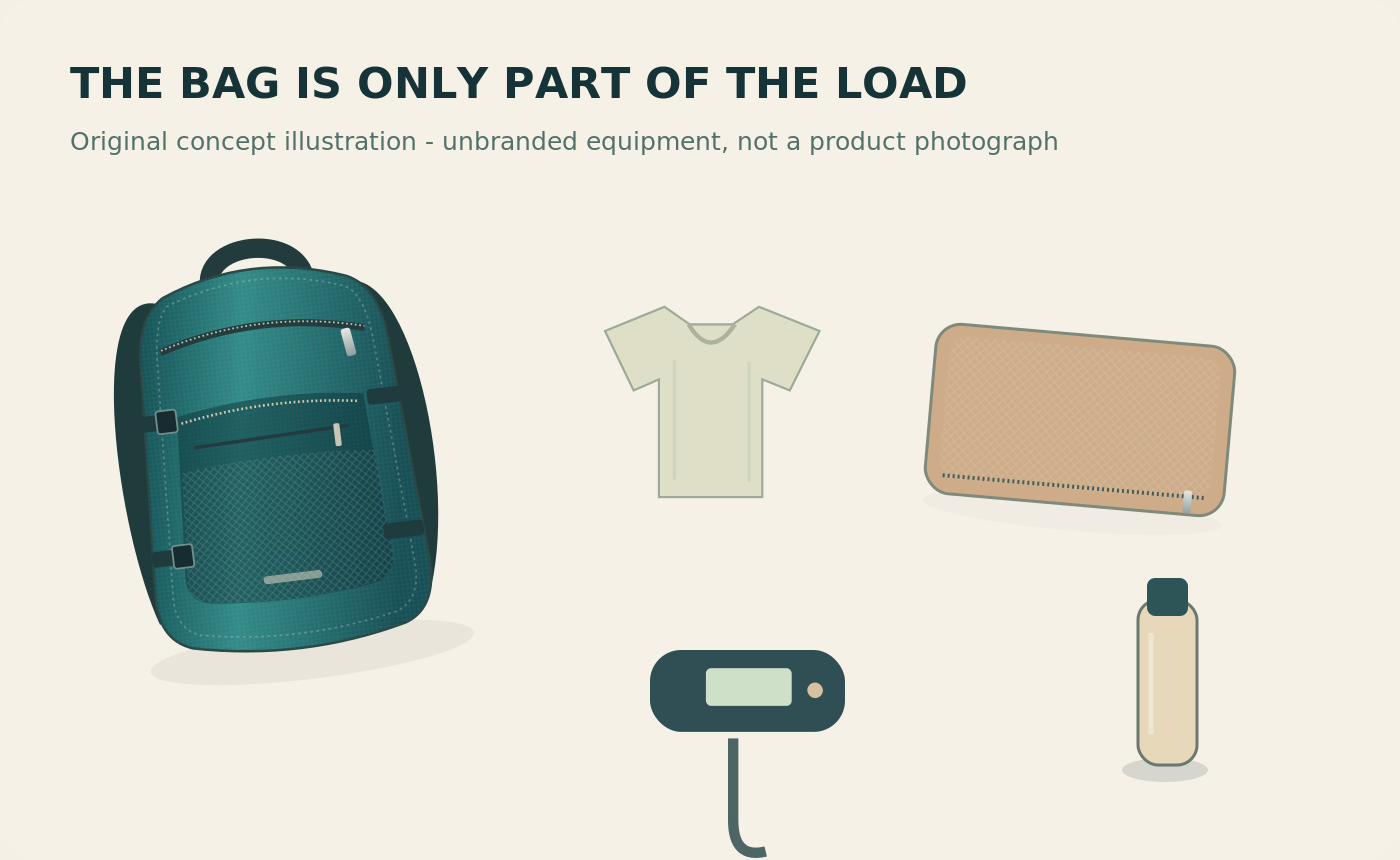
Empty weight is only the first line
A one-kilogram threshold is helpful because it gives the shortlist a clear boundary. It is not a magic dividing line between comfortable and uncomfortable travel. A 1.1kg bag that genuinely replaces several accessories may produce a lighter complete system than an 800g bag that needs extra padding, a large organiser and a separate day bag.
Build a small weight budget using your own equipment. Weigh the empty bag first, then the laptop if carried, then toiletries, clothing and optional items. Keep the calculation visible while packing. That is more reliable than assuming that a lightweight backpack leaves enough allowance for everything you would normally put in a suitcase.
A worked example, not a baggage allowance
Imagine a personal packing target of 7kg. With a 700g backpack, 6.3kg remains for contents. A 920g backpack leaves 6.08kg. The difference is 220g, which is useful but not a reason to ignore a poor fit or a difficult laptop pocket. These are arithmetic examples, not a statement that your airline allows 7kg.
Now suppose you add a 250g sleeve and 200g of extra pouches to the lighter bag. Its shell-plus-accessory weight becomes 1.15kg, compared with 920g for the other bag before any accessories it may need. This does not prove one model is better. It shows why the whole system should be compared on equal terms.

Measure consistently
Use the same scale and the same included items when comparing. Keep removable straps, covers and accessories beside the bag so none are accidentally omitted. Then repeat the measurement after packing the items you will actually take. A published number is a useful filter, whereas the weight hanging from your scale is the practical departure check.
A handheld luggage scale is optional rather than compulsory; a suitable existing scale may be enough. However, a small dedicated one can be convenient when you need to repeat the check away from home. Do not mistake fine display increments for a guarantee of laboratory accuracy.
Match the backpack to your actual cabin allowance
Free underseat and large cabin are different categories
At the editorial check, Ryanair's small personal-bag limit was 40 x 30 x 20cm, with a separate 55 x 40 x 20cm, 10kg allowance under Priority and Two Cabin Bags. easyJet listed 45 x 36 x 20cm for the small underseat bag and 56 x 45 x 25cm for a large cabin bag when included or booked. Rules checked 9 October 2026. [9] [8]
These examples explain why one backpack can be suitable for one fare and unsuitable for another. They do not establish a permanent label for the product. Check your booking, route and operating carrier again before departure, particularly where several airlines are involved.
Apply the numbers without wishful thinking
On the published figures, the Classic 28L sits within Ryanair's small-bag rectangle, while the Classic 36L sits within easyJet's small-bag rectangle. Those are comparisons of stated dimensions, not guarantees about a bulging packed bag. A bottle, an overfilled front pocket or a tightly stuffed main compartment can change the result. [2] [1] [9] [8]
Measure the fullest points, including external items. Use a simple box-shaped test space rather than measuring only the flat back panel. Also try removing the bag from that space without rearranging everything: a bag that only fits after a lengthy repack is not a relaxed choice for a tight boarding situation.
Keep access in mind
A backpack that fits under the seat still needs to work once it is there. Put the items needed during the flight near a reachable opening rather than behind tightly packed clothing. Meanwhile, anything you will not need until arrival can remain deeper in the bag. This small change is often more helpful than adding another external pocket.
Pack a light bag so it remains comfortable
Give dense items a deliberate home
For a practical starting layout, keep the densest objects close to your back and avoid leaving a heavy pouch loose at the outermost edge. Then use soft clothing to fill awkward spaces without creating hard corners. This is packing judgement rather than a claim that a particular untested bag has a measured comfort advantage.
A laptop changes the arrangement. It creates a firm surface that may help organisation but also limits how much the bag can bend or compress. Therefore, complete the airline-fit check with the computer in place. A demonstration using an empty bag is not evidence that your work setup will fit equally well.

Keep the number of organisers proportionate
Packing cubes can make an open bag easier to use, especially when you need to retrieve one category of clothing without disturbing another. However, buying a large set does not mean every piece belongs in your backpack. Start with the smallest useful combination and leave unused pieces at home.
Compression is primarily a volume tool. It does not make the clothes lighter, and a very firm cube can be less comfortable than a softer arrangement. Avoid packing the entire bag as one rigid block, particularly when it has little structure of its own. Keep enough flexibility to close the zip without pressure.
Run a small departure rehearsal
Put the packed bag on, walk around your home and use the handles you will need when lifting it onto a rack. Next, retrieve your travel documents, charger and outer layer without emptying the main compartment. A short rehearsal can reveal inconvenient packing decisions while there is still time to change them.
For illustration, allow around fifteen minutes for this check rather than trying the bag for a few seconds while empty. That is a suggested routine, not a comfort-test standard. Stop and change the load or fit when something feels wrong instead of treating discomfort as proof that you simply need to tighten every strap.
Make the packing list lighter before replacing the backpack
A clothing-led weekend
For an illustrative two-night trip, lay out the clothing you expect to wear rather than packing by habit. Begin with one coherent set of interchangeable pieces, the underwear you need and a layer appropriate to the forecast. Then decide whether a second pair of shoes genuinely earns its place. This is a packing exercise, not a universal clothing prescription.
The useful question is which item determines the size of the bag. If it is one bulky spare shoe pair, removing or changing that choice may make the compact Classic 28L possible without sacrificing anything else important. On the other hand, keep equipment that the trip genuinely requires. Lightweight packing should reduce duplication, not leave you without the things you need.
A trip built around doing laundry
A longer journey does not necessarily require a separate outfit for every day. Sketch a realistic laundry routine and include the practical consequences, such as somewhere to separate worn clothing and enough flexibility while items dry. Avoid assuming that handwashing will solve everything if your accommodation and timetable make it inconvenient.
Next, pack for the longest interval you expect between usable laundry opportunities, rather than the entire trip length. This changes the bag comparison from a vague promise about how many days it holds to a specific clothing cycle. A simple front-opening pack may work well because the clean and worn clothing modules can be exchanged without reorganising the rest of the contents.
A computer-led short break
When a laptop is essential, weigh it with the charger and case before considering clothing. Those items can dominate both weight and shape. Then ask whether an integrated laptop layout replaces equipment you would otherwise add to a simpler bag. Do not count the lighter shell as a saving while ignoring a substantial sleeve in the alternative setup.
This is a useful reason to compare the Daylite 35 with a basic clothing carrier, provided its external dimensions suit the journey. Try retrieving the computer after the bag is fully packed, then repeat the process with the other design. The better solution may be the one that needs fewer separate components, even when its published empty weight is slightly higher.
A bag used mostly at the destination
Some travellers carry a backpack only briefly during the journey but use it every day after arrival. In that situation, the way it behaves partly empty deserves extra attention. A broad travel rectangle may organise clothes well yet feel excessive for a light layer, bottle and a few daily essentials.
Try both loads before buying: the full departure arrangement and the smaller local-use arrangement. Notice whether the contents slide around, whether the shape collapses awkwardly and whether access remains sensible. This is why the Patagonia and Quechua options belong in a travel comparison even though they do not duplicate the boxier suitcase-style layouts. The most useful bag may be the one you enjoy using between flights.
Understand what you are trading for a lower empty weight
Count the hardware you actually use
A bag can save weight through fewer dividers, simpler straps, less padding or different materials. None of those choices is automatically good or bad. The relevant issue is whether the removed feature is something your own packing routine needs. A traveller who never carries a computer has a different requirement from someone whose work depends on one.
Make a short feature audit of your current bag. Note which pockets remain empty, which straps are never used and which compartments save time on every journey. That gives you a more useful buying brief than a general wish for the lightest possible backpack. Keep the features that repeatedly solve a problem and question the ones that merely look impressive in a specification list.
Do not infer durability from one fabric number
A material description is useful, but it is not a complete durability test of the finished bag. Look at the way you intend to use it: ordinary cabin travel, daily commuting or frequent handling on rough surfaces create different demands. Then examine the manufacturer's care information, repair options and warranty terms for that model.
Avoid choosing between two products solely because one description sounds tougher. This guide has not independently tested abrasion, seam strength or long-term zip wear, so it does not award durability scores from fabric names. During your own inspection, focus on visible construction, smooth operation and whether the bag can hold your packing list without forcing the closures.
Keep the saving in perspective
A smaller weight difference can matter when every gram is accounted for, but it should be compared with the entire load. Removing an item you do not use can change the result more than replacing a functional bag. Conversely, a repeated small saving can still be worthwhile when the new bag also improves the fit and organisation.
Use a simple decision rule: replace the bag when the new system solves a specific problem and passes the packed test. Keep the existing one when it already works comfortably within your allowance. That approach avoids spending money simply to move a number below a threshold while leaving the real travel problem unchanged.
Buy carefully and keep the bag useful for longer
Inspect before removing the tags
When the backpack arrives, compare the model and capacity with the order, then check the included features. Try the zips gently, inspect the strap attachment areas and confirm that your normal pouches fit. Do the initial packing test indoors and keep packaging until you have checked the retailer's return conditions.
A lower price is not automatically the better deal when delivery time, return postage or model ambiguity changes the risk. Likewise, a long warranty headline is not a promise to cover airline damage, ordinary wear or every accidental problem. Read the terms for the exact product and retailer rather than transferring a claim from another brand.
Recheck the exact listing
The product link for the Classic 36L is useful for comparing the named bag, but marketplace selections and sellers can change. Confirm capacity, condition and seller before ordering. In particular, do not assume a different colour or a similarly named Tech version has the same empty weight and internal layout.
Do not replace a workable bag just for the threshold
Start by weighing the backpack you already own. Then try removing duplicated equipment or changing the packing arrangement. If it becomes a comfortable system within your allowance, buying a new bag to save a modest amount may solve less than you expect.
For ongoing care, follow the bag's own instructions. Empty it after travel, let damp areas dry before storage and address trapped grit around zips before forcing them. Those are simple inspection habits, not permission to machine-wash every model. A repairable, regularly used bag can be a more sensible purchase than a lighter one that does not match your routine.
The advantages and compromises of going below 1kg
What can work well
A lower shell weight leaves more room within your packed-weight target. Simpler designs can also be easier to repurpose for local use, especially when you choose only the organisers you need. The benefit is strongest when the bag already matches your laptop, body and booked allowance.
What you may give up
Less structure or fewer built-in compartments can mean adding separate equipment. A very light bag may not provide the harness you want for a dense load. Moreover, low weight does not correct an excessive height, width or depth; the complete packed system still needs measuring.
The saving is real, but it is not free
The clearest advantage is retaining more of a packed-weight target for the things you actually need. A lighter bag can also be easier to lift when empty and less of a burden when used around your destination. However, the benefit depends on avoiding the temptation to fill the saved allowance with unnecessary extras.
The usual decision is not light versus bad. It is simplicity versus specific features. You may reasonably choose more structure for a demanding laptop setup or a more substantial harness for longer loaded walks. Instead of treating one kilogram as a quality standard, use it as the boundary for this particular buying exercise.
Common mistakes that undermine a lightweight purchase
Comparing different products as though they were one
A bag family can contain several capacities, materials and revisions. BAGSMART's fixed 28L and expandable 38L versions are a clear example in this guide. Similarly, an older marketplace listing may not describe the current manufacturer's feature set. Save the specification for the exact item you ordered so you have something concrete to check against delivery. [3] [7]
Chasing an empty-bag number and ignoring the journey
A beautifully light backpack can still be wrong for your trip if it forces a separate computer bag, prevents easy access to essentials or carries badly with your load. For a laptop-led journey, compare the Daylite's travel organisation with the accessories your simpler alternative would need. The goal is a coherent system, not a victory in one column.
Treating a compression strap as airline permission
Compression is something to verify with the packed bag, not a substitute for reading the allowance. Once a laptop, shoes or a firm cube prevents further movement, tightening the outside may not reduce the relevant dimension. Leave a little practical margin rather than planning to rely on a sympathetic interpretation of the rules.
Frequently asked questions about lightweight travel backpacks
Is a backpack under 1kg automatically comfortable?
No. Empty weight is only one part of the carrying experience. Strap shape, harness position, packed weight and where the load sits all matter. A useful comparison is to put the same belongings into each candidate and walk with them. However, do not assume that the lightest shell will suit every body or that a more expensive bag will correct a poor fit.
Does the one-kilogram limit include a laptop sleeve?
The shortlist uses published empty-bag weights. A sleeve or organiser you add separately belongs in your complete-system calculation. Integrated components are normally part of the listed bag, but removable accessories and different versions can create ambiguity. Therefore, weigh the exact configuration you intend to carry rather than treating a product-page number as your final packed total.
Which option should I consider for a small laptop and a weekend away?
The fixed BAGSMART Blast 28L is a useful candidate when its compartment suits your device and its external dimensions suit your allowance. However, a 15.6-inch label is not an internal-width guarantee. Test the laptop with any protective case attached, then repeat the fit check after adding your clothes. A sleeve that works only in an empty bag is not enough. [3]
Can I use a lightweight backpack for a longer holiday?
Possibly, but trip length is a weak predictor of required capacity on its own. Laundry plans, weather layers, footwear and work equipment usually change the packing list more directly. For example, a repeating small wardrobe may be easier to manage than several occasion-specific outfits on a shorter trip. Make the packing list first, then choose the bag rather than assigning litres to a number of days.
Are packing cubes worth their extra weight?
They are useful when the organisation they provide changes how easily you pack and retrieve things. They are less useful when you fill every available compartment with another organiser simply because it came in a set. Start with one clothing cube and a small essentials pouch, then add only what solves a specific problem. Weigh the result rather than assuming compression also reduces weight.
Should I trust a manufacturer's cabin-approved claim?
Treat it as a prompt to check dimensions, not a substitute for your airline's policy. The fare may include only a personal item, and different carriers use different rectangles. Measure the bag after packing, include external pockets and check the current allowance. The comparison here flags obvious mismatches, but it cannot guarantee an airline's decision about your particular bag. [9] [8]
What should I do when two pages give different measurements?
First check that they describe the same model, size and revision. If they do, ask the retailer for confirmation rather than averaging the numbers or choosing the smaller one. This guide identifies the conflicting width on Decathlon's Escape 500 page for precisely that reason. A narrow safety margin is not the place to resolve uncertainty by optimism. [6]
Final recommendation: choose a light system, not just a light shell
For uncomplicated clothing-led packing, the Classic 36L is the most straightforward starting point here. Choose the smaller Classic 28L when its footprint is more important than extra room. Meanwhile, the Daylite 35 deserves consideration for its travel-focused organisation only when its dimensions work for your journey.
For a compact laptop-and-clothes arrangement, compare the fixed 28L Blast rather than assuming every Blast version meets the weight threshold. Patagonia and Quechua remain useful alternatives when everyday use matters as much as suitcase-style packing. None needs to be the universal winner for the shortlist to be useful.
The final check is simple: assemble your own contents, weigh the complete system, measure the packed shape and try carrying it. Keep the bag that makes those four checks easier. A lower published number is valuable only when the backpack still does the job you bought it to do.
Sources and fact-checking
The shortlist uses the named manufacturers' published empty weights and dimensions, reviewed on 9 October 2026. Different capacities and revisions are kept separate. Patagonia's current UK page gives 48 x 30 x 15cm, while the conflicting width on Decathlon's Escape 500 page remains flagged. Packing calculations and selection judgements are illustrative; no hands-on tests or guaranteed airline acceptance are claimed.
- CabinZero Classic 36L: current model specifications
- CabinZero Classic 28L: dimensions, weight and sleeve
- BAGSMART UK Blast 28L: fixed-capacity nylon version
- Osprey Daylite Carry-On Travel Pack 35: UK specifications
- Patagonia Black Hole Pack 25L: UK specifications, style 49298
- Decathlon Quechua Escape 500 23L: product 8649342
- BAGSMART UK Blast 38L: expandable version specifications
- easyJet: small and large cabin-bag allowances
- Ryanair: personal-bag and Priority cabin-bag policy
Illustrations in this article were created for Taylor’s Trailblazing Travel Gear. Third-party photographs, where used, are credited beside the image or in the source list.