Best Garment Folders for Travel
Choose a useful folded footprint without expecting an organiser to make every garment wrinkle-free.
The best garment folders for travel are not necessarily the models with the biggest clothing count on the label. A useful folder has to suit the fold your garments can take, fit the clear interior of your luggage and remain easy to remove when you arrive. If any of those conditions fails, a premium organiser can become an awkward rectangle rather than a packing improvement.
This guide concentrates on shirts, trousers, blouses and other clothes that benefit from an orderly stack. It also explains when a full-length suit carrier or a simple packing cube is the more sensible category. The distinction matters because a folding board cannot make every structured or delicate garment suitable for compact luggage.
The comparison uses manufacturer information and identifiable product listings. It does not claim personal ownership, a flight trial or a measured reduction in creases. Published wrinkle-free promises are treated as marketing rather than repeated as guaranteed results. Where specifications differ between listings or a current UK page omits a weight, that uncertainty remains visible.
Start with the clothes you actually need, then mark out the candidate folder’s footprint inside the case. The detailed routines below cover building the stack, using the supplied board, sharing luggage and handling the return journey. Together, those checks help distinguish an organiser that improves a repeated work or event trip from one that merely looks attractive in an empty suitcase.
This guide contains paid shopping links. Purchases through them may earn us a commission at no extra cost to you. As an Amazon Associate I earn from qualifying purchases. Recommendations are research-led, and illustrations do not show product tests.
Measure the M first
A smaller footprint can leave useful space beside the folder.
Check the clear floor
Large folders need usable interior width, not just a cabin-size label.
Verify the specification
Do not infer exact weight from the word Ultralight.
Consider the category
A short folding board is not a full-length suit carrier.
Best garment folders for travel: choose by the folded footprint
What a folder is meant to organise
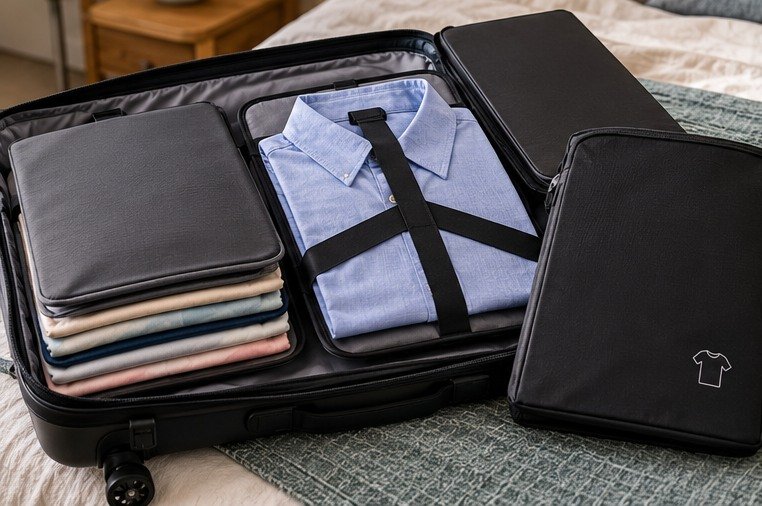
The best garment folders for travel hold a stack of folded clothes together inside luggage. A folding board or card helps produce a consistent footprint; fabric wings, a hook-and-loop closure or a zipped outer section then keep the bundle organised. That is a more realistic starting point than the common promise of arriving completely wrinkle-free.
A folder can be useful for shirts, blouses, trousers and other garments you prefer to keep in a controlled stack. However, it is not the same as a full-length garment carrier. A structured jacket, an embellished dress or a garment with special care requirements may need a different packing method. Decide what you are trying to transport before choosing an organiser that only looks appropriate in a product photograph.
How the options were compared
This guide compares published dimensions, materials, closure styles, folding aids and manufacturer capacity claims. It does not report hands-on travel tests or measured wrinkle reduction. The four folder choices cover two Eagle Creek sizes, a broader Thule format and Osprey’s zipped approach. A TORRO suit carrier is included only as an alternative when a folder is the wrong category.
The recommendations prioritise fit inside existing luggage, a manageable clothing stack and an accessible arrival routine. Product generations and retailer data do not always agree, so the tables identify current manufacturer specifications rather than merging conflicting numbers. Where a UK page does not provide a comparable weight, that absence is stated rather than filled with an estimate.
Compare the current folder formats
| Folder | Manufacturer-listed dimensions | Weight or capacity note | Best reason to shortlist |
|---|---|---|---|
| Eagle Creek Reveal M, orange listing | 36 x 26cm flat footprint | 270g; claimed capacity up to 7 items | A smaller footprint for a modest smart-clothing stack |
| Eagle Creek Reveal L, Black listing | 43 x 30cm flat footprint | 420g; claimed capacity 8-12 shirts and trousers | A broader stack in luggage with enough clear floor space |
| Thule Garment Folder, TGF201 | 42 x 31 x 8cm | 0.4kg; claimed capacity up to 12 items | A large folding-board system with adjustable wings |
| Osprey Ultralight Garment Folder | 40 x 28 x 5cm | 6L; UK page does not list a weight | A wide-opening zipped format with folding card |
The figures above are published product specifications, not measurements made for this guide. Eagle Creek’s flat dimensions and the three-dimensional listings from Thule and Osprey are not directly equivalent measures of filled capacity. Treat item counts as the makers’ claims rather than a promise about your own shirt sizes or fabrics. [1] [2] [3] [4]
Match the listing to the generation
The same broad product name can appear on older and newer listings. For example, retailer pages may describe a different weight or capacity from the current manufacturer page. Check the dimensions, closure and included board on the specific listing you intend to buy. A colour choice is secondary to receiving the product version that fits the packing plan.
Eagle Creek Reveal M: the smaller-footprint starting point
Why it is the first one to measure
Eagle Creek lists the current Reveal M at 36 x 26cm and 270g, with mesh wings, a folding board and a hook-and-loop closure. The brand describes a capacity of up to seven items. That combination makes it a sensible starting point for a traveller protecting a small smart-clothing selection rather than attempting to organise the whole suitcase in one folder. [1]
The smaller footprint is its principal practical attraction. A folder that leaves room beside it for toiletries or underwear can be easier to integrate than a broad model that covers the entire case half. Nevertheless, the trade-off is the fold you ask the clothes to take. A large shirt may need a more compact fold than you would prefer, so test your own garments against that outline.
Do not fill it to a headline count
Seven thin items and seven bulky items are different loads. Start with the clothing needed for the first smart occasion, then add only what the closure can hold comfortably. A neat smaller stack may work better than a maximum-capacity bundle whose wings barely meet and whose collar area is being compressed by the case lid.
Mark out the current manufacturer’s footprint on paper before ordering. Check the supplied board and actual model details when it arrives. The listing’s wrinkle-free wording is a seller claim, not a guarantee made here. The folder’s value is controlled organisation; the condition of the clothes on arrival still depends on the garments, folding and surrounding luggage pressure.
Eagle Creek Reveal L: more width, not permission to overpack
When the larger size is justified
The current Reveal L is listed at 43 x 30cm and 420g, with a manufacturer capacity claim of eight to twelve shirts and trousers. Like the M, it uses a folding board and adjustable mesh wings. Its larger footprint makes it worth considering for a broader clothing stack, provided the case has enough uninterrupted space for it. [2]
This is the option to examine when the smaller outline forces an awkward fold in your own clothes. A broader board can be useful for keeping the stack shape consistent, but it also occupies more of the luggage floor. In a small travel backpack, that broad rectangle can be harder to position than the word large alone suggests.
Count the organiser’s weight too
The larger folder adds more empty weight than the M. Whether that matters depends on the complete bag and the benefit you gain, not on a rule that every accessory must be ultralight. A traveller carrying several presentation-sensitive garments may accept the extra structure. Someone packing two casual shirts may not need it.
Compare the Reveal L Black listing with the actual interior of your luggage, including handle channels and curved corners. Then do a full closure trial with the surrounding packing in place. If the only way to close the case is to force the lid down onto the folder, reduce the load or reconsider the format. More width should improve the arrangement, not disguise an already overfilled suitcase.
Thule Garment Folder: a broad adjustable-wing system
What makes it worth comparing
Thule lists the TGF201 garment folder at 42 x 31 x 8cm and 0.4kg. It includes a folding board, adjustable wings and a webbing handle, with a manufacturer claim of up to twelve items. The UK page identifies nylon fabrics and describes a semi-transparent construction. These details make it a relevant comparison with the larger Eagle Creek format rather than the smaller M. [3]
Its useful role is a clearly defined flat clothing module that can be lifted from the case as one unit. That could suit a work trip where shirts and trousers are unpacked before casual clothes. However, the benefit depends on where the folder sits. A handle is less useful if the whole organiser is buried beneath shoes and a toiletry bag.
Where the footprint needs attention
The 31cm width is a practical dimension to check against a tapered backpack or narrow suitcase interior. Do not assume that fitting most cabin luggage means fitting your particular personal-item bag. Airline outer limits and usable interior floor space are different measurements, and the folder must satisfy the latter before you even consider the former.
The brand’s item count should be treated as an upper planning reference, not a target. Try the clothes you actually need and keep the closure under control. Thule recommends cleaning marks with a damp cloth and mild soap, then air-drying the folder. Follow the care instructions supplied with the actual product rather than washing the board and fabric together by assumption. [3]
Osprey Ultralight Garment Folder: the zipped alternative
A different access style
Osprey’s UK page lists a 40 x 28 x 5cm, six-litre garment folder with a dual-zippered wide-angle opening, a hook-and-loop closure and an included folding card. Its main fabric is identified as recycled 40D high-tenacity nylon. The UK specification shown during research does not include a product weight, so this guide does not invent one from the word Ultralight. [4]
The zipped opening is the main reason to consider this design. It can appeal to somebody who prefers a more enclosed module rather than relying solely on external wings. Nevertheless, a zip does not turn the folder into a compression press. The clothes still need a sensible fold and enough room for the closure to operate without strain.
Use the six-litre figure carefully
Capacity does not tell you the longest useful fold or whether the folder fits through a backpack opening. The published footprint remains more relevant when comparing it with your shirts and luggage. Likewise, six litres of clothing can look very different when it consists of thin blouses rather than a thick jumper and trousers.
Choose this option for its format and verified dimensions, not for an assumed weight advantage over every other folder. If exact accessory weight is critical, ask the retailer or manufacturer for the current version’s figure before purchase. That small check is preferable to building a precise packing calculation around a number copied from a different region or product generation.
A garment folder, packing cube or suit carrier?
Use a folder for a controlled stack
A folder is most useful when you want several garments to share a repeatable footprint. Think of shirts and a pair of trousers that belong together for a work event, or a small collection of clothes you would otherwise keep refolding every time you search the case. The benefit is maintaining the group, not eliminating every crease.
A packing cube is often simpler for casual tops, underwear or items that do not need a folding board. It can also use irregular spaces more easily because it may have less structure. Therefore, a mixed system can be more sensible than putting every garment into a folder. The Eagle Creek Starter Set is a separate bundle to compare when you need both a large folder and two clothing cubes. Do not confuse it with the Essentials Set or buy the bundle when the individual folder is all you need. [5]
Choose a carrier when the garment needs length
A full-length carrier is a different category. TORRO’s Trifold Canvas Suit Carrier is listed at 125 x 56cm unfolded, 40 x 56cm folded and 1,100g, with a claimed capacity of up to two suits or several garments. Those dimensions show why it should not be presented as another small folder to put beside underwear cubes. [6]
Consider the TORRO suit carrier for a journey centred on formalwear, then check the airline allowance and the way the carrier will be transported. The stated folded dimensions do not include a universal packed-depth guarantee. A carrier is not automatically a free additional cabin item, nor a promise that every structured garment will arrive ready to wear.
Leave some garments out of the experiment
When a garment’s shape, decoration or care requirements make folding risky, ask its maker or a suitable clothing professional about transport. Do not force it around a small board simply because the rest of the wardrobe fits. The organiser should adapt to the clothes you need, rather than making an expensive garment the price of a tidy suitcase.
Measure the luggage interior before ordering
Ignore the outside label for this task
A suitcase advertised by its external height does not provide that whole height as usable internal space. Wheel housings, handle channels, lining, curves and dividers can all affect the floor available to a folder. Open the exact bag you will travel with and measure the clear space at the level where the folder will lie.
A backpack adds another question: can the folder pass through the opening? A rectangle may fit inside a flexible bag once inserted but still be awkward to load without bending. Check the access path as well as the final position. This is particularly relevant to top-loading designs or bags with a narrower opening than their broadest internal section.
Use paper before spending money
Cut or fold a paper rectangle matching the candidate’s footprint. Place it in the intended position and mark any corners that clash with luggage structure. For the Reveal M, use the current 36 x 26cm outline; for the Reveal L, use 43 x 30cm. These are fit templates based on the listed footprints, not substitutes for trying the finished, filled folder. [1] [2]
Next, add a stack of your actual clothes on the template. The stack’s thickness matters as much as its outline, especially when the case has a shallow half. Close the internal divider if there is one, then check whether the main lid can close without using body weight to force it shut.
Reserve surrounding space deliberately
Do not fill every gap around the folder during the first trial. Leave room for the toiletries, shoes and chargers that will share the case. A flat clothing module can look impressively tidy in isolation while being incompatible with the complete load. The useful result is a workable suitcase, not a perfect photograph of one compartment.
The folder must fit through the opening, lie in the available interior and leave enough depth for the case to close. All three checks matter.
Build the clothing stack around the trip
Choose by outfit role
Lay out the complete smart outfits before deciding how many items the folder should hold. Include the trousers, blouse, shirt or light layer that actually belongs with each occasion. Then remove duplicates that do not add a useful combination. A folder is more effective when it preserves a purposeful capsule rather than a stack assembled only to reach its advertised capacity.
For an illustrative two-night work trip, the protected stack might contain two shirts and one spare pair of trousers, while casual clothing stays elsewhere. That is a planning example, not a prescription. Climate, dress code, personal comfort and access to laundry can change the list, and necessary clothing should not be cut simply to fit a favourite organiser.
Keep bulky layers separate when that helps
A thick jumper or heavily structured garment can dominate the stack and make the closure harder to adjust. Test whether it is better placed in another part of the luggage, worn during transit or replaced with a more suitable layer already in your wardrobe. The aim is not a minimalist contest; it is an arrangement in which the folder can do its intended job.
Similarly, separate accessories that create hard pressure points. Belts, jewellery cases and chargers do not need to sit within the shirt stack simply because they belong to the same outfit. Give them a different location so you can adjust the clothing without redistributing small hard objects every time.
Put the first-needed garment where you can reach it
Arrange the stack in a sequence that suits arrival. If a shirt is needed before the rest of the wardrobe is unpacked, do not bury it below everything else. A consistent order also makes it easier to notice a missing item before departure. The Reveal M can be a candidate for this smaller first-occasion module, but the method is not tied to a particular brand.
A practical folding-board routine
Prepare the surface and the garment
Use a clean, flat surface large enough to support the garment. Empty pockets and remove items that could create lumps or snag the fabric. Smooth the garment gently without stretching it into a shape it does not naturally take. For clothes that need ironing, follow the care label and prepare them before packing rather than expecting the folder to repair an untidy starting condition.
GINETEX’s care guidance explains that ironing treatment should be selected from the garment’s care label rather than inferred solely from the fibre name. That matters when a shirt combines different fabrics, finishes or decorative details. A travel-packing guide should not override those instructions. [7]
Use the supplied instructions as the starting point
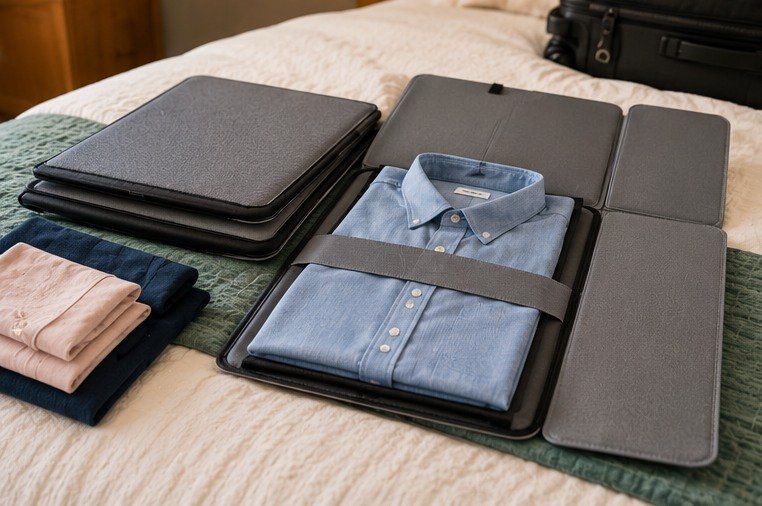
Follow the folding sequence supplied with the particular board. In general, the purpose is to create a consistent rectangle without sleeves, hems or ties protruding unpredictably from the stack. Keep the fold gentle enough that buttons and collars are not being forced into hard ridges. A board is a guide to repeatability, not a licence to crease every garment sharply along the same lines.
Once the garment is folded, place it in the folder in the orientation that leaves the stack balanced. Avoid building a tall ridge of collars or waistbands at one edge if that makes the wings pull unevenly. Try alternating the orientation when it improves the stack, but do not assume one technique is best for every garment shape.
Close in stages rather than one hard pull
Bring the wings or closure around the clothes gradually, checking that no fabric is caught. The goal is to keep the stack together, not to compress it as tightly as possible. If the closure needs excessive force, remove an item or change the arrangement before continuing.
Then lift the folder carefully by its intended handle and check whether the stack remains manageable. Do not shake it aggressively as a substitute for normal travel testing. Place it in the actual case and inspect the closure again after the surrounding packing is added. A neatly closed folder can still be pressed too hard by an overfilled suitcase.
What wrinkle-reduction claims cannot promise
Organisation is not an arrival guarantee
Several manufacturers use confident wrinkle-free language. This guide does not adopt that as an independently verified outcome. A folder can hold clothes in an organised stack, but the result also depends on the garment, folding method, journey length and pressure from the rest of the luggage. No comparative crease measurements were made for this article.
Decide what acceptable means for the occasion. A casual overshirt can tolerate a different finish from clothing for a formal photograph or important presentation. That distinction helps you choose between a folder, a longer carrier, wearing a garment during transit or arranging suitable pressing at the destination.
Plan for the first few minutes after arrival
If appearance matters, give unpacking a place in the arrival schedule. Open the folder, inspect the garments and hang or lay them out as their care requirements allow. Do not leave the clothes compressed simply because the folder makes them easy to ignore.
Check the practical options before relying on a hotel iron, steamer or laundry service. Availability, suitability and cost can vary, and a garment may not tolerate the treatment you planned. There is no need to pack extra equipment automatically, but there is value in knowing what you would do if the clothes require attention.
Avoid improvised heat treatments
Do not apply steam, high heat or a pressing spray without checking the garment instructions. A technique that suits one shirt may be unsuitable for another. In particular, the absence of an iron does not justify using a hot styling appliance on clothing or trying to force a delicate fabric flat. Protect the garment first; an organiser is a convenience, not a reason to take avoidable risks with it.
Adapt the system to different journeys
A short business trip
Keep the first meeting outfit together and readily accessible. The rest of the packing can use softer cubes or separate compartments, especially when the laptop and charging kit need a predictable location. The site’s one-bag business-travel guide is useful for considering those competing space requirements without treating clothing as the only part of the bag.
A smaller folder can be enough when the smart wardrobe is modest. Conversely, several large shirts may justify a wider footprint even on a short trip. Trip duration alone is not a capacity measurement; the actual clothing stack should decide.
A wedding or formal event
Identify which garment has the highest consequence if it arrives badly creased or misshapen. That item may deserve a transport method different from the rest of the wardrobe. The TORRO Trifold Suit Carrier is an alternative to investigate when length and formalwear organisation matter more than fitting everything into one small folder. [6]
Do not assume the carrier eliminates the need for a clothing-care plan. Check the garment’s own requirements and the transport allowance, then leave time to inspect it on arrival. A formal outfit should not depend on an untested fold performed for the first time on the night before travel.
A longer trip with laundry
Use the folder for the subset of clothes that benefits from it, not as the storage location for every clean and used garment. As the trip progresses, move worn items to an appropriate laundry arrangement and keep the remaining stack stable. A larger Reveal L only helps if its dimensions and the changing load still suit the case.
Where laundry is part of the plan, ensure garments are properly dry and cared for before returning them to the folder. Do not use its tidy appearance to hide unfinished drying. The site’s seven-day carry-on packing guide helps place laundry within the wider trip rather than adding it as an afterthought.
Run a useful home trial
Make the test representative
Use the clothes and luggage intended for the trip, not a few thin substitutes that make the organiser appear easier to fill. Start with a clean, return-safe fit check that respects the seller’s conditions. Then, once the product is yours to use, practise the full folding and packing sequence.
Time the routine only to understand your own preparation needs. For example, allowing fifteen minutes for an unhurried first attempt is a practical planning suggestion, not a measured claim that every folder can be packed in that time. The aim is to discover awkward garments, confusing closures and inaccessible positions before departure.
Simulate normal handling
Close the case, stand it upright and move it as you ordinarily would at home. With a backpack, try the normal carried position and check whether the folder’s corners create pressure against the back panel. Afterwards, open the luggage and inspect the arrangement.
Look for the reason behind any problem. A shifted stack may reflect too much empty space, while a compressed collar may come from overpacking above it. Do not immediately buy a different organiser when changing the placement could solve the issue. The trial should identify a cause, not merely produce a pass-or-fail verdict on the brand.
Compare with the no-folder arrangement
Fold the same clothes without the organiser and place them in the same luggage. Then compare access, stack stability, preparation effort and the space left for other items. This is a fairer personal buying check than comparing a carefully arranged folder with a deliberately messy pile.
The folder earns its place when it improves a task you actually repeat. If ordinary folding already works for your clothes and journey, keep that simpler method. A buying guide should leave room for the possibility that the best purchase is no purchase at all.
Sharing suitcase space without mixing up the wardrobe
Give the folder a defined owner or occasion
In shared luggage, decide whether a folder belongs to one traveller or to one occasion. A person-based system makes it easy to remove a complete clothing selection; an occasion-based system can keep the outfits for a shared event together. Both can work, but switching between them halfway through packing makes it harder to notice what is missing.
A simple luggage note or small identifying tag may be enough. Avoid putting adhesive directly onto delicate fabric or the folding board unless the maker allows it. The purpose of identification is to prevent unnecessary opening and handling, not to add another elaborate labelling project to an otherwise straightforward trip.
Keep the sequence visible
Before closing the folder, check the contents against the actual outfits. A shirt on its own is not a complete solution when the matching trousers are still in another room. Put accessories in their own appropriate compartment and record where they are. That lets you keep the clothing stack smooth without losing the connection between the items needed together.
During the trip, return unused garments to the same order when practical. If the layout changes, make the change clear to the other person using the suitcase. A shared folder only saves effort when everybody understands the arrangement; otherwise, a second smaller organiser or separate luggage section may be less frustrating.
Compare one large folder with two smaller ones
Two smaller folders can let travellers unpack independently and may fit separate areas of a divided case. However, they duplicate boards, closures and empty organiser weight. One larger folder keeps the group together but can make access to a single item more disruptive. Use the whole suitcase layout to decide rather than assuming either arrangement always saves space.
Try both layouts with paper outlines and the actual clothes before purchasing. Notice whether a second folder would solve an access problem or simply make the packing look more symmetrical. The useful arrangement is the one that remains understandable after clothing has been worn, laundry has accumulated and the suitcase has been repacked for the journey home.
Care for the fabric, board and closures separately
Do not wash the board by assumption
Eagle Creek specifically says its garment folder is washable but the folding board should not be washed. Thule gives a spot-cleaning approach for its folder. Those are examples of why the organiser’s components should not be treated as one identical washable object. Follow the instructions supplied with the model you own. [1] [3]
Remove loose debris and inspect the parts that contact clothing. A rough board edge, damaged seam or trapped hook-and-loop tab can create an avoidable snag. Close exposed fastening surfaces when appropriate for storage, following the product’s design, so they are less likely to catch delicate fabric the next time you pack.
Check condition before storing it
Make sure the fabric is dry before folding the organiser away. Keep the board somewhere it will not be bent under heavy luggage or damaged by sharp accessories. A distorted board may no longer provide the footprint you relied on during packing.
Inspect handles and closure points before the next trip, especially when the folder is routinely lifted with a substantial stack inside. Ask the manufacturer about care or replacement components when required. Do not assume a homemade board of the same apparent size will have the same edge finish or behave safely against delicate clothes.
Keep the system uncomplicated
Store the folder with the luggage it fits or with a note of the case in which it worked well. This avoids repeating a purchase or packing the wrong size for a different bag. The goal is a dependable routine that becomes easier with use, not an expanding collection of nearly identical organisers.
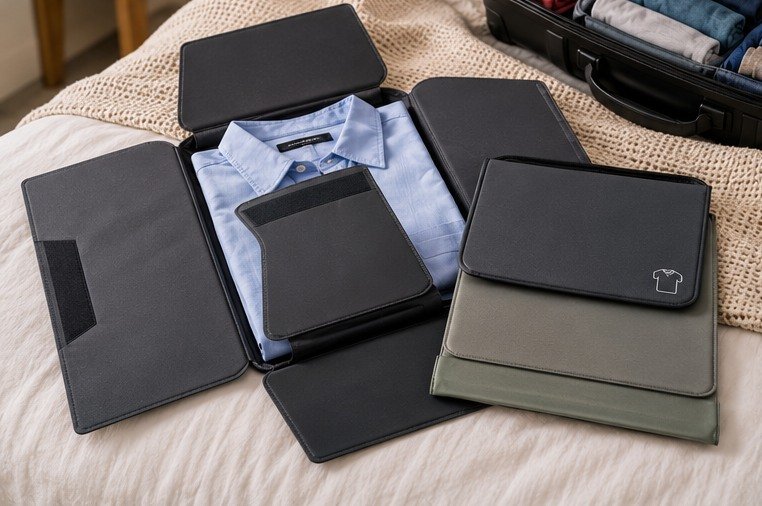
Pros and cons of travelling with a garment folder
Where the structure helps
A folder can keep a smart-clothing group together, make repeated folding more consistent and simplify removing that group from a suitcase. A board also provides a clear footprint to compare with luggage. For somebody who repeatedly transports a similar work wardrobe, that consistency can be more useful than a large collection of general-purpose cubes.
Where it can work against you
The organiser adds weight and occupies a relatively fixed rectangle. It may not suit tapered backpacks, very small personal-item bags or clothes that resist the chosen fold. Moreover, it can encourage overpacking if the manufacturer’s maximum item count becomes a target. A folder is most useful when its limitations are accepted rather than treated as problems to overcome by pulling the closure tighter.
Mistakes that make folders less useful
Treating twelve items as the goal
An upper capacity claim is not a packing recommendation. Start with the outfits required, then check the stack. Remove or rearrange clothing when the folder becomes strained, even if the number of items is below the headline figure. Bulk, size and shape matter more than counting each garment as one identical unit.
Measuring only the suitcase exterior
The usable interior can be smaller or less regular than the outer dimensions suggest. Include the wheel housings, handle channels and depth available beneath the divider. A paper outline is a cheap way to catch a mismatch before ordering a folder that cannot lie comfortably in the bag.
Assuming more compression means fewer creases
Pulling the wings harder is not an independently proven wrinkle-reduction method. It can simply increase pressure on the stack. Secure the garments enough to keep them organised, then judge the complete luggage arrangement. The case lid should not need to act as a second compression device.
Buying an organiser before choosing the clothes
A folder selected by its colour or brand may dictate an awkward clothing fold later. Reverse the order: choose the required outfits, make a representative stack and measure the luggage. Then compare the smaller Reveal M with broader alternatives instead of trying to make an unsuitable size work.
Forgetting the return journey
The outgoing stack is only half the task. Decide where used clothes will go and how the remaining clean items will stay organised. A folder that works only while every garment is clean, folded and present in the original order may not suit a multi-stop trip.
Garment-folder questions answered
Will a garment folder stop all wrinkles?
No such result is established by this guide. Manufacturers may use wrinkle-free language, but this is a specification-led comparison rather than a measured crease test. A folder can organise the stack; the outcome also depends on the garment, preparation, pressure and journey. Plan appropriate unpacking and care when appearance matters.
Is the medium or large Eagle Creek folder better?
The M is the first size to compare when a smaller footprint and modest stack are enough. The L is worth measuring when your clothing fold needs more width and the luggage has room for it. Neither is automatically better. Use the actual stack and interior measurements rather than choosing solely by trip length. [1] [2]
Can I pack trousers in a shirt folder?
The shortlisted manufacturers describe trousers or broader garment uses, but suitability still depends on the particular item and fold. Keep bulky waistbands and hard details from creating an uneven stack. A garment with special pressing or transport requirements should not be forced into a folder simply because trousers appear in the marketing description.
Does a folder count as another cabin bag?
When it is inside the luggage permitted by your ticket, it is an internal organiser. Carrying it separately may create another item, and acceptance depends on the operator’s rules. Do not assume a small handle or the words carry-on compatible create an additional allowance. Check the complete packed arrangement you will take to the airport.
Can I remove the folding board to save weight?
Check the product instructions and test how the folder behaves without it. Some boards primarily guide folding, while structure and storage arrangements differ between models. Do not assume every board is optional during transport. Also, removing a board is not worthwhile if the resulting stack becomes harder to manage than ordinary folding.
Is a zipped folder better than mesh wings?
A zipped design may appeal when you want a more enclosed module, while wings can make adjustment and access straightforward. Neither closure proves better clothing condition on arrival. Compare the opening, the stack you need and how the organiser sits in your case. Avoid buying on closure type alone without a fit check.
Can I use the same folder for clean and used clothes?
You can change its role when the clothing condition and the organiser’s care requirements allow, but avoid mixing clean items with damp or dirty ones. A separate laundry arrangement is usually clearer during a longer trip. Clean and dry the organiser appropriately before returning it to smart-clothing duty.
What is best for a suit jacket?
A small folder is not automatically the right tool for structured tailoring. Consider the garment maker’s advice, a suitable carrier and the way you will travel. The TORRO carrier is a category alternative to investigate, not a promise of fit or crease-free arrival for every suit. Check its dimensions and your transport allowance before buying. [6]
Do I need matching cubes as well?
Only when they solve another organisation problem. Underwear, casual clothes and accessories may work well in existing pouches or compartments. A matching set can simplify identification, but it can also duplicate equipment. Start with the folder’s specific purpose, then add only the organisers that make the remaining luggage easier to use.
How should I judge value without a laboratory test?
Compare fit, access, care requirements, published construction, delivered cost and the return conditions. Then run a fair home comparison against your existing packing method. A folder is good value when it repeatedly improves your own travel routine, not simply because it carries a premium name or an ambitious item count.
The recommendation: choose the footprint, then the closure
Begin with the Eagle Creek Reveal M when you need a manageable smart-clothing module and its footprint suits your case. Compare the Reveal L and Thule when a broader fold is genuinely useful. Osprey belongs on the shortlist when the zipped format and its published dimensions fit the way you pack, while its UK page’s missing weight should be checked before making a weight-led purchase.
For formalwear that needs more length or different support, step outside the folder category rather than forcing it to work. Above all, carry out the same practical sequence before committing: choose the outfits, make the stack, measure the luggage, practise the fold and inspect the arrangement after normal handling.
A useful garment folder should make a repeat journey easier. It should not determine how many clothes you carry, encourage excessive compression or replace the garment’s care instructions. Buy the organiser that supports the wardrobe and luggage you actually use, then leave room in the arrival plan to unpack properly.
Sources and fact-checking notes
Manufacturer specifications and identified listings were reviewed on 10 October 2026. Product generations can differ, and garment counts are maker claims rather than equal-volume measurements. The comparison excludes invented hands-on results and does not treat wrinkle-free marketing as a guaranteed outcome.
- 1. Eagle Creek – Reveal Garment Folder MCurrent footprint, weight, capacity claim and folding-board care.
- 2. Eagle Creek – Reveal Garment Folder LCurrent larger format and manufacturer clothing-count claim.
- 3. Thule – Garment Folder TGF201Dimensions, weight, materials, closure and cleaning advice.
- 4. Osprey UK – Ultralight Garment FolderUK dimensions, nominal volume, opening and fabric; no weight shown.
- 5. Amazon UK – Eagle Creek Starter SetSeparate bundle containing a large folder and two cubes.
- 6. TORRO – Trifold Canvas Suit CarrierFull-length category alternative and published folded/unfolded measurements.
- 7. GINETEX – ironing care guidanceFollow the garment care symbol rather than inferring treatment from fibre alone.
- 8. Amazon UK – Reveal M orange listingIdentification of the linked smaller-folder variant.
- 9. Amazon UK – Reveal L black listingIdentification of the linked larger-folder variant.
Illustrations in this article were created for Taylor’s Trailblazing Travel Gear. Third-party photographs, where used, are credited beside the image or in the source list.