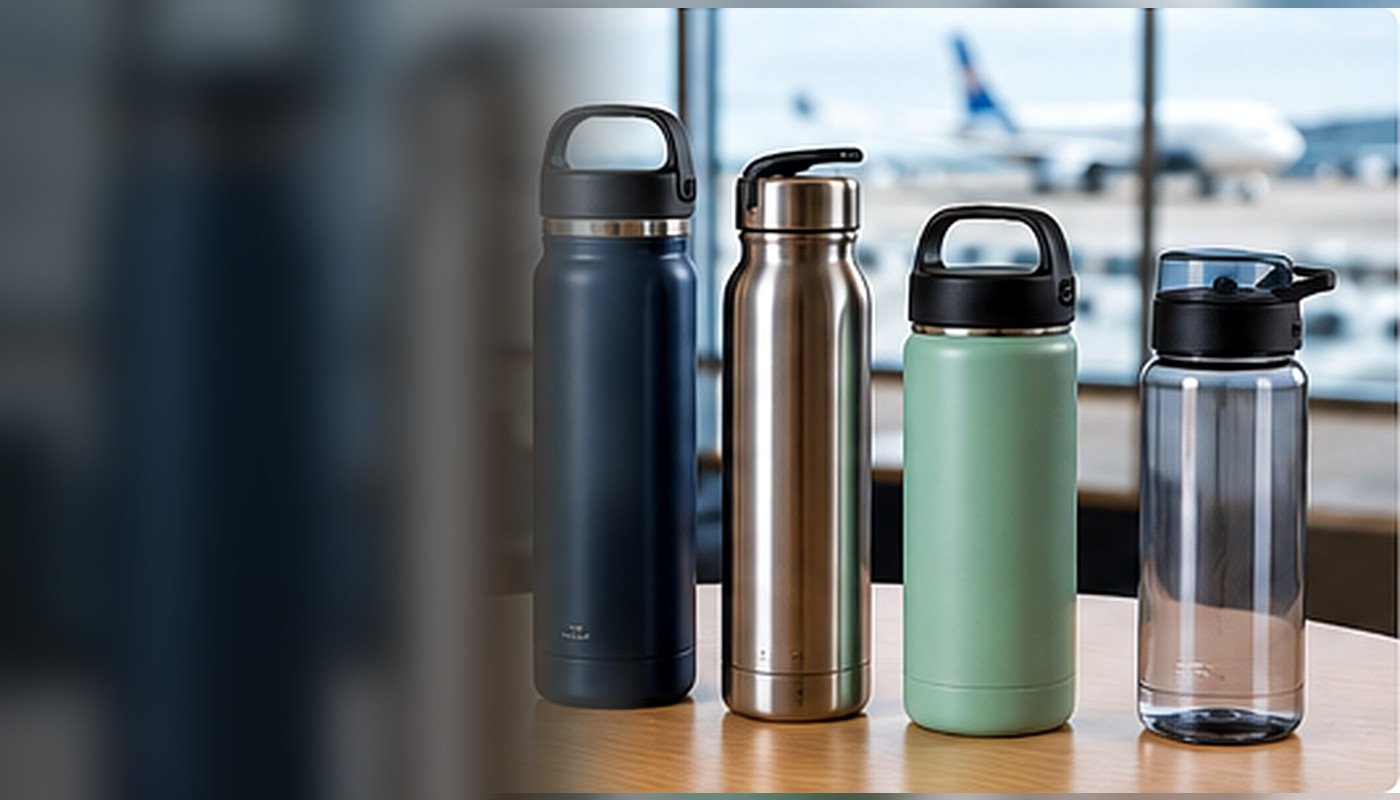
Top 10 Refillable Water Bottles for Flying
Ten specific bottles compared for leak-resistant travel, empty security screening and convenient refilling.
The best refillable water bottles for flying are easier to choose when you stop asking which brand is fashionable and start thinking about what happens between airport security and the seatbelt sign going on. You need a bottle you can bring to security empty, fill where potable water is available and close securely before placing it beside a passport, laptop or headphone case. A large vessel with a fiddly lid can become an annoyance in the narrow space around a seat.
This researched comparison covers insulated stainless-steel bottles, lighter plastic and aluminium options, filtered bottles and different sipping systems. It uses manufacturers’ published details, not hands-on leak or insulation tests. A brand describing a lid as leakproof does not mean every worn seal will withstand every orientation or pressure change. Test the specific bottle with plain water over a sink before trusting it in your carry-on.
UK airports do not all use identical liquid-screening rules, and some now permit containers above 100 ml while others retain more restrictive arrangements. For predictable travel, arrive with the reusable bottle completely empty, confirm rules at every departure and transfer airport, and refill only after screening at a suitable drinking-water source. More expensive and more insulated are not always more useful for a four-hour journey.
Owala FreeSip 24oz
Drink through a straw or sip from the wide opening.
Hydro Flask 21oz
A conventional leak-resistant screw-top profile.
SIGG Traveller 0.6L
Uninsulated aluminium reduces the carry weight.
Travel empty
Check departure and transfer security rules every time.
At-a-glance comparison: ten exact models
Start here: each row names one verified manufacturer model, its most useful role and the main trade-off. The buying recommendations are research-led, not the result of first-hand product testing or equivalent laboratory scores. Use the linked model page to confirm region, version and current stock before ordering.
| Product and official model page | Best for | Key trade-off |
|---|---|---|
| Owala FreeSip 24oz Stainless Steel | Best dual drinking styles | The straw and mouthpiece add surfaces to clean. An insulated 24oz |
| Hydro Flask 21oz Standard Mouth Bottle | Best straightforward insulated cap | The bottle is heavier than an equivalent uninsulated plastic or aluminium |
| Klean Kanteen Insulated TKWide 20oz Twist Cap | Best insulated twist style | The cap and straw need cleaning and the published warnings matter: |
| Nalgene 1L Wide Mouth Sustain | Best lightweight high capacity | The 89mm diameter can make it incompatible with narrow backpack bottle |
| SIGG Traveller 0.6L Aluminium Water Bottle | Best light aluminium classic | Aluminium does not hold drinks cold like a vacuum bottle. The |
| BRITA Active Water Filter Bottle 0.6L | Best filtered tap-water option | This is not a purifier for water whose microbiological safety is |
| Ocean Bottle Go 500ml | Best compact sip convenience | A flip top must latch completely and may be vulnerable to |
| CamelBak Chute Mag Insulated Stainless Steel 25oz | Best rugged insulated sports cap | The metal insulated construction has a noticeable empty weight, and 25oz |
| CamelBak Chute Mag Tritan Renew 25oz | Best lightweight CamelBak design | There is little temperature retention and the larger width still requires |
| Owala FreeSip Sway 18oz | Best smaller FreeSip variation | The handle changes the bottle’s outer footprint even though the fluid |
How the ten products were selected
Research-led selection, not claimed hands-on testing
Each model is a distinct design, not a colour variation. The primary button links to the exact official product page where available. A second Amazon UK link, clearly labelled a model-specific search, is included only as a shopping fallback; results can contain unrelated variants. Review seller identity, exact model, returns and country compatibility before ordering.
Relevant background: Consult GOV.UK guidance on liquids [11]. Check Heathrow security requirements [12]. Review current UK aviation baggage guidance [13].
Owala FreeSip 24oz Stainless Steel
Published design and useful specifications
Owala’s 24oz stainless-steel FreeSip combines an internal drinking straw with an opening that also supports tilting for a wider swig. The lid includes a covered drinking spout and locking carry handle. The manufacturer describes the bottle as leakproof with the lid securely closed.[1]
Best for a traveller who wants to drink without tipping a full insulated bottle while seated and still likes the option of a conventional swig. Its two drinking methods are distinct from a basic screw cap.
The meaningful drawback
The straw and mouthpiece add surfaces to clean. An insulated 24oz bottle also occupies more external space than a slim aluminium option, and the advertised leak-resistant lid does not excuse carrying it open inside a backpack.
Practice opening the lid without accidentally pressing other belongings against the release. Before boarding, fill it below the rim, close the lock and place it upright in a suitable exterior bottle pocket rather than beside a laptop.
A real comparison against alternatives
Compared with the Hydro Flask Standard Mouth, FreeSip prioritises flexible sipping over the simplest possible closure.
The locking handle is useful when the bottle rides in an accessible backpack side pocket. It is less useful if you plan to push the filled bottle into the same main compartment as documents. Test how naturally you can use both the straw and larger sip opening while seated, and whether the mouthpiece stays clean when opening the bag. A removable straw is another small component to clean between journeys.
Hydro Flask 21oz Standard Mouth Bottle
Published design and useful specifications
Hydro Flask lists a 21oz/621ml capacity, vacuum-insulated stainless-steel construction and a leakproof standard screw-style cap when correctly closed. Its UK product specifications list a weight of approximately 0.34kg for this size.[2]
Best for travellers who care about keeping a drink cool without complicated drinking valves. The opening is relatively slim and straightforward, and the screw-cap approach is easy to understand.
The meaningful drawback
The bottle is heavier than an equivalent uninsulated plastic or aluminium option. A narrow standard mouth can be less convenient to add ice to or clean thoroughly, and a different accessory cap may have different sealing behaviour.
Unscrew only when the bottle is stable on a tray or in your hand. Check the gasket is clean and reseat the cap firmly, then carry the bottle upright in its holder on the walk through the terminal.
A real comparison against alternatives
Choose a Nalgene or SIGG if low empty weight matters more than temperature retention.
The standard-mouth design is a reliable comparison point for insulated travel bottles because it has fewer moving parts than many straw lids. However, do not underestimate the filled weight of water plus stainless steel when travelling with a strict cabin allowance. Check that the bottle can be gripped and opened one-handed if you expect to use it on an aircraft without moving the tray.
Klean Kanteen Insulated TKWide 20oz Twist Cap
Published design and useful specifications
Klean Kanteen describes the 20oz/592ml insulated TKWide with a Twist Cap and integrated reusable steel straw. The UK page lists a weight around 416g for the bottle and cap and warns against using this particular straw cap with hot or carbonated drinks.[3]
Best for a traveller who specifically likes a built-in straw but wants a stainless-steel insulated design from a well-established refillable-bottle maker. Its twist-operated straw changes the drinking routine compared with a fully removable lid.
The meaningful drawback
The cap and straw need cleaning and the published warnings matter: it is not a general-purpose hot-drink flask with that lid. The empty weight is also more noticeable than an aluminium bottle in a small carry-on.
Close the twist mechanism fully before returning the bottle to its pocket, and keep the straw-cleaning tool or suitable brush at home for post-trip hygiene. Do not put pressurised fizzy drinks in a closure not designed for them.
A real comparison against alternatives
If you prefer a completely simple screw cap, Hydro Flask or SIGG avoids the straw-maintenance trade-off.
The TKWide’s straw system can make drinking easier when there is little room to tip a full bottle. It also changes what liquids are appropriate for that specific lid, and the care routine becomes more involved. Travellers who mainly want hot coffee should examine a cap made for hot drinks, not assume the Twist Cap is equivalent. Read the exact manufacturer warnings before use.
Nalgene 1L Wide Mouth Sustain
Published design and useful specifications
Nalgene sells a one-litre wide-mouth Sustain bottle made with Tritan Renew material, using a tethered screw cap and an uninsulated body. The manufacturer lists a diameter of approximately 89mm and a weight of about 177g.[4]
Best for long days when carrying more drinking water matters than keeping it chilled. The large opening is convenient for filling at airport taps and for thorough cleaning after travel.
The meaningful drawback
The 89mm diameter can make it incompatible with narrow backpack bottle pockets. A one-litre fill becomes noticeably heavy and may be too much to accommodate in the space around a tight aircraft seat.
Measure your bag’s actual bottle pocket before buying. Leave the bottle empty for security, fill after screening and tighten the large screw cap carefully so the threads align instead of cross-threading.
A real comparison against alternatives
Against insulated FreeSip or Hydro Flask, Nalgene offers simpler hygiene and lower empty mass but little temperature control.
A one-litre bottle sounds efficient until you place it beside a packed laptop bag and need to lift it repeatedly. The large Nalgene mouth is ideal for cleaning or fast refilling, but it may splash when opened in motion and feel ungainly in a narrow seat. Try your normal backpack pocket with a cylinder about nine centimetres wide before assuming it will fit.
SIGG Traveller 0.6L Aluminium Water Bottle
Published design and useful specifications
The SIGG Traveller 0.6L is a reusable aluminium bottle built around a familiar narrow-mouth screw-top design. SIGG lists the unfilled weight at roughly 106g and describes the screw closure as leakproof.[5]
Best for travellers who want a bottle noticeably lighter than a vacuum-insulated steel one while keeping a narrow carry profile. It suits shorter flights and those who prioritise baggage weight.
The meaningful drawback
Aluminium does not hold drinks cold like a vacuum bottle. The slim opening makes cleaning and ice insertion less convenient, and some finishes require more delicate care than ordinary dishwasher-safe plastics.
Carry it empty through security, add drinking water at the gate and check the seal ring occasionally for damage. Pack it upright rather than relying on screw threads alone after years of use.
A real comparison against alternatives
The Hydro Flask keeps drinks cooler; SIGG helps when the bottle itself must be very light.
The Traveller’s low weight is its key travel advantage, not premium thermal performance. It is a sensible option for people who spend their holiday walking in mild weather and can refill regularly after airport security. The narrow opening and particular finish still dictate cleaning, so follow the manufacturer’s care guidance rather than automatically putting aluminium bottles in a dishwasher.
BRITA Active Water Filter Bottle 0.6L
Published design and useful specifications
BRITA’s Active 0.6L bottle has a replaceable MicroDisc drinking-water filter designed to improve taste and reduce certain substances in potable tap water. The manufacturer lists a weight of roughly 152g and describes a squeeze-style sports drinking system.[6]
Best for a traveller who is sensitive to the taste of ordinary potable airport tap water and wants an integrated filter rather than a separate jug. The bottle is light and useful where replacement MicroDiscs are readily obtainable.
The meaningful drawback
This is not a purifier for water whose microbiological safety is unknown. Filters and valves require cleaning and periodic replacement, and the bottle’s sports closure may feel different from a rigid screw-cap flask. Product availability also changes.
Fill only from a known safe drinking-water supply, follow the MicroDisc replacement interval, and do not assume filtering makes an unsafe tap safe. Consider a plain bottle where airport refill taps already provide pleasant drinking water.
A real comparison against alternatives
Nalgene offers a simpler container with no consumable disc; BRITA addresses taste preferences with added maintenance.
BRITA adds a distinct taste-management function that many filtered water bottles do not describe clearly in retailer listings. Read what the MicroDisc is designed to reduce, the approved water type and when a disc must be replaced. A filter that improves pleasant-tasting tap water is not a substitute for potable water during overseas travel; a simple sealed bottle may be safer and easier.
Ocean Bottle Go 500ml
Published design and useful specifications
The Ocean Bottle Go is a 500ml travel bottle designed with a flip-up straw top, a carry loop and a stainless-steel insulated body. The maker lists an unfilled weight around 271g and describes leakproof closure when closed correctly.[7]
Best for shorter flights or compact bags where a half-litre capacity balances a manageable bottle with a convenient covered straw. The carrying loop can help at the terminal, although it is not a substitute for secure storage in flight.
The meaningful drawback
A flip top must latch completely and may be vulnerable to pressure from other luggage. The relatively narrow half-litre capacity means more frequent refills and the manufacturer may show limited stock for some colours.
Choose a position where the release button cannot rub against the backpack interior. At boarding, close the cap and place the bottle upright to reduce the consequences of a damaged seal.
A real comparison against alternatives
FreeSip has a larger standard option and two sip methods; Ocean Go is a distinct half-litre straw arrangement.
The 500ml Go is a neat example of a modest-capacity straw bottle. Its release button needs protecting from accidental pressure inside a bag, and the half-litre size may require several top-ups on a long layover. Consider whether the smaller bottle stays upright securely in your bag. Some colour options may not be available locally, so confirm the actual variant before purchase.
CamelBak Chute Mag Insulated Stainless Steel 25oz
Published design and useful specifications
CamelBak’s insulated stainless Chute Mag 25oz combines a wide angled drinking opening with a magnetic cap retainer that holds the cap out of the way while sipping. CamelBak lists a weight around 376g for the insulated version.[8]
Best for someone who dislikes holding a dangling lid near their face when drinking. The magnetic retention is an access feature; the seal still depends on threading the main cap correctly.
The meaningful drawback
The metal insulated construction has a noticeable empty weight, and 25oz may be bulky in some seat pockets. The magnetic docking point is not itself a locking or leakproof feature.
Use the cap magnet only while drinking; then screw the cap down completely before stowing. Test whether the full bottle sits clear of seat hinges and the under-seat bag zipper.
A real comparison against alternatives
The separate uninsulated CamelBak Tritan version saves weight but cannot match the insulated bottle’s temperature retention.
A magnetic cap retainer is about convenience while the bottle is open, not a leakproof magnetic closure. The Chute Mag still depends on correctly fitted screw threads and a sound seal. A wide drinking spout can be practical at a refill station, but in an aircraft aisle or moving vehicle it needs care to avoid spilling onto clothing or someone else’s belongings.
CamelBak Chute Mag Tritan Renew 25oz
Published design and useful specifications
This 25oz Chute Mag uses an uninsulated Tritan Renew body rather than the stainless-steel insulated shell. The maker gives a weight around 169g, with the same magnetically stowed cap concept and a practical carry handle.[9]
Best for regular fliers who like a broad drinking opening and easy filling but do not want to carry heavy insulation. The lighter body makes sense for personal-item-only travel.
The meaningful drawback
There is little temperature retention and the larger width still requires checking the bag pocket. Like every screw cap, it can leak if the threads or seal are damaged or left incompletely tightened.
Use a simple rinse and dry routine between trips, especially after flavoured drinks. Check the cap seal before packing and let the bottle dry fully before storing it for weeks.
A real comparison against alternatives
Choose the stainless Chute Mag if cold retention matters, or this Tritan version when low empty weight is the priority.
The plastic Chute Mag may be the more proportionate choice if the main goal is drinking room-temperature water. With less metal weight, it suits short trips, although a relatively broad bottle still needs a suitable pocket. Compare identical nominal sizes but different bodies: the insulated and uninsulated models are not interchangeable for thermal claims or empty weight.
Owala FreeSip Sway 18oz
Published design and useful specifications
Owala’s FreeSip Sway is a distinct design from its regular FreeSip, with a side-mounted bucket-style carrying handle and a protected mouthpiece combining a straw-style sip with a wider swig option. The 18oz option is a more compact capacity than regular FreeSip 24oz.[10]
Best for travellers who prefer a larger side handle for carrying through terminals and a smaller fill volume for crowded seats. The two drinking modes can help accommodate seated use.
The meaningful drawback
The handle changes the bottle’s outer footprint even though the fluid capacity is lower. It may catch on narrow bottle pockets, and a complex lid needs thorough cleaning. Availability of exact UK colours and sizes varies.
Try the side handle with your backpack pocket before buying and do not treat 18oz as a universal under-seat size. Secure the lid lock after filling and avoid keeping liquids beside electronics without secondary separation.
A real comparison against alternatives
Choose ordinary 24oz FreeSip for greater capacity and a more conventional top handle; the Sway is its distinctive ergonomic cousin.
The Sway’s distinctive carry handle should be considered part of its effective outside dimensions. It may feel comfortable in the hand but awkward in a tight elastic pocket. Compare the smaller 18oz version with a conventional FreeSip of larger capacity using the bag you actually own. Whichever version you choose, clean the straw system and fully engage its lid lock before boarding.
Airport security, capacity and bottle size
What airport security actually requires
The safe planning routine is straightforward: empty the bottle before the security checkpoint, take it through empty and use a potable-water station after screening if available. UK airport liquid rules have changed unevenly as new screening equipment has been introduced. The government advises checking the departure airport and any connecting airport because permitted liquid quantities and presentation can differ.
Heathrow describes provisions for larger liquid containers at some checkpoints, but this does not justify assuming every UK or overseas airport follows the same rule. A reusable water bottle is also separate from restrictions that may apply to other liquids in your hand luggage. Transit screenings can change the plan, so keep the container empty when instructed.
For departure-specific liquids rules, consult the UK government [11] and Heathrow’s own checkpoint guidance [12].
Pick a size you will actually use
A half-litre bottle suits frequent top-ups and a compact seat area; a 600–750ml bottle often balances convenience with fewer refills. One litre can be useful on a long airport day, but a full 1L bottle contains about one kilogram of water before accounting for the container itself. Measure the bag pocket and consider weight distribution when the bag is under a seat.
A good bottle is not one that holds the largest possible amount. Water fountains may be scarce, queues may delay filling, and cabin crew may restrict service at certain stages of flight. Consider whether you prefer a smaller bottle you can refill easily or a larger one that occupies significant luggage space throughout the journey.
Bottle materials, seals, lids and cleaning
Insulated steel versus lightweight plastic or aluminium
Vacuum-insulated stainless steel reduces temperature changes but introduces more weight and a thick wall. Tritan and aluminium alternatives are typically lighter in the examples here, although their temperature retention is lower. The right trade-off depends on the weather at the destination, how much water you want at boarding and whether the empty bottle counts against a strict carry-weight allowance.
Choose a closure before choosing materials. A screw cap with a clean gasket can be easier to verify visually than a complicated straw lid. Conversely, a straw can make it easier to drink while seated with a tray table open. Neither feature removes the need to close the lid fully before packing.
A leak-resistant lid is not a waterproof bag
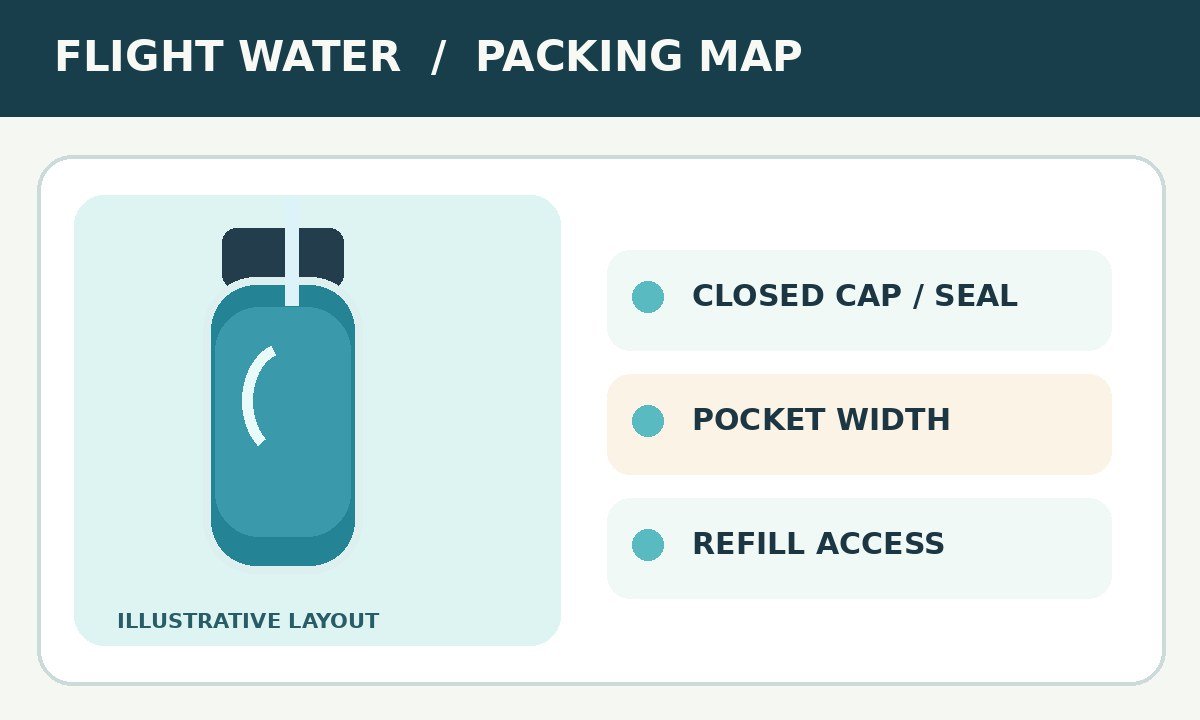
Manufacturers may describe bottles as leakproof when closed, but no label eliminates the chance of loose threads, damaged gaskets, pressure changes or accidental opening. Test the filled bottle over a sink before travel and carry it upright in a designated pocket. Do not place it in the same unprotected compartment as a passport, laptop or spare lithium battery.
For an unfamiliar straw lid, try closing it with one hand before boarding. Check whether a carrying loop, clip or backpack fabric can press against the release. A bottle that is secure in a dedicated holder may be a poor fit loose on top of an electronics pouch. If it must share a compartment, add a sensible waterproof separation layer.
Straws, wide mouths and cleaning
Straw and flip mechanisms are convenient but add channels and crevices. Clean them according to the manufacturer’s instructions, allowing all removable parts to dry thoroughly between journeys. A wide-mouth screw bottle can be simpler to scrub and refill, though it may splash more if opened abruptly on an aircraft.
Flavoured drinks, dairy drinks and sugary liquids raise the cleaning burden. Plain potable water is generally the easiest cabin choice. Inspect seals for wear or residue and follow the specific cap-care instructions: a stainless bottle body and its plastic lid may have different dishwasher guidance.
Refills, aircraft stowage and trip length
Filter bottles are not automatic purification systems
A filter bottle designed to improve taste of potable tap water is not necessarily a way to make microbiologically unsafe water safe. BRITA’s bottle literature describes taste-oriented filtration with a replaceable MicroDisc. Check exactly which substances a maker claims to reduce and whether the device is designed for drinking water that was safe to begin with.
For international travel, local drinking-water advice takes priority over a filter marketing slogan. When in doubt, use a known potable source rather than assuming a reusable bottle solves destination water safety. Filter cartridges add costs, maintenance and a further part that may be difficult to source overseas.
Bottle placement and aircraft turbulence
Keep the bottle within reach without letting it roll through the footwell. Seat-back pockets are intended for specific contents and can be narrow or unsuitable for heavy bottles. A backpack side pocket or secure under-seat holder is often safer. Avoid putting a heavy filled bottle on an edge of the tray table, particularly when turbulence could move it.
Follow crew instructions to stow loose items for take-off and landing. If the bottle does not fit securely, close it and return it to hand baggage. A dangling carabiner or oversized handle can snag seat straps and tray mechanisms. Practical cabin fit matters more than the size printed on the bottle label.
Refilling at airports without awkward detours
Before setting out, check whether your departure airport shows potable-water refill stations, then allow time to fill after security without risking your gate arrival. Some airports have filtered fountains, while others rely on taps marked as drinking water. Never fill from a sink or dispenser of uncertain potability simply because it is near the toilets.
For connections, drink or empty remaining water if the next screening checkpoint requires it. A refillable bottle reduces single-use packaging when suitable water is accessible, but it still needs a hygiene routine. Treat signage at the actual checkpoint and instructions from staff as controlling over internet checklists.
For departure-specific liquids rules, consult the UK government [11] and Heathrow’s own checkpoint guidance [12].
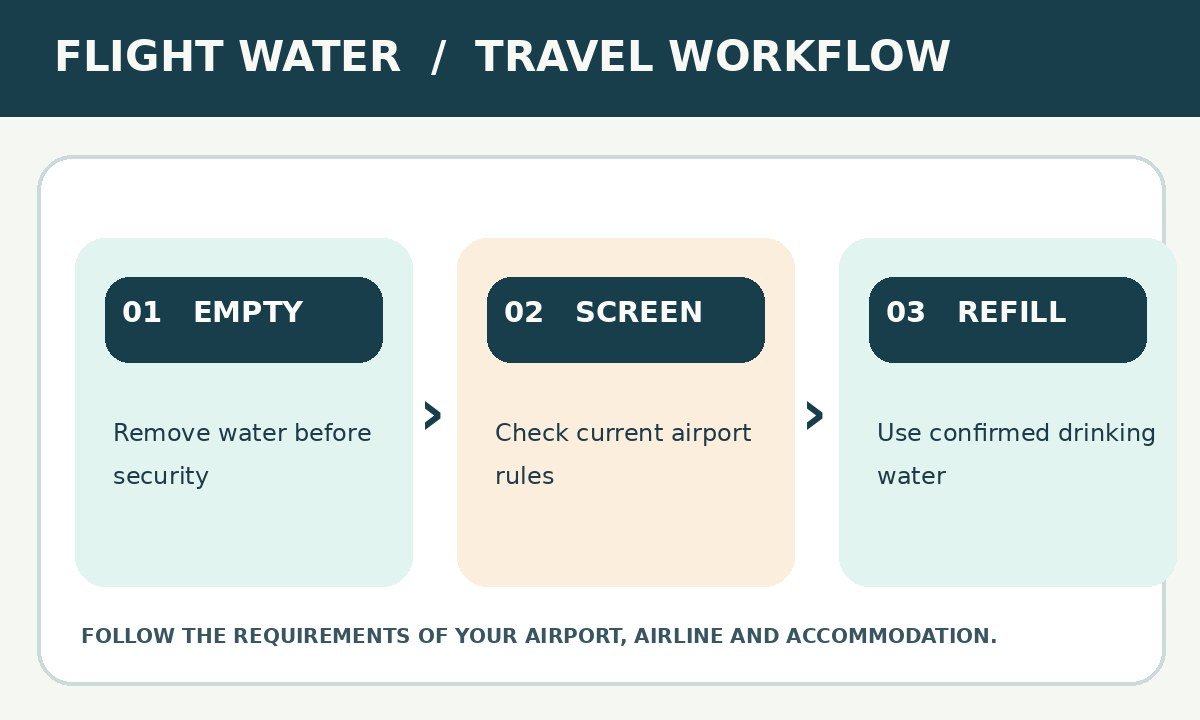
Door-to-gate screening and refill routine
The empty-bottle security routine from door to gate
Check the departure airport’s official security information before leaving home. UK airports do not all apply identical liquid-screening arrangements, and the situation can differ again at an overseas connection. The simplest plan is to arrive with the reusable water bottle completely empty, follow checkpoint staff instructions and use a designated drinking-water refill point on the secure side when one exists.
Do not assume the airport will have a convenient fountain directly beside your gate. Some terminals require a short walk; others have tap-water points near washrooms or food areas. Check signs and confirm the source is intended as potable drinking water. If there is uncertainty about safety or access, buy appropriately supplied drinking water instead of filling from a questionable tap.
At a connecting airport, you may have to pass through screening again. Be prepared to empty your bottle there even if the first departure accepted it filled. It is more useful to know the current rule for your particular journey than to repeat a universal statement that all airports allow or forbid the same liquid quantity.
Preventing leaks without making the bottle difficult to drink from
Before the trip, wash the lid and gasket according to the manufacturer’s instructions, fill with plain water and check closure over a sink. If the manufacturer claims leakproof performance when closed, test that claim conservatively for your own worn bottle. A straw lid, flip closure and screw cap need different handling, and all can fail if damaged or incompletely sealed.
Use a bag’s proper bottle pocket and keep heavy water away from a laptop sleeve. If the only available space is inside the bag, add separate protection for electronics and documents rather than trusting an untested seal. In flight, the bottle should be accessible without sitting loose on a tray table or rolling across the floor.
Refill when it is safe and convenient; do not force a filled bottle into an unsuitable seat-back pocket. Follow cabin crew directions on stowing items during take-off, landing and turbulence. A bottle that feels excellent in the hand can still be a nuisance if its handle catches another passenger’s bag or protrudes into the aisle.
Leaks, bag fit and washing on the road
A packing checklist for bottle size, weight and cleaning
Start by measuring the external bottle diameter against the backpack’s elastic or zipped pocket. Do not compare only fluid capacity, because an insulated wall or wide handle may change the actual fit. A one-litre fill weighs roughly a kilogram before adding the container; that is significant when you also have a computer and chargers.
Next decide whether insulation matters to you. A steel vacuum bottle is a reasonable comfort upgrade when you like cool water but is not the best choice if every gram counts. Aluminium and plastic options are more proportional for short trips and frequent refills, although they do not maintain temperature as well.
Finally, make sure you can clean the exact lid. Straws, valves and filters need more attention than ordinary open-mouth screw bottles. Products that include consumable filters can add expense and create sourcing problems abroad. An easily maintained bottle that fits your bag and routine is generally preferable to an impressive one you do not regularly refill.
Mistakes that make a flight bottle inconvenient
Packing for an overnight versus short flight
A short domestic flight may only justify a small empty reusable bottle that is easy to carry through town after landing. For a long-haul sector, comfort and drinking access may justify a 600–750ml insulated bottle, provided it fits the bag and can be refilled. More capacity does not guarantee that drinking water will be available at every gate or onboard at any particular time.
If travelling with children, choose a container appropriate to their ability to open and close it without spilling. Avoid describing a specialist filtered or vacuum bottle as necessary for everybody. The best travel accessory is one that is easy to manage in your ordinary routine, not one that needs repeated troubleshooting.
Common bottle-buying mistakes
The recurring mistakes are trusting the word leakproof without testing the exact lid, choosing a bottle too wide for the backpack pocket, forgetting its filled weight and arriving at security with water inside. Another is paying for insulation when the traveller really values a lighter bag and does not care if the drink becomes room temperature.
Avoid picking only by a photograph: different colour options, caps and litre sizes can change weight and product function. A linked retailer search is not proof the precise model or volume is on sale. Use the manufacturer listing as the specification reference and review current stock before buying.
Pros, cons and common trade-offs
Advantages
- Reusable bottle can be filled after security
- Different materials suit different weight needs
- Insulated options maintain drink temperature
Limitations
- Security requirements differ between airports
- A damaged lid can leak onto devices
- Insulated or filled bottles add carry weight
None of these trade-offs is automatically decisive for everyone. Start with the physical demands of your trip, identify the worst plausible failure for your bag and favour the simplest model that avoids it. A predictable routine usually delivers more value than unused premium features.
Frequently asked questions
These answers cover recurring questions that affect packing, aircraft use, compatibility and product choice. Always follow the current instructions for the exact manufacturer model and transport provider.
Can I take an empty metal water bottle through airport security?
Generally yes, subject to the departure airport’s rules and staff directions. Empty it completely before screening for the simplest approach and check connections separately, because liquid-screening rules differ.
Can I carry a filled water bottle through security in the UK?
It depends on the airport and current screening rules. Some airports permit larger liquid containers; others retain more restrictive limits. Check the official policy for each departure and transfer checkpoint, and take an empty reusable bottle as the simplest reliable plan.
Can I refill a bottle after security?
Usually where a suitable drinking-water tap or refill station is provided and local rules permit it. Check signage, ask staff if necessary and avoid questionable water sources.
What size bottle is best for a long-haul flight?
Many people find roughly 500–750ml convenient, but the useful volume depends on refill opportunities, cabin storage, bag allowance and drinking preference. A larger bottle is heavier when full.
Are stainless-steel bottles allowed on aircraft?
An ordinary empty stainless-steel reusable water bottle is usually permitted, subject to applicable airport and airline security rules. Its contents, not merely the bottle material, are usually the critical liquid-screening concern.
Which bottle cap is least likely to leak?
A properly maintained cap designed by its manufacturer to be leakproof when closed is a starting point, but every mechanism can fail. Screw caps are simple to inspect; flip and straw caps may need more cleaning and lock checks.
Will a straw bottle spill during a flight?
It can if the lid opens, the mechanism is pressurised or parts are not seated correctly. Close and secure the straw fully, keep the bottle upright and avoid storing it loose with electronics.
Is a filtering water bottle enough for unsafe drinking water abroad?
Not unless the exact filter is explicitly certified for the relevant risks and used correctly. A taste-oriented BRITA bottle is not a universal microbiological purifier. Use known potable water.
Can I put a refillable bottle in a seat-back pocket?
Only if it fits securely and the aircraft and crew allow it. A heavy bottle that protrudes or could fall is better kept closed in a suitable under-seat luggage pocket.
Should I buy an insulated bottle for a flight?
Choose one if you value cooler water and do not mind extra weight and bulk. A lightweight uninsulated bottle may be more practical when travelling with a small personal item.
Final recommendation: match the model to your trip
What changes the decision
Choose Owala FreeSip 24oz when dual sipping methods suit how you drink in a seat, Hydro Flask Standard Mouth when you prefer a simpler insulated screw cap, or Nalgene Sustain when low empty weight and ample capacity outweigh temperature control. SIGG suits those wanting an especially light metal bottle; Klean Kanteen and Ocean Bottle Go are more specifically about a particular straw arrangement.
Practical planning example
Any bottle is secondary to the security and hygiene plan: carry it empty to screening, refill with known potable water when allowed, and keep it shut near electronics. If a named model is unavailable, compare its actual features before choosing a genuine alternative. The right size is the one you will clean, refill, close and carry comfortably.
Sources and fact-checking
References [1]–[10] are official pages for the precise named products. References [11]–[13] support the relevant regulatory, travel, shopping or general context. Manufacturer claims are not presented as independent tests; availability and specifications may change. Checked for this editorial review: 13 October 2026.
- Owala FreeSip 24oz Stainless Steel — official product information — manufacturer’s published design and specification; checked 13 October 2026.
- Hydro Flask 21oz Standard Mouth Bottle — official product information — manufacturer’s published design and specification; checked 13 October 2026.
- Klean Kanteen Insulated TKWide 20oz Twist Cap — official product information — manufacturer’s published design and specification; checked 13 October 2026.
- Nalgene 1L Wide Mouth Sustain — official product information — manufacturer’s published design and specification; checked 13 October 2026.
- SIGG Traveller 0.6L Aluminium Water Bottle — official product information — manufacturer’s published design and specification; checked 13 October 2026.
- BRITA Active Water Filter Bottle 0.6L — official product information — manufacturer’s published design and specification; checked 13 October 2026.
- Ocean Bottle Go 500ml — official product information — manufacturer’s published design and specification; checked 13 October 2026.
- CamelBak Chute Mag Insulated Stainless Steel 25oz — official product information — manufacturer’s published design and specification; checked 13 October 2026.
- CamelBak Chute Mag Tritan Renew 25oz — official product information — manufacturer’s published design and specification; checked 13 October 2026.
- Owala FreeSip Sway 18oz — official product information — manufacturer’s published design and specification; checked 13 October 2026.
- UK Government: liquids in hand luggage — www.gov.uk.
- Heathrow Airport: hand baggage and liquids guidance — www.heathrow.com.
- UK Civil Aviation Authority: permitted items and baggage — www.caa.co.uk.
Illustrations in this article were created for Taylor’s Trailblazing Travel Gear. Third-party photographs, where used, are credited beside the image or in the source list.
Back to this guide ↑