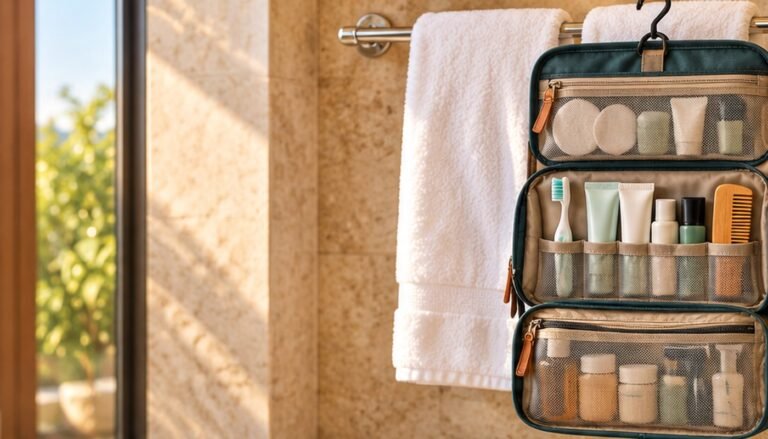
Best Airplane Seat Organisers
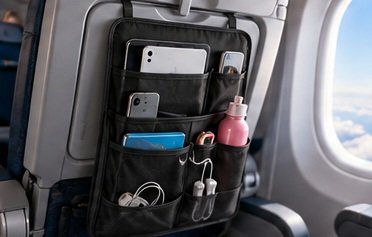
Best Airplane Seat Organisers
Keep a few essentials within reach without turning the seat in front into an overloaded storage unit.
The best airplane seat organisers are not necessarily the ones with the most pockets. They are the ones you can use in the seat you actually receive, load without crowding your knees and put away promptly when required. An elaborate organiser is a poor purchase when it depends on a tray table or pocket that your aircraft does not have.
There are several different products hiding behind the same search term. Some slide over a tray table, some use a flap in an existing seat pocket, others are compact bags intended to sit inside that pocket. A normal zipped pouch is another option: it does not hang from the seat at all, but may be the most practical solution when attachments are unsuitable.
This guide compares those designs using current product information checked on 10 October 2026. It does not claim hands-on installation tests or universal airline permission. You will find a shortlist, a seat-fit checklist and realistic loading plans, followed by the details that determine whether an organiser reduces clutter or simply moves it into your lap.
Airplane Pockets
A washable cover-and-pocket design, conditional on the actual tray and crew instructions.
SO~MINE Commuter
An organiser format to compare when an appropriate seat-back pocket is available.
A compact zipped pouch
Keeps small items together without relying on seat fittings or a hanging mechanism.
No universal approval
A manufacturer’s fit claim is not permission from your operating airline.
Best airplane seat organisers: compare the mechanism first
The mechanism matters because it determines what has to be present on the aircraft. A tray sleeve cannot be assessed as though it were a free-standing pouch. The table separates genuine seat-organiser designs from the no-attachment alternative, and it does not treat any of them as universally accepted cabin equipment. [1] [2] [3] [4] [5] [6]
| Product | How it is intended to work | Useful reason to consider it | Main limitation |
|---|---|---|---|
| Airplane Pockets | Sleeve over a tray table with storage pockets | Combines a fabric tray cover and four pockets Check Airplane Pockets | Needs a compatible tray; no blanket permission claim |
| SO~MINE Commuter Essential | Flap-style seat-pocket organiser | Flat organiser layout for frequently used items Check SO~MINE | Check the exact version, pocket fit and permitted use |
| Genius Pack High Altitude Flight Bag | Bag with a wrap-around tray attachment design | A larger bag-style approach | More bulk; UK purchase and aircraft fit require checking |
| Airpocket original | Neoprene bag intended for a seat-back pocket | Protective bag with internal divisions | Not every seat pocket can accept it |
| BAGSMART Bubble | Ordinary zipped pouch; not a seat attachment | A small no-hanging fallback Check BAGSMART Bubble | No tablet capacity or seat mounting claim |
How the options were assessed
The shortlist starts with four practical questions
First, what supports the organiser: a tray, an existing pocket or nothing beyond your own bag? Second, what do you need to reach during the flight? Third, what happens when the seat in front reclines or the tray is used? Finally, how quickly can the organiser be removed and stowed? Those questions are more useful than counting every slot in a marketing photograph.
The list includes a small zipped pouch deliberately. It is labelled as an alternative, not misrepresented as a hanging seat organiser. That comparison helps a reader decide whether they need a specialised attachment at all. A pouch that remains in the personal item may solve the access problem with less dependence on the aircraft layout.
What has and has not been verified
Product identity and published features were checked against the manufacturer where available. SO~MINE is described from the identified UK retail listing rather than an independently verified manufacturer specification sheet. Precise dimensions are not supplied for that product here because the current listing evidence is not strong enough to support a reliable like-for-like measurement.
No organiser has been physically fitted to an aircraft for this article. We have not measured weight limits for seat pockets, tested tray latches or obtained blanket airline approval. Where a product page makes a broad fit claim, the article keeps that claim separate from the decision the traveller must make on board. These are buying judgements, not aircraft engineering assessments.
Why international options remain qualified
Genius Pack and Airpocket illustrate bag-style approaches that differ from a simple tray sleeve. They are useful comparisons, but a UK buyer must confirm delivery, returns and the final total rather than assume the terms of an Amazon UK purchase. A product existing on a manufacturer’s site is not proof of local stock.
The purchase links let you inspect a current listing; they do not determine the order of this comparison. The larger bags remain in the shortlist because their design differences matter. Read their manufacturer information alongside the smaller options and decide whether the additional capacity is genuinely useful for your own journey.
Which design belongs in your cabin kit?
Airplane Pockets: a tray cover with built-in storage
Airplane Pockets describes a stretch polyester sleeve that goes over a tray table, with four expandable pockets and machine-washable construction. This makes it a combined surface cover and organiser rather than a separate bag with rigid compartments. Its own product page was showing sold out when reviewed, although a UK marketplace listing remained identifiable. [1]
Choose this style when you specifically want the cover-and-pockets combination and have a suitable tray arrangement. It may be more appealing than putting every small object into the aircraft’s existing pocket. However, a fabric cover is not proof of disinfection or protection from illness, and stretchy fabric does not establish compatibility with every latch or table shape.
The key check is what happens when you close and latch the tray, use it for a meal or need to stow everything. Do not force a latch through fabric or leave the arrangement fitted when the crew requires removal. A good plan also limits the contents: glasses in a case, a small packet of tissues and an earplug case make more sense than treating the pockets as a substitute for all cabin baggage.
SO~MINE Commuter Essential: an organiser with a supporting flap
The checked SO~MINE UK listing identifies the Commuter Essential travel organiser in black, medium size, with a fold-over organiser format. Its appeal is access to separate small-item spaces rather than one deep shared seat pocket. Check the current photographs and product description because similarly named listings can refer to different versions. [2]
This style is worth considering when the existing aircraft pocket can accept the supporting part without crowding or distortion. Yet that is a conditional fit question, not an invitation to push the flap into a tight mesh pocket or wedge it behind a safety card. The usable arrangement must leave aircraft information visible and easy to retrieve.
For a traveller with several small accessories, a flatter layout can make it easier to notice what is missing. The trade-off is that the layout still takes up knee space when filled. Evaluate the thickness of your actual contents, especially glasses cases and charging plugs, rather than judging the empty organiser alone. Pack it so that removal does not scatter those contents into the footwell.
Genius Pack High Altitude Flight Bag: the larger bag approach
Genius Pack publishes dimensions of 12 × 2 × 11 inches and a 0.9 lb weight for the High Altitude Flight Bag. Its features include a padded tablet section, designated small-item spaces, a top handle, a removable shoulder strap and a design intended to wrap around an aircraft tray. [3]
This makes sense to investigate when you want a small bag for the terminal as well as an organiser during the flight. However, that additional structure and capacity can be unnecessary for someone carrying only earphones and glasses. The bag format should replace another item in your packing plan, not automatically become an extra piece beyond the permitted allowance.
Its use on the aircraft still depends on the seat and crew instructions. A wrap-around design is not evidence that it should remain attached during every flight phase. UK buyers should also check the final shipping and return arrangements on the manufacturer’s site. Treat it as a distinct design option, not as a proven universal fit or a locally stocked recommendation.
Airpocket original: a protective bag intended for the pocket
Airpocket describes a neoprene bag with flexible internal pockets, designed to move between your luggage and a suitable seat-back pocket. Its website also describes slipping it over an extended luggage handle. Confirm the current dimensions and weight with the seller before buying; a comparable specification was not established from the checked Australian page. Rather than hanging from a tray cover, the concept is a bag that can sit within a suitable seat-back pocket. [4]
The attraction is moving one contained set of belongings between terminal and seat. Nevertheless, it is a bag-style organiser rather than a thin sleeve for a few loose small accessories. A pocket that looks adequate from the aisle may become tight when the bag contains a tablet, book and other items.
Do not press a loaded Airpocket into a pocket that was not designed to take it, and do not assume its soft construction removes that limitation. Keep a fallback location within your allowed baggage. The checked red product was offered for back-order, so a UK buyer should confirm a delivery estimate and return terms before choosing it over a simpler locally available pouch.
BAGSMART Bubble: the no-attachment alternative
BAGSMART’s Bubble Electronic Organizer is a compact zipped pouch, not a hanging seat organiser. The UK page lists 21 × 13.5 × 5.8 cm, 100 g, polyester construction and internal mesh storage. It is a small-accessory organiser; it should not be described as a laptop or normal tablet bag despite broad marketing language elsewhere on the page. [5]
The useful role here is a fallback when you do not know the aircraft layout or do not want to attach anything. Keep it in an accessible part of your permitted personal item, remove a needed object and return the pouch to its place. That can reduce the number of belongings left on a tray or inside the seat pocket.
Choose this approach when you carry a modest kit and value predictable containment more than a display of individual pockets. It gives up the hands-free hanging function, but also avoids depending on a compatible flap or tray. Check the selected colour’s availability and do not interpret a visible product page as proof that every variant is ready to ship.
Airline permission and stowage come first
A fit claim is not an airline rule
Manufacturers can describe how their product is intended to attach. They do not decide what your operating airline permits in a particular aircraft or seat. The FAA tells passengers to check their carrier’s baggage guidelines and notes that airline rules can be stricter than general regulations. That is the appropriate starting point for a specialised organiser too. [6]
Before travel, look for guidance from the airline you will actually fly, including any codeshare operating carrier. A social-media demonstration on another aircraft is not permission for yours. When a product depends on aircraft fittings and the published guidance does not answer the question, ask the airline rather than treating silence as approval.
Be ready to remove it, not to argue about the listing
On board, follow the crew’s instructions. Your organiser should be easy to clear and stow without leaving loose pieces behind. If it interferes with the tray, access, safety information or another traveller, stop using that arrangement. Having purchased a product specifically labelled for airplanes does not change that decision.
US regulation 14 CFR 121.589 requires compliant baggage stowage for take-off and landing and compliance with relevant crew instructions for the operations it covers. This is US regulatory context, not a claim that every country uses the same wording. The practical planning rule for this guide is conservative: do not assume your organiser is an approved stowage location. [7]
Pack a fallback into the allowed personal item. An organiser that cannot be stowed anywhere else encourages a poor decision at the moment it needs removing. A useful purchase should make following instructions easier, not become a reason to resist them.
Safety information and controls must remain usable
Do not cover, remove or relocate aircraft safety information to make an organiser fit. Likewise, keep the tray latch and any seat controls free of fabric, straps and small objects. If you cannot see how the arrangement works without interfering, choose the pouch fallback.
Avoid improvising with hooks, adhesive clips or straps around unfamiliar components. The fact that an attachment holds while the aircraft is stationary tells you nothing about its suitability under flight conditions. This guide does not recommend modifying aircraft equipment or assigning a safe load to a fitting that has not been assessed for that purpose.
Check the actual seat, not a generic cabin photograph
Identify what is in front of you
A conventional seat-back tray, an armrest tray and a bulkhead position offer different arrangements. A product that needs a table in the seat ahead cannot be assessed against an image of a fold-out armrest table. Start by identifying the mechanism your organiser relies on, then check whether that mechanism exists in your seat.
An airline can also change aircraft. This is another reason not to build your entire packing system around a single attachment point. A bag-contained fallback preserves the value of the organiser even when the seat layout differs from the one you expected.
Consider the full movement of the tray
A tray moves between closed, opening and working positions. An organiser must not prevent it reaching the required position or latching correctly. Consider what happens to the pockets and their contents as the table moves, not just how the arrangement looks in one static photograph.
Never force the mechanism because the fabric appears thin. If the tray does not move and latch normally with the crew’s permitted setup, remove the product. Similarly, do not create a meal arrangement in which a hanging cable or pocket pulls across food and drinks. Simpler access may be more useful than a permanent display of accessories.
Allow for your knees and the seat ahead
An empty organiser can look almost flat. Fill it with a hard glasses case, power plug and book, and the effective depth changes. In a seated trial at home, arrange the loaded item in front of your knees without attaching it to furniture unsafely. This does not reproduce an aircraft, but it shows whether your chosen contents make the organiser much thicker than expected.
Think about a reclined seat as well as an upright one. Anything you need to remove with two hands may become inconvenient in restricted space. The best response is usually a lighter load and a simpler layout, not forcing more belongings into every available pocket.
Load it for access, not for maximum capacity
Start with the objects you reach for repeatedly
Write down what you actually used on your last comparable journey. For many travellers, a compact set might be glasses in a protective case, tissues, earplugs, a pen and a small snack. That is an illustrative packing idea, not a requirement or an approved weight limit. Remove objects that are only there because an empty pocket invited you to fill it.
Put frequently handled items where you can see and retrieve them without disturbing everything else. Reserve zipped storage for small pieces that could slip out. If the organiser has only open pockets, think carefully about what will happen when you remove it or stand up.
Do not use spare capacity as a reason to add heavy objects
A pocket large enough to accept a full bottle or large device has not necessarily been assessed to carry it on that aircraft. This guide does not provide a numerical seat-pocket load limit because that would require information about the actual installation. Use appropriate baggage stowage for heavier belongings and follow crew direction.
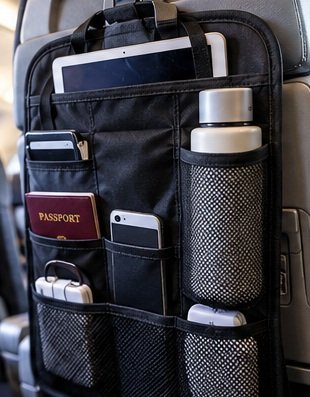
Product photographs often show many items together to demonstrate available spaces. Treat that as merchandising, not a suggested full-flight load. Your own loading plan should make the organiser easier to remove, not turn it into the densest bag on the aircraft.
Keep high-consequence items in deliberate locations
A passport, spare payment card and essential medicine should not disappear into an open pocket merely because it is convenient. Decide where each important item belongs and whether you need to access it during the flight. In many cases, a secured pocket in the personal item is the more controlled location.
Do not put every backup in the same removable organiser. The related guide to travel document organisers explains the single-point-of-failure issue in more detail. Here the basic decision is straightforward: convenience at the seat should not mean that one forgotten pouch takes every way of identifying yourself or paying for the onward journey.
Battery access needs its own check
Power banks and spare lithium batteries have cabin-carriage requirements, and airlines can impose additional limits on use and storage. Keep the actual battery rules separate from a bag maker’s demonstration of charging pockets. A pass-through hole or mesh compartment is not permission to charge a device on board. [8]
Choose a packing arrangement that allows you to follow the operating airline’s instructions without dismantling the whole organiser. Do not bury a battery underneath several items simply because that pocket was the neatest fit. When rules require visibility or prompt access, the layout needs to support that.
Three realistic seat-access setups
A small reading and resting kit
This setup is for someone who wants a few small things close by and otherwise leaves the main bag stowed. Put glasses in their case, a pen, tissues and an earplug case in distinct places. Keep the reading device protected and use it only as allowed, rather than assuming an organiser needs to hold it throughout the entire flight.
Airplane Pockets is worth comparing when you specifically prefer the tray-cover design. The buying decision should still be conditional on seat fit and permission. If the layout offers no clear advantage over a small pouch, there is little reason to add a specialised attachment.
A parent managing small shared items
The useful goal is reducing the number of objects that move between hands, not displaying every toy at once. Set out only the next activity and keep other supplies contained. A shared item should have one obvious return location so the second adult can find it without unpacking the whole bag.
A fold-over organiser such as SO~MINE may help someone who values separate visible spaces. However, snacks, wipes and small toys can quickly make any organiser thick and awkward. Keep drinks secured appropriately and make the clear-away routine something one adult can perform while attending to the child.
A traveller who does not want seat attachments
Pack a small zipped pouch near the opening of your permitted personal item. Remove the one item you need and return the pouch, rather than leaving an open organiser across your lap. This keeps the system usable across unfamiliar cabins, though it may require a little more reaching than a permitted hanging design.
BAGSMART Bubble is the compact alternative here. Do not overfill it merely to imitate the capacity of a larger bag-style organiser. Its role is a small, contained set of accessories. A separate document pocket and a protected device remain useful because the pouch does not have to solve every storage problem.
A boarding-to-arrival routine that avoids clutter
Prepare the kit before boarding begins
Put the organiser or pouch where it can be removed without opening the whole cabin bag. Check that anything you may need for the flight is in the correct place, then close the bag. This reduces the temptation to block the aisle while moving a dozen objects after reaching your seat.
Keep the items needed for boarding separate from those needed for the flight. Once you have finished with a passport or boarding pass, return it to a secure place rather than automatically transferring it into a seat organiser. The organiser’s job is convenient access, not replacing your document system.
Wait until the arrangement is permitted
Follow the crew’s instructions about cabin preparation and stowage. Do not assume that boarding is the right moment to fit a sleeve or hang a bag. When use is permitted, assess the actual tray and pocket without forcing anything. A quick decision not to use the attachment is preferable to a complicated workaround.
Keep the fallback pouch or bag within the permitted stowage arrangement. You should not need to empty another passenger’s space or move unrelated baggage to put your organiser away. Your accessories must remain manageable within your own allowance.
Clear the working surface for meals
Before a meal or hot drink arrives, put loose small items back into their designated places. Check that cables do not pass across the tray or pull on pockets when you move a device. Leave enough clear surface for the service rather than balancing items on top of a full organiser.
A setup that requires constant rearrangement may be telling you that you packed too much. On the next flight, remove the least-used items from the immediate-access kit. The organiser should simplify the sequence of sitting, eating, reading and resting, not interrupt each one.
Use a fixed departure check
Before leaving the seat, account for the objects that were out: phone, glasses, reading device, earplugs, case and any documents you handled. Then check the organiser itself and the aircraft pocket. A light-coloured lining or a simple consistent layout can help you see a missing object, but neither replaces an actual check.
Fold or close the organiser before standing, tuck away straps and return it to the appropriate bag. In an emergency evacuation, leave all baggage and accessories behind and follow the crew. Saving an organiser is never the priority.
Washable does not mean germ-proof
Understand what a removable cover can and cannot do
A washable fabric layer provides a surface you can clean according to its instructions. It does not establish that the underlying tray has been disinfected, that every object placed on it is clean or that using the cover prevents illness. Avoid paying extra on the assumption that a general cleanliness claim is a medical guarantee.
Treat the side that touches aircraft fittings separately when you fold it. Putting that surface directly against the inside of your clean pouch defeats the organisational benefit. A consistent folding method and suitable temporary bag can help keep used and clean surfaces apart without turning the journey into a complicated cleaning ritual.
Follow the actual material instructions
Airplane Pockets states that its polyester product is machine washable. Other organisers use padding, neoprene, coatings, stiffening or mixed materials, so that guidance should not be copied across the shortlist. Check the instructions for both the organiser and any removable components before washing. [1] [3] [4] [5]
Empty every compartment first. A forgotten pen, tissue or cable is a common practical reason for a simple wash to become a nuisance. Let the item dry as directed before repacking it, paying attention to padded seams or layered pockets where moisture may remain.
Check wear where the item folds and hangs
Look at the parts that support the load: stitching, flap edges, stretch pockets and carrying handles. A damaged organiser should not be given a heavier load to compensate for a loose compartment. If a repair is needed, follow the maker’s guidance or replace the item appropriately.
Also check whether the previous packing arrangement caused a hard object to rub through the lining. Moving a charger to a different pocket or adding an appropriate protective case can be more useful than buying an entirely new organiser. Use the experience of the trip to simplify the next layout.
What to check on the listing before paying
Confirm it is intended for aircraft rather than cars
Many search results mix car-seat organisers with flight accessories. Long straps intended for a car headrest, large bottle holders or broad kicking mats do not establish suitability for an aircraft seat. Read the product’s intended mechanism and avoid substituting a different design merely because it has more storage.
Check the model name, colour, size and included parts on the actual offer. A marketplace page can group several versions together. Reviews or photographs for another variation should not be treated as evidence that the selected one will work in your seat.
Check the footprint when loaded
Published dimensions describe an object under some stated or unstated condition. Ask whether the figure refers to open, folded, packed or empty size. With a soft organiser, your glasses case or device may determine the final depth more than the fabric itself.
For larger bags, compare their dimensions with the space inside your own personal item. You need a plausible place to stow the product when attachment is not allowed. Do not depend on a cabin pocket accepting a loaded bag simply because the manufacturer markets it for that purpose.
Make returns and delivery part of the decision
An uncertain fit makes return terms particularly relevant. Read the conditions before opening packaging or using the product. International purchases can involve a less convenient return journey, so they deserve more checking than a vague promise that the bag is suitable for flying.
Stock information can also vary by colour and seller. This guide confirms identifiable products, not a guaranteed dispatch date. Verify the actual delivery estimate against your departure and leave time for a home packing rehearsal instead of ordering a complex organiser for arrival on the morning you leave.
Pros and cons of using a seat organiser
Common seat-organiser mistakes
Buying on pocket count alone
More pockets create more possible locations for a small item to disappear. Decide what needs immediate access and choose a layout around that short list. If most compartments are empty or filled only with speculative extras, a smaller pouch may be the more useful purchase.
Treating a promotional loading photo as an approved load
A photograph demonstrates storage shapes, not the engineering limits of an aircraft seat pocket or tray. Do not copy a display containing a large bottle, several devices and a heavy book without considering where those items should actually be stowed. No universal safe load is provided by this guide.
Forgetting the fallback location
The organiser needs to fit inside your allowed baggage when it cannot be used. Test that with the bag otherwise packed. If you must carry the organiser loose because it has no place to go, you have not yet solved the storage problem; you have added another one.
Leaving valuables behind because the layout looks tidy
A tidy pocket can still contain a forgotten passport or phone. Use a fixed final check rather than trusting the appearance of the seat. Count the essential items you handled, close the organiser and check the original aircraft pocket before leaving.
Frequently asked questions
Are airplane seat organisers allowed on every airline?
No universal permission is claimed here. The operating airline, aircraft arrangement and crew instructions determine whether a particular product can be used and when it must be stowed. Ask about the actual design rather than assuming that an airplane-themed listing settles the question. Always keep room to put the organiser back inside your permitted baggage.
Which style works without a seat-back tray table?
A normal zipped pouch inside your personal item does not require a tray attachment. A pocket-insert design still depends on having a suitable seat pocket, so it is not automatically the answer for a bulkhead or unusual seat. Choose the no-attachment approach when you want a system that does not rely on a particular fitting.
Can I keep my laptop in a hanging organiser?
Do not assume that a pocket’s apparent capacity establishes a safe or permitted load. This guide recommends light immediate-access items and appropriate baggage stowage for heavier belongings. Follow the airline and crew instructions for devices, and assess the exact product dimensions. The small BAGSMART alternative is not a laptop pouch.
Does a tray cover make the aircraft tray hygienic?
A removable washable cover gives you a fabric surface you can care for, but it is not proof of disinfection or protection from illness. Keep used contact surfaces separate when folding and follow the product’s washing instructions. A cleanliness claim should not be interpreted as a medical guarantee.
Is a larger flight bag better than a thin organiser?
Only when the additional capacity solves a real need and you can stow the bag within your allowance. A larger format can be useful between terminal and seat but may consume knee space or crowd a pocket when loaded. Compare the weight and dimensions with the small set of items you actually need during the flight.
Should I keep my passport in the seat organiser?
Decide deliberately rather than using the most convenient open slot. Once boarding is complete, a secured pocket within your personal item may be a more controlled location. Avoid putting every identity, payment and backup item in one removable organiser. Whatever system you use, include documents in the final seat-area check.
Which option is the least dependent on the aircraft layout?
The compact zipped pouch is the least dependent because it stays within your own permitted personal item and does not attach to aircraft equipment. It gives up the hanging display of pockets, but that trade-off may be worthwhile across different aircraft. Choose a pouch small enough to retrieve and stow without disturbing the whole bag.
Are the recommendations based on fitting the products to real aircraft?
No. They are research-led comparisons of product information and practical design trade-offs. No physical fit trials or aircraft-load tests are claimed. The article explicitly keeps manufacturer claims separate from airline permission and gives a no-attachment fallback for situations where compatibility or acceptance is uncertain.
Choose the simplest setup that stays useful when plans change
For a tray-cover design, Airplane Pockets is the focused comparison. For a flatter organiser supported by a suitable pocket, consider SO~MINE. The larger Genius Pack and Airpocket formats are worth investigating only when their extra bag function, dimensions and purchase arrangements fit your needs. None should be treated as universally compatible or automatically approved.
For many travellers, the better answer is a small zipped pouch with a fixed place in the personal item. Start with the belongings you need, decide whether hanging them genuinely helps and preserve an easy stowage plan. A seat organiser earns its place when it reduces handling and forgotten objects, not when it allows you to hang the contents of an entire bag in front of your knees.
Sources and fact-checking notes
The product and stowage sources below were reviewed on 10 October 2026. SO~MINE information comes from the identified retail listing; the other product descriptions use manufacturer material. No physical aircraft-fit test, universal approval or numerical seat-pocket load limit is claimed.
- Airplane Pockets: tray-cover construction and four-pocket design
- SO~MINE Commuter Essential: the checked UK listing
- Genius Pack High Altitude Flight Bag: dimensions and features
- Airpocket: neoprene bag design and current ordering information
- BAGSMART Bubble Electronic Organizer: UK product specifications
- FAA carry-on baggage guidance: airline rules, straps and stowage
- US carry-on baggage regulation, 14 CFR 121.589
- FAA PackSafe: batteries, cabin carriage and safe packing
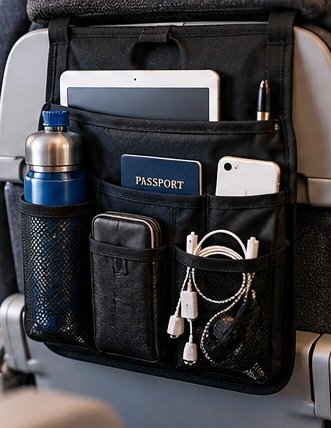
Product photographs have not been presented as test evidence. The generated illustrations show generic travel-gear concepts; they do not establish a named product’s exact appearance, performance or approved use. Retail stock and seller terms should be checked when ordering.
Illustrations in this article were created for Taylor’s Trailblazing Travel Gear. Third-party photographs, where used, are credited beside the image or in the source list.