Best Two-Wheel Suitcases for Uneven Ground
Choose for the roughest part of the journey, not just the smooth airport floor.
AI-generated conceptual scene created for this guide. It is not a photograph of a recommended model or evidence of product testing.
The best two-wheel suitcases for uneven ground are the ones you can still manage when rolling stops being convenient. A pair of fixed wheels can be a sensible starting point for broken paving and station approaches, but it cannot remove the need to lift a case over steps, deep gaps or loose gravel. The handle, packing weight and shape of the bag matter alongside the wheels.
This guide separates compact wheeled cases from much larger checked duffles. They solve different problems, so a 122-litre bag does not beat a small case simply because it carries more. You will also find a true two-wheel business-case alternative, plus the checks that help distinguish a useful rough-pavement bag from one that merely looks rugged.
Our recommendations are research-led judgements, not the results of a rolling obstacle course or long-term ownership. Published wheel diameters and ground-clearance measurements were not consistently available, so we have not invented terrain scores. Instead, the shortlist connects documented construction and size to a specific packing and carrying job.
Some links may earn this website a commission when you buy, at no extra cost to you. Recommendations remain based on the suitability and limitations explained in the guide.
Tranverz S
A relatively compact, split-opening wheeled case. Check the selected version and airline depth.
Prodiver 55 backpack
Two wheels plus backpack straps, but a 25cm body depth needs the right allowance.
Prodiver 79
A 122L wheeled duffle for bulky packing, not a cabin-bag substitute.
Lift it fully packed
A case that rolls well can still be the wrong choice when the route includes steps.
Best two-wheel suitcases: the shortlist and its limits
Start with the amount you actually need to carry
A compact bag is usually the more manageable choice for a short trip, even when a larger model has more substantial-looking wheels. However, a traveller moving bulky clothing by car and checking a bag for the flight has a different brief. The table therefore identifies a role for each design rather than pretending that one bag wins for every journey.
The selection includes soft-sided upright luggage and wheeled duffles. That distinction matters: a flexible duffle may accommodate awkward items, while a more structured case can make clothing easier to arrange. Neither construction is automatically better on an uneven pavement. The loaded bag still needs to remain clear of the ground when tilted and turn without repeatedly catching your heels.
Height x width x depth, in centimetres, unless stated otherwise. Published figures reviewed 10 October 2026; a listed size is not a packed-fit guarantee.
| Model | External size / cm | Weight / capacity | Best use / key limit | Details |
|---|---|---|---|---|
| Eastpak Tranverz S [1] | 51 x 32.5 x 23 | 2.41kg manufacturer 42L | Compact soft-sided case Not a free underseat bag; packed depth needs checking | Manufacturer details |
| Samsonite Prodiver 55cm wheeled backpack [2] [3] | 55 x 40 x 25 | 2.8kg 51L | Hybrid for occasional carrying 25cm depth exceeds a 20cm allowance | Check model |
| Samsonite Prodiver 79cm 2-wheel duffle [4] [5] | 79 x 44 x 31 | 3.4kg manufacturer 122L | Bulky checked luggage Large load; retailer gives a different empty weight | Check model |
| Briggs & Riley Baseline Large 2-Wheel Duffle [6] [7] | 74 x 46 x 41.9 | About 5.4kg 124L | Structured checked packing Heavy before clothes; check total-size rules | Check model |
| Eagle Creek No Matter What Rolling Duffel 130L [8] [9] | About 91 x 39 x 38 | 1.35kg manufacturer 130L name; 132L specification | Bulky, low-density kit Flexible body and webbing pull handle; confirm exact variant | Check model |
What earns a place here
We looked for an identifiable two-wheel model, accessible manufacturer or retailer information, a useful carrying arrangement and a clear reason to choose it. We then checked the limitations: size, empty mass, opening style and whether the manufacturer description was being confused with another version. The recommendations are not ranked by commission, customer-star totals or unsupported claims of being indestructible.
A useful illustration is Samsonite’s naming. Prodiver is the current name for the range formerly called Ecodiver, but the range contains both two-wheel and spinner designs. The 140882 wheeled backpack and the 140884 large duffle are two-wheel products; the family name alone does not establish the wheel layout. [2] [4]
Eastpak Tranverz S: the compact starting point
Why the format suits modest packing
The Tranverz S is a conventional compact choice within this selection: a soft-sided wheeled case with a split main opening, compression straps and a telescopic handle. Eastpak lists the black model at 51 x 32.5 x 23cm, 42 litres and 2.41kg. The page header rounds the width to 32cm; we use the larger measurement from its detailed description. Check the chosen colour and version before relying on those figures, particularly when a retailer uses different measurements. [1]
Its appeal is not that 42 litres guarantees a particular number of nights. Rather, the relatively narrow body gives you a sensible starting point for a compact wardrobe without moving immediately into a large checked duffle. For example, a traveller carrying casual clothes and one pair of shoes has different needs from someone packing formalwear, bulky winter layers and a second set of footwear.
Because it opens into two sections, think about where it will be unpacked. A bed or clear floor works differently from a narrow luggage stand. Keep the items needed during a transfer near the accessible opening, rather than burying them in the section that requires the whole bag to lie flat. That small packing decision can matter more than an additional pocket.
The checks that could rule it out
The published 23cm depth exceeds a 20cm allowance. Do not turn a soft side into a promise that the complete bag will compress to any desired size; wheels, internal structure and densely packed contents still impose limits. Likewise, the Tranverz S is much larger than the free small-bag allowances discussed later. It is not an automatic underseat option. [1] [11]
Before buying, try the handle at a natural walking pace with a realistic load. A shorter case can work well for one person yet feel too close to another person’s heels. Also check how easily you can use its fixed carrying handle with the telescopic handle retracted. Rough paving frequently turns a rolling journey into a sequence of short carries.
Samsonite Prodiver 55cm wheeled backpack: carry the awkward sections
Two carrying methods, with a size trade-off
The Prodiver 55cm wheeled backpack, model 140882, combines two wheels with backpack straps and a wheel cover. Samsonite lists 55 x 40 x 25cm, 51 litres and 2.8kg. The nylon-and-polyester design also has a front compartment and several grab handles. Those are documented features, not evidence that it will feel comfortable on every back. [2]
This is the shortlist’s clearest option for someone who expects short sections where pulling is inconvenient. Imagine a smooth terminal followed by an accommodation entrance with steps. The backpack arrangement provides another way to move the bag, although it should be tried with the intended load rather than judged from an empty showroom sample.
The wheels and frame do not disappear when the shoulder straps are deployed. Consequently, do not expect the same carrying experience as a purpose-built backpack of similar capacity. Check where the wheel housing sits, whether the back length suits you and whether the straps can be stowed neatly before rolling. A convertible design is useful only when both modes work for your actual journey.
Why depth is the deciding measurement
At 25cm deep, this model needs a suitable cabin allowance. It exceeds Ryanair’s 20cm larger-cabin-bag depth, even though it is marketed as cabin-sized. By contrast, a bag within easyJet’s larger-bag dimensions may be suitable only when that larger bag is included or purchased. A product label cannot add an allowance to your booking. [2] [11] [12]
Use this option when its hybrid function solves a real carrying problem, rather than simply because it has more features. For a trip with almost no stairs, a simpler case may be enough. For repeated long walks with the bag on your back, a fitted travel backpack deserves a separate comparison before you buy.
Check the exact model, selected size, current price and retailer terms before ordering.
Samsonite Prodiver 79cm: a large checked-bag option
Capacity for bulky items, not permission to overpack
The 79cm Prodiver wheeled duffle is a very different proposition from the compact options. Its published dimensions are 79 x 44 x 31cm and its volume is 122 litres. Samsonite specifies two wheels, several grab handles and a double-tube pull handle. The manufacturer lists 3.4kg, while the UK retailer listing reviewed here gives 3.2kg; confirm the supplied version rather than treating either figure as universal. [4] [5]
The useful role is bulky checked packing, especially where an upright pull handle is preferable to carrying a large holdall. However, capacity and carrying weight are separate limits. A bag can be only partly filled yet already reach the ticket’s weight allowance when the contents include books, equipment or several pairs of shoes.
A long soft-sided body also needs deliberate packing. Put dense items close to the wheeled end and keep the two sides balanced, then see whether the bag remains stable when parked. Clothing can fill spaces around awkward items, but it should not be used to conceal a load that is difficult to lift or control.
Choose it for the whole route
A large wheeled duffle may be reasonable when most movement is between a car, check-in and a hotel entrance. The same bag becomes less attractive when the plan includes a walk-up room, small transport connections or repeated luggage storage. Therefore, judge the largest unavoidable lift before being persuaded by the generous main compartment.
It is not cabin luggage. Check both the checked-bag weight allowance and any total-size limit, including wheels and handles. Its soft construction does not remove those limits, and compressing the sides does not necessarily reduce the rigid dimensions. Leave spare packing room rather than treating every available litre as something that must be filled.
Check the exact model, selected size, current price and retailer terms before ordering.
Briggs & Riley Baseline Large 2-Wheel Duffle: organised checked packing
A more structured alternative to a simple holdall
The Baseline Large 2-Wheel Duffle combines a large duffle section with a flat packing section. Briggs & Riley describes an exterior-mounted handle and a removable side panel that allows the bag to collapse for storage. The retailer lists approximately 74 x 46 x 41.9cm, 124 litres and 5.4kg for BLUWD129. This is substantial checked luggage, not a light cabin case. [6] [7]
That divided construction is worth considering when the packing list contains clothing that benefits from a flatter arrangement alongside bulkier items. Nevertheless, organisation is only useful when the compartments match your belongings. A beautifully divided bag can waste space if your usual items sit awkwardly across its boundaries.
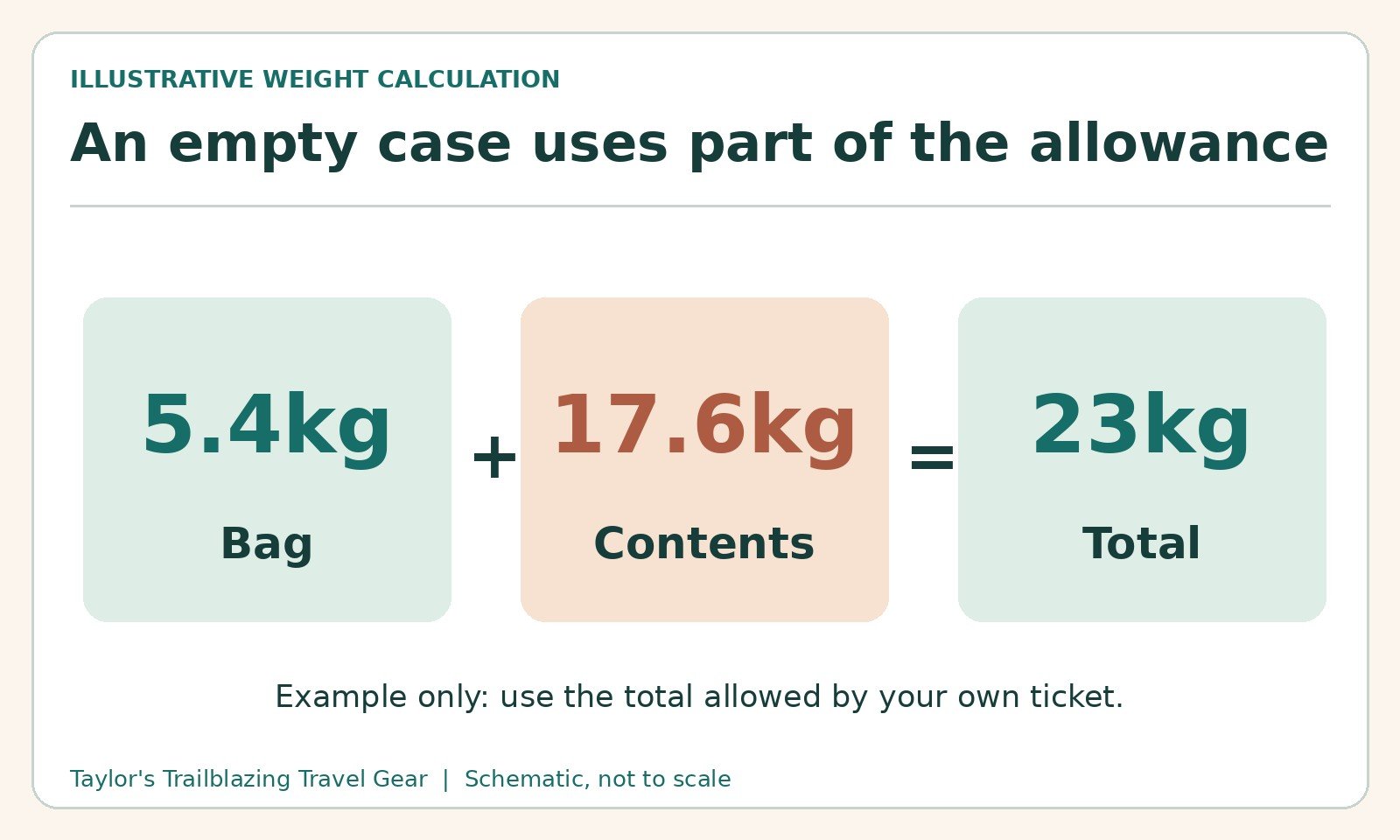
Its approximate empty mass is a central trade-off. With an illustrative 23kg total allowance, a 5.4kg bag leaves about 17.6kg for contents before adding any external accessories. That is arithmetic, not a statement that every airline grants 23kg or that you should aim to carry that much. Compare the actual allowance on the ticket with the weight you can handle comfortably.
Service support is part of the decision
Briggs & Riley’s repair guarantee is a reason to investigate the brand, but it should not replace practical questions about the repair process. Ask where the bag would be sent, which arrangements apply in the UK and what happens if a repair is needed immediately before a trip. A long-term service promise does not eliminate inconvenience at the time of a failure. [6] [14]
For occasional travel, this may be more structure and weight than you need. For regular checked packing where its layout genuinely reduces unpacking and repacking, the case is stronger. Try opening it on the sort of luggage stand you normally use, then check whether both sections remain easy to reach without balancing the bag precariously.
Check the exact model, selected size, current price and retailer terms before ordering.
Eagle Creek No Matter What 130L: a specialist rolling duffle
A different pulling arrangement
The No Matter What Rolling Duffel 130L uses heavy-duty wheels, a padded pull handle, corner bumpers and several carrying handles. It can pack into a storage sack when empty. Unlike a conventional upright suitcase, its flexible construction and webbing-style pulling arrangement need to suit the load and the person moving it. [8]
The useful brief is bulky, relatively light kit where compact storage between trips matters. It is not the first recommendation for someone seeking a tidy little suitcase for a weekend. Nor should its outdoor styling be interpreted as proof that it can be dragged indefinitely over any surface without its fabric touching the ground.
The specification evidence also needs care. The European product page calls it 130L but gives a 132L capacity in its specification block, alongside 91 x 39 x 38cm and 1,350g. Consequently, the volume in the product name and the specification block do not exactly agree. Confirm the precise supplied version; we have not used this flexible specialist bag to claim a universal lightweight winner over the more structured cases. [8] [9]
A home trial is especially valuable
Load a flexible duffle with something close to your real kit and check its shape while pulling. If the centre sags, the lower fabric brushes the floor or the pull handle puts your hand in an awkward position, more volume is not an advantage. However, avoid dragging a new bag outdoors before you understand the retailer’s return conditions.
Also consider whether you can move it without the wheels when required. A large soft duffle can be awkward to control through a narrow doorway even when its contents are not particularly heavy. Buy for that awkward moment as well as the easy roll across a departure hall.
Check the exact model, selected size, current price and retailer terms before ordering.
Need a true business upright instead of a duffle?
Compare the Baseline two-wheel model separately
Briggs & Riley also makes a Baseline Essential two-wheel carry-on, identified by the BLU122CX model family. It is a useful alternative to investigate when your priorities are an upright case, garment organisation and a flat packing surface rather than a duffle opening. The similar BLU122CXSP name refers to a spinner, so do not swap their specifications or buying destinations. [10]
We have not treated the American term ‘domestic carry-on’ as a UK airline guarantee. Check the precise UK listing, complete external dimensions and availability for the chosen version. That matters particularly for cases sold around the 22-inch or 56cm category, which can exceed an airline’s 55cm height allowance despite fitting another carrier’s larger limit.
This alternative is included because an expensive rolling duffle is not automatically the right replacement for a conventional suitcase. A traveller carrying shirts and a small laptop might prefer the upright layout; somebody transporting unusually shaped kit might favour the duffle. The choice should follow the contents and handling needs, not the appearance of the bag in a product photograph.
Match the wheels to the ground you actually expect
Uneven paving is not the same as loose terrain
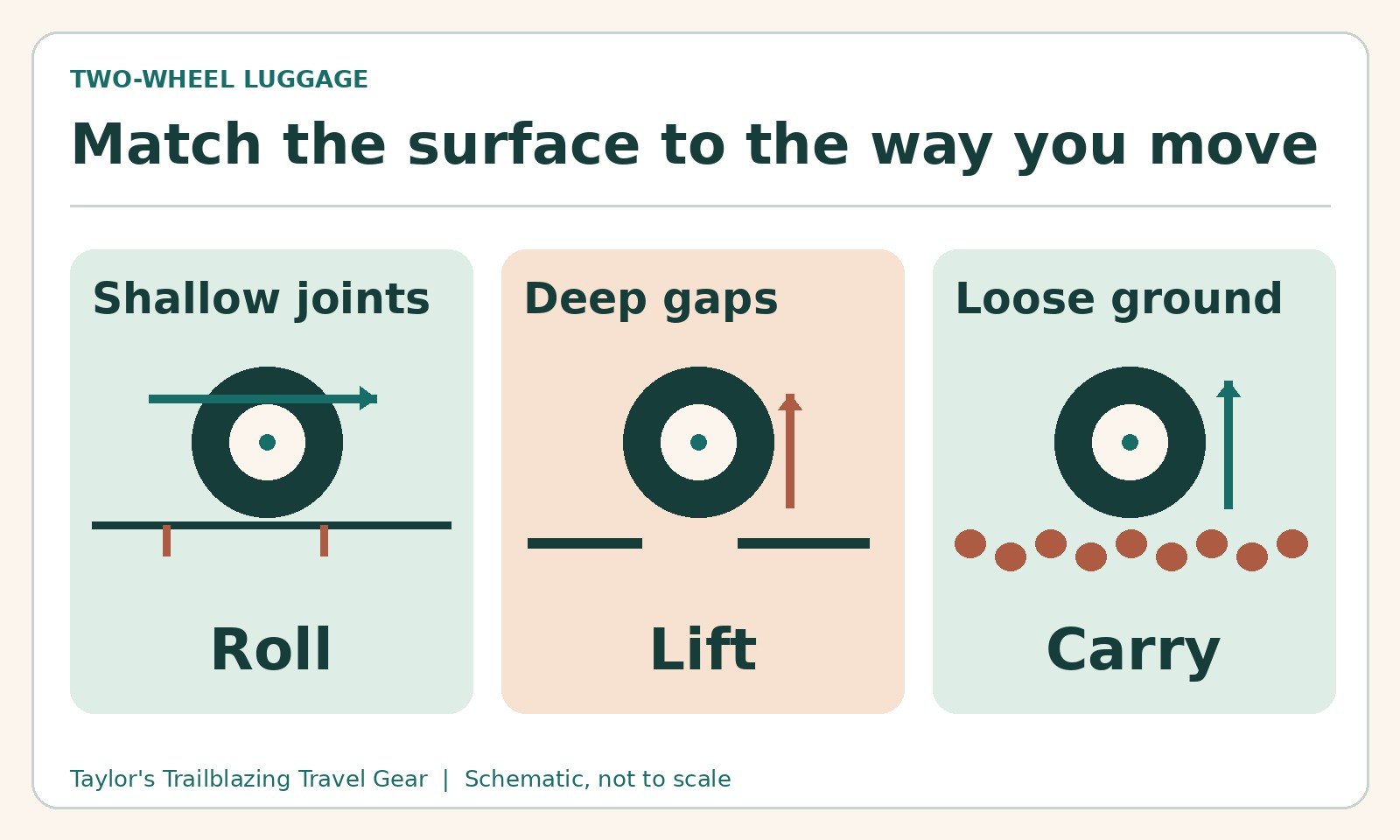
A fixed-wheel case is worth considering where the main issue is joints, shallow gaps or rough paving. Its wheels track in one direction, which removes the need for small swivel assemblies to keep changing orientation. However, that is a design-based reason to shortlist the format, not a measured claim that every two-wheel case beats every spinner.
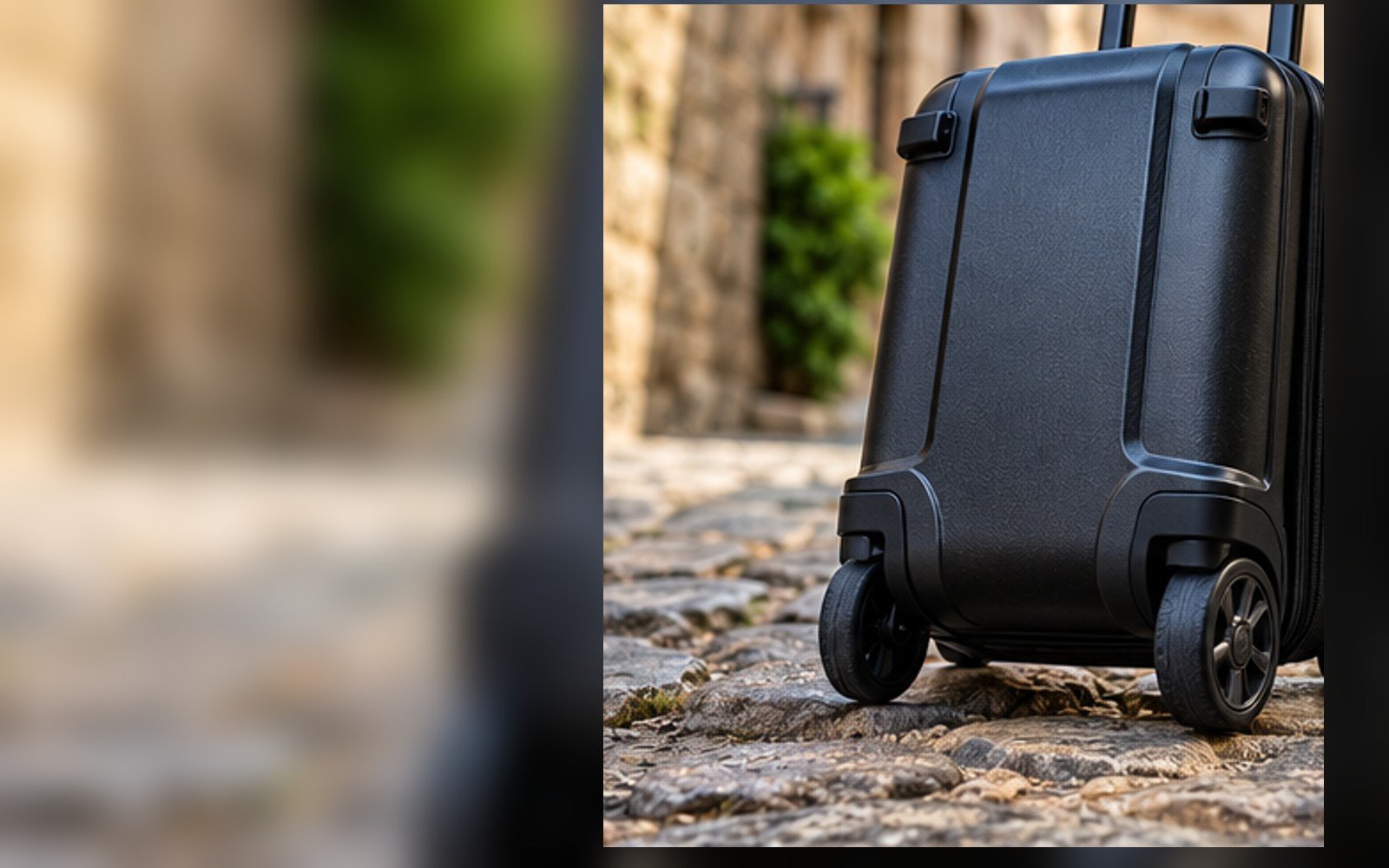
Loose gravel, sand and deep cobbles create a different problem. The wheel may sink, meet an obstacle too large to climb easily, or force the lower part of the bag towards the ground. In those situations, the practical answer is often a short carry, a different path or less luggage. Buying a larger suitcase does not make the surface disappear.
Inspect clearance while the bag is tilted
Look at the distance between the loaded bag and the floor in the position you actually use for pulling. A wheel can look large in isolation while a low foot, corner or soft panel catches behind it. Furthermore, packing changes the shape of a soft bag. Check with a realistic load rather than judging an empty case standing upright.
The useful questions are specific: does the lower corner touch first, can you lift the front over a shallow obstacle, and is the handle comfortable at your natural walking angle? Where the manufacturer does not publish wheel diameter or axle clearance, a retailer demonstration is more informative than an invented millimetre comparison.
Know when to stop pulling
Treat a kerb or a flight of steps as a lifting point, not an opportunity to test the telescopic handle. Use the designed grab handles and avoid bouncing the wheels repeatedly down edges. If the load is difficult to lift in a controlled way, reduce it or arrange help; the fact that it rolled comfortably a moment earlier is irrelevant.
Handle fit and lifting weight deserve a proper trial
Check stride, turns and stopping
Walk a short indoor route with the bag behind you, turn in both directions and stop without letting it run into your feet. The handle should allow a natural arm position rather than forcing you to reach backwards. Also try a narrow doorway, because a bag that follows neatly along a corridor can still be awkward during a tight turn.
Do not infer handle quality from the absence of any movement in an empty display model. Instead, check that it extends and locks consistently, retracts without trapping fabric and does not collapse under normal pulling. Ask the retailer about a specific loose or sticky mechanism rather than assuming that every small movement is either harmless or a fault.
Test the lifts that your trip requires
A useful trial includes raising the loaded bag onto a stable low surface and carrying it a few steps using the fixed handle. Keep within a weight you can manage and do not perform an unsafe overhead lift simply to prove a point. The purpose is to expose an unsuitable bag, not to rehearse a difficult manoeuvre alone.
For the Prodiver hybrid, also deploy and stow the backpack straps several times. If that process is cumbersome in a calm room, it may not become easier during a hurried connection. Conversely, a well-fitting alternative carrying mode can be valuable when it prevents repeated awkward one-handed lifts.
Cabin labels, checked limits and the actual booking
The free bag and the overhead bag are different products
Ryanair’s free small personal bag is 40 x 30 x 20cm. Its larger 10kg cabin-bag option uses a 55 x 40 x 20cm allowance and requires the appropriate booking entitlement. easyJet allows a small bag up to 45 x 36 x 20cm, while the larger 56 x 45 x 25cm option must be included or booked separately. These rules were reviewed on 10 October 2026. [11] [12]
That makes both compact selections in this guide too large to describe as universal free personal items. The Tranverz S has a listed 23cm depth, and the Prodiver backpack is 25cm deep. A retailer’s airline checklist is useful only when it identifies the exact bag allowance rather than displaying an airline name without its fare conditions.
British Airways lists 40 x 30 x 15cm for a handbag or laptop bag and 56 x 45 x 25cm for cabin luggage. Check the operating carrier when a journey includes another airline. A bag that suits one flight can still create a problem on a smaller connecting service or on the return itinerary. [13]
Checked luggage has dimensions as well as weight
For the large duffles, read the checked-luggage conditions rather than the cabin chart. Some tickets or routes use a total of the three external dimensions, while others publish their own size rules. Add handles, wheels and any expansion to the measurements that apply, then compare the actual packed item with the airline’s wording.
For example, the retailer dimensions for the large Baseline duffle total about 161.9cm. That calculation does not establish whether your airline accepts it; it simply shows why a capacity label is not enough. If a particular itinerary uses a lower total-size limit, the weight being acceptable does not solve the size issue. [7]
Pack for stability and maintain the moving parts
Keep the rolling load balanced
Start with heavier items near the wheeled end, then distribute them evenly across the width. Use soft clothing to stop hard items shifting, but keep anything fragile independently protected. An unbalanced load can make a bag harder to steer or park even when its total weight is comfortably within your allowance.
Avoid putting all quick-access items in one bulging front pocket. That can change both the depth and the balance of the bag. Instead, make a small pouch for documents, chargers and other items you will need during the journey, then give it a deliberate home where you can reach it without opening both halves of the case.
Remove debris before it becomes a bigger problem
After a trip, look for grit, hair or threads around the wheels. Wipe away loose dirt and allow damp luggage to dry before closing it for storage. Follow the manufacturer’s care instructions and avoid applying lubricant or dismantling an axle unless the brand provides a suitable procedure for that model.
Check the fixed handles, zip ends and corners at the same time. Damage found a week before departure leaves more options than a fault discovered while packing the night before. Keep a record of the model code and purchase details so that a repair enquiry refers to the correct version rather than simply ‘the blue suitcase’.
Three packing briefs that lead to different choices
A short break with a walk from the station
Consider an illustrative three-night trip with casual clothing, a wash kit and a small pouch of electronics. You expect a station approach with paving joints and one short flight of steps at the accommodation. In this example, the first task is to keep the load compact. A bigger checked duffle would introduce lifting and storage problems without solving a genuine capacity shortage.
The Tranverz S would be a reasonable format to inspect, provided its dimensions suit the flight. The Prodiver hybrid offers another carrying method, but its extra depth and hardware need to earn their place. Compare the two with the same sample packing list, not with one bag empty and the other filled. That makes the handling difference more meaningful.
After packing, practise retrieving your outer layer and wash kit without emptying the whole case. A short trip can involve several quick repacking moments, so ease of access deserves attention alongside the wheel layout. Keep the return journey in mind too: the bag should still close comfortably once clothes are no longer folded with departure-day precision.
A longer trip with bulky clothing and vehicle transfers
Now imagine a checked-bag journey carrying larger clothing items, with most ground movement by vehicle. A large Prodiver or Baseline duffle becomes easier to justify because capacity is addressing an actual need. Nevertheless, measure the available boot space and the accommodation’s storage area. A bag can meet an airline rule yet be inconvenient once you arrive.
Make a draft packing pile before choosing between the two layouts. The Baseline’s flatter section may be useful for clothing that needs to remain organised, whereas a less divided duffle may suit a less structured load. Neither arrangement protects fragile contents by itself. Anything that needs impact protection should have appropriate internal protection rather than relying on the word ‘durable’ in the bag description.
The final test is the lift into the vehicle or onto the check-in belt. If that requires an awkward heave, reduce the load or choose a different arrangement. The planned transfers may make a large wheeled bag practical, but they do not remove the short lifting tasks at either end.
A gear-heavy trip with limited storage at home
A very large rolling duffle makes more sense when the items are bulky rather than dense and the empty bag must occupy little cupboard space. That is the specific attraction of a collapsible design such as the Eagle Creek. However, it requires more attention to the loaded shape than a rigid case with a defined interior.
Lay out the gear in roughly the bag’s footprint before buying. Check whether long objects will remain within the body rather than pressing against a zip end or forcing the bag to bow. Also decide which pieces must remain accessible during the journey. A cavernous compartment is less helpful when every useful item ends up beneath the heaviest object.
If the packing list repeatedly pushes a large bag close to the itinerary’s limits, question the list rather than immediately moving to an even larger model. Some equipment may need a different transport arrangement. A wheeled duffle is not a substitute for checking the airline’s rules for unusual or fragile items.
Keep the comparison fair
Use the same contents, the same footwear and the same short indoor route when comparing bags. Note your own impressions of pulling angle, heel clearance and lifting rather than assigning a universal score from a few minutes’ use. That limited trial cannot establish long-term durability, but it can reveal a mismatch before the bag accompanies you on a trip.
The advantages and compromises of two-wheel luggage
Where the format earns its place
Two-wheel luggage can be a sensible way to combine stable directional pulling with an upright or duffle-style packing arrangement. It is especially worth investigating when your route includes mixed paving and you do not need the bag to glide sideways beside you. Several options also provide useful fixed grab handles for the moments when the wheels are no longer helpful.
The choice is strongest when the bag remains modest enough to lift and the handle suits your stride. In that situation, a less complicated design may be more useful than a long feature list. However, the advantage comes from the whole arrangement working together, not from the number two printed in a product description.
Where a different bag may work better
A two-wheel case normally needs to be tilted and pulled rather than pushed upright beside you. That may be less convenient in a slow queue or a narrow hotel lift. It also does not remove pulling effort, and a large flexible duffle can demand careful packing to avoid sagging or instability.
If most of the route is smooth indoor flooring, compare a spinner on its own merits. If the route is dominated by long carries, repeated stairs or surfaces where wheels repeatedly stop working, consider a backpack or a smaller load instead. Do not buy a wheeled bag to solve a problem that is fundamentally a carrying problem.
Common buying mistakes that are easy to avoid
Shopping by the range name alone
Ecodiver or Prodiver, Baseline and Tranverz are family names, not complete specifications. Record the model code, size and selected version before comparing. Similarly, make sure a duffle actually has wheels: a nearly identical photograph of the wheel-free version can appear beside a rolling model in a collection. [2] [10] [8]
Treating capacity as a target
A larger bag encourages extra packing but does not increase what you can lift or what the airline includes. Build the packing list first, then choose the smallest practical format that leaves a little flexibility. Buying a huge bag ‘just in case’ is rarely helpful when the real problem is negotiating steps on a short break.
Ignoring the return and repair process
Read the conditions before taking a new case onto rough ground. Outdoor wheel wear may affect a change-of-mind return, while a manufacturing-defect warranty is a different matter. Also ask about replacement wheels and handle parts for the exact model; a general statement that a brand offers repairs does not prove that every part is immediately available. [14]
Questions about two-wheel suitcases and uneven ground
Are two-wheel suitcases always better than spinners on cobbles?
No. Wheel diameter, clearance, the depth of the gaps, the load and the lower shape of the case all matter. Fixed wheels are a reasonable design to investigate for mixed paving, but we have not measured a universal advantage. If the surface repeatedly catches the bag, lifting it briefly or choosing a smoother route is more sensible than continuing to drag it.
Can I pull a two-wheel suitcase across gravel?
Short stretches of firm, shallow gravel may be manageable with some bags, but loose or deep material can stop small luggage wheels working well. Do not buy from the assumption that a rugged-looking duffle is an all-terrain trolley. The decisive question is whether you can carry the packed bag when the gravel becomes impractical.
Is a 55cm wheeled bag automatically allowed in the cabin?
No. Height is only one measurement, and a cabin allowance also depends on the fare or optional bag you booked. The Prodiver wheeled backpack is 55cm high but 25cm deep, so it does not meet a 20cm depth rule at its published dimensions. Compare all three measurements with the operating airline’s exact allowance. [2] [11]
Do bigger wheels mean the suitcase is more durable?
Not by themselves. A wheel’s mounting, axle, housing and surrounding case construction also matter, along with how the bag is used. Larger diameter may help with particular obstacles, but durability is a separate claim that needs evidence. Where dimensions are not published, ask for a demonstration rather than accepting a vague claim about ‘off-road’ luggage.
Should I use compression straps on a wheeled duffle?
Use them as the manufacturer intends to stabilise the contents and reduce loose fabric. However, compression cannot reduce the mass of the packed bag or shrink rigid wheel and handle components. Check that straps are secured away from moving wheels and that the resulting shape still fits the airline limit rather than simply looking tidier.
How much empty weight is too much?
There is no single cut-off. Compare empty weight with your total allowance and with the load you can lift. For example, an approximately 5.4kg checked duffle consumes a meaningful part of an illustrative 23kg total. Its organisation may justify that for one traveller, while a lighter or smaller bag will be more useful for another. [7]
Can the Prodiver wheeled backpack replace a hiking backpack?
Not automatically. It is a travel bag with an additional carrying mode, not a claim of trekking suitability. Try the straps and back length with your expected load and consider how often you will carry it. For long walks, a backpack selected around torso fit and carrying comfort deserves its own assessment rather than being replaced by a wheeled hybrid on paper.
Is the Eagle Creek 130L a good ordinary weekend suitcase?
It would be excessive for most modest weekend packing lists. Its specialist value is accommodating bulky kit and reducing storage bulk when empty. The flexible shape, very large capacity and different pull-handle arrangement require their own trial. A compact case is a more proportionate starting point when you are carrying only a small wardrobe and personal essentials.
Choose the bag you can manage when the wheels stop helping
For compact packing, begin with the Tranverz S and check the selected version’s dimensions. Consider the Prodiver 55cm wheeled backpack when short carries are genuinely part of the route and your booked allowance permits its depth. Its additional straps are a reason to try it, not a reason to skip a fit check.
For larger checked loads, the Prodiver 79cm is the more straightforward starting point of the large options here. The Baseline Large 2-Wheel Duffle earns consideration when its divided packing and service support justify the additional empty weight. The Eagle Creek remains a specialist bulky-kit alternative rather than the default holiday suitcase.
Before ordering, write down three things: the tightest baggage allowance on the itinerary, the heaviest packed load you can handle, and the part of the route where you will have to stop rolling. Those answers make the final choice clearer than a promise that any suitcase will glide over every surface.
Sources and fact-checking notes
Research reviewed on 10 October 2026. Recommendations are design-based judgements, not comparative terrain or durability tests. Prodiver/Ecodiver naming and exact model numbers matter. The 79cm Prodiver weight differs between the manufacturer and retailer; Eastpak’s header rounds its width, and Eagle Creek’s product name and detailed capacity are not identical. Check the selected version before purchase.
- Eastpak: Tranverz S, BlackBlack model: 2.41kg; header rounds width to 32cm, detailed description gives 32.5cm. The larger figure is used.
- Samsonite: Prodiver wheeled backpack 55cm, 14088255 x 40 x 25cm; 51L; 2.8kg; two wheels; formerly Ecodiver.
- Case Luggage: Prodiver 55cm wheeled backpackUK retail listing for the exact model family; check colour and version.
- Samsonite: Prodiver wheeled duffle 79cm, 14088479 x 44 x 31cm; 122L; 3.4kg; two wheels.
- Case Luggage: Prodiver 79cm 2-wheel duffleRetailer lists 3.2kg; manufacturer lists 3.4kg. Do not silently merge the claims.
- Briggs & Riley UK: Baseline Large Two-Wheel DuffleTwo-section packing, collapsing side panel and repair guarantee.
- Case Luggage: Baseline BLUWD129 large 2-wheel duffle74 x 46 x 41.9cm; approximately 5.4kg; 124L.
- Eagle Creek Europe: No Matter What Rolling Duffel 130LThe page calls it 130L but lists 132L, 1350g and 91 x 39 x 38cm; no ranking by disputed capacity or weight.
- Case Luggage: No Matter What 130L wheeled duffleUK listing for the specific rolling version, not the wheel-free duffle.
- Briggs & Riley: Baseline Essential 22-inch 2-wheel carry-onTrue two-wheel upright alternative; do not confuse with the CXSP spinner.
- Ryanair: baggage policy
- easyJet: cabin bags
- British Airways: baggage essentials
- Case Luggage: repairs and warranty informationBrand-specific coverage and repair routes, not a promise of free repairs for every fault.
Buying links open the relevant retailer. Prices, colour choices and stock can change; no fixed price or availability is promised.
Illustrations in this article were created for Taylor’s Trailblazing Travel Gear. Third-party photographs, where used, are credited beside the image or in the source list.