Luggage Strap vs Luggage Lock
One wraps the case; the other restricts a closure. Choose the job before choosing the accessory.
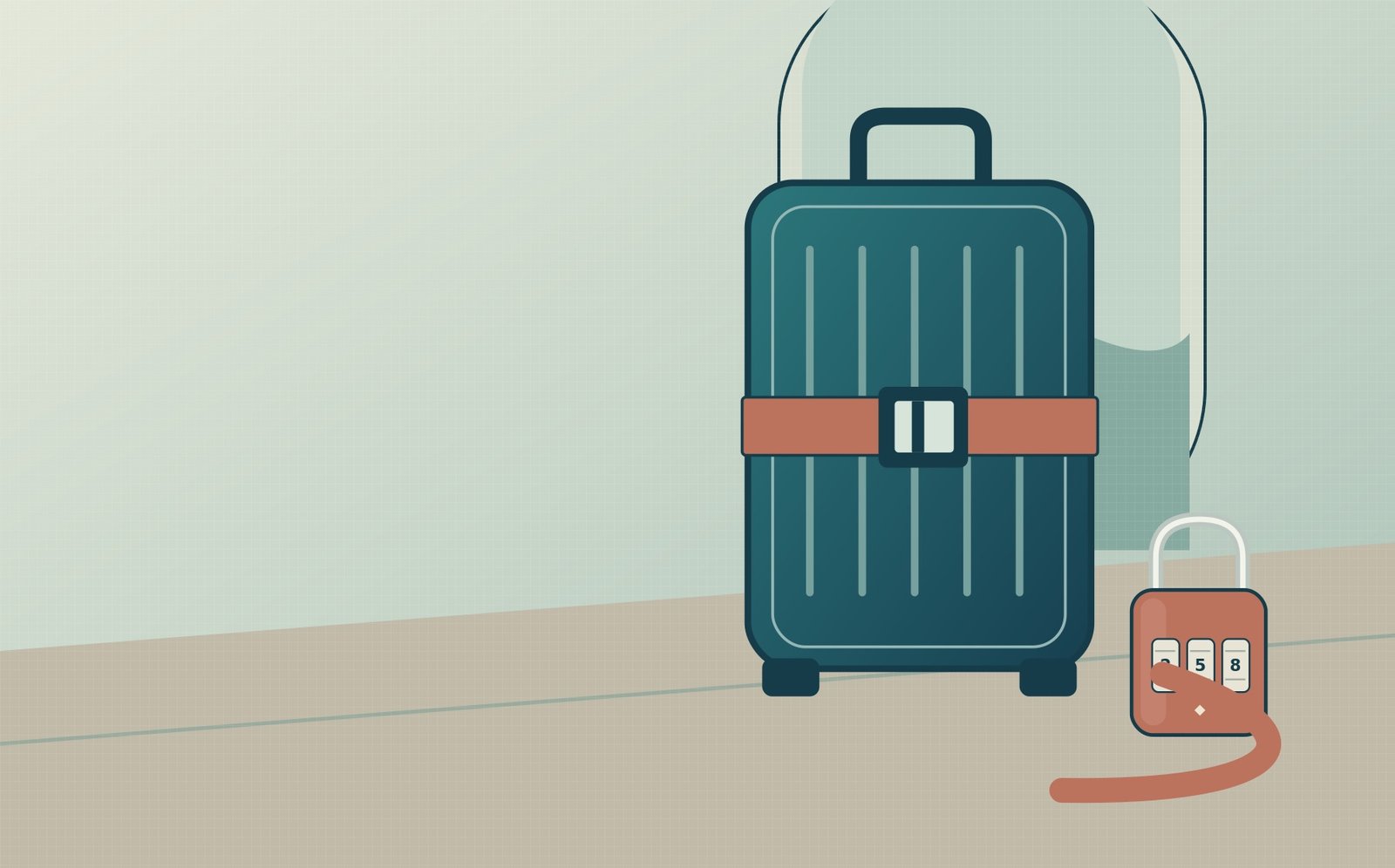
Original illustration of a suitcase band and a separate padlock; not a product-test photograph.
A bright band around a suitcase and a small padlock beside its zip can look like two versions of the same security purchase. They are not. In a luggage strap vs luggage lock decision, the strap mainly adds an external band and a visual marker, while the lock restricts a suitable closure. Either can be useful, but neither turns ordinary luggage into a secure storage safe.
The choice becomes easier when you name the problem. Is your case difficult to recognise? Are you worried about accidental opening? Do you want to keep compatible zip pulls together? Or are you trying to compensate for a damaged fastening that should actually be repaired? Different problems need different answers, and buying both accessories does not automatically solve all of them.
This guide compares their practical roles, current product examples and the checks that matter before travelling. It is based on manufacturer information, retailer listings and screening guidance, not hands-on security testing. The fitting exercises are suggestions for checking your own luggage, with no claim that they establish a certified level of protection.
A fitted strap
Adds a band around the case, not a repair for broken luggage.
A compatible lock
Holds suitable closure points together; it cannot secure the whole bag.
A distinctive strap
Makes identification easier, but still check the luggage label.
A measured combination
A strap and lock can complement each other without making a case theft-proof.
Luggage strap vs luggage lock: start with the problem
There are three different jobs
The first job is recognition. A distinctive strap can help you spot your case among similar luggage, although you must still check the identifying label. The second is containment: a correctly fitted band may provide another restraint around the body. The third is restricting access through a particular fastening. A lock is usually aimed at that third job.
Those jobs overlap only partly. A plain buckle strap can be removed without knowing a code or holding a key, so it is not equivalent to a padlock. Conversely, a padlock joining two zip pulls does not wrap around the shell or make a plain black case much easier to recognise across a baggage hall.
Decide whether the existing case already solves it
Inspect your suitcase before buying an accessory. A functioning integrated lock may already restrain the main closure. Internal compression straps organise the contents but are not external security straps. A distinctive case colour may already make identification straightforward. Buy the missing function rather than duplicating something your luggage already provides.
What a plain luggage strap actually offers
A visible band and a secondary restraint
A plain strap runs around the suitcase and closes with its own buckle. Its usefulness depends on the route around the case, the adjustment range and whether it stays in place without loose ends. Go Travel describes its bright 889.101 strap as an identification aid and a way to help prevent accidental opening. That is a manufacturer-style purpose, not our own drop-test result. [3]
Do not turn that purpose into an unlimited guarantee. If the strap slips off, the buckle is not properly engaged or a different part of the case fails, the band may not provide the support you expected. It also does not necessarily restrain an outside pocket, laptop compartment or separate zip that sits outside its route.
A strap is not normally a lifting handle
Unless a product is specifically designed and rated for lifting, use the suitcase’s intended carry handles. Do not lift a heavy case by an external band just because it feels tight. The forces applied to a strap while lifting differ from the ordinary job of sitting around the case.
Check that the band does not cover the luggage label, wheel, handle mechanism or anything staff need to identify and handle the bag. A striking colour is helpful only when it does not create an awkward obstruction. Keep all loose material secured in the manner intended by the manufacturer.
What a luggage lock actually secures
The locking points determine the protection
A padlock normally joins compatible zip pulls or another purpose-made locking point. Before buying, check that the points can meet naturally and that the shackle or cable can pass through them without force. A large lock body can be awkward even when its narrowest part technically fits the hole.
The lock restrains that connection, not every possible part of the suitcase. It does not stop someone moving an unattended bag, prevent all forms of damage or guarantee that valuables are protected. For that reason, keep essential items with you where required and avoid treating a locked checked bag as the only place for something you cannot afford to lose.
Cable and rigid shackle are different fitting choices
A cable can accommodate some offset locking points more easily than a rigid shackle. A rigid shackle may sit more compactly on a close pair of zip pulls. These are geometry questions before they are security questions. Neither shape proves a particular level of resistance without relevant independent evidence.
Go Travel’s Combi Cable Twin Locks and Large Classic Combi illustrate the two layouts. Their appearance is a useful starting point, but the correct choice still depends on your own zip hardware. Retailer statements that a lock fits most luggage are not a measurement of your exact suitcase. [7] [9]

A comparison table for the job you need
Use this table to decide which function is worth paying for. It deliberately avoids assigning an unsupported security score to products with different purposes.
| Need | Plain strap | Separate lock | Locking strap |
|---|---|---|---|
| Easier visual recognition | Often helpful if distinctive | Usually a minor contribution | Helpful if visible and distinctive |
| Extra band around the case | Yes, when correctly fitted | No | Yes, when correctly fitted |
| Restrict a pair of zip pulls | Not its normal job | Yes, if the hardware fits | Not necessarily |
| Owner access without a code or key | Usually simple buckle access | Depends on the lock | Usually needs its combination |
| Screening access | May simply need removal | Check the recognised-lock system | Check the exact strap version |
| Repair a failed closure | No | No | No |
On smaller screens, scroll the table sideways within its frame.
Do not confuse a feature with a result
A product can have a lock without making the whole suitcase theft-proof. It can have bright webbing without being unique on the carousel. It can carry an inspection-compatible symbol without being immune to damage. The useful approach is to describe what the accessory is designed to do and then check the particular limitations.
This is also why a strap-and-lock combination should be chosen deliberately. You gain more only when the two items solve different problems and fit together sensibly. Adding a second object that you never close properly is not automatically an improvement.
Locking straps: useful hybrid or unnecessary complication?
They combine functions, but do not erase the trade-offs
A locking strap adds an owner-operated lock to the buckle arrangement. That can be convenient when you want both an outer band and a closure that is not opened by simply pressing a plain buckle. However, the strap still has to fit the case and follow a route that makes practical sense.
It does not automatically lock the suitcase’s separate zip pulls. Depending on the luggage design, some openings may remain outside the strap. Work through every compartment you expect to restrict rather than assuming one band has changed the entire case’s access arrangement.
Similar names can describe different screening systems
Go Travel’s black 342.101 Combi Luggage Strap TSA and its Blue/Orange 491.101 Combi Luggage Strap have similar names. The manufacturer explicitly identifies the first as TSA recognised and the latter as not TSA recognised. A combination buckle alone therefore does not establish screening compatibility. [2] [10]
Use the full model reference and inspect the actual marking on the supplied product. Do not rely solely on a retailer’s general collection title. In a large catalogue, a description written for a whole range can be less precise than the individual product’s own specification.
Measure a strap around the packed case
Measure the route, not the suitcase height
For a simplified rectangular example, a path around a 75 cm height and 30 cm depth would be approximately 210 cm before allowing for real contours. A 170 cm strap would not suit that route. A path around a 50 cm width and the same 30 cm depth would be approximately 160 cm. This is illustrative geometry, not a fitting approval for either arrangement.
Check minimum as well as maximum adjustment
A strap can also be too long at its shortest usable setting. Go Travel gives 105 cm as the minimum length in the FAQ for its 342.101 TSA strap and lists 170 cm overall length. Confirm the usable adjustment for your case rather than treating the largest printed dimension as a promise about every buckle position. [2]
Leave the buckle in a position you can reach and operate. A band that only fits by sitting across a wheel or by using an unintended thread-through arrangement is not a satisfactory fit. Choose a different size or design rather than improvising a stressed installation.
Expansion changes the measurement
If you might expand the suitcase for the return journey, repeat the measurement expanded. This affects both the strap route and the baggage size you will present to the airline. A strap does not reduce an oversized case to its advertised unexpanded dimensions simply because it compresses a soft part of the exterior.
Fit a lock without damaging the closure
Check clearance in more than one position
Close the empty suitcase and bring the intended locking points together naturally. Then check how a proposed lock would sit when the bag is upright, on its side and laid flat. The lock body should not have to lever the zip pulls against each other or sit where it is continually pressed between the shell and floor.
Repeat with the case packed normally. Overfilling can pull the closure into a different shape and make a previously easy connection awkward. If the zip needs force before the lock is attached, reduce the load or investigate the closure rather than using the lock to hold a strained arrangement together.
A printed body size is not a shackle measurement
Retail listings often give overall height, width and depth. Those figures may tell you how much space a lock occupies but not the precise internal clearance or cable diameter. Ask for the relevant measurement when it is missing, especially for small backpack zip loops or unusual luggage hardware.
The Go Travel Large Classic Combi listing is useful for identifying the product, but it does not remove the need to check your closure. A lock that is easy to operate in your hand can still be a poor physical match once attached. [8]
Screening access and the meaning of TSA recognition
Inspection access is not a theft-resistance rating
TSA guidance explains that recognised locks can allow security personnel to inspect baggage without cutting the lock. It also makes clear that a lock may have to be cut if the bag requires inspection and cannot be opened. Recognition should therefore be understood as an access arrangement, not a promise that a lock will never be removed or damaged. [1]
The same distinction applies to a locking strap. A recognised buckle can assist the relevant screening process, but it does not make the strap suitable for every suitcase or every use. Check the exact product and follow the airline, airport and screening instructions that apply to the journey.
The owner’s method can be different from the inspector’s
Some travel locks use owner combination dials alongside a separate inspection keyway. Other products are key-operated for the owner. A keyhole does not, by itself, tell you which arrangement you are buying. Travel Sentry distinguishes the different types rather than treating every travel lock as the same mechanism. [11]
Go Travel’s Alert Key Lock is genuinely key-operated for its owner. Do not confuse its supplied padlock keys with a screening tool, or its alert-reset key with an ordinary spare opening key. Read the item-level instructions, particularly when a generic catalogue description uses the word combination incorrectly. [5] [6]
Which should you use on different kinds of luggage?
Hard-shell suitcase with a working integrated lock
If the integrated mechanism already restrains the intended main closure, an additional padlock may provide little convenience. A strap might still be useful for identification or as an extra external band, provided the manufacturer does not prohibit the arrangement and the fit is safe.
Do not fit a strap across a front-opening panel you need to access repeatedly unless you accept the extra removal step. A convenient laptop compartment can become awkward when a band crosses its opening. The problem is not that either product is badly designed; it is that two features have been combined without checking their everyday interaction.
Soft-sided suitcase with several compartments
Map the openings separately. The main zip may accept a padlock while a front pocket uses a different shape or has no appropriate locking points. An external strap may cross part of the case yet leave that front pocket untouched. Decide what you actually intend to place in each compartment.
Do not force a lock through a decorative pull, fabric loop or point not intended for the load. The purpose is to restrain a designed closure, not to create an improvised fastening that tears the bag when pulled. Sometimes the better packing decision is to leave a vulnerable pocket free of important items.
Backpack or duffel
A broad suitcase strap may be a poor match for a smaller or irregular bag. It can slip, distort the shape or add a buckle where the bag rests against your body. A compact compatible lock may be more practical for its specific zip points, while the bag’s own compression straps already manage the load.
If the bag will be checked, secure any carry straps according to its design and the carrier’s instructions. A luggage padlock is not a substitute for managing loose shoulder straps, and an external band is not permission to leave long tails hanging.
A sensible setup for four common journeys
A short flight with hand luggage only
You may not need either accessory. A bag that remains with you and has a sound closure can be perfectly practical without an added strap. A lock can still be useful for a particular compartment or a later part of the trip, but buy it for that clear purpose rather than assuming every flight needs new security equipment.
Focus first on a packing arrangement that keeps essentials accessible without leaving the bag open. If you frequently need to remove documents, a lock across the entire access panel may slow the routine enough that you stop using it.
A checked suitcase with a connection
This is a stronger case for considering an identification strap and an appropriate lock as separate functions. Measure the band carefully, check the locking points, keep the baggage label clear and photograph the closed setup before departure for your own records.
The photograph is an organisational aid, not proof that the baggage will remain unchanged or a guarantee about a future claim. Keep the essential documents and items you need during a delay in the luggage you retain, subject to the applicable carriage rules.
A rail trip with repeated hotel stops
Repeated opening makes usability important. A plain strap is quick to remove but does not restrict deliberate access in the same way as a lock. A locking strap combines two actions, yet requires remembering the code every time you want the band off. Choose the arrangement you will actually use consistently.
If the main issue is distinguishing family suitcases in a luggage rack, a bright strap may address it without another padlock. If the issue is restraining suitable zips while carrying the bag, a compatible lock is the more direct tool.
A shared family case
Agree how the case will be opened before somebody leaves with the only key. Shared access can be handled with an agreed combination or a sensibly located spare key. A locking strap adds another access requirement, so do not create a system that only one person understands.
Use different visual markers to tell similar cases apart, but check ownership labels rather than relying on colour alone. Another family can own the same bright strap. Convenience should support identification, not replace it.
Current examples and the distinctions to check
Plain Go Travel 889.101: identification first
The Orange/Blue listing provides a straightforward example of bright webbing without a code-operated buckle. It was marked sold out when checked. Its description refers to 5 cm webbing, while the larger overall width shown elsewhere on the page includes the complete assembly; these are not necessarily the same measurement. [3]
Check the selected plain strap’s stock status only after measuring the route around your luggage. Choose it for visibility and an extra band, not as though a plain quick-release buckle were a padlock.
Go Travel 342.101: a recognised locking strap
The black TSA locking strap combines a three-dial buckle with the external band. Its appeal is reducing two accessory functions into one object, but it still has a minimum adjustment and cannot necessarily restrain every opening on the case. Confirm those practical limits before adding it to a cabin-sized suitcase. [2] [4]
Compare the 342.101 TSA strap when you genuinely want both functions. Do not accidentally substitute the similarly named non-TSA 491.101 model when inspection compatibility is part of your reason for choosing it.
Go Travel 335.101: keyed access with an indicator
The Alert Key Lock is worth examining when you prefer an owner key to combination dials. Its indicator relates to operation through the inspection arrangement; it should not be treated as a complete record of everything that may have happened to the bag. The retail listing offers assorted colours rather than a guaranteed colour choice. [5] [6]
Inspect the Alert Key Lock pack details and distinguish the owner keys from the separate reset tool. A product with several small keys or tools needs a storage plan before you travel.
Go Travel 352.101 and 360.101: two combination layouts
The Large Classic Combi uses a rigid shackle, while the Combi Cable Twin pack uses flexible cable loops. A cable can be convenient where the intended points are slightly offset; a rigid form can be neat where two points sit close together. Neither layout should be forced to compensate for incompatible hardware. [7] [9]
Check the cable twin pack for the exact number of locks and their closure layout. Keep the manufacturer’s product instructions with your travel preparation notes rather than assuming every three-dial mechanism is set in the same way.
Pre-trip checks that add more value than an extra gadget
Check the suitcase before adding anything
Inspect the zip, latch, seams, wheel housings and carry handles using the manufacturer’s guidance. Remove unnecessary load if the case only closes under excessive pressure. A strap can hide the visual signs of an overpacked case without solving the strain underneath it.
Then fit the accessory with all labels and intended handles accessible. Check the strap tail, buckle position and lock body. Walk the case through the ordinary movements you expect at home, including standing it upright and laying it down. This is a usability rehearsal, not a destructive durability test.
Practise the opening routine away from the luggage
Set a new combination or learn the key arrangement with the accessory open and off the suitcase, following its instructions. Confirm that you can operate it repeatedly before using it to secure a packed case. Keep the code or spare key in a sensible place that remains accessible if the case is closed.
Do not improvise a reset procedure borrowed from a different product. Similar-looking locks can use different setting mechanisms. When instructions are missing or unclear, contact the manufacturer or retailer before relying on the accessory for an important journey.
When using both makes sense
Combine different functions, not identical promises
A plain strap plus a separate lock can make sense when one provides a recognisable external band and the other restrains the main zip pulls. The pair is most useful when each is easy to fit, easy to remove when required and unlikely to interfere with the other.
Check where the buckle sits relative to the lock. You should not need to release one item merely to reach the other unless that is an inconvenience you knowingly accept. Likewise, a strap should not press the lock body into a fragile panel or leave it where it repeatedly catches during normal handling.
Keep the system proportionate
Two accessories create more objects to store after opening the case. Give them a dedicated place so a loose key does not disappear into bedding or a strap get left behind at a hotel. A system that is simple to repack is more likely to be used correctly on the return journey.
For a measured setup, compare the rigid-shackle combination option only after deciding whether your existing lock already does the job. The objective is not to decorate the suitcase with as many protective-looking objects as possible; it is to remove a specific weakness or inconvenience.
Returns, upkeep and sensible value
Check the whole cost of the choice
A low-priced accessory can become poor value if its dimensions do not match your case or its operation is too fiddly. Compare delivery charges, the number of items in a pack and the returns conditions before choosing between apparently similar offers. Do not treat a twin pack as automatically better when you only need one compatible lock.
Avoid buying unnecessary extras solely to reach a free-delivery threshold. A single correct accessory can be more useful than a collection of near-matches. Where measurements are missing, ask first; a product name containing universal or travel does not replace an actual clearance check.
Inspect and maintain without improvising repairs
After a trip, inspect straps for damaged webbing and buckles that no longer engage properly. Check locks for corrosion, distorted components or unreliable operation. Follow the manufacturer’s maintenance advice rather than applying an arbitrary lubricant, washing method or repair procedure.
If an accessory repeatedly jams, do not make the next trip its test run. Seek support or replace it with a suitable option. A low replacement cost is not a reason to continue using an unreliable lock on luggage you need to open at a particular time.
One strap or crossed straps?
Decide what the second band would actually add
Two bands at right angles can look more reassuring than one, but appearance is not a test result. A second route may restrain a different part of the case, yet it also adds another buckle, another tail and another adjustment. Decide what the second band is intended to support before buying it or improvising an arrangement with two unrelated straps.
Follow the product’s intended routing. A cross-strap system designed as one accessory is not necessarily equivalent to overlapping two ordinary bands. The buckle positions, joining points and way tension is distributed can differ. We have not load-tested either arrangement and do not claim a measured containment advantage from the number of visible bands.
Check the point where the bands meet
A crossing can create extra thickness on the face of the suitcase. Inspect whether it interferes with an opening panel or places hardware against the surface when the case is laid flat. If the bands slide against one another during a normal handling rehearsal, do not assume adding more tension is automatically the correct solution.
Keep the intended carry handles usable. A route through or around a handle can change how the strap behaves, so use only a configuration supported by the luggage and accessory instructions. The presence of a convenient gap does not establish that the handle is intended as an anchor for that purpose.
More coverage does not secure every pocket
A second band can still leave an outside compartment accessible. Work through the separate openings rather than counting straps. If an item should remain with you, moving it out of checked luggage is a different and often more direct decision than adding another accessory to that luggage.
For many travellers, one properly fitted strap does the identification job adequately. For others, no strap is necessary because the bag is already distinctive and its closure works well. The useful conclusion should follow the actual problem, not an assumption that a more elaborate setup is always better.
A quick decision audit before you order
Write down the function and the measurement together
A useful shopping note contains both the job and the dimension: a visible band for this measured route, or a keyed lock that fits these intended zip points. This stops a familiar product name or an attractive pack offer from replacing the practical requirement halfway through browsing.
For a strap, record the route around the normally packed case and any alternate expanded configuration. For a lock, identify which clearance measurement is missing rather than asking only whether it fits suitcases. A retailer can answer a precise hardware question more usefully than an undefined request for universal compatibility.
Compare the product page with the item in the basket
Variant selections can change colour, size or even the type of buckle. Recheck the selected item before payment, especially where a non-locking strap, a combination strap and a recognised inspection-access version share a product family. The picture in a recommendation is not necessarily the exact variant a marketplace selects by default.
The Go Travel Alert Key model is a good example of why the individual product matters: its owner uses keys, even though general catalogue wording can describe a range of locks differently. Confirm the model and contents rather than inferring operation from the category heading. [5] [6]
Think through the moment you remove it
A strap has to go somewhere while you open the suitcase. A separate padlock and key need somewhere too. Choose a consistent pouch or compartment that does not make the items disappear into the contents. Avoid placing them on hotel bedding or a shelf that you might leave without checking.
This is not a reason to buy another organiser automatically. A suitable existing pocket can work. The practical question is whether the accessory has a place in the whole packing routine, including the part of the journey when it is not attached to the luggage.
Check the return journey rather than only departure
Souvenirs, a damp jacket or a differently folded packing load can change the shape of a soft-sided case. Repeat the closing and routing checks after repacking. A strap setting that worked outbound is not proof that it remains appropriate when the load has changed.
Similarly, inspect the lock after handling rather than assuming that recognition or branding makes it immune to damage. The same simple checks apply at the end of each stage: primary closure working, accessory engaging correctly, labels and handles accessible, and no loose tails or awkward protrusions.
Pros and cons of each approach
Advantages
A plain strap can make a case easier to identify and add a separate external band. Meanwhile, a compatible lock directly restrains its intended closure. A locking strap combines two functions, while separate accessories let you choose the fit and operating style of each independently.
Trade-offs
Straps require correct length and routing; locks require suitable locking points and reliable owner access. Both add a removal and storage routine. Neither prevents every kind of theft, secures every compartment, repairs damaged luggage or guarantees damage-free inspection.
Common mistakes that undermine the purchase
Treating recognition as ownership proof
A bright strap helps you locate a likely case, but it is not unique. Check the baggage label and your own identifying details before leaving the carousel. Do not assume that a familiar colour means the bag is yours, particularly when several family cases use the same accessory.
Another mistake is relying on a strap to hold an overpacked suitcase together. Reduce the load instead of increasing tension until the buckle or shell looks strained. The additional band should supplement a properly closed case, not conceal a failing closure.
Assuming a keyhole tells the whole story
The keyhole on a combination travel lock can be part of the inspection system rather than an owner backup. On a keyed model, the supplied owner keys serve a different function. Read the particular instructions instead of buying based on a close-up photograph alone. [11]
Finally, do not follow an automated airline-size widget on an accessory listing. A strap’s long webbing measurement is not the size of a suitcase. Baggage compatibility must be assessed using the complete packed bag and the carrier’s actual rules, not a generic result calculated from strap dimensions.
Frequently asked questions
Is a luggage strap better than a lock?
Only for the jobs it actually performs. A strap can help with recognition and provides a band around the case. A lock restricts a compatible closure. Decide which problem matters on your trip rather than ranking them as interchangeable security products.
Do I need a strap if my suitcase has an integrated lock?
Not automatically. The integrated lock may already handle the main closure. An external strap can still serve a separate identification or containment purpose, but measure it and check that it does not obstruct the way the suitcase opens or is handled.
Does a TSA locking strap guarantee that it will not be cut?
No. Recognised mechanisms facilitate inspection access, but TSA says a lock can be cut when baggage needs inspection and cannot be opened. The recognition is not a guarantee against damage, loss or every circumstance during screening. [1]
Can I use a strap to lift my suitcase?
Use the suitcase’s intended carry handles unless the accessory is specifically designed and rated for lifting. A band that holds the case around its body is not automatically a safe carrying handle. Avoid testing that assumption with a heavy packed case.
Will a strap stop someone opening the front pocket?
Not necessarily. It depends on the pocket’s position, the route of the band and the case design. Inspect each opening separately. Do not store something important in an unrestricted outer compartment merely because the main body has a strap around it.
Can I put a lock on any zip?
No. The zip needs suitable locking points, and the lock must fit without forcing or twisting them. A decorative pull is not necessarily intended for a padlock. Check actual clearance and avoid using a lock to hold together a closure already under excessive packing strain.
Is a locking strap simpler than two separate items?
It can be, but only if its size, buckle position and access routine suit you. Separate items allow independent choices and can be easier to remove for different purposes. A hybrid reduces the number of objects but does not remove the need to check every function.
Final recommendation: buy the missing function
Choose a plain strap when visibility or an additional outer band is the useful improvement. Choose a compatible lock when restraining the intended closure is the actual goal. Consider a recognised locking strap only when its combined role fits your case and your opening routine.
For a hybrid starting point, review the black Go Travel TSA strap and its adjustment limits. For a case with a sound integrated lock, the best decision may be to add nothing. Prioritise correct fitting, a working primary closure and a sensible packing plan; those foundations matter more than how secure an accessory looks in a product photograph.
Sources and fact-checking notes
Editorial research checked on 11 October 2026. Named specifications are manufacturer or identified seller information, not measurements from our own product tests. Prices, stock, product versions and rules can change. Check the exact item and current terms before buying or travelling.
- TSA: travel tips and recognised locks. Inspection may require access; recognised locks reduce the need to cut, without a guarantee.
- Go Travel: TSA Combi Luggage Strap 342.101. 5 cm webbing; 105 cm minimum in FAQ, 170 cm overall listed length. Confirm usable adjustment.
- Case Luggage: Go Travel plain strap 889.101. Orange/Blue showed sold out when checked. Body width and overall hardware width differ.
- Case Luggage: Go Travel TSA lock strap 342.101. Retailer listing for the black locking strap.
- Go Travel: Alert Key Padlock 335. Key-operated owner access; alert-reset key is not a luggage-opening master key.
- Case Luggage: Alert Key Lock 335.101. Assorted colour listing. Manufacturer product details take priority over generic collection wording.
- Go Travel: Classic Large Combi 352.101. Three owner dials; rigid shackle. Fit must be checked on your own closure.
- Case Luggage: Large Classic Combi. Retail product reference, not an independent security rating.
- Case Luggage: Combi Cable Twin Locks 360.101. Twin cable combination-lock pack.
- Go Travel: non-TSA Combi Strap 491.101. The non-TSA version has a similar name but TSA recognised is explicitly 0.
- Travel Sentry: travel lock types. Distinguishes owner locking arrangements and inspection access.
Illustrations in this article were created for Taylor’s Trailblazing Travel Gear. Third-party photographs, where used, are credited beside the image or in the source list.