
Checked-Bag Security Checklist: Tag, Tracker, Photos and Receipts
Four useful layers, one clear handover and realistic expectations.
AI-created editorial concept image; not a personally tested product.
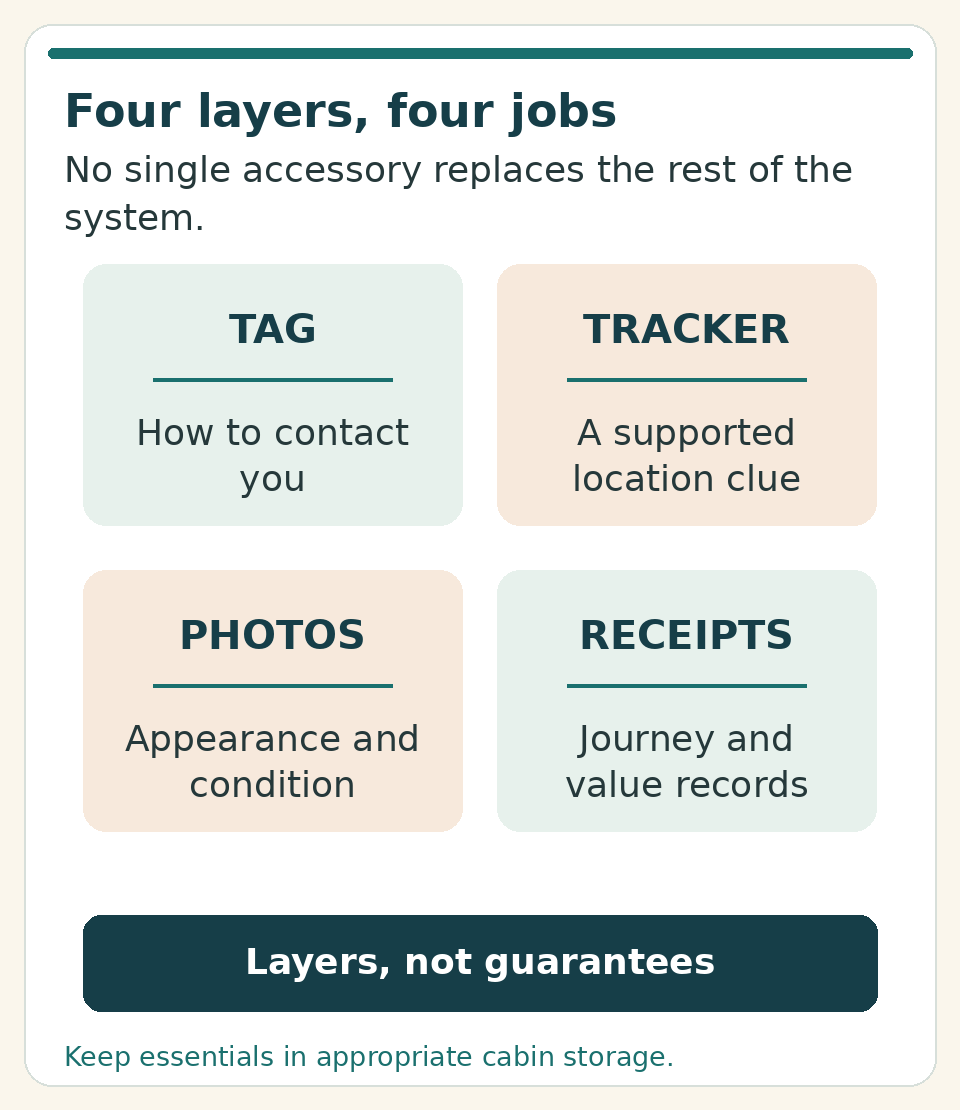
A checked-bag security checklist works best when it deals with several different problems instead of expecting one gadget to solve them all. Your tag helps someone contact you. A tracker may provide a location clue. Photographs record appearance and condition. Receipts support an explanation of value. A lock or strap adds a physical layer, but none of these makes a suitcase impossible to lose, damage or open.
The useful preparation is a coordinated system that remains understandable when you are tired at baggage reclaim. You should know which bag was checked under which passenger, where its receipt is stored and how to reach the relevant records without opening the missing suitcase.
This guide combines current official baggage and battery guidance with a practical sequence for packing, handing over and collecting a case. It is research-led preparation, not a guarantee of security, a claim of hands-on product testing or a determination of compensation rights.
Start with the contents: essential medication, documents and prohibited-in-hold batteries should not become inaccessible merely because the suitcase has a good tag and tracker. The CAA advises keeping essential items in cabin baggage and checking the airline’s rules for batteries and other restricted goods. [1]
Tag
Make the responsible traveller reachable.
Tracker
Add a compatible location clue, not a guarantee.
Photographs
Keep an honest record of appearance and condition.
Receipts
Link the bag, journey and genuine value records.
Use this checked-bag security checklist in order
Finish the decisions before the airport
The checklist below separates preparation from handover and arrival. It is an editorial workflow, not a list of products that every traveller needs to buy. Work through the sequence with the actual packed bag, because a good plan can be undermined by a last-minute transfer of a power bank or a forgotten contact card.
| Stage | Check | What completion looks like |
|---|---|---|
| Contents | Cabin-only and essential items removed | Nothing prohibited in the hold remains in the case |
| Condition | Wheels, handles, seams and closures inspected | Bag closes normally without excessive strain |
| Identification | Outer tag and internal card current | A reachable contact is clear in both places |
| Optional tracker | Compatible, set up and permitted | You can identify this exact device and bag |
| Evidence | Condition, contents and value records saved | A usable copy is accessible outside checked baggage |
| Closure | Appropriate lock or strap fitted if used | No blocked labels, loose ends or stressed fittings |
| Bag drop | Receipt matched to the case | Passenger, bag and journey records are linked |
| Arrival | Identity and condition checked | Problems recorded and reported promptly |
Use a named owner for each task
For a solo traveller, the owner is obvious. In a family or group, say who has the receipts and who manages each tracker. Avoid “someone packed it” or “the documents are somewhere in the hand luggage” as the final state of the system.
Take a moment to confirm completion rather than adding an accessory at the last minute. The most valuable checks often cost nothing: correct contact details, a working zip, a readable receipt and a clear record of what was actually packed.
Back to top ↑Remove the items that should remain with you
Protect access, not just property
Keep passports, essential medication and other immediately necessary belongings in suitable cabin storage. Consider what you would need if the checked bag arrived a day later or not at all. Spare clothes and basic personal items in the cabin can reduce inconvenience, but stay within the actual baggage allowance.
The CAA advises that power banks, spare batteries and certain other battery items remain in the cabin, with additional conditions for their carriage and use. Do not leave them inside a suitcase merely because it has a charging port or is sold as smart luggage. [1]
Recheck after any last-minute packing change
A bag can be correctly packed at home and become unsuitable when someone adds a charger pouch at the airport. Before closing it for handover, ask specifically about batteries, medication and documents. General questions such as “have we got everything?” are less effective than naming the items that matter.
If a cabin bag is unexpectedly taken for hold carriage, repeat the check. Remove items that cannot travel in the hold and retain essentials. A removable pouch can make this transfer easier, but the pouch must have been packed deliberately; it should not conceal an unreviewed mixture of devices and spare batteries.
Back to top ↑Inspect the suitcase as a load-bearing object
Check normal function under the actual load
Roll the packed bag on a suitable surface, extend the handle and check that the carry handles are sound. Inspect wheel housings, seams, shell corners and zip attachments. A security accessory cannot compensate for a cracked mounting point or a fastening already struggling to contain the load.
Close the bag without sitting on it or forcing the pulls together. If the case only closes under heavy pressure, remove contents or choose a suitable alternative. Leave straps and pockets arranged so they will not trail or catch. Follow the case manufacturer’s instructions for expansion and closure.
Decide whether a defect needs attention now
Record ordinary wear, but do not dismiss a functional problem because a flight is imminent. A loose wheel or torn handle may be much harder to deal with at a transfer airport. Repair or replace unsuitable luggage before travel where possible, and keep any genuine repair records with the bag’s history.
A short condition check also helps establish the baseline for later photographs. Describe what you observe without claiming that the bag is indestructible or professionally tested. The practical question is whether it is sound for its intended use, not whether it can survive every possible handling event.
Back to top ↑Give the bag two clear identification routes
Use a covered contact tag outside
Write a readable name, internationally usable phone number and monitored email address. Keep unnecessary personal details out of constant public view, while meeting the carrier’s requirements. Lufthansa asks for a name and mobile number inside and outside each item of baggage; other operators may give additional instructions. [2]
Inspect the tag’s fastening and choose a sensible fixed attachment point. A bright colour can help you recognise the case, but the written information should still do its job. Do not assume a ribbon, distinctive strap or unusual shell colour will be enough for someone who needs to contact you.
Put the backup card where it can be found
Place a similar card near the top of the contents or in an obvious internal pocket. It is there for the situation in which the outer tag is missing or unreadable. Protect it from leaking toiletries and replace it when contact details change.
For several bags, add a private descriptive code such as “navy case A” to the internal record. Keep the same description in your phone notes and receipt list. The code helps you organise the records; it does not need to advertise the value or nature of the contents.
Back to top ↑Separate a permitted tracker from smart-bag batteries
Small tracking devices have specific conditions
A baggage tracker is not automatically governed in the same way as a large removable battery intended to charge a phone. The FAA’s current guidance identifies small battery limits for tracking devices in checked baggage: no more than 0.3g lithium content for lithium-metal batteries or 2.7Wh for lithium-ion batteries. It also directs travellers to check the airline. [3]
Those figures are a US regulatory reference, not blanket approval for every device on every international journey. Confirm the actual battery specification and operating carrier’s policy. Do not infer compliance from a product’s small size or from a seller calling it airline friendly.
Do not alter safety features to make a device fit the plan
Use a reputable, intact tracker as instructed. Do not modify batteries, disable required alerts or improvise a power supply inside the case. If the specification is unclear, obtain the manufacturer’s information or leave the device out until the position is resolved.
British Airways’ published restrictions distinguish battery types and place separate conditions on power banks and smart baggage. Check the current route-specific instructions rather than applying an old online summary. A tracker should add useful information without introducing a preventable safety or compliance problem. [15]
Back to top ↑Choose a tracker that matches your phone
The finding network is part of the purchase
Apple AirTag, Samsung Galaxy SmartTag2 and Chipolo POP are not interchangeable just because they are small locating devices. Check the phone, account and software requirements before buying. A tracker that relies on a network your phone cannot manage is not a useful luggage accessory for your trip. [4] [5] [6]
Also distinguish nearby finding from wider network updates. A phone may locate an item nearby using supported features, while a distant update depends on other devices and the relevant service. Do not read a marketing range as a promise of continuous global tracking.
Compare the role, not just the headline feature
AirTag is the natural candidate to examine for a compatible Apple setup. SmartTag2 is associated with Samsung’s Galaxy and SmartThings ecosystem. Chipolo POP can be configured for Apple’s Find My or Google’s Find Hub network, but not both simultaneously. [4] [5] [6]
The right choice is the one you can set up, recognise and use confidently. You do not need all three for one suitcase. A conventional contact tag and good records remain useful even when you choose not to carry any electronic tracker.
Back to top ↑Test and name the tracker before packing
Confirm the specific device, not just the account
Pair the tracker, name it descriptively and make it ring while you can see it. Check battery information where available and confirm the relevant permissions. If several family trackers are identical, test them individually so “large blue case” does not actually refer to a device attached to the car keys.
Place the tracker securely according to its instructions, preferably somewhere it cannot fall out during ordinary opening. Avoid loose placement among clothing that will be removed at the first hotel. Do not surround it with an improvised metal enclosure or bury it in a way that prevents sensible access for maintenance.
Test recovery information and sharing
Check which contact information is shown through the device’s supported lost-item process and who can access the location. Where a service provides sharing, set it up with consent and confirm that the intended travelling companion can use it. Do not assume account access will sort itself out after the bag disappears.
Apple’s Share Item Location can provide a temporary location link for supported recovery situations, including participating airline processes. Keep that separate from ordinary family sharing and send it through the intended official channel. It is not a reason to post live location information publicly. [14]
Understand what a location update cannot tell you
Read the time as carefully as the pin
A map position may be old, approximate or based on the last available network contact. Check the timestamp and context before drawing conclusions. A bag apparently near an airport has not necessarily been loaded onto your aircraft, and a lack of updates does not establish that it was stolen.
Use the tracker as one piece of information alongside the airline’s status and your own records. If the systems disagree, report the relevant details calmly. Repeatedly refreshing an app cannot create a network update where the required conditions are absent.
Use official recovery channels
Do not enter restricted areas, attempt to retrieve a bag from an operational facility or confront a person because a location pin appears nearby. Share useful information with the airline or appropriate authorities. A consumer tracker is not a warrant to investigate someone else’s property or movements.
British Airways allows additional identification details and an AirTag location link to be added to a missing-baggage report. That is an example of using the information within an established process rather than treating a map as a substitute for reporting. [12]
Back to top ↑Use locks and straps for the job they can actually do
A screening-compatible lock allows authorised access
Travel Sentry explains that its recognised lock system permits authorised security personnel to open and relock compatible luggage for inspection. The relevant feature is controlled inspection access, not a guarantee that the case can never be opened, damaged or lost. [7]
Choose a suitable lock for the case’s actual fittings and follow the instructions. Do not force a cable or shackle through a component that is not designed to carry it. Keep the combination recorded securely away from the bag, and test the lock before the travel day.
A strap is containment and identification, not a safe
A properly fitted luggage strap may help keep a case contained and make it easier to distinguish. It cannot repair a failed shell or guarantee protection against deliberate interference. Keep loose ends secured and ensure the strap does not cover the current airline label or make handles unusable.
Do not add multiple locks, ties and wraps without considering inspection and handling. Security screening may require access. The sensible goal is a sound bag with a manageable closure, not an elaborate arrangement that creates new problems for staff or for you at the destination.
Back to top ↑Record condition, contents and value as separate evidence
Take useful photographs before the handover
Photograph the closed case from several angles, including wheels, handles, corners and fastening areas. Record existing damage honestly. Then take a clear view of the packed contents and any relevant model or serial label. A brief video can supplement the record for normal handle or wheel operation.
Retain original files and a backup outside the checked bag. A photograph of a packed cube does not show all the clothes inside it, and a photograph of an expensive item does not establish its purchase price. Match the evidence to the question it can answer.
Keep genuine value records
Save receipts, order confirmations or other available proof of value. Be accurate about age, condition and what was actually packed. The CAA explains that evidence of value matters and that a baggage claim is not simply a new-for-old replacement exercise. [13]
Keep these records accessible from your cabin belongings or a trusted backup. The only receipt for a suitcase should not be inside that suitcase. Likewise, avoid storing all recovery information solely on the phone that a companion has taken into a different queue.
Back to top ↑Compare optional kit without buying duplicate systems
Seven examples cover different functions
The following products illustrate a written tag, a lock, a strap, three alternative trackers and document organisation. They were selected for distinct roles using official or retailer specifications. This is not a tested security ranking, and the three trackers are alternatives rather than a recommendation to attach three devices to each case.
| Product | Role in the checklist | Main selection question | Product link |
|---|---|---|---|
| Go Travel Classic tags, black twin pack | Readable contact information | Is the insert clear and the fastening sound? | Go Travel Classic tags |
| Go Travel Combi Cable Twin Padlocks TSA, 360.101 | Compatible zip-pull closure | Does the cable suit the case’s fittings? | Go Travel cable-lock twin pack |
| Go Travel TSA Combi Lock Strap, 342.101 | Additional containment and identification | Does it fit without obstructing labels? | Go Travel locking strap |
| Apple AirTag, second generation | Compatible Apple finding option | Does your device meet current requirements? | AirTag, second generation |
| Samsung Galaxy SmartTag2, black, single pack | Samsung Galaxy finding option | Is your Galaxy device supported? | Samsung SmartTag2 |
| Chipolo POP, yellow, single unit | Choice of supported Apple or Google network | Which single network will you configure? | Chipolo POP in yellow |
| TORRO Leather Passport Holder | Keeps travel papers and receipts together | Can the relevant slips be retained securely? | TORRO document holder |
Do not buy a product simply to complete a row. A sound existing tag, a working closure and an organised phone folder may already cover your needs. Verify seller, pack size and model before purchase; current price and stock are not guaranteed here.
Back to top ↑Match the physical accessories to the case
Go Travel Classic: keep the contact layer conventional
The Classic tag uses a covered contact window and a buckle attachment. Its value is the simple readable card, so assess the insert and fastening before worrying about colour. Keep a matching backup card inside the suitcase and replace old details rather than crossing them out repeatedly. [10]
The identified shopping link is the black twin pack. A pair can cover two bags, but each bag should still be assigned to the correct passenger in your records. Do not rely on matching tags to tell otherwise identical cases apart.
View Go Travel Classic black twin-pack tags
Go Travel Combi Cable Twin Padlocks: check the fittings
The 360.101 twin pack provides compact combination cable locks for suitable luggage fittings. The flexible cable may be more convenient than a rigid shackle where zip pulls are positioned awkwardly. However, test the fit without stretching pulls or pressing the lock against a vulnerable shell area. [8]
Set and test the combination following the supplied instructions, with the case still open. Then confirm normal operation several times. Keep the code in a secure record rather than on a visible luggage tag. A lock that you cannot operate reliably is a poor travel companion.
View Go Travel Combi Cable Twin Padlocks
Go Travel TSA Combi Lock Strap: fit before you photograph
The 342.101 strap combines an adjustable band with a three-dial lock. It can be useful when you want an additional containment layer, but the fit matters: it should remain secure without blocking handles, wheels or the airline’s label. Follow the product instructions rather than treating the catalogue dimensions as a fitting guarantee. [9]
Photograph the final arrangement after adjusting it. That records how the bag was presented and helps you identify it later. Do not describe the strap as proof that the contents could not be accessed or as a substitute for a sound case closure.
View Go Travel TSA Combi Lock Strap
Back to top ↑Choose one appropriate tracker and keep the record accessible
AirTag: confirm the generation and Apple requirements
The second-generation AirTag is the intended model in this guide. Apple’s current specifications and support guidance are the reference for compatibility and setup. A listing for a holder, an older generation or a multi-pack is not automatically the same purchase. [4]
Use a descriptive item name and check the supported lost-item features before travel. The tracker should be part of a manageable record, not an invitation to keep every important document inside the checked case because you expect to see it on a map.
View the second-generation Apple AirTag
SmartTag2: a Samsung-specific alternative
Galaxy SmartTag2 belongs in a Samsung Galaxy and SmartThings-based setup, with feature availability dependent on the compatible device. It should not be recommended as a universal Android equivalent without checking the manufacturer’s requirements. The identified link is for a black single-unit listing. [5]
Pair and test it with the phone that will travel, not a different household device that remains at home. If another adult needs access, settle the appropriate sharing arrangement in advance. A theoretically compatible product is less useful than one whose everyday operation you understand.
Chipolo POP: choose the finding network at setup
Chipolo POP can use Apple’s Find My or Google’s Find Hub, one network at a time. That flexibility is useful when choosing between ecosystems, but it does not mean the device broadcasts to both simultaneously. Confirm the supported software and relevant companion-app features on the manufacturer’s page. [6]
The yellow single-unit listing is the example here. Check that you are buying POP rather than a different Chipolo model with another battery or feature set. Keep the ordinary contact tag in place regardless of which network you select.
TORRO holder: put the paperwork where you can retrieve it
TORRO’s passport holder has internal pockets and an elastic closure. It can help keep boarding documents and baggage receipts together, but check the size and retention of small slips. It is not a waterproof archive and should remain in appropriate cabin storage. [11]
Make a digital copy of important receipts as well. The holder solves the paper-handling problem; the backup solves the problem of losing access to that holder. Keep those functions separate when deciding whether the accessory adds value to your existing arrangement.
View the TORRO leather passport holder
Back to top ↑Make bag drop a deliberate handover
Match the label, receipt and passenger
Watch the current airline label being attached where practical and check the receipt before moving away. When several bags are checked, connect each receipt to a simple bag description. A photograph can help, where airport rules and staff permit, but do not obstruct the queue or photograph other passengers’ information.
Keep the baggage receipt with you. A later missing-baggage report number is a separate identifier, and both can be useful in the process. British Airways makes that distinction explicit in its reporting guidance. [12]
Confirm the route rather than assuming it
Ask where the bag is checked to when the itinerary involves connections, separate tickets or a change of airline. Do not infer through-checking solely from the fact that all flights appear in one travel plan. Follow the instructions for collecting and rechecking baggage where required.
If the itinerary changes, record the updated arrangement. A security checklist should reflect the actual journey, including a reroute or overnight stop, not just the plan you printed at home. Keep the new information with the receipts so the records remain coherent.
Back to top ↑Keep the evidence accessible during the journey
Prepare for a dead phone or an unavailable account
Store key references in a form you can retrieve without relying on one device. A travelling companion may hold a copy with your consent, or you may keep a secure offline note and separate backup. Do not place account passwords or recovery codes in a publicly shared folder.
Check that you can find the bag photograph and receipt quickly. A useful test is to ask yourself how you would describe the suitcase at a desk without opening your photo library and scrolling through the entire holiday. A named trip folder or album makes that task much simpler.
Avoid exposing the records unnecessarily
Baggage barcodes, booking references, contact details and full itineraries are not suitable for casual public posting. Keep original evidence privately and make redacted copies for any public appeal. Share live tracker information only through the relevant intended channel.
Take care with messages claiming to offer recovery. Use the airline’s official website or app to verify sensitive requests rather than entering details through an unexpected link. The existence of a real missing bag does not make every message about it genuine.
Back to top ↑Inspect the case before leaving baggage reclaim
Check ownership as well as appearance
Confirm that the bag is yours before leaving with it. Similar cases and matching straps are common enough that colour alone is a poor test. Read the relevant identifying details, then inspect wheels, handles, shell or fabric and closures while the journey is fresh in your mind.
Do not remove the current airline label or discard receipts immediately. Retain them until you have completed the inspection and resolved any issue. If the case is wet, damaged or open, take appropriate photographs without creating a hazard or blocking the carousel area.
Report the actual problem promptly
Use the airline’s baggage desk or official reporting route and keep the confirmation. Describe what is missing, damaged or not functioning. Retain the bag and detached parts where practical, and follow instructions about inspection or repair rather than disposing of the evidence. [12]
For a missing case, provide accurate contact and delivery details. A tracker update can supplement the report, but it does not replace it. Keep a note of the time, latest relevant location and the information you supplied, without making unsupported claims about how the loss occurred.

Know which action comes next when a bag is missing
Open the report before chasing the pin
Start with the airline’s official process, using the baggage receipt and bag description. Save the new report reference separately and check that the contact details are correct. If the airline has already created a report, follow its instructions to confirm and update it rather than creating avoidable duplicates. [12]
Then provide any useful tracker information through the accepted route. Keep location timestamps in context and avoid promising that the device identifies a precise room, vehicle or person. The recovery team needs accurate information, not certainty that the app does not provide.
Keep necessary expenses and communications organised
When buying essentials because a bag is delayed, retain itemised receipts and record why the purchase was needed. Follow the airline and insurer’s requirements, and do not assume a fixed daily allowance unless it has actually been confirmed for your case.
Report delivery-address changes promptly. A bag sent to yesterday’s hotel can create another avoidable delay. Keep a record of the update and confirm that the new location can accept the bag. Practical recovery information often matters more than adding another screenshot of an unchanged map.
Back to top ↑Do not confuse reporting with compensation
The report and the written claim are distinct
An airport report records a baggage problem, but it should not be assumed to complete every claim requirement. The CAA advises written claims for damaged baggage within seven days and for delay within 21 days of receiving the delayed bag. Check the applicable process and submit promptly rather than waiting for perfect paperwork. [13]
Those periods should not be confused with every airline’s operational reporting window or the treatment of a bag that remains missing. Keep the exact dates relevant to your case and obtain appropriate advice where the rules or a dispute are unclear.
Claim actual losses, not the price of reassurance
A tag, tracker or lock does not establish the value of the contents. Nor does having followed a checklist guarantee that an airline or insurer will pay a particular amount. Present genuine records of ownership, condition, expenses and what was actually packed. [13]
Tell the relevant parties about any repair, replacement or payment already offered. Avoid claiming the same loss twice without disclosure. The checklist’s role is to improve preparation and evidence, not to manufacture entitlement or make a compensation process automatic.
Back to top ↑Adapt the checklist for families and unusual journeys
Use a bag-to-person map
For a family travelling with three cases, record a simple description, the passenger associated with each receipt and the tracker name if used. Keep that small map with the travel records. Do not rely on everyone remembering which black case received which printed label.
Distribute essential cabin items sensibly rather than putting every necessary object in one checked bag. Agree who handles documents, medication and the first report if a case is missing. The goal is continuity when one adult is occupied, not a complicated division of responsibilities that nobody remembers.
Treat special equipment separately
Sports equipment, musical instruments, mobility aids and other specialist items may have different packing, handling and claim arrangements. Do not assume the ordinary-suitcase workflow answers those requirements. Contact the operator in advance and follow the relevant instructions. [1]
For a cruise connection, road transfer or hotel storage period, document the handovers you can actually observe. A pre-flight photograph is not proof of condition after several other transport stages. Keep the chronology accurate and distinguish airline custody from other parts of the journey.
Back to top ↑Benefits and limits of the complete system
The layers reduce different uncertainties
Identification helps a finder reach you. A compatible tracker may add information. Condition photographs and value records help you explain a problem. A sound closure can reduce accidental opening, while a deliberate handover connects the bag to the journey’s paperwork.
The system is resilient because no single layer is expected to do everything. It is also easy to maintain once you have a simple routine. Replacing an old contact card and testing one tracker can be enough preparation for the next trip when the case and records are already organised.
More accessories are not always more security
Every additional device, strap or container adds weight, maintenance and another possible failure. Overcomplicated closures can hinder inspection. A tracker can create false confidence, and a folder of evidence can become useless if access depends on a missing phone.
Use the least complicated arrangement that meets your needs. A well-prepared bag without a tracker is preferable to an unlabelled, overpacked case fitted with several gadgets. Keep the contents and essential-access decisions at the centre of the plan.
Common mistakes to remove from the routine
Mistaking a gadget for a completed check
A new tracker that has not been paired, a blank tag and an unopened lock package are not preparation. Test each item in the actual arrangement. Check that the companion travelling with you understands the relevant record rather than merely knowing that a device was purchased.
Do not let a successful outbound flight end the maintenance habit. Contact details, battery condition, contents and the case itself can change. Refresh the relevant checks before the return journey, particularly after several hotel or transport handovers.
Losing the paperwork while watching the app
Keep the baggage receipt, report reference and expense records organised even when a tracker provides frequent updates. Those documents serve a different role. Avoid repeatedly photographing the same map while forgetting to record the current delivery address or submission confirmation.
Finally, do not delay reporting because the bag seems close or because you expect it to arrive soon. Use the official process, then update it as facts change. Good preparation should make the next action clear, not encourage you to wait for a device to resolve the entire problem.
Back to top ↑Frequently asked questions
Is a tracker allowed in checked baggage?
It depends on the device, battery and airline rules. The FAA publishes small-battery limits for baggage-tracking devices and tells travellers to check the carrier, particularly for international journeys. Verify the specification of your exact device rather than assuming every product sold as a luggage tracker is permitted. [3]
Can a power bank stay in a checked smart suitcase?
Do not assume so. Power banks and spare batteries must remain in cabin baggage under the CAA’s passenger guidance, with additional conditions for protection and use. Follow the airline’s smart-baggage instructions and remove the battery where required before handing over the case. [1] [15]
Does a TSA-accepted lock prevent theft?
It is designed to allow authorised security inspection using the recognised system. That does not make the suitcase theft-proof or guarantee that damage will never occur. Use a suitable lock as one layer, while keeping irreplaceable and essential belongings in appropriate cabin storage. [7]
Should the tracker be attached outside the case?
A secure internal position can be more discreet and less likely to be lost with an external tag, provided it follows the device’s instructions and remains practical for maintenance. Keep a readable contact tag outside as well. Do not improvise enclosures or modify the device to conceal it.
Does a tracker showing the airport prove my bag is aboard?
No. Check the timestamp and recognise that the update may be approximate or old. The location is a clue, not confirmation of loading onto a particular aircraft. Use the airline’s official baggage process if there is a problem rather than relying entirely on the map.
What should I do if my bag arrives damaged?
Photograph the whole case and the specific damage, report promptly through the airline’s process and retain the bag. Keep the confirmation and follow the written-claim requirements. Do not discard or repair it before checking what evidence the airline needs, unless an immediate safety issue requires appropriate action. [12] [13]
Do I need to buy every item in the comparison table?
No. The trackers are alternatives, and you may already own a suitable tag, closure and document arrangement. Buy only to fill a real gap. Correct information, an intact case and accessible records are more important than assembling a large collection of security accessories.
Back to top ↑Final recommendation: prepare the handover, not just the suitcase
Use a sound case, retain essentials in the cabin, make contact details clear and keep evidence accessible. Add a compatible tracker, suitable lock or strap only where it helps your actual routine. Then match the bag to its receipt and inspect it promptly on arrival.
The strongest checked-bag preparation is deliberate without being elaborate. Each layer should have a clear purpose, and you should know what to do if that layer fails. A straightforward system that you maintain before every journey is more useful than a suitcase covered in accessories that nobody has checked.
Back to top ↑Sources and fact-checking notes
Research reviewed on 16 October 2026. Airline rules, regional product versions and availability can change. The numbered references support the adjacent factual claims. Packing routines and purchasing judgements are editorial assessments, not results from personal product testing.
- UK Civil Aviation Authority: Pack right. Safe flight.
- Lufthansa: basic rules for bag drop and identification
- FAA PackSafe: baggage equipped with lithium batteries
- Apple Support UK: AirTag second-generation technical specifications
- Samsung UK: Galaxy SmartTag2
- Chipolo: POP specifications and supported finding networks
- Travel Sentry: how TSA locks work
- Go Travel: Combi Cable Twin Padlocks TSA, 360.101
- Case Luggage: Go Travel TSA Combi Lock Strap, 342.101
- Go Travel: Classic luggage tags, covered contact insert
- TORRO: Leather Passport Holder
- British Airways: delayed, lost and damaged baggage
- UK Civil Aviation Authority: lost, delayed or damaged baggage
- Apple Support: share location of a lost item
- British Airways: restricted and prohibited items
Illustrations in this article were created for Taylor’s Trailblazing Travel Gear. Third-party photographs, where used, are credited beside the image or in the source list.