Best Suitcase Size for a 20kg Baggage Allowance
Choose a manageable checked case by packing volume, empty weight and the allowance you actually booked.
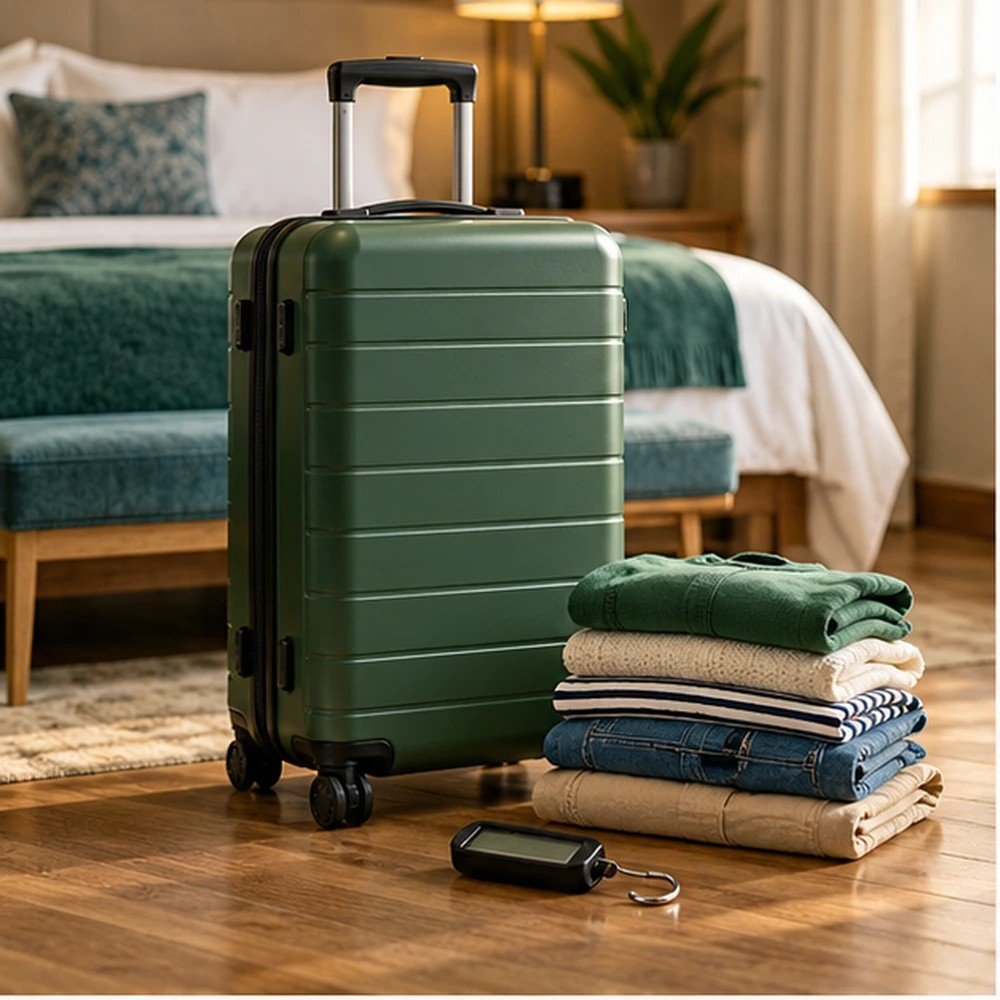
Original AI-created editorial illustration; not a photograph of a tested product.
Searching for the best suitcase size for a 20kg baggage allowance often produces a confusing mix of centimetres, inches, litres and claims about how many weeks a case can hold. None of those numbers tells you what your own packed suitcase will weigh.
The useful starting point is more practical: decide what you need to take, find a case that accommodates it without strain, and leave enough of the allowance for the container itself. A medium case is often worth trying first, but your footwear, clothing bulk and packing habits determine whether it is enough.
This guide separates the airline’s limit from the luggage shop’s size label. It compares specific cases, explains the empty-weight trade-off and shows how to test a complete load before spending money. You will also find ways to preserve room for the return journey without buying a suitcase that is unnecessarily large for every other trip.
The recommendations are research-led judgements based on published specifications and official baggage information, not hands-on testing. Where a retailer’s figures differ from a manufacturer’s, that difference is identified rather than quietly treated as a reliable measurement. You can use the same decision process with an existing case, a borrowed bag or a new purchase.
Medium, not maximum
Try a 65-70cm case before moving to larger luggage.
Count the shell
A 3.5kg case leaves 16.5kg before your personal margin.
Pack the real list
Shoes, clothing bulk and organisers matter more than trip length.
Save two kinds of room
Leave both spare litres and spare kilograms for purchases.
Best suitcase size for a 20kg baggage allowance
Start by comparing medium checked suitcases around 65-70cm tall and roughly 60-80 litres. That is an editorial starting range, not an airline rule or a promise that a full case will weigh 20kg. It works as a sensible first shortlist because it gives one person useful clothing space without immediately moving into the very largest luggage.
A suitcase near 75cm can still be appropriate when the contents are bulky but light. Conversely, someone carrying books, several pairs of shoes or work equipment may reach the weight limit in a smaller case. The right size is the smallest one that holds your actual packing list, closes without force and meets every operator’s dimensions.
Decide which problem you are solving
Ask whether you normally run out of space or run out of weight. A larger case addresses the first problem only. A lighter empty case can help with the second, but removing things you do not need usually costs nothing.
For a straightforward holiday, I would shortlist the Tripp Holiday 8 Medium, Samsonite Upscape 68cm and Samsonite Nuon 69cm before looking at larger cases. They illustrate different balances of capacity, empty weight and organisation rather than a universal ranking. Their individual limitations appear below. [1][2][3]
Keep an existing serviceable case when it already passes the packing test. Buying something labelled “20kg luggage” does not create extra allowance, and an attractive sale price is not a reason to carry more.
Understand what your 20kg booking actually includes
The 20kg figure refers to the complete checked item: suitcase, contents and anything attached to it. A cover, luggage strap, spare shopping bag packed inside and empty organiser all belong in that total. Your clothing does not receive a separate 20kg allocation.
Ryanair’s published maximum dimensions for its 20kg checked bag are 80 x 120 x 120cm. Those generous outer limits should not be mistaken for a recommended suitcase size. A bag approaching them would be a completely different handling proposition from ordinary medium holiday luggage. Check the exact baggage product on your booking rather than a retailer’s airline compatibility badge. [4]
Separate the airline from the suitcase shop
Record the booked weight, permitted number of pieces and maximum external dimensions. Then repeat that check for the return flight and any separately booked connecting flight. Your outbound airline’s allowance does not make a different operator accept the same bag.
Do not assume a 20kg limit is the default everywhere. For example, easyJet describes 23kg as its standard hold-bag option, alongside other purchased weights. The point is not to buy a case for the largest number you have seen online; it is to buy or pack for the allowance you actually hold. [5]
Photograph or save the relevant booking information before travelling. That gives you a useful reference when packing away from home, without relying on a search result that may describe a different fare.
Compare the shortlist before choosing a brand
The following are research-led examples selected for their differing size, mass and closure arrangements. None has been personally load-tested for this article. Capacities are the suppliers’ published figures; they are not measurements of how much of your wardrobe will fit.
| Exact model | Published size | Empty weight | Stated capacity | Why compare it? |
|---|---|---|---|---|
| Tripp Holiday 8 Slate Medium | 65 x 45 x 28/32cm | 3.6kg | 66/75L | Smaller holiday format with expansion [1] |
| Samsonite Upscape 68cm | 68 x 47 x 28/31cm | 3kg | 75/83L | Lower empty weight and removable lining [2] |
| Samsonite Nuon 69cm, 134400 | 69 x 45 x 28cm unexpanded | 3.2kg | 79/86L | Boxier packing layout; retailer specifications [3] |
| Samsonite Essens 69cm | 69 x 49 x 30cm | 3.8kg | 88L | A roomier latch-closing alternative [6] |
| Samsonite C-Lite 69cm | 69 x 46 x 29cm | 2.5kg | 68L | Premium option when reducing case weight matters [7] |
A slash separates unexpanded and expanded figures. The Essens demonstrates why height alone is misleading: two cases called 69cm can offer noticeably different capacity and width. Comparing just “medium” versus “large” hides those differences.
Use the shortlist without overbuying
Pick two realistic candidates, not five cases you feel obliged to inspect. Someone packing dense items should focus on empty weight and useful internal shape. Someone transporting winter clothing needs to check whether the extra volume is genuinely needed before accepting a wider shell.
No price ranking is implied by the order above. Prices, colours and availability change, so the buying links identify models rather than promise a particular offer.
Tripp Holiday 8 Medium: a compact holiday starting point
The current Slate medium listing specifies 66 litres before expansion, 75 litres expanded and a 3.6kg empty weight. Its 65cm height puts it towards the smaller end of this shortlist. The case uses polypropylene, a mesh divider and packing straps. [1]
The useful constraint of a smaller main compartment
For an individual holiday wardrobe, a more contained packing area can be helpful. It encourages you to settle the shoe and outfit choices before departure instead of treating unused corners as invitations to add things. However, this is a packing preference, not evidence that the case prevents overpacking.
At a 20kg limit, 3.6kg of case leaves 16.4kg for everything else before any personal margin. That calculation is more useful than a promise about how many days the case accommodates.
The main reservation is mass relative to the lighter examples here. Choose it because its format, handling and purchase price suit you, not because the word “medium” automatically makes it light. The Amazon listing’s capacity field differs from Tripp’s own description; use the manufacturer’s 66/75L figures and confirm the supplied model.
Upscape and Nuon: choose between two packing layouts
Upscape 68cm: more headroom in the weight budget
Samsonite lists the Upscape 68cm at 3kg with 75/83 litres of capacity. Its removable, hand-washable lining is a practical consideration for people who want easier access when cleaning the interior. That feature is distinct from claiming the entire suitcase can be washed. [2]
Compared with the 3.6kg Tripp, the stated empty-weight difference is 600g. You could keep that as spare allowance rather than immediately spend it on another item. Test whether the internal wheel housings and handle channels suit your packing cubes, because advertised litres do not describe the exact floor shape.
The Case Luggage listing inspected showed Cloud White as sold out. Treat that destination as a model listing and availability check, not a promise of immediate purchase; the separate manufacturer page provides another route to the current range.
Nuon 69cm: a boxier alternative without a huge case
Case Luggage lists the Nuon 134400 at 3.2kg, 69 x 45 x 28cm unexpanded and 79/86 litres. Its relatively straight-sided layout is worth investigating when you pack rectangular organisers or folded clothing. Those figures describe the retailer’s listed version; confirm the model and colour before ordering. [3]
Do not infer that 79 litres is precisely four litres more usable packing space than another manufacturer’s 75-litre case. Measurement methods and internal obstructions can differ. The useful question is whether your own items fit without wasting the corners.
Choose between these two by testing access, handle position and the packed shape, rather than paying solely for the larger capacity number.
Essens and C-Lite: two different reasons to depart from the default
Essens 69cm: room for bulk, not extra permitted kilograms
The Essens offers 88 litres in a 69 x 49 x 30cm shell, weighs 3.8kg and uses a three-point closure with removable packing containers. It is a useful comparison for travellers who want a latch-closing case and an interior they can lift out in sections. [6]
Under 20kg, its extra room needs discipline. The empty case leaves 16.2kg for the rest, so filling all 88 litres with dense clothing and footwear may not be realistic. I would consider it for bulky layers or shared lightweight textiles, not simply because it can hold more.
C-Lite 69cm: paying to reduce the container’s share
Samsonite’s stated 2.5kg empty weight and 68-litre capacity make the C-Lite an interesting alternative when case mass is the main frustration. Its saving against the 3.8kg Essens is 1.3kg, but it also offers less published volume. These are different designs solving different problems. [7]
The lighter specification does not prove better durability, a smoother ride on your route or good value for an occasional traveller. Compare the cost difference with how often you actually need the saving. The buying search below is specifically for the 69cm model; it is not an exact Amazon product page.
Build a weight budget before filling the case
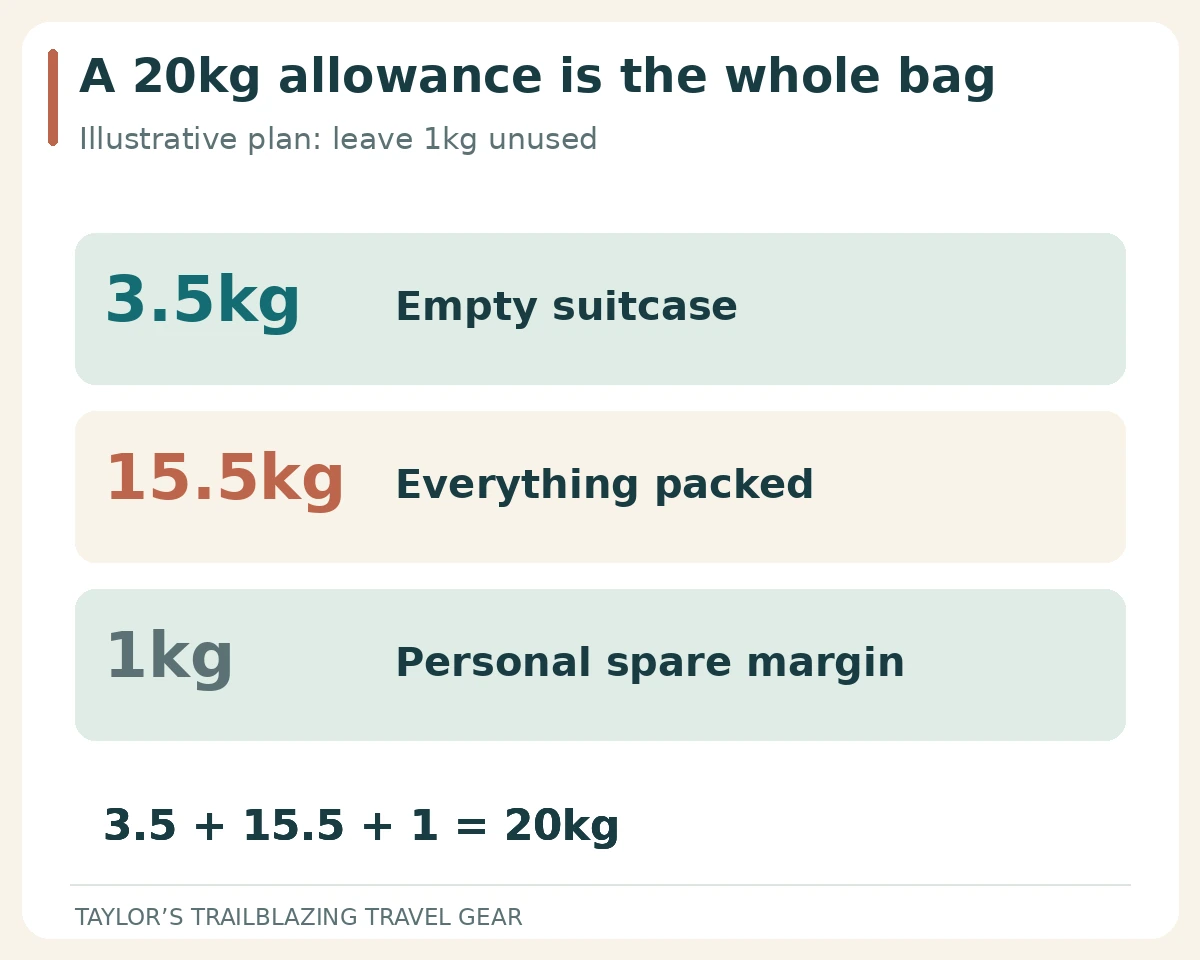
A helpful planning example is a 3.5kg suitcase, 15.5kg of contents and 1kg left unused. The total ceiling is still 20kg. The unused kilogram is your own buffer for repacking, scale differences or purchases, not an airline-granted tolerance.
| Part of the example | Weight | What it means |
|---|---|---|
| Empty suitcase | 3.5kg | Include the normal fitted interior |
| Clothes, shoes and toiletries | 13kg | An illustrative allocation, not a measured packing list |
| Organisers and other packed items | 2.5kg | Count the small items too |
| Personal spare margin | 1kg | Deliberately left below the booked maximum |
| Complete allowance | 20kg | Case plus contents plus unused margin |
Adjust the budget around your actual possessions
Replace every illustrative number with your own measurement. Someone with light clothing and heavy footwear will allocate the categories differently from someone carrying formalwear. A small digital scale is useful only if you use it before the final evening’s packing rush.
Go Travel’s Digital Scale Pro, model 2004.101, is listed with a 50kg maximum and a built-in tape measure. It is a tool for monitoring the bag, not a guarantee that its reading matches airport equipment exactly. Keep the suitcase clear of the floor and repeat a doubtful reading rather than choosing whichever result you prefer. [8]
Find your packing volume with a trial, not a day count
Lay out the clothes and equipment for the whole trip, including the items that usually arrive late: spare footwear, a wash bag, charging cables and the jacket you might otherwise wear. Separate what will genuinely travel in an independently permitted cabin bag.
Pack your current suitcase or a borrowed candidate using the organisation you expect to maintain on the return journey. Close it normally. A case that shuts only while you sit on it has failed this test, even when the scale reading is acceptable.
Test three realistic states
First, test your neat outbound packing. Next, rearrange it as it might look after several hotel changes, with a laundry bag and a less orderly fold. Finally, introduce the modest purchases you genuinely expect to bring home. Do not assume you will reproduce a perfect packing video in a small room before an early flight.
The failure tells you what to change. Excess weight means reducing mass or selecting a lighter container. Insufficient space with weight available may justify more capacity. An awkward single object may need a different internal shape rather than a taller case.
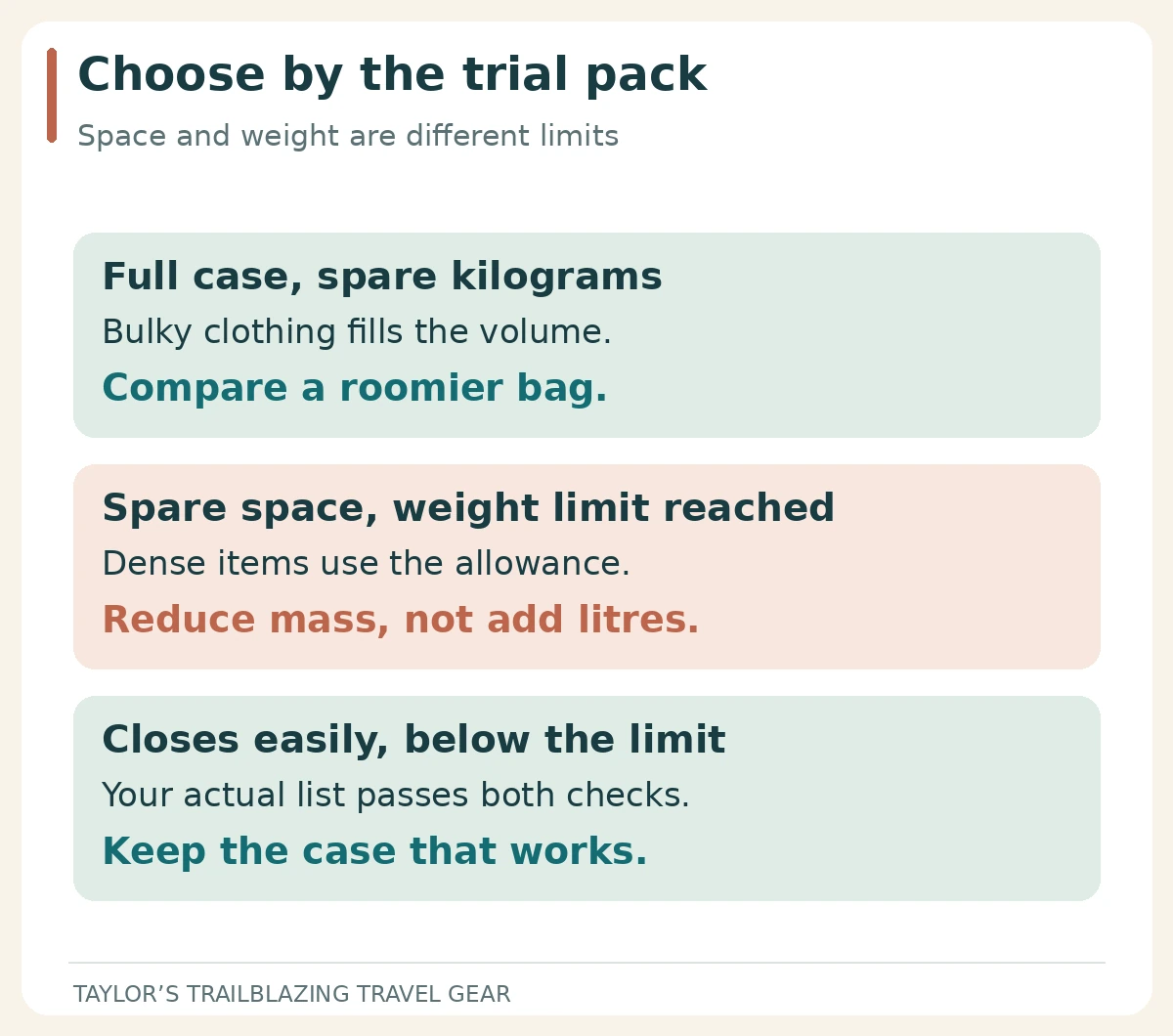
If the bag closes easily with substantial empty space, try removing an organiser or using a smaller case. There is no reward for transporting unused shell volume when another bag already does the job.
Match the suitcase to your wardrobe rather than your trip length
A one-week warm-weather holiday
Start with a repeatable set of outfits rather than a fresh complete outfit for every possible activity. For example, decide which trousers or skirt work with several tops, whether your walking footwear can also serve an informal evening, and whether you need a second bulky layer.
A medium suitcase may be comfortable for that list, but there is no honest universal claim that 65 litres equals seven days. Clothing sizes, fabrics, footwear and personal needs make such equations unreliable. The trial pack is the evidence that matters.
Two weeks with laundry available
Access to laundry changes the clothing cycle, not the duration of the trip. A traveller willing to wash halfway through may use the same case as for a shorter holiday, with a few extra consumables and a realistic drying plan.
Keep clean and used clothing separated without devoting half the case to empty spare bags. Peak Design’s Medium Packing Cube has a movable internal division intended to separate clean and dirty contents. It can help maintain a repeatable layout, although the organiser itself adds weight and cannot make the clothing lighter. [9]
Cold weather or an event wardrobe
An extra fleece, formal shoes and clothes that cannot be tightly folded can change the volume requirement dramatically. In that situation, compare a roomier medium before jumping directly to an extra-large case. Wear a suitable outer layer in transit when comfortable, but do not depend on wearing an impractical collection of heavy clothes to make the allowance work.
Control shoes, toiletries and organisers before they take over
Shoes are awkward because their shape leaves spaces that may be too small for clothing bundles. Put clean socks or soft small items inside them only when that is appropriate for the footwear and its contents. Bag dirty soles separately, then place the shoes where they will not press against fragile items or distort the closure.
Toiletries deserve a separate review. Take the quantities you need rather than automatically moving full household bottles into a checked suitcase. Larger liquid containers still count towards the bag’s weight, and individual substances can have their own carriage restrictions.
Use an organiser for a defined task
BAGSMART’s 6PCS Compression Travel Packing Cubes for Suitcases set includes separate organisers and a shoe bag. It is a practical option when you need category separation, but you do not have to use every piece. Test two or three useful pieces first; a complete matching set is not a packing requirement. [10]
Compression reduces the air between suitable soft contents. It does not remove their mass. If compressing your clothes creates room for another pair of shoes, weigh the case again instead of assuming the new space is free capacity in every sense.
Keep power banks and spare batteries in the cabin as directed by the CAA and your airline. Do not move them into the hold just because that bag has more unused weight. Essential medication also belongs somewhere accessible during the journey. [11]
Decide whether expansion or a larger shell is the better solution
Expansion is useful when it solves a specific occasional need, such as carrying an extra soft layer home. However, it changes external depth and encourages you to fill the resulting space. Recheck both dimensions and total weight after opening the expansion zip.
A case that needs expansion on every ordinary trip may simply be the wrong baseline size. Conversely, a large suitcase purchased for one unusually bulky journey can become an inconvenient default for years afterwards. Borrowing a larger bag for that trip may make more sense.
Compare the packed footprint
Put the expanded case beside an unexpanded alternative and compare depth, width and handling. A nominally medium case with a swollen front can be less pleasant to move than a sensibly packed larger one. Do not judge from height alone or from product photographs without scale.
If you need roughly 90 litres of published capacity, the 75cm C-Lite provides a 94-litre comparison at a stated 2.8kg. It is not the automatic recommendation for 20kg travel: its larger exterior and purchase cost only make sense when you have a genuine volume problem. [12]
Prefer usable space over a case that is packed to maximum tension. Straining a zip or latch to gain a few millimetres is a poor substitute for removing an item or choosing a better-fitting container.
Check the journey between home and the airport
A case that meets the airline rules can still be awkward in a narrow hallway, a small boot or a station luggage rack. Before buying, consider the smallest lift, steepest stairs and most demanding transfer on the actual journey.
LNER, for example, tells passengers to bring only what they can comfortably lift themselves and to put heavy items and large suitcases in the appropriate end-of-coach racks. Its luggage guidance is a useful reminder that a generous airline allowance does not erase the practical constraints of getting to the airport. [13]
Wheels do not remove the need to lift
Four-wheel cases are convenient on suitable smooth surfaces, but door thresholds, steps and car loading still require handling. Check the fixed lifting handles, not only the telescopic pull handle. Walk the empty candidate beside you, then assess a safely manageable representative load where the retailer permits it.
The suitcase’s own width matters when walking through gates or beside other travellers. A broad case with excellent capacity may be less convenient on repeated public-transport connections than a slightly narrower alternative.
For longer-term use, check how replacement wheels are identified. Samsonite directs owners to use the product ID when ordering compatible parts. Keep a record of the exact model rather than assuming all spinner wheels are interchangeable. [14]
This is where a familiar, repaired suitcase can beat a new purchase. Reliable handling on your route matters more than owning the lightest specification on a comparison table.
Check how the case opens where you will stay
A clamshell suitcase may need space for both halves when open, not just the footprint of the closed bag. Before ordering, mark out that arrangement beside a bed or on the floor at home. A case that fits a cupboard perfectly can still be awkward to live out of in a small room.
Think about whether you usually unpack into drawers or keep everything inside the suitcase. Removable organisers can help the second approach, while a large rigid divider may affect access to the items underneath. Try retrieving your wash bag and a change of clothes without disturbing the entire load.
This is also a useful way to assess photographs that make an interior look exceptionally spacious. Your own access routine, awkward items and storage space are better evidence than a display filled with identical soft clothing cubes. Choose a layout you can use comfortably on an ordinary morning, not only a capacity that works in a perfectly organised trial.
Weigh and measure the finished bag properly
Remove shopping labels and packaging before establishing the empty weight, but leave the normal lining, dividers and fitted components in place. Then weigh the fully packed bag with its intended strap, cover and identification tag attached.
For a handheld luggage scale, follow its instructions and use a fixed carrying handle. Lift only enough to suspend the bag clear of the floor, without twisting or straining. If that is not comfortable, use a suitable platform scale or ask for help instead of forcing a difficult lift.
Avoid a misleading measurement
A bag touching the floor or your leg is not freely suspended. An unstable reading should prompt another measurement, not a guess. Check that the display is set to kilograms; a unit mix-up can undo careful planning.
Measure the outside of the closed, packed case rather than the empty shell’s flat panel. Include wheels and protruding handles when the airline requires overall dimensions. KLM explicitly includes those parts in its checked-baggage measurement, illustrating why a manufacturer’s body-only figure would be insufficient for that operator. [15]
Place a straight edge against a rounded protrusion if the tape is difficult to align. Measure again after expansion or after attaching something externally. Record the three dimensions rather than only the tallest one.
An under-limit reading on your own scale is reassuring, but planning exactly to the final decimal leaves no practical room for change. Choose a personal margin you can live with and treat the airport’s accepted reading as decisive.
Benefits and compromises of choosing a medium case
Reasons to start with medium
A smaller exterior can be easier to store and manoeuvre. It also gives you a useful packing boundary and often avoids buying far more volume than one person needs. A well-chosen medium remains versatile when you change trip length by doing laundry rather than adding clothes.
Reasons to choose more space
Bulky winter layers, formalwear, unusually large footwear or shared lightweight items may not fit comfortably. A medium case is not a virtue when the closure is permanently strained or the return packing requires repeated compromises. More volume can be justified without increasing your target packed weight.
Keep the decision reversible
Compare the returns terms before loading a new suitcase for a trial. Keep the packaging and avoid taking it outside until you know the size works. An indoor packing assessment is different from a holiday’s worth of use, and the retailer decides what return condition it accepts.
Consider storage at home as well. A case bought for one trip still needs somewhere to live afterwards. Nesting luggage can help in some households, but only when both the actual interior and exterior dimensions allow it without forcing handles or wheels.
The strongest purchase is the case that makes your ordinary trips easier. A feature used once every several years should not dominate the decision if it adds weight or awkwardness to every other journey.
Common mistakes that turn 20kg into an airport problem
Treating litres as kilograms is the main error. A 75-litre case has no fixed loaded weight, just as a shopping basket has no fixed weight when full. Denim, toiletries and books behave differently from a fleece or empty insulated jacket.
Another mistake is counting only the objects you deliberately packed. The case, organiser set, luggage cover and shoes worn into the shop all need to be considered in their final travel arrangement. Your outbound outfit may not be the same outfit you wear home.
Beware of a last-minute “just in case” pile
The final evening often adds a second charger, another pair of shoes and toiletries that were still being used. Reserve a place on the packing list for those items instead of declaring the bag finished too early.
Do not hide a weight problem by transferring unsuitable items into another bag. Check the cabin bag’s independent allowance and restrictions first. Nor should an external bag attached to the suitcase be assumed to become part of an accepted single piece.
Finally, avoid unnecessary purchases designed to fix an unedited packing list. A scale gives useful information; it does not solve overpacking. Compression cubes can tidy a layout; they do not make it lighter. Start by removing what has no clear job, then buy only the equipment that addresses a remaining problem.
Frequently asked questions
Is a 24-inch suitcase right for 20kg?
It may be, but the inch label is not enough to decide. Retailers may describe a shell height or use a rounded category name. Look for the actual external dimensions, empty weight and usable layout, then trial-pack your belongings. A roughly medium case is a reasonable starting point rather than an automatic answer.
Can I check in a cabin-size suitcase using a 20kg allowance?
A smaller case is not inherently a problem if it satisfies the booked checked-bag conditions. However, do not load it beyond what you can handle or what its construction can reasonably accommodate. Compact luggage can become surprisingly dense, and a bag fitting cabin dimensions does not mean it remains cabin-permitted at its new weight.
Is a 28-inch suitcase too large?
Not necessarily under the airline’s rules, but it may be more volume than you need. Measure the exact product and compare it with your packing trial. A larger shell suits bulky light possessions better than a dense load that already reaches 20kg in a medium case.
Does 20kg include the suitcase itself?
Yes: plan around the weight of the complete checked item. For example, a 4kg empty case leaves 16kg before adding a personal margin. That is why comparing empty weights can be useful, although a lighter case only helps when its size and handling also suit the trip.
Can two travellers share one 20kg case?
They can share the packing space, but the booked bag still has its own allowance. Do not assume each traveller adds an automatic 20kg to that same piece. Read the airline’s rules for piece count, pooling and maximum individual bag weight before arranging shared luggage.
Should I leave room for souvenirs?
Leave both space and weight when you expect to bring purchases home. An empty corner without spare kilograms is not a complete plan. Decide a realistic return allowance before departure, then remove items or budget for a different baggage arrangement rather than relying on goodwill at check-in.
Will a luggage cover protect a poorly chosen suitcase?
A cover does not correct weak wheels, an unsuitable size or an overweight load. It also adds weight and must not interfere with handling. Use one only for a defined purpose and check it is compatible with the case and operator; do not regard it as necessary equipment for every holiday.
The recommendation: fit the load, then protect the margin
For most readers starting without a case, I would investigate a 65-70cm medium first, then prove that choice with a complete trial pack. The Tripp Holiday 8 Medium is a straightforward smaller-format comparison; the Upscape 68cm merits a look when the 600g published difference from the Tripp would be useful.
Choose the Essens for its roomier latch-closing arrangement, or the C-Lite 69cm when reducing empty weight justifies the extra spending. A larger case is a valid answer only when you have demonstrated a volume need, not because a luggage shop equates it with a number of holiday days.
The final purchase test is simple: the case closes normally, your total stays comfortably within the actual booking, and you can manage it throughout the journey. Keep the bag you already own when it meets those conditions.
For the final packing check, the Go Travel Digital Scale Pro is the most directly useful accessory in this guide. It helps you measure the thing that the 20kg allowance actually controls: the complete bag.
Sources and fact-checking notes
Source review: 15 October 2026. Product information comes from the linked manufacturer or retailer pages. Airline conditions depend on the actual booking. Calculated budgets and practical judgements are identified in the text; no personal product testing is claimed.
- Tripp: Holiday 8 Slate Medium Expandable, item 46370. 65 x 45 x 28/32cm; 66/75L; 3.6kg. Manufacturer capacity takes precedence over conflicting marketplace fields.
- Samsonite: Upscape Spinner 68cm, 143109-1041. 68 x 47 x 28/31cm; 75/83L; 3kg; removable lining and suspension wheels.
- Case Luggage: Samsonite Nuon 69cm, 134400. Exact retailer model listing. Treat colour availability and quoted specifications as variant-specific.
- Ryanair Help Centre: dimensions for a 20kg checked bag. Official 20kg-bag dimension limit; not a suitcase purchase recommendation.
- easyJet: hold luggage. 15kg, standard 23kg and heavier purchased hold-bag options.
- Samsonite: Essens Spinner 69cm, 146911-1549. 69 x 49 x 30cm; 88L; 3.8kg; three-point closure and removable packing containers.
- Samsonite: C-Lite Spinner 69cm, 122860-1041. 69 x 46 x 29cm; 68L; published empty weight 2.5kg.
- Go Travel: Digital Scale Pro, 2004.101. 50kg maximum, 91g listed product weight, spirit level and built-in tape measure.
- Peak Design: Packing Cube. Compression zip and movable clean/dirty division; no claim of reducing contents mass.
- BAGSMART UK: 6PCS Compression Travel Packing Cubes for Suitcases. Named six-piece set, compression construction and included shoe bag.
- UK Civil Aviation Authority: Pack right. Safe flight.. Cabin carriage of power banks and spare batteries; keep essential items accessible.
- Samsonite: C-Lite Spinner 75cm, 122861-1041. 75 x 51 x 31cm; 94L; published empty weight 2.8kg.
- LNER: luggage information. Storage, handling and luggage-rack guidance for LNER services.
- Samsonite: spare parts. Identify model before ordering wheels or other parts; follow model-specific fitting instructions.
- KLM: checked baggage allowances. 23kg Economy Standard/Flex allowance and 158cm overall measurement including wheels and handles.
Illustrations in this article were created for Taylor’s Trailblazing Travel Gear. Third-party photographs, where used, are credited beside the image or in the source list.