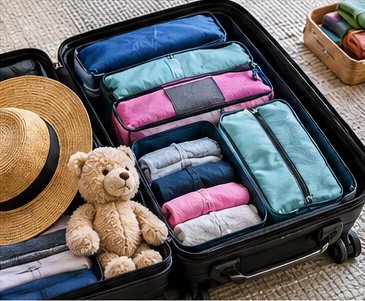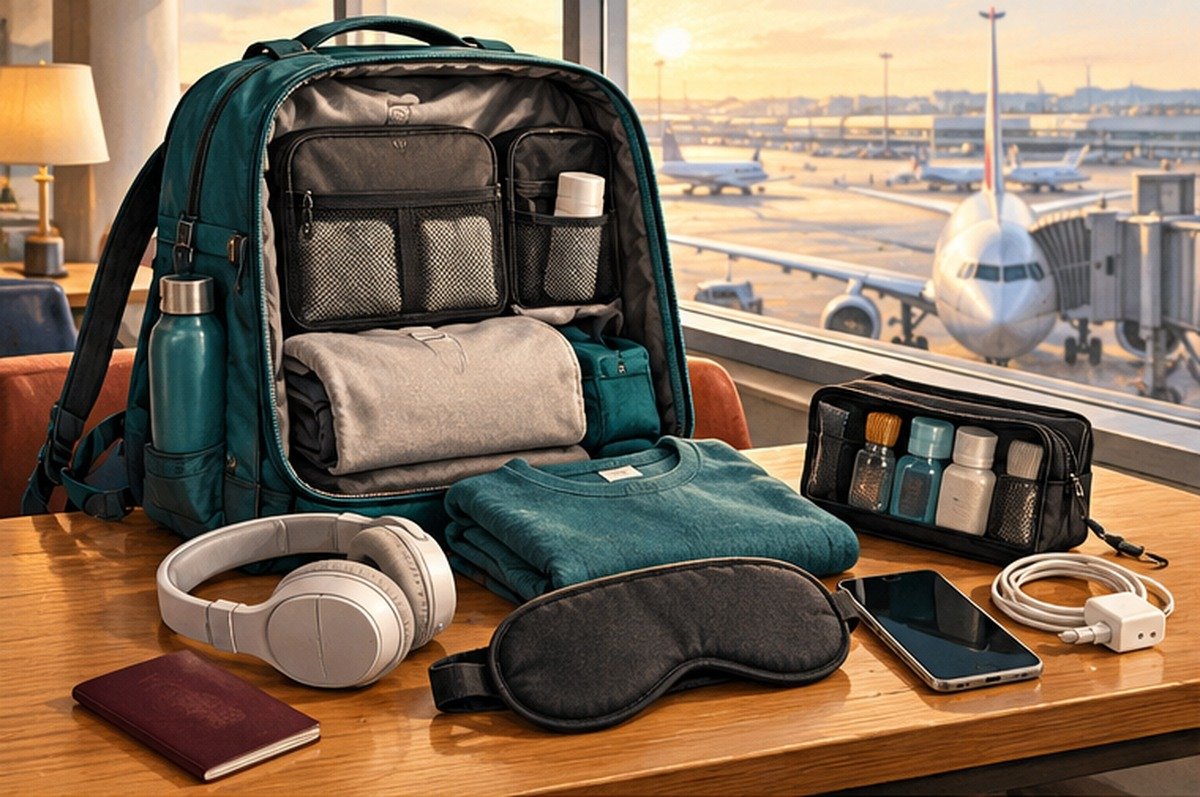
Long-Haul Flight Carry-On Packing List
A practical cabin kit for the flight, the connection and the first night without your main suitcase.
A long-haul flight carry-on packing list should do more than collect travel accessories. It should help you find what you need while seated, keep essential belongings with you if a bag is checked at the gate, and give you a workable first-night backup when the main suitcase is unavailable.
The awkward part is usually access rather than finding one more pocket. Headphones buried beneath clothing are not much use after the cabin lights go down. Similarly, a spare top does not make a complete clothing change if everything else you need is in the hold. This guide starts with those practical moments and builds the bag around them.
Use the checklist for a flight of roughly ten to fourteen hours, then adapt it to your own itinerary. That duration is a planning example, not a definition of every long-haul service. The advice also distinguishes a flight kit from a complete cabin-only holiday wardrobe, so you can decide which items deserve to remain beside your seat.
Expect ordinary packing decisions, selective buying options and current official rule references rather than claims of first-hand product testing. A bag you already own may be enough. The most useful improvement is often moving a few essentials into a removable pouch and leaving more breathing room around it.
Essentials stay with you
Documents, medicines and valuables should never depend on overhead access or suitcase delivery.
One removable seat pouch
Group what you will use while seated, without treating the pouch as an extra bag allowance.
A complete light change
Pick clothes that work with the shoes and layers you wear travelling.
Rehearse a gate check
Know which battery and personal-essential items must come out before a bag goes to the hold.
Long-haul flight carry-on packing list: the essentials
Pack for the journey and the first night
Start with the things that would genuinely interrupt your trip if your larger bag disappeared: identity documents, essential medicines, glasses, payment cards and your phone. Next, add the small items that make a long flight manageable. Only then consider spare clothing, entertainment and optional comforts. This order stops a bulky pillow taking space that your arrival essentials need.
The list below assumes an adult taking a long-haul flight with some clothing in checked luggage. It is not a complete holiday wardrobe. However, the same priorities work when you travel cabin-only: keep the journey kit easy to reach, rather than burying it beneath everything you need for the next fortnight.
| Group | What to put in the cabin bag | Where it belongs |
|---|---|---|
| Identity and money | Passport, required travel documents, payment cards, small cash reserve | Secure, reachable pocket |
| Personal essentials | Prescribed medicines, glasses, relevant paperwork, essential personal-care supplies | Removable essentials pouch |
| Power and communication | Phone, suitable cable, mains charger, permitted power bank | Protected tech compartment |
| Rest | Eye mask, earplugs or headphones, one suitable neck-support option | Small seat pouch |
| Clothing backup | Underwear, socks, one top and compact spare bottoms if needed | Separate clothing cube |
| Wash and refresh | Toothbrush, small toiletries, tissues, sanitary products | Leak-contained wash pouch |
| Food and drink | Empty refillable bottle and permitted, manageable snacks | Accessible side or upper pocket |
Set priorities before shopping
Use what you already own for the first trial pack. A washable zip pouch can separate chargers; a clean drawstring bag can hold spare clothing. Buy an organiser only when the rehearsal reveals a specific problem, such as loose plugs catching on fabric or a top-opening bag making documents difficult to reach.
Our recommendations are research-led, not the result of hands-on flight testing. Items are organised by access, usefulness and packing burden rather than commission or a universal ranking. Quantity suggestions are planning examples: adjust them for your health needs, journey length and the baggage allowance you actually booked.
Choose the bag combination your ticket allows
A cabin suitcase is not the same as a personal item
A two-bag arrangement can work well: a larger cabin case for clothing and a smaller bag for the seat. Nevertheless, you cannot assume both are included. British Airways lists a handbag allowance of 40 × 30 × 15cm and a cabin bag of 56 × 45 × 25cm; flights operated by another airline may have different rules. Check the operating carrier and your booking, not simply the airline whose logo appears on the ticket. [S1]
The smaller bag needs to fit without forcing your feet into an awkward position. Rather than selecting the biggest possible backpack, test whether its loaded shape suits your travel documents, electronics and clothing backup. A rigid laptop compartment may improve organisation but uses space even when you leave the laptop at home.
| Arrangement | Useful when | Main compromise |
|---|---|---|
| Small bag plus overhead case | Your allowance includes both and you want clothing separate | Two pieces to supervise during transfers |
| One backpack with a removable pouch | You prefer a consolidated load and can carry it comfortably | The pouch must still fit within the booked allowance |
| Compact seat bag plus checked suitcase | Most holiday clothing can travel in the hold | Keep a genuine clothing backup with you |
Avoid the word “approved” as a sizing shortcut
BAGSMART lists the Blast 28L at 42 × 31 × 20.5cm. Those measurements do not match every personal-item allowance, despite the product page’s broad underseat language. Treat it as a backpack to assess against your actual ticket, not automatic proof of compliance. [S2]
For overhead baggage, compare the empty weight as carefully as capacity. A beautifully organised case can consume an unhelpful share of a tight weight allowance before you add anything. The Case Luggage cabin collection is useful for comparing shapes and dimensions; the airline’s current allowance remains the deciding document.
Give documents and valuables one reliable home
Build an access pocket, not a dumping pocket
Keep your passport and boarding documents in a closed pocket that you can reach without opening the whole bag. Put a pen beside them when your itinerary may involve paper forms. Meanwhile, move shopping receipts, loose coins and old boarding passes elsewhere so that the document pocket stays predictable throughout the journey.
Store an offline copy of key booking details and the address of your first accommodation. A screenshot is a backup, not a substitute where an original document is required. Likewise, avoid relying on the same phone for every form of access: a charged device can still be lost, damaged or temporarily unavailable at a checkpoint.
A TORRO passport holder is an optional way to organise one passport and a small amount of paperwork. Its leather construction is a style choice, not a security requirement. A simple document sleeve may be lighter, and you should remove your passport whenever a member of staff needs to inspect it. [S3]
Divide risk sensibly
Keep your main payment method reachable, with a backup card in another secure location rather than the same tiny wallet. However, do not distribute essential documents across so many pockets that you forget where they are. Two deliberate locations are easier to manage than six improvised ones.
Before every move, use the same short check: passport, phone, wallet and bag. Repeat it after security, after changing seats and before leaving the aircraft. This is a packing habit rather than a promise against theft, but it makes absent-minded losses easier to catch while there is still time to look.
Keep medicines and personal-care essentials accessible
Plan around your own requirements
Carry the medicines and equipment you need in the cabin, with appropriate identification and any required documents. UK guidance specifically requires medicines containing controlled drugs to travel in hand luggage when entering or leaving the UK, and advises checking destination rules with the relevant embassy. A valid UK prescription does not automatically make a medicine lawful everywhere. [S4]
Leave medicines in their labelled packaging where practical. Ask your pharmacist or prescribing team about sufficient supply, storage conditions and any time-zone questions before departure. This guide cannot decide doses or whether a particular medicine is suitable for you. Moreover, specialist equipment, liquids and refrigeration needs should be discussed with the airline rather than left to an airport conversation.
Separate must-have from nice-to-have
Put glasses, contact-lens essentials, hearing-device supplies and period products where you can retrieve them without standing in the aisle. Carry the products you normally use instead of building a speculative pharmacy of unfamiliar remedies. For a long transfer, a modest delay allowance is more useful than multiple duplicate travel gadgets.
A small personal-care pouch also helps when the aircraft lights are low. Use a recognisable texture or zip pull so you can distinguish it from a charger pouch by touch. However, avoid putting leak-prone toiletries directly against medicine labels or paper prescriptions. A separate barrier protects information that matters as much as the contents themselves.
Pack power safely and simplify your electronics
Check the battery rule that applies now
Read the watt-hour marking on the actual unit rather than estimating from its marketing name. A clearly labelled unit no greater than 100Wh is the simpler starting point, but the airline’s policy still controls. Leave damaged or recalled equipment at home, and do not buy a large battery merely to compensate for carrying too many devices. [S5]
Build the smallest useful charging set
Lay every device beside its cable before packing. Then remove duplicate plugs and leads that serve no remaining device. A phone and an e-reader may need less equipment than a laptop-based work setup; conversely, a laptop needs a charger that actually supports its power requirements, not merely a connector that fits.
Keep one short cable easy to reach and the remaining equipment together. The BAGSMART electronics-organiser collection offers different formats, but compare the organiser’s own bulk before buying. A padded sleeve intended for a laptop is not necessarily a good replacement for a small cable pouch.
Prepare for a last-minute gate check
Before boarding, move your power bank, spare batteries, valuables and essential medicines into the bag you can keep with you. Tell staff about batteries when a larger cabin bag is unexpectedly taken for the hold. Do not assume there will be enough time to search through tightly compressed clothing at the gate. [S5]
Make liquids a whole-journey decision
The return airport matters as much as departure
UK guidance now says liquid rules depend on the airport: many still restrict containers to 100ml, while some permit up to two litres. Check every airport where you will pass through security, including connections and the return trip. Where a clear bag is required, follow that airport’s size and closure rules. [S6]
Packing ordinary toiletries in containers of 100ml or less remains a practical conservative approach for an itinerary involving different airports. It is not a claim that every airport requires this. Nor does a half-empty larger bottle become a smaller container: choose the bottle size deliberately rather than measuring the liquid left inside. [S6]
Carry a refresh kit rather than a bathroom cupboard
For the flight itself, consider a toothbrush, a small amount of toothpaste, lip care, tissues and the personal products you regularly need. Leave a full skincare routine in the main holiday bag unless there is a genuine reason to carry it. Fragranced sprays and messy products are also awkward in a shared cabin, even when permitted.
Use a leak barrier inside a washbag, not the washbag as your only defence. A BAGSMART Blast hanging toiletry bag is an option when you also need accommodation storage, but a larger hanging bag can be excessive for the seat. Pack the flight-sized pouch separately and check that any security liquids bag meets the airport’s requirements. [S7]
Choose comfort items that fit how you actually rest
One sleep system is usually enough
A pillow, eye mask and headphones can be useful, but buying all the largest versions produces a surprisingly bulky comfort kit. Begin with the thing that most often interrupts your rest. Light sensitivity points towards an eye mask; sensitivity to cabin noise may make headphones or earplugs the more valuable item.
Try a pillow at home while sitting upright in an ordinary chair. Check whether it pushes your head forwards, clashes with headphones or feels restrictive around your neck. The test cannot reproduce your eventual seat, yet it can identify an obvious mismatch before the item uses valuable cabin space.
The Go Travel Ultimate Pillow 3.0 at Case Luggage is a memory-foam option with an adjustable magnetic closure. Consider it as one candidate, not a guarantee of sleep or a medical solution. An inflatable alternative may pack smaller, while the best answer for a flat-bed seat may be no personal pillow at all. [S8]
Keep shared-space manners in the packing plan
Avoid equipment that needs to attach to the seat in front or occupy another passenger’s space unless the airline explicitly permits it. Likewise, check before using accessories that alter the seat belt or create an obstruction. A simple scarf or removable warm layer usually causes fewer complications than an elaborate arrangement around the seat.
Pack footwear you can put back on easily, and keep something on your feet when moving around. Put used tissues and snack wrappers into a small rubbish pouch rather than leaving them in the seat pocket. These are modest choices, but they make an already confined personal space more manageable.
Build a clothing backup that solves a real problem
Choose a complete change, not miscellaneous extras
Underwear and a fresh top are useful, but they will not solve every clothing mishap. Think through one plausible scenario: a spilled drink, a delayed suitcase or a long wait before check-in. Then assemble the smallest change that lets you continue comfortably. Compact trousers or leggings may earn their space more readily than a second bulky jumper.
Use clothing that combines with what you wear on the aircraft. A fresh top that only works with shoes and trousers in checked luggage is a weak backup. Similarly, save elaborate evening clothes for the main bag unless you genuinely need them before your luggage is likely to reach you.
The BAGSMART Blast packing cubes provide separation and compression zips, but compression does not remove weight. Use one suitable cube for the backup rather than filling every piece in a set. Leave enough room around it that you can take it out without disassembling the entire bag. [S9]
Dress for adjustable comfort
Wear layers that you can remove independently. For example, a comfortable base outfit and a light zip layer are easier to adjust than several heavy garments piled on to avoid packing them. Leave yourself somewhere to put a removed layer; otherwise it becomes one more loose object to manage at security.
After arrival, air any clothing that was compressed or worn for a long period. Keep used socks and underwear separate from the clean backup. However, do not seal damp garments indefinitely: a temporary containment bag is a transport tool, not a substitute for drying and washing.
Plan snacks, water and arrival connectivity
Keep food simple and contained
Choose snacks that you know you tolerate and can eat without preparation. A resealable packet is easier to manage than something that sheds crumbs or needs cutlery. Check the airline’s rules for food on board and the destination’s import restrictions; permission to eat an item on a flight does not mean you can carry leftovers across the border.
An empty refillable bottle gives you flexibility after security, subject to local facilities and rules. Do not pack a huge insulated bottle merely because it appears on a packing list. The bottle’s empty weight, the space it occupies and the amount you can reasonably carry all matter. Keep it separate from electronics and documents.
Download before the airport
Download entertainment, useful booking information and any essential app updates at home. Test that an offline film or book actually opens without a connection. Then reduce the number of screens you bring: a tablet may be enough for entertainment when the laptop has no other purpose.
For arrival data, compare the roaming already included in your mobile plan with a travel eSIM. An Airalo eSIM can be an alternative for a compatible, unlocked device, but check your exact handset variant, destination coverage and activation policy before buying. It is an arrival-planning tool, not a promise of connectivity during the flight. [S10]
Pack in the order you will use things
Work from the bottom upwards
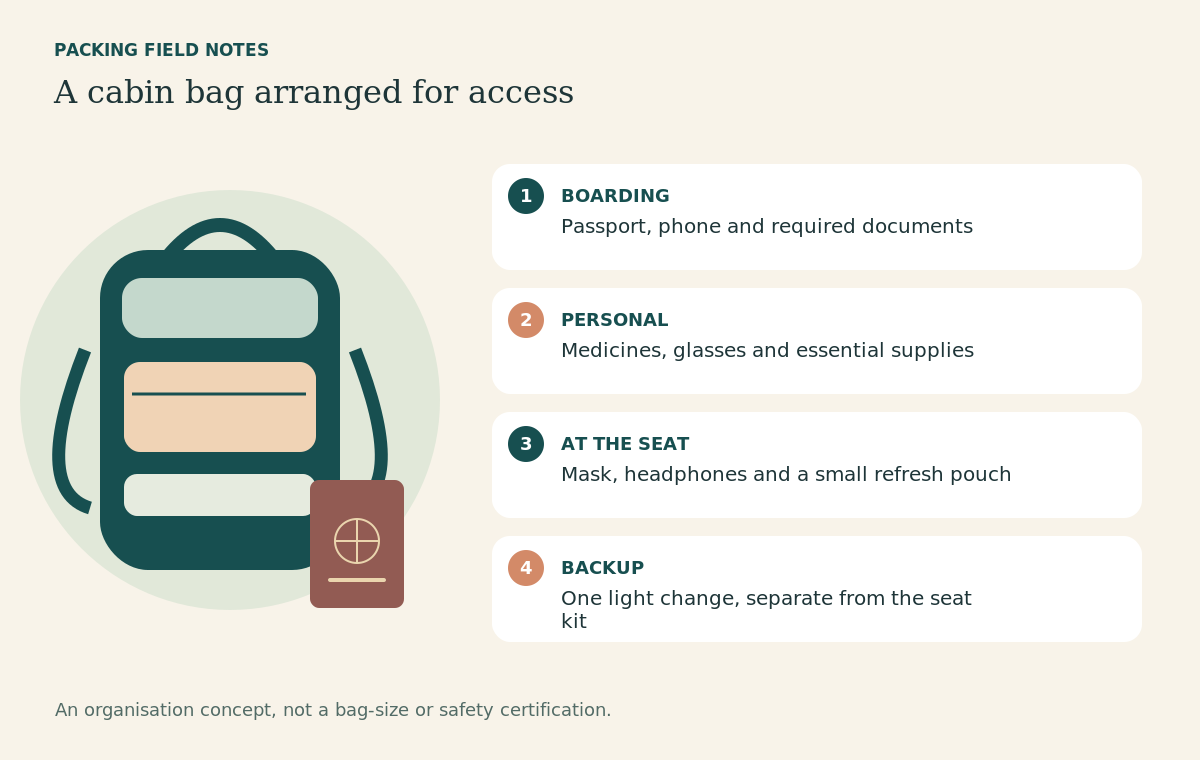
Place the least frequently needed clothing at the bottom or rear. Put the refresh pouch and anything that may need screening nearer an opening. Finally, add documents, the phone and your small seat kit. Avoid using every exterior pocket: a bottle or stuffed front pouch can change the dimensions of an otherwise compliant bag.
For a clamshell backpack, leave the side closest to the opening free of tightly wedged shoes or hard accessories. For a top-loader, use a small number of distinct pouches that can be lifted out in order. Both systems work; the failure is mixing loose items with organisers until nothing can move independently.
Rehearse from an ordinary chair
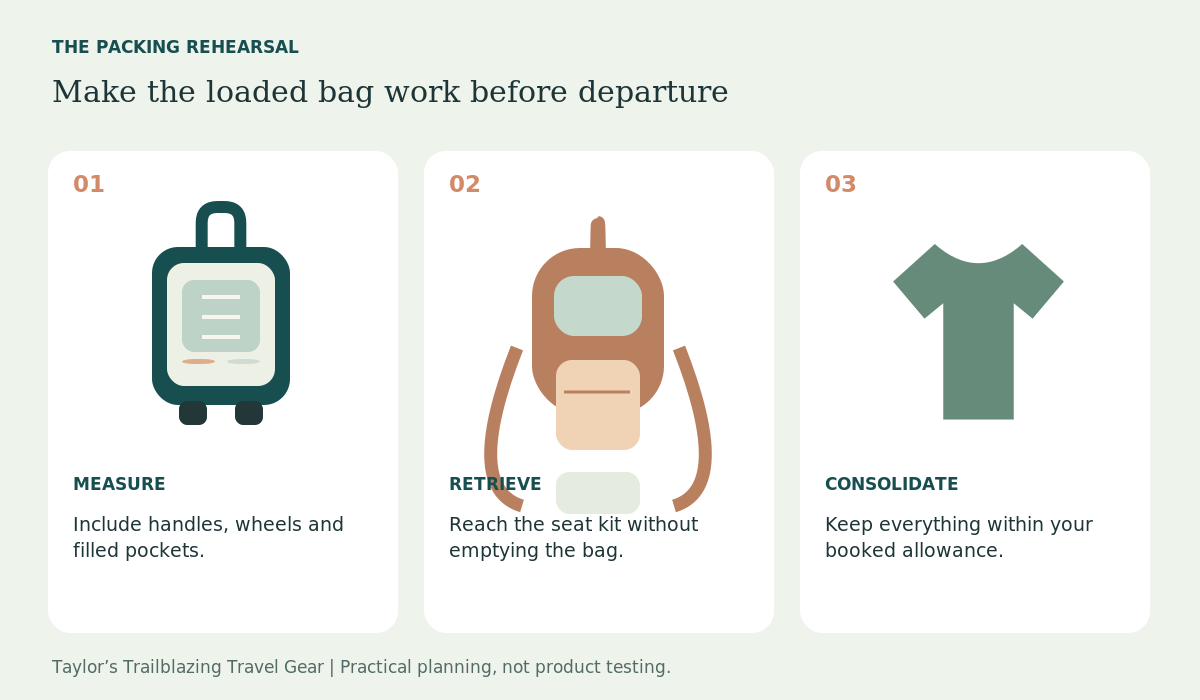
Put the packed bag under a table, sit down and retrieve your eye mask, glasses and charging cable. If you have to empty it, revise the layout. Then stand up, close everything and walk around for ten minutes. This is more informative than judging a neatly arranged flat lay on the bed.
Check zips with the bag standing upright and lying on its back. Also test the grab handle you would use when lifting it out of an overhead compartment. A bag that closes only while you lean on it leaves little tolerance for airport purchases, a hastily repacked jumper or a security inspection.
Weigh the final version
Include every pouch, bottle and attached accessory when checking the weight. The Go Travel Digital Pro Scale at Case Luggage is one optional tool; a reliable scale you already own is equally useful. Leave a margin rather than treating a home reading at the exact limit as a guarantee that every airport scale will agree. [S11]
Adapt the list to three different long-haul journeys
Overnight flight with a checked suitcase
Prioritise the small seat kit and a complete clothing backup. Pack the larger washbag and most clothing in checked luggage, while keeping personal essentials with you. Before boarding, take out the items you expect to use first so you are not opening the overhead locker repeatedly once people have settled down.
A sensible trial is a compact bag that holds documents, medicines, electronics, one clothing cube and an adjustable warm layer without being crammed. Do not treat a specific litre capacity as a promise: shoe size, clothing size and medical requirements change what fits.
Daytime flight followed by a connection
Make the walking load the deciding factor. A heavy shoulder tote can become tiring when you carry it through several terminals, so test the bag over a realistic period rather than across the bedroom. Keep the connection documents together and leave space to repack items that security asks you to remove.
Plan for the possibility that your comfortable first-leg allowance is not the tightest one. In particular, recheck the operating carrier for the onward flight. Also make sure your refresh kit and power arrangements work without relying on a specific airport lounge or an available socket.
Cabin-only holiday with the flight kit inside
Pack the holiday clothing first, then create a removable journey pouch that sits at the top. That pouch is not automatically an extra permitted bag: keep it inside your allowance until you are allowed to take it out. Once seated, you can use it to avoid searching through the entire holiday wardrobe.
This version benefits from ruthless editing of duplicate comforts rather than cutting essential clothes indiscriminately. Choose one entertainment device, one main warm layer and a small number of versatile shoes. The aim is a manageable trip, not a tiny bag that makes every other part of the holiday difficult.
Make the list work for families and different access needs
Assign responsibilities before the queue
For a family, put shared booking information in one agreed place and make sure another adult knows how to access it. However, each adult should know where their own essential medicine and identification are stored. A single shared bag is convenient until the group separates for toilets, assistance or security screening.
Give children a realistic personal kit rather than filling a small backpack because there is room. One activity, a familiar comfort item and a clothing change can be easier to manage than a collection of loose toys. Check the airline’s child and infant allowances separately: an adult’s allowance is not a reliable guide to another passenger’s entitlement.
For shared family paperwork, a TORRO family travel wallet can hold up to four passports. That capacity is useful only when the people travelling agree who carries the organiser and where it goes after each inspection. Keep essential personal supplies separately identifiable rather than assuming one shared document wallet also needs to contain every medicine, cable and payment card. [S12]
Design around reach and carrying comfort
Someone who finds deep bags difficult may prefer a shallow opening and larger zip pulls. A traveller who cannot comfortably lift a case overhead should plan around that limitation and arrange assistance where appropriate. Neither a fashionable backpack nor the lightest published weight is automatically the best solution for every body.
Keep frequently needed items on the side you can reach most easily. Meanwhile, avoid attaching important pouches to flimsy clips simply to make them visible. The most useful access improvement may be removing one unnecessary layer of packaging rather than buying another pocket system.
Prepare the bag for landing before you are tired
Keep the arrival essentials as a separate group
Picture the first few minutes after leaving the aircraft. You may need your passport, the address of your accommodation and a light layer, while headphones and an eye mask have finished their immediate job. Arrange the bag so that the arrival items are easy to retrieve without pulling out the sleep kit. This small change in priorities can prevent the most frequently used departure pocket becoming cluttered on arrival.
Keep house keys or car keys in a secure place even when you will not need them until the return journey. They are easy to overlook while preparing for the destination, yet losing them creates a problem at the end of the trip. A zipped internal pocket is generally more predictable than a loose corner beside snack packets.
Make the return pack easy to reproduce
Take a simple private photograph of the packed compartments before leaving home, avoiding visible identity details. It can remind you where the useful pouches belonged without creating another printed checklist to carry. Afterwards, note which comfort items stayed untouched. On the next trip, remove those before cutting essential supplies that proved useful.
Leave enough space for an imperfect repack. A tightly optimised bag that works only on the bedroom floor is less useful than one you can close calmly at the gate.
Pros and cons of a compact cabin kit
What the pared-back approach does well
A deliberate cabin kit makes it easier to find documents, protect essentials during a gate check and carry your belongings through a connection. It also reduces the temptation to buy last-minute accessories just because the flight is long. You can see which items already have a job and which would merely duplicate something packed.
The main benefit is not a guaranteed lighter number on the scales. It is a more predictable bag: essentials are reachable, the clothing backup is intact, and you know which pouch to take out at your seat. Those advantages can be worthwhile even when medical equipment or work tools make a minimalist load impossible.
Where minimal packing has limits
A small kit provides less clothing redundancy, and a single entertainment device creates a single point of failure. Furthermore, wearing your largest layer may be uncomfortable in a warm terminal. Do not take minimalism so far that it removes practical choices you know you need.
A better compromise is selective duplication. Keep a backup payment method and an essential clothing change, but question the third charger or second oversized pillow. The correct balance depends on the consequences of doing without something, not how neatly everything fits into a photograph.
Common mistakes that are easy to prevent
Confusing volume with permission
A bag that contains everything is not necessarily within the airline’s dimensions or weight limit. Compression can make this worse by allowing you to add more clothing. Measure the loaded bag, include protruding pockets and compare the actual dimensions rather than its advertised capacity.
Clipping a pillow, shoe bag and headphones case outside the backpack is not a dependable workaround. Those items still have to travel safely and may be treated as additional pieces. Keep your system capable of being consolidated within the allowance you bought.
Packing for an ideal flight
Do not depend on working seat power, an empty neighbouring seat, immediate boarding or guaranteed access to a particular lounge. Instead, build a kit that still works when you spend longer sitting at the gate and have less personal space than expected. Downloading entertainment and charging equipment at home are part of that preparation.
Another common error is putting every comfort item in the overhead case while leaving the underseat bag mostly empty. Reverse that arrangement: put what you need during the flight close to hand, then use the larger case for the less frequently needed clothing.
Forgetting the final collection
Before landing, collect headphones, glasses, charging leads and anything placed near your seat. Check the seat pocket without relying on it as permanent storage. Then repack liquids and batteries so the bag is ready for another security check or an unexpected transfer. A well-packed departure bag still needs a disciplined arrival routine.
Frequently asked questions
What should always stay in my long-haul carry-on?
Keep identity documents, essential medicines, valuables, payment methods and the electronics you cannot reasonably replace during the journey with you. Add a compact clothing change and the personal-care items you need before reaching your main luggage. Power banks must also remain in the cabin under the applicable aviation rules. Build the rest of the kit around these priorities, rather than starting with comfort accessories. [S5]
Do I need both a backpack and a cabin suitcase?
No. A single appropriately sized bag may be simpler, especially when you are checking a suitcase. Two cabin pieces are useful only when your booking permits them and you can manage both comfortably. Consider the transfers and stairs as well as the flight. The biggest combination allowed is not automatically the most practical one for your journey.
How many spare clothes should I pack for the flight?
For the example used here, start with one complete lightweight change rather than a miniature second wardrobe. Include underwear and socks, then choose a top and bottoms that work with the shoes you are wearing. Add more only for a clear reason, such as travelling with a child or needing specific clothing before your checked bag will be accessible.
Is a travel pillow worth the space?
It can be, particularly when you know that upright neck support helps you rest. However, the fit matters more than the size or number of features. Test it with your headphones and usual sitting posture. A bulky pillow you dislike is dead weight; a compact option you actually use can justify its place. There is no universal winner for every seat and sleeper.
Should my whole toiletry bag go under the seat?
Usually not. Separate the products you expect to use during the flight from the rest of the holiday wash kit. Keep security-regulated liquids accessible wherever they are packed, and prevent leaks reaching documents or electronics. A small flight pouch is easier to manage in a confined washroom than a large hanging organiser filled for a week away.
What should I remove if my bag is too heavy?
Begin with duplicate electronics, spare chargers, books you are unlikely to read and oversized comfort items. Then examine the weight of the empty bag and organisers themselves. Do not immediately remove important medicines or all backup clothing. A few large decisions usually help more than trimming tiny necessities that would be inconvenient to replace during a connection.
Can I rely on buying everything after arrival?
Only to the extent that you are comfortable doing without it first. Ordinary toiletries may be easy to replace, but arrival times, local availability and your personal requirements differ. Essential medicines, specialist supplies and travel documents require a more deliberate plan. Keep enough in the cabin to make a delay manageable, without treating every optional item as an emergency essential.
Should I take a laptop just for entertainment?
Only when it offers something you value enough to justify the weight, charger and protective storage. Try downloading the same reading or viewing material to the phone or tablet you already intend to carry. Then compare the experience at home. A larger screen can be worthwhile, but the decision should be deliberate rather than automatic.
For a work trip, the answer may be different. Pack the equipment required for the actual task and make sure the bag protects it without blocking access to documents or medicines. Keep work accessories together so that a mouse, adaptor or presentation cable does not become a collection of loose objects throughout the bag.
Final recommendation: pack for access, then add comfort
The best long-haul flight carry-on packing list is the one you can use while tired, seated and short of space. Start with documents, medicines, power and a clothing backup. Give each of those a reliable place, then add a modest comfort kit that suits how you travel.
Before departure, complete three practical checks: measure the loaded bag, weigh it with every accessory included, and retrieve your seat essentials without emptying it. Afterwards, remove anything that still has no clear job. That final edit is more valuable than squeezing in one additional organiser.
You do not need every product mentioned here. A bag that fits your ticket, a few existing pouches and a thought-through access plan can be enough. Spend only where a real problem remains, and let the journey dictate the packing rather than the other way round.
Sources and fact-checking notes
Editorial review: 12 October 2026. Official guidance and the linked product pages were consulted for the factual points identified in the text. Packing quantities, bag layouts and sample journey scenarios are editorial planning suggestions, not operator guarantees or claims of hands-on testing.
Check the current rules for your own airline, airport or cruise operator before travel. Product colours, sizes, stock and delivery conditions may change. No fixed retail prices, unverified offers or assumed discounts are used here.
- British Airways: baggage essentials [S1] — Published handbag and cabin-bag dimensions; check the operating carrier and booking.
- BAGSMART: Blast 28L product specifications [S2] — Published size and design information. Broad compatibility language is not treated as airline permission.
- TORRO: leather passport holder [S3] — Document-storage format and product identification.
- GOV.UK: taking medicine into or out of the UK [S4] — Controlled-medicine hand-luggage and documentation requirements; check destination rules separately.
- UK Civil Aviation Authority: March 2026 battery-rule changes [S5] — Updated power-bank carriage and use restrictions, effective from 27 March 2026; airline limits may be stricter.
- GOV.UK: liquids in hand luggage [S6] — Airport-specific limits and the need to check connections and return journeys.
- BAGSMART: Blast 4.5L hanging toiletry bag [S7] — Product format and stated capacity; not treated as a substitute for a compliant airport liquids bag.
- Case Luggage: Go Travel Ultimate Pillow 3.0 [S8] — Retailer-listed memory-foam design and adjustable closure; no sleep or medical outcome is promised.
- BAGSMART: Blast packing cubes [S9] — Compression-zip and organisation features; no quantified space-saving claim is adopted.
- Airalo: supported eSIM devices [S10] — Device compatibility, regional model limitations and unlocked-device checks.
- Case Luggage: Go Travel Digital Pro Scale [S11] — Identification of the optional luggage-weighing accessory.
- TORRO: family travel wallet [S12] — Manufacturer-stated capacity of up to four passports.
Illustrations in this article were created for Taylor’s Trailblazing Travel Gear. Third-party photographs, where used, are credited beside the image or in the source list.