
Best Flight Pouches for Long-Haul Travel
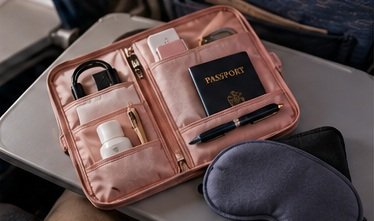
Best Flight Pouches for Long-Haul Travel
A practical home for the small things you use in the air, with separate plans for documents, liquids and batteries.
The best flight pouches for long-haul travel solve a modest but persistent problem: retrieving one small thing without emptying the bag under your seat. A charging cable, glasses case or earplug container is not difficult to pack individually. The difficulty is finding it when the cabin is dim, the tray is occupied and the rest of your belongings have settled into one untidy layer.
A pouch can help, but only when its layout matches what you carry. For example, a rigid tech organiser may be excellent for cables and awkward for a bulky eye mask. A slim document wallet can protect boarding papers without having room for a charger. Buying the biggest option usually postpones the decision about what belongs in it rather than making that decision easier.
This guide compares five useful formats using product information and UK listings reviewed on 10 October 2026. Recommendations are research-led, with no claim of personal flights, drop tests or waterproof testing. It also explains what should stay outside a general flight pouch, so a neat-looking kit does not conflict with airport screening, battery rules or a sensible document backup plan.
Bellroy Compact
A clamshell layout for cables and small accessories rather than a large toiletry collection.
Peak Design Small
A more structured way to separate several compact items.
Osprey Zipper Sacks
A modular alternative when you would rather group items than fill many internal slots.
TORRO travel wallet
A separate document-led format, not a general-purpose electronics or wash pouch.
Best flight pouches for long-haul travel: choose the format
These are not five interchangeable bags. The document wallet has a narrower purpose than the tech organisers, while the Osprey set gives you separate containers rather than a built-in grid. Use the intended role to narrow the shortlist before comparing colour, price or a vague claim of being “travel-ready”. [1] [2] [3] [4] [5]
| Option | Best suited to | What distinguishes it | Check before buying |
|---|---|---|---|
| Bellroy Tech Kit Compact | Small electronics accessories | Lay-flat clamshell, loops and mesh spaces Check Bellroy Compact | Compact, not full-size; current variant dimensions |
| Peak Design Small Tech Pouch | Several items needing separate spaces | Divided interior and wide opening Check Peak Design Small | Small model; Coyote colour and fabric version |
| BAGSMART Bubble | A soft small-accessory kit | 21 × 13.5 × 5.8 cm; 100 g Check BAGSMART Bubble | Selected colour stock; not a laptop pouch |
| Osprey Ultralight Zipper Sack Set | Separate groups of loose small items | Three different-sized zipped sacks | Little built-in structure or protective padding |
| TORRO zipped travel wallet | One-passport document organisation | 18.5 × 13.5 × 2.5 cm; 255 g Check TORRO wallet | Document-focused capacity, not an all-in-one kit |
How the recommendations were selected
Judge the pouch by the job it has to do
The shortlist prioritises access, interior layout, closure, published specifications and a clear role inside a cabin bag. A good pouch should let you retrieve a small object without dislodging five others. It should also close around the actual contents without putting strain on a cable, glasses frame or zip.
No star ratings have been converted into laboratory-style scores. We have not tested abrasion, measured water resistance or timed retrieval during a real flight. Instead, the comparisons explain the design consequences: a structured clamshell needs opening space, a soft sack needs a simple grouping method, and a slim wallet is not a substitute for a thick accessory pouch.
Why not every promising product made the main shortlist
The research found an instructive problem with BAGSMART’s Pomona organiser page: its compact-accessory description appeared alongside dimensions and capacity presented for a much larger laptop-style item. Rather than combine those fields into a confident specification, that product is not used as a size-based recommendation here. Ask the retailer to confirm the actual model before buying it. [9]
Bellroy also illustrates why version checking matters. Its current model comparison and some retail listings show different external measurements. This guide avoids treating one retailer’s compact-size figure as universally applicable to every colour or version. Compare the actual selected offer with the maker’s current information when a few millimetres determine whether your charger fits.
Availability is a check, not a promise
A current product page can include a colour waiting for restock, another colour ready to order and regional delivery limitations. BAGSMART Bubble’s selected Crepe Pink variant was showing a notification option during research, so the guide does not promise immediate availability for that colour. Check the live selection and the final delivery terms. [3]
A buying button identifies the relevant product route rather than guaranteeing the cheapest offer. Leave enough time to receive the pouch, assess the layout and return it under the seller’s terms when it does not fit. Ordering a tightly specified kit immediately before departure leaves little room to correct a size mistake.
Five pouches and the packing style each suits
Bellroy Tech Kit Compact: for a restrained cable kit
Bellroy’s compact model opens flat and uses a mixture of stretch-mesh spaces, elastic loops and a slip pocket. The current comparison shows fewer cable organisers than the full-size Tech Kit. It is intended to give small tech accessories a repeatable layout without moving to a much larger organiser. [1]
The most suitable user is someone carrying a short, stable list: perhaps a cable, earphones, a compact charger and a small adapter. That is an illustrative load, not a guaranteed fit list. Check your actual charger shape because a bulky UK plug can be the item that determines whether the pouch closes sensibly.
The trade-off is that a neat internal arrangement takes some discipline. A traveller who throws several tangled leads and an oversized eye mask into the same space may be better served by a different format. Also, clamshell access is most convenient when you can open it on a clear surface or hold it securely, rather than balancing it beside a drink.
Peak Design Small Tech Pouch: for deliberate separation
Peak Design’s Small Tech Pouch uses a divided, origami-style interior with stretch and zipped spaces and a wide-opening format. The small design has its own configuration; do not copy features from the regular Tech Pouch simply because both sizes appear on one page. The buying link here identifies the Coyote Small version. [2]
Choose this approach when you like giving individual objects defined places and can remember that layout. Small adapters, memory cards, short cables and similar pieces can benefit from separation. However, a generous number of compartments is not the same as a generous amount of room for bulky comfort items. Decide whether the structure serves your load rather than filling every slot because it exists.
Check the material description for the selected colour, too. Product families can use different fabrics or finishes, and photographs of one version do not establish another’s construction. The appeal is organised access; this guide does not claim the pouch is waterproof, a crush-proof case or a proven fit for every charging brick.
BAGSMART Bubble: a soft pouch for mixed small accessories
The Bubble’s published UK specification is 21 × 13.5 × 5.8 cm, 100 g and polyester construction, with a dual-layer layout and mesh storage. These dimensions describe a small accessory pouch despite broader wording about devices elsewhere in the marketing copy. The practical comparison is with glasses cases, earphone cases and compact leads, not laptops. [3]
Its softer format may appeal to someone who wants a little division without the feel of a rigid equipment case. Nevertheless, padding uses space too. Trial your bulkiest object first and check whether it presses awkwardly against the opposite side when closed. A zip that can be forced shut is not a useful definition of fit.
The stock qualification matters: inspect the selected colour before planning around delivery. As with any soft pouch, keep leak-prone items and exposed sharp edges separate. A fabric marketed as water-resistant does not turn a bag with ordinary openings into a container you should trust beside an uncapped drink.
Osprey Ultralight Zipper Sack Set: fewer built-in decisions
Osprey’s UK set provides three different-sized zipped sacks, with D-ring attachment points and a 40D recycled nylon main fabric. The design is straightforward containment rather than an internal collection of loops and padded compartments. It is the modular alternative in this comparison. [4]
For example, one sack can hold a small dry comfort kit while another remains elsewhere in the bag for spare accessories. That makes sense when you can recognise the groups immediately and do not want one increasingly crowded organiser. You do not need to take every sack in the set on every flight; choose the number that solves your actual packing problem.
The trade-off is less inherent shape and protection. Glasses still need an appropriate case, and loose connectors can settle together unless you manage the contents. A zipped sack is not a battery-safety certification or a waterproof dry bag. Use it to separate items, then assess the protection each item needs on its own merits.
TORRO zipped travel wallet: a document-led alternative
TORRO’s current leather travel wallet is listed at 18.5 × 13.5 × 2.5 cm and 255 g. Its specification states one-passport capacity, with document storage, a zipped internal pocket, a removable card holder and a pen loop with pen. It also includes the maker’s RFID-blocking feature. [5]
This is the appropriate comparison when the flight pouch you really need is a controlled home for one person’s papers and payment items. It is not being recommended as a family passport folder, a toiletry pouch or a place to compress a bulky charger. The slim format is useful precisely because its task is narrower.
Treat RFID blocking as one listed feature, not a reason to relax ordinary care with valuables. It cannot prevent the whole wallet being misplaced or stolen. A separate backup payment method can still be sensible, and personalisation should be considered only after checking the seller’s return conditions.
Decide the contents before choosing the capacity
Build a during-the-flight list
Write down the things you expect to handle while seated, rather than everything you will use during the whole trip. A daily hotel charger, spare camera cable and full wash kit may belong elsewhere. Keep the immediate-access pouch focused on the objects that are inconvenient to find when the main bag is stowed.
Use your previous journey as evidence. Which items came out repeatedly, which came out once and which stayed untouched? This simple distinction prevents the pouch becoming a miniature storage cupboard. A smaller, relevant load is easier to recognise and check before leaving the aircraft.
Let the awkward object set the minimum size
Spread the proposed contents on a table and identify the thickest or least flexible object. It might be a hard glasses case, a charging plug or a chunky headphone case. Measure that object in the orientation it will occupy, including protruding pins or connectors. A pouch’s overall length does not tell you whether one internal compartment will accept it.
Put that object in first during a trial, then add the smaller items. Check whether the zip follows its path naturally. When the pouch closes only by crushing the contents towards the centre, reduce the load or choose a different shape. Do not assume a soft exterior means the objects inside can tolerate compression.
Leave some deliberate empty room
A completely full pouch is hard to work with because removing one thing can disturb several others. Leave enough room to return an item without reproducing a precise packing puzzle. This matters particularly after you have uncoiled a cable or opened a packet that no longer folds into its original shape.
Empty space is not wasted when it makes the pouch usable. The goal is not to achieve the highest possible packing density. It is to retrieve and replace small belongings without spilling them across a tray or into the footwell.
Keep a comfort kit different from a technology kit
A soft eye mask, tissues and earplugs need different spaces from hard plugs and adapters. Combining them can work in a sufficiently simple layout, but do not force the arrangement. A small soft bag for comfort items may be more convenient than stretching every mesh slot in a tech organiser.
Likewise, do not place an unprotected glasses frame beside loose metal connectors just because both objects are small. Give fragile items their appropriate case. The pouch keeps cases together; it does not automatically replace the protection they provide.
Test access, not just whether it fits in the bag
A pouch has two useful sizes
The first is its closed size inside your personal item. The second is the space it needs while you open it and reach for something. A clamshell may fit neatly while closed but need more working room than a simple top-opening pouch. Consider both stages before deciding that a shape is compact.
At home, sit in a chair with the packed personal item in the place you expect to reach. Retrieve the pouch, take out one familiar object and put it back. Keep the exercise ordinary rather than making the bag unusually empty. The aim is to notice awkward access, not to stage a successful demonstration.
Check the pull tab and opening direction
Look at whether the zip is easy to identify and operate with your normal grip. A small smooth pull may be less practical than it looks, especially when you are tired or wearing a light layer over your wrists. Do not assume another traveller’s favourite fastening will suit your hands.
Opening direction also matters. If an internal mesh pocket faces downwards when the pouch is held naturally, you may have to rotate the whole item to reach it. That is not necessarily a defect, but it affects whether the layout will feel intuitive when lighting and space are limited.
Try returning it with the rest of the bag untouched
After retrieving the object, put the pouch back without rearranging the laptop sleeve, jumper and other contents. This tests the part of the routine that product photographs never show. A pouch that only fits when the entire bag is rebuilt may lead you to carry it loose after the first use.
Choose one repeatable position: an upper compartment, a side-access section or another pocket that the bag is designed to provide. Avoid wedging the pouch against a fragile device or using a crowded corner that repeatedly catches the zip. A predictable home makes the system easier to maintain.
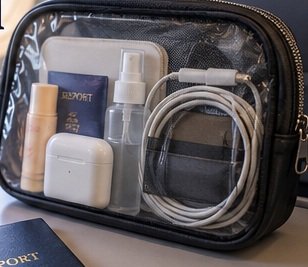
Four practical packing layouts
The minimal reading-and-resting pouch
For this layout, start with glasses in their case, an earplug case, tissues and perhaps a small eye mask. Keep any reading device separately protected. There is no reason to add a spare charger merely because the pouch has an empty elastic loop; the kit’s job is to support the period when you are trying to settle down.
A softer pouch can be a better comparison than a densely divided tech organiser when most of the contents are fabric or cases. BAGSMART Bubble is one option to assess against your objects, with the current colour availability checked before purchase. Close the pouch while wearing your usual glasses so you can judge the routine you will actually use.
The modest phone-and-cable kit
A phone user may need one compatible cable, a compact adapter and an earphone case rather than a full mobile office. Keep the cable loosely organised so it can be removed without pulling another object out. Do not wrap it so tightly around a plug that the connectors are constantly bent at the same point.
Bellroy Compact suits the idea of a restrained, repeatable layout. However, remember that carrying a charger does not establish permission to use every power source on board. Keep the power-bank rules separate and do not bury batteries where the carrier requires them to remain accessible.
The traveller carrying several small adapters
A more divided organiser can make sense when several similar small items need their own locations. Give each one a stable place and remove obsolete pieces before the trip. A collection of adapters retained from old devices is not a useful reason to buy a larger pouch.
Peak Design Small is the structured comparison in this scenario. The point is separation and recognition, not taking the maximum number of objects. Use one place for a genuinely needed spare and avoid filling every remaining compartment with speculative extras.
The traveller whose priority is documents
Keep a document wallet focused on documents. Put the passport, relevant papers and a working payment method where you can identify them quickly, while retaining suitable backups separately. Once boarding is finished, close the wallet and return it to a secure pocket rather than leaving it on the tray beside a drink.
TORRO’s wallet suits a one-passport layout according to its current specification. A family needs a different capacity assessment, and a bulky flight comfort kit needs a different type of pouch. It is better to make those distinctions before buying than to force every item into an expensive wallet afterwards.
Separate liquids, documents and batteries deliberately
A general pouch is not automatically a screening bag
GOV.UK advises checking the rules at the departure airport, any transit airport and the airport used for the return journey. Liquid restrictions and the need for a transparent bag can depend on the airport. Do not assume an opaque tech pouch is acceptable merely because it contains small bottles. [6]
Keep your screening arrangement easy to remove when required. After security, you can organise permitted items for the flight, but remember that a later connection may involve another check. A neat layout should not depend on never having to separate the contents again.
Put leak-prone items away from paperwork and electronics
A small bottle can still spoil the contents of a pouch. Use appropriate closed containers and keep liquids away from documents and devices rather than trusting a general fabric description. A mesh divider may make a bottle visible without providing any meaningful separation from the objects beside it.
The same principle applies to a used damp cloth or recently cleaned item. Give it a suitable separate place until it can be dried or dealt with properly. Do not turn the dry flight-accessory pouch into a temporary bin for everything that no longer has an obvious home.
Follow the carrier’s battery rules, not the pouch photograph
The CAA’s current advice places power banks in cabin baggage and warns against charging them during flight. The actual operating airline may have additional restrictions on quantity, capacity, use and location. A pouch with a cable opening is not evidence that an in-flight charging arrangement is permitted. [7]
For example, Qatar Airways’ current alert limits passengers to two power banks of no more than 100 Wh each, prohibits charging the power banks in flight and requires accessible storage rather than overhead or side lockers. This is a dated airline example checked on 10 October 2026, not a universal rule for every carrier. [8]
Choose a layout from which the battery can be removed or made accessible as the rules require. Do not conceal it under layers of comfort items. Check your specific carrier again before departure, particularly when a connecting journey uses more than one operating airline.
Keep essential medicines identifiable and accessible
A general flight pouch should not become a reason to discard necessary medicine labelling or ignore storage directions. Keep required information and suitable packaging, and check official rules for the journey. Liquid medicines and other medical items can have separate screening provisions; GOV.UK directs travellers to the relevant guidance. [6]
Plan accessibility around your own needs and professional advice, not around the prettiest arrangement of compartments. This buying guide does not prescribe treatment or set a universal medicine-packing list. The useful principle is to avoid burying something important beneath a collection of optional accessories.
Keep organisation from becoming a single point of failure
One tidy wallet can still be one vulnerable object
A zipped wallet makes papers easier to contain, but putting every form of identification and every payment backup into it creates a concentrated loss. Decide what needs to travel together and what should remain separate. The related document-organiser guide explores that trade-off more fully.
Do not assume an RFID feature changes the ordinary risk of misplacing the whole wallet. It cannot stop you leaving it in a seat pocket or handing it over with another bag. A deliberate storage routine is still necessary, regardless of the material or the sophistication of the marketing.
Plan the airport handover points
Think about the moments when documents move: check-in, security where relevant, the boarding gate and arrival checks. Give the passport a clear return location after each use. A wallet that is difficult to close one-handed may need a different handling routine from a slim sleeve.
When travelling with someone else, agree who is holding shared paperwork. Avoid a system in which each person assumes the other has returned a document to the pouch. A simple spoken check can be more useful than adding another concealed compartment.
Reduce visible personal information when it is not needed
A transparent organiser can make contents easy to identify but also leave information visible to others. Decide whether you really need a boarding pass or document displayed throughout the flight. Once an item has served its purpose, return it to a closed storage place.
Likewise, a luggage-style label on the pouch does not need to display more personal information than is useful for return. Use an appropriate contact method and consider the context. Organisation should make your own access easier without turning the pouch into an unnecessary display of private details.
Make the pouch part of a repeatable travel routine
At home: pack the same way twice
After the first packing trial, empty the pouch and repeat it without looking at a photograph. This tests whether the layout is memorable. If you keep placing the same object in a different compartment, simplify the system or choose a more obvious location rather than adding labels to every tiny slot.
Check that the pouch remains useful when one item is absent. A charger plugged into the wall at home or earphones currently in use should not make the remaining layout collapse. The system needs to work during the journey, not only when every compartment is full.
Before boarding: remove last-minute additions
Airports create opportunities to add receipts, sweets, sample toiletries and spare cables to whatever pouch is nearest. Before boarding, take a moment to return the kit to its intended role. Put waste and shopping elsewhere, within your permitted baggage, so the pouch remains easy to navigate.
Keep the handle or pull accessible inside the personal item. There is little value in a beautifully arranged kit hidden beneath the very items you need to avoid moving. A consistent top-level location can save more effort than another internal compartment.
During the flight: take out one object, then close it
Avoid leaving the pouch open across the tray for long periods. Remove what you need, close it and return it to its place when practical and permitted. This reduces opportunities for small pieces to mix with meal items or disappear among bedding.
A wide-opening organiser is still useful for occasional full access, but it does not need to stay open to justify its design. Think of it as a tool for retrieval rather than a miniature desk display. The simplest routine is usually the one that produces the fewest loose objects.
Before leaving: check against a short mental inventory
Account for the few essential items that came out of the pouch. Then check the tray area, the aircraft pocket you used and any folded clothing or blanket. Do not rely on the pouch looking approximately the same weight or shape as it did at boarding.
Put it back inside the appropriate bag before standing when possible. A small case carried loose in one hand is easy to set down during the next task. Keep all belongings stowed as required, and leave them behind in an emergency evacuation while following crew instructions.

Care for the pouch and the objects inside it
Clean according to the actual material
Leather, padded fabric, lightweight nylon and coated shells do not share one universal washing method. Follow the manufacturer’s guidance for the selected model. An organiser can also contain stiffening or a lining that is less obvious than its outer surface, so avoid assuming the whole item can be soaked.
Empty all compartments first and check hidden corners. A forgotten tissue or small adapter can turn a routine clean into a nuisance. Allow the pouch to dry as directed before placing electronics or documents inside again.
Inspect the places that take the strain
Look at the zip ends, pull attachment, elastic loops and pocket seams. If a compartment is repeatedly stretched around an oversized object, change the layout rather than waiting for it to fail. The shape of the contents can be as important as the fabric’s advertised toughness.
Check the objects too. A cable with visible damage or a swollen battery needs appropriate action, not a deeper pocket to hide it in. The pouch is a good opportunity for a quick equipment check before the next trip.
Reset the kit after every journey
Remove receipts, expired items and accessories that were not useful. Replenish consumables and put the pouch away with only the stable parts of the kit. Leave enough flexibility to adjust for a different airline, device or length of journey.
A short note about one awkward object can guide the next change. Perhaps the glasses case was too bulky for a mesh slot, or the eye mask caught in the zip. Solve that specific problem before replacing the entire organiser with a larger version.
Spend on the layout you will use
An existing pouch may already be enough
Try a clean zipped bag you already own before buying a specialist organiser. If it contains the right objects, fits your personal item and is easy to recognise, you may not need anything else. A dedicated tech pouch earns its price when its layout solves a real retrieval or protection problem.
Do not mistake a branded label for a better packing habit. A premium organiser full of obsolete cables remains a poor kit. Begin with the contents and only pay for features that improve how you carry those particular objects.
Compare return terms and variant information
Read the seller’s terms while the purchase is still optional. A personalised document wallet may have different return conditions from a standard item. An overseas delivery or a restock notification may not suit a trip leaving soon. These details can be more consequential than a small difference in headline price.
Compare the same size, colour and included parts across offers. A full-size tech pouch and its compact sibling are not direct substitutes merely because they share a product family name. Likewise, photographs may show accessories that are not included.
Do not let an accessory become another luggage problem
The FAA advises checking the permitted number and size of carry-on items with the airline and keeping straps controlled. A small pouch does not automatically receive a separate allowance because it is sold for use in flight. Plan to keep it within your permitted baggage arrangement. [10]
Avoid adding a long strap solely because it is available. A strap can be useful when a product is designed to carry that way, but it also needs a clear place when the pouch returns to a bag. Choose around your actual handling routine rather than the maximum number of possible configurations.
Pros and cons of a dedicated flight pouch
Common flight-pouch mistakes
Buying litres instead of usable space
An advertised capacity does not describe the shape of every compartment. Your hardest-to-fit object may still be too wide or thick. Measure that object and check the actual opening and layout, rather than assuming a larger overall volume solves the problem.
Mixing clean comfort items with leaking toiletries
A soft eye mask and a bottle of lotion do not become good neighbours because a mesh divider sits between them. Keep leak-prone items appropriately contained and separate from dry fabrics, documents and electronics. Build the screening arrangement around the airport rules rather than the organiser’s appearance.
Keeping every backup in the most convenient case
A single tidy pouch can be misplaced as easily as a loose object. Separate important backups according to your travel needs and maintain a clear document routine. Do not let convenience at the seat quietly undo a sensible plan for identification and payment.
Choosing complicated organisation for a tiny kit
When you carry only three or four small objects, numerous internal slots may add little value. A simple closed pouch can be easier to use and inspect. Choose more structure only when you can explain which retrieval problem each division solves.
Frequently asked questions
What is the difference between a flight pouch and a tech pouch?
Flight pouch describes the role rather than one standard product. It might hold comfort accessories, documents or a small technology kit. A tech pouch usually provides compartments for cables and electronic accessories. Choose the interior around your own contents, and do not assume every tech organiser is comfortable to use for bulky fabric items or toiletries.
How large should a long-haul flight pouch be?
Large enough for the actual objects you use while seated, with a little room to return them easily. Measure the thickest object first and consider the opening space as well as the closed size. There is no universal ideal capacity. A smaller kit with a repeatable layout is often more useful than a larger pouch full of speculative extras.
Can my flight pouch hold my liquids through airport security?
Only when the arrangement meets the requirements of the airports on your journey. GOV.UK advises checking departure, transit and return-airport rules because liquid limits and transparent-bag requirements can differ. An opaque organiser or a bag marketed for travel is not automatically acceptable. Keep any required screening bag easy to remove. [6]
Should I keep a power bank inside a tech pouch on the plane?
Follow the operating airline’s current rules about carriage, quantity, capacity, use and accessible storage. A tech pouch is not permission to conceal or charge a battery. Be ready to remove the power bank from a cabin bag that is being checked into the hold, and arrange the kit so any required access or visibility is straightforward. [7] [8]
Is the TORRO wallet suitable for a family’s passports?
The current product specification reviewed for this guide states one-passport capacity. Do not stretch that into a family recommendation simply because the wallet has several document slots. A family needs a separate capacity and access assessment. Keep the wallet’s document role distinct from the pouch holding comfort accessories and electronics.
Does water-resistant mean the contents will stay dry after a spill?
Not necessarily. Fabric treatment, seams, zips and openings all affect the outcome, and this guide has not tested the pouches for liquid ingress. Keep bottles closed and separated from vulnerable contents. Use a genuinely suitable protective container when the risk requires it rather than inferring waterproof performance from a general marketing phrase.
Can I use a normal washbag instead?
A clean, dry washbag can be a useful trial when its size and layout suit the kit. Check that it has no residue, does not force fragile objects together and is easy to retrieve from your personal item. You only need a specialised flight pouch when it provides a meaningful improvement over the container you already own.
Are these products reviewed from personal flying experience?
No. The recommendations are based on published product information, identifiable listings and practical analysis of the layouts. No personal flight trials, waterproof tests or measured durability claims are made. The guide highlights uncertain specifications and stock qualifications rather than turning them into confident performance promises.
Build a useful kit, then choose its container
Choose Bellroy Compact for a small repeatable technology load, Peak Design Small when separate spaces genuinely help, and a soft pouch such as BAGSMART Bubble when the contents are less rigidly organised. Osprey’s set is the modular alternative. Keep TORRO’s wallet for the document-led role it is designed to serve rather than forcing it to become an all-purpose flight kit.
The winning arrangement is the one you can retrieve, use, close and put back without a second thought. Start with fewer objects, keep liquids and batteries subject to their own rules, and avoid putting every important backup into one case. A flight pouch should make the journey easier to manage, not become another bag that needs managing itself.
Sources and fact-checking notes
Sources were reviewed on 10 October 2026. Where model measurements or stock information were unclear, the limitation is stated rather than silently resolved. Airline and airport requirements can change; recheck the operating carrier and every relevant airport before departure.
- Bellroy Tech Kit Compact: current layout and model comparison
- Peak Design Small Tech Pouch: small-model design and features
- BAGSMART Bubble Electronic Organizer: dimensions and UK availability
- Osprey UK Ultralight Zipper Sack Set: three-bag format
- TORRO zipped leather travel wallet: capacity and dimensions
- GOV.UK: liquids in hand luggage and airport-specific requirements
- CAA: current power-bank and lithium battery packing advice
- Qatar Airways: power-bank travel alert and current restrictions
- BAGSMART Pomona: product page with conflicting size context
- FAA: carry-on allowance, stowage and loose straps
Product photographs have not been presented as test evidence. The generated illustrations show generic travel-gear concepts; they do not establish a named product’s exact appearance, performance or approved use. Retail stock and seller terms should be checked when ordering.
Illustrations in this article were created for Taylor’s Trailblazing Travel Gear. Third-party photographs, where used, are credited beside the image or in the source list.