Thailand travel planning
Bangkok, Chiang Mai and Krabi without treating transfer days as free time.
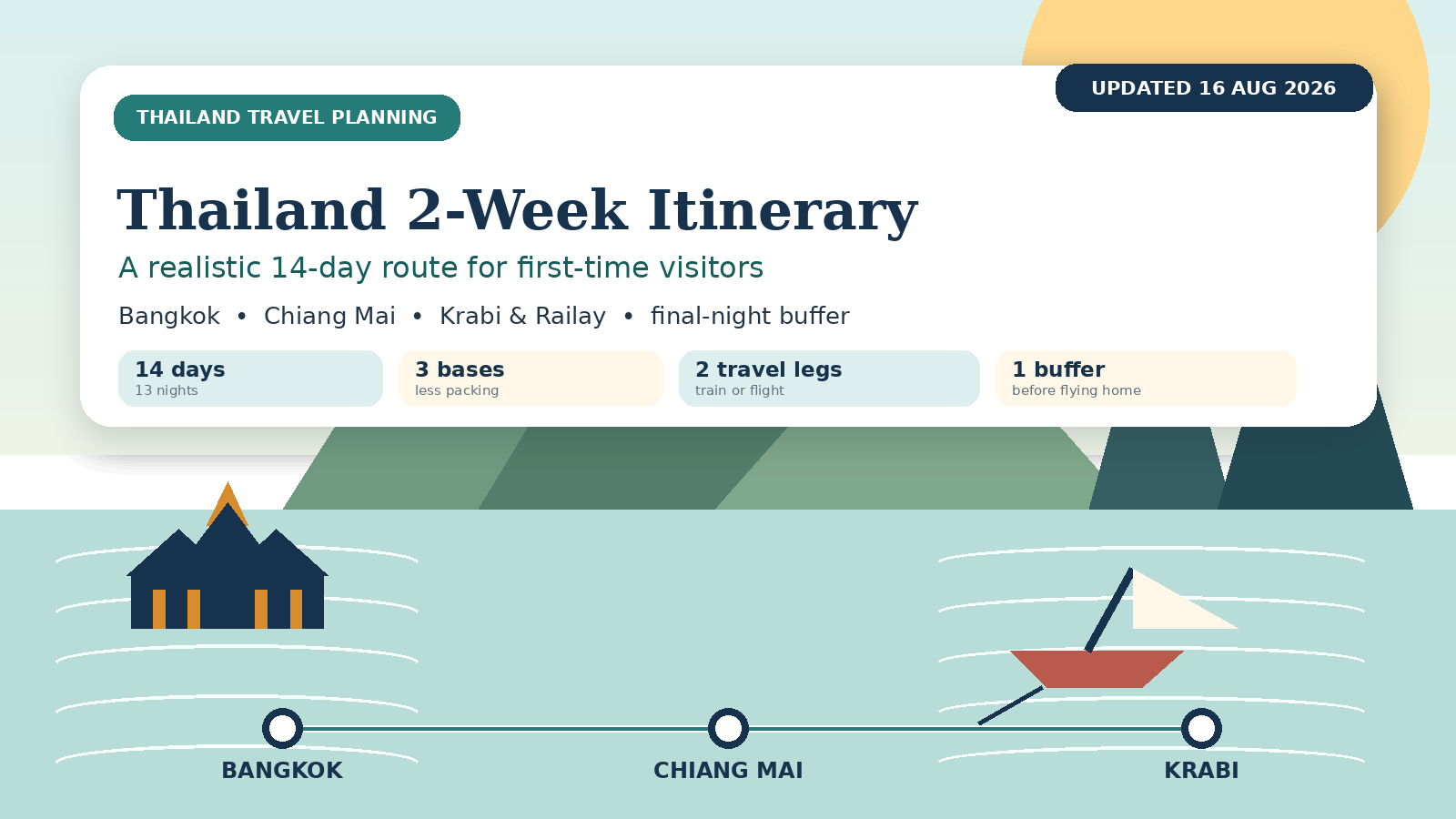
A Thailand 2-week itinerary can feel generous on paper. Then the airport transfers, hotel check-ins, baggage queues and boat schedules arrive. A flight advertised as 70 minutes may take four or five hours door to door, while a beach transfer can absorb most of a morning once the pier and road journey are counted.
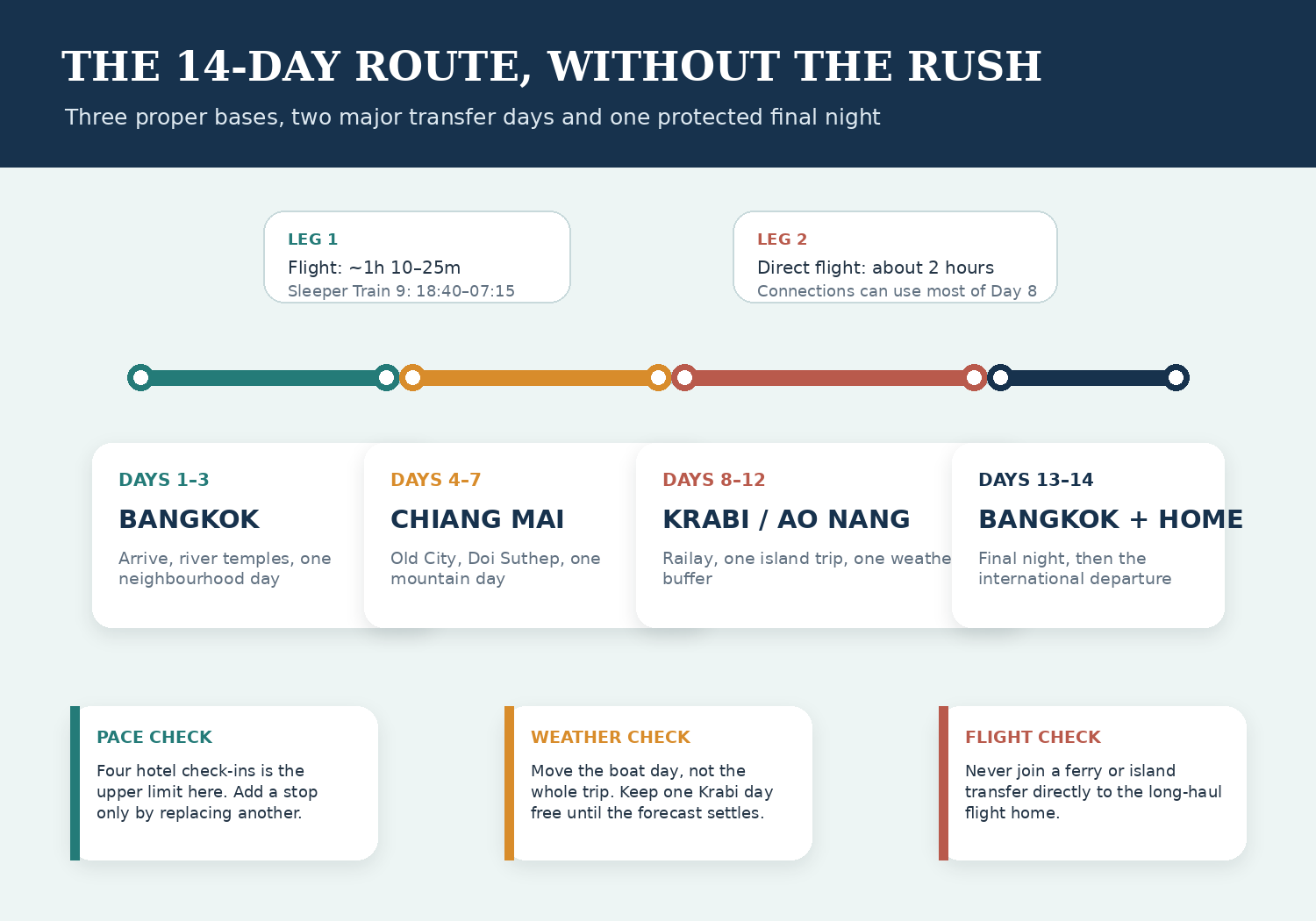
That is why this route stays deliberately simple. It begins with three nights in Bangkok, continues with four nights in Chiang Mai, then finishes with five nights around Krabi and Railay before one final night back in Bangkok. You see a modern capital, northern Lanna culture, mountain scenery and the Andaman coast, yet you only unpack in three proper holiday bases.
The route is also designed to bend. March and April need an air-quality check before you commit to northern Thailand. During wetter Andaman months, the Krabi section needs flexible boat days or a switch to the Gulf. In every season, the final Bangkok night protects the long-haul flight from a delayed ferry or domestic connection.
However, prices and schedules below are dated planning anchors, not promises. Therefore, recheck official opening hours, entry requirements, weather warnings and live fares for your exact dates.
The best Thailand 2-week itinerary, quick answer:
A balanced Thailand 2-week itinerary uses 3 nights in Bangkok, 4 nights in Chiang Mai, 5 nights in Krabi or Ao Nang and 1 final night in Bangkok. Keep Days 4, 8 and 13 as transfer days, then leave one southern day flexible for weather.
Thailand 2-week itinerary: quick answers
Best first route
Bangkok, Chiang Mai and Krabi/Railay.
Minimum comfortable trip
13 nights in Thailand, plus the international travel time.
Best all-round months
November to February, while still checking exact forecasts.
Working mid-range budget
About 65,000-110,000 baht per person, excluding international flights and based on sharing rooms.
Train or flight north
Fly for time; take the sleeper when the journey is part of the holiday.
Best Krabi base
Ao Nang for convenience; Railay for atmosphere and boat-only seclusion.
Most useful buffer
One mainland or Bangkok night before the long-haul departure.
Biggest planning mistake
Adding Phuket, Phi Phi, Koh Lanta and Koh Samui without removing another stop.
The 14-day Thailand route at a glance
This plan uses 14 calendar days and 13 hotel nights. In practice, Day 1 is an arrival day, and Day 14 is the international departure. A late landing does not magically create a sightseeing evening, so the first useful full day is Day 2.
Day-by-day overview
| Day | Sleep in | Main plan | Travel reality |
|---|---|---|---|
| 1 | Bangkok | Arrive, reach the hotel, eat nearby and sleep. | Airport, immigration and check-in day. |
| 2 | Bangkok | Grand Palace, Wat Pho, Wat Arun and Chinatown. | Keep the old-city sights together. |
| 3 | Bangkok | Choose a market, food tour, museum or neighbourhood day. | One paid activity is enough. |
| 4 | Chiang Mai | Fly north or arrive after the sleeper train; easy evening. | Major transfer day. |
| 5 | Chiang Mai | Old City temples, food and a walking market when dates align. | Full city day. |
| 6 | Chiang Mai | Doi Suthep, Nimman and a relaxed evening. | Half mountain, half city. |
| 7 | Chiang Mai | Doi Inthanon, Mae Kampong or another full-day trip. | Choose for weather and energy. |
| 8 | Ao Nang or Krabi | Fly south, transfer to the hotel and keep the evening loose. | Major transfer day. |
| 9 | Ao Nang or Railay | Railay and Phra Nang with tide and sea conditions checked. | Boat-access day. |
| 10 | Ao Nang or Krabi | Hong Islands, Four Islands or a mainland alternative. | Forecast decides. |
| 11 | Ao Nang or Krabi | Pool, beach, spa, climbing or a slow local day. | Protected recovery day. |
| 12 | Ao Nang or Krabi | Second outing, Krabi Town or the moved weather day. | Keep flexible. |
| 13 | Bangkok | Fly to Bangkok and stay central or near the departure airport. | Protect the long-haul flight. |
| 14 | Departure | Airport transfer and flight home. | No ferry connection today. |
Why this pace works
The simplest test I use is to count hotel check-ins. This itinerary has Bangkok, Chiang Mai, one Krabi-area base and the final airport-protection night. Therefore, any extra stop must earn its place by replacing another destination, not by being squeezed between two existing ones.
There is also a deliberate free day in the south. However, that is not wasted space. Instead, it can absorb rough seas, a delayed flight, sun fatigue or the perfectly reasonable decision to spend an afternoon by the pool. As a result, one uncommitted day on a two-week trip often creates more enjoyment than a fifth booked excursion.
Who should choose a different route
By contrast, travellers focused almost entirely on islands may prefer Bangkok plus two southern bases. Most importantly, anyone sensitive to smoke should reconsider Chiang Mai in the late dry-season haze period. Meanwhile, families with young children may be happier with Bangkok, Chiang Mai and one resort for six nights rather than several boat days.
Best time for this Thailand 2-week itinerary
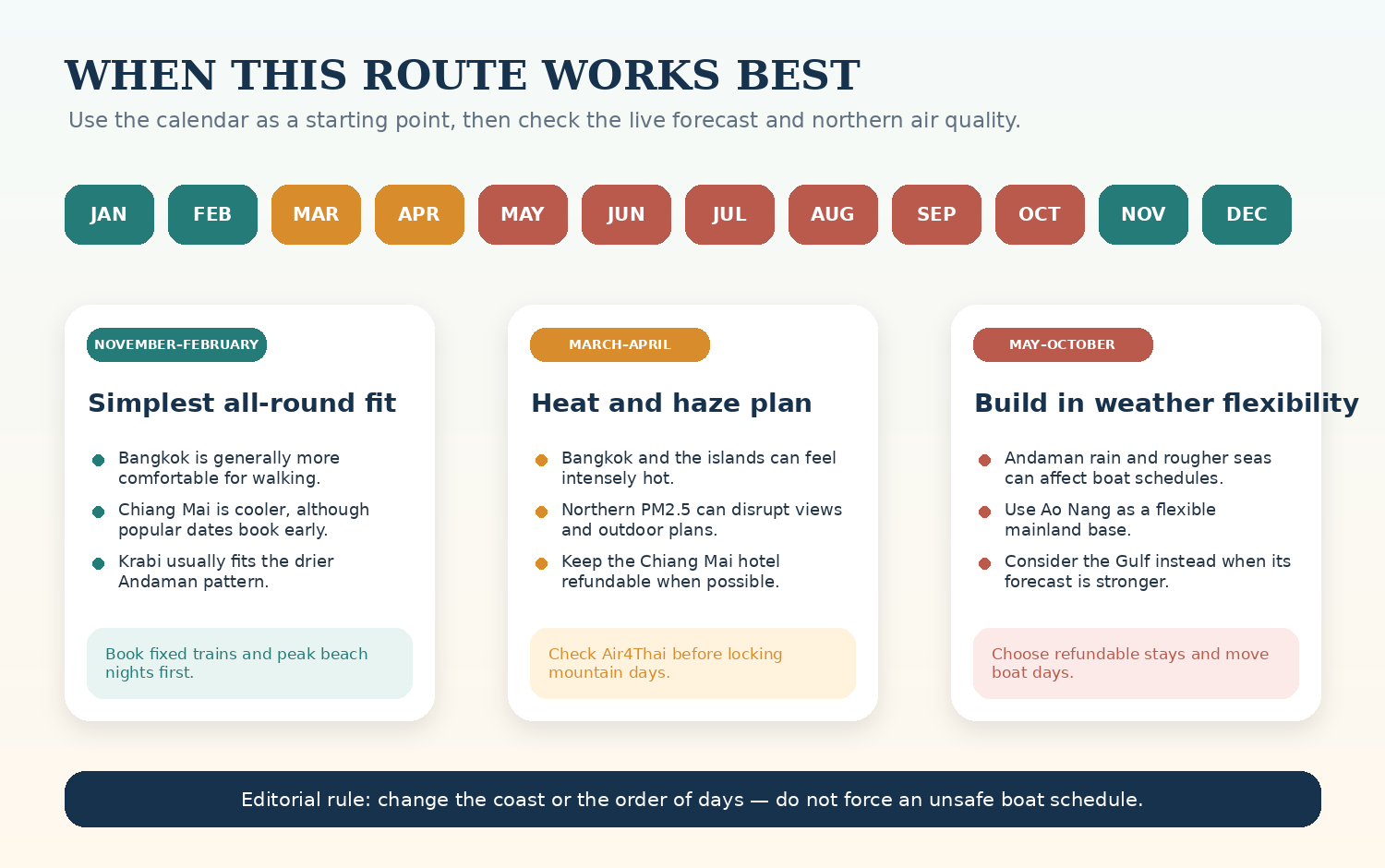
November to February is the easiest window for the route as written. Meanwhile, Bangkok is usually more comfortable for walking, Chiang Mai can be pleasantly cool and Krabi generally sits in its drier Andaman pattern. However, peak-season prices and demand rise, especially around Christmas, New Year and major festivals.
Month-by-month planning approach
| Travel period | Keep | Watch | Sensible adjustment |
|---|---|---|---|
| November-February | The full Bangkok-Chiang Mai-Krabi route. | Peak accommodation and popular sleeper berths. | Book fixed transport and beach nights earlier. |
| March-April | Bangkok and the south. | Heat plus northern PM2.5 and smoke. | Keep Chiang Mai refundable or replace it if air quality is poor. |
| May-October | Bangkok and Chiang Mai with weather flexibility. | Andaman rain, rougher seas and changed boat schedules. | Base on the mainland, keep boat days movable or compare the Gulf coast. |
Chiang Mai air quality needs its own decision
Northern haze is not a minor footnote for a March or April itinerary. For example, official Pollution Control Department reporting in 2026 recorded days with PM2.5 above Thailand’s 24-hour standard in Chiang Mai and neighbouring northern provinces. Moreover, the same reports direct travellers to Air4Thai for current readings and health guidance.[7]
For a traveller with asthma, young children or a strong preference for mountain views, I would keep the Chiang Mai hotel cancellable and check readings before the free-cancellation deadline. Therefore, a poor forecast is a reason to change the route, not to buy a mask and pretend the scenery will be clear.
Do not judge monsoon travel by a single rain icon
Thailand’s weather is shaped by different monsoon systems, and conditions vary by coast. A rainy-season forecast may mean short heavy bursts, but it can also mean marine warnings and cancelled small-boat trips. Therefore, use the Tourism Authority of Thailand climate overview for context and the Thai Meteorological Department for current warnings.[12][13]
Before booking two weeks in Thailand
Count nights in Thailand, not annual-leave days
An overnight outbound flight, time difference and early flight home can turn a 14-day leave window into 12 usable days. First, start with the number of nights your accommodation must cover. In practice, 13 nights is comfortable for this route: 3 Bangkok, 4 Chiang Mai, 5 around Krabi and 1 final Bangkok night.
With only 11 or 12 nights, remove one northern night and one beach night. However, do not remove the final buffer unless the international ticket departs directly from a southern airport and the preceding night is already on the mainland.
Complete the Thailand Digital Arrival Card through the official site
Foreign travellers are required to register for the Thailand Digital Arrival Card before entry. Official Thai government guidance directs travellers to the Immigration Bureau’s TDAC website, and a separate government notice states that registration is completed online within 72 hours before travel.[1][2]
Most importantly, the form is free. Therefore, avoid unofficial websites that charge for a service that can be completed directly. You will need passport details, travel information and your accommodation in Thailand, so have the first hotel address ready.
Book in this order
- International flights and the exact arrival/departure airports.
- The first Bangkok hotel and the final Bangkok or airport hotel.
- Bangkok-Chiang Mai sleeper berths or domestic flights.
- Chiang Mai-Krabi transport, especially when a direct flight operates only on selected dates.
- Peak-season beach accommodation with practical cancellation terms.
- Fixed, high-demand activities; keep ordinary weather-dependent boat trips flexible where possible.
Days 1-3: Bangkok without wasting time in traffic
Day 1: arrive and stay close to the hotel
International arrival days are unreliable. In practice, immigration, baggage, cash or data setup, the airport transfer and hotel check-in are enough. Then eat nearby, take a short walk and protect the first proper morning.
From Suvarnabhumi, the Airport Rail Link is useful for travellers with manageable luggage and a hotel near onward rail. Official information lists fares from 15 to 45 baht, operating hours of 05:30 to midnight and a journey of no more than roughly 30 minutes to the city end of the line, with connections at Makkasan and Phaya Thai.[3]
By contrast, a taxi or pre-arranged transfer makes more sense for a family, a late arrival, bulky luggage or a riverside hotel. Before joining any queue, confirm the airport code: BKK is Suvarnabhumi and DMK is Don Mueang.
Day 2: Grand Palace, Wat Pho, Wat Arun and Chinatown
Start early and keep the day around Rattanakosin and the river. The Grand Palace publishes daily opening hours of 08:30-16:30, with tickets sold until 15:30 and a standard foreign-visitor price of 500 baht. Ceremonial schedules can change, so check the official site the evening before.[4]
Afterwards, Wat Pho sits close enough to follow naturally. Its official visitor page lists 08:00-19:30 opening and a 300-baht admission fee, alongside respectful-dress guidance.[5] From there, cross the river for Wat Arun. Finish with a hotel break or continue to Chinatown after the heat eases.
- Wear light clothing that covers shoulders and knees.
- Carry water and sun protection; heat changes the realistic pace.
- Check closure claims at the official entrance rather than trusting an unsolicited stranger.
- Do not add a distant market between the river temples. Geography should shape the day.
Day 3: choose the version of Bangkok you enjoy
Use the third day for one interest rather than another checklist. For example, weekend visitors can spend the morning at Chatuchak. Likewise, design and history travellers might pair Jim Thompson House with Siam. Food-focused travellers can choose a small-group tasting route, while anyone still jet-lagged can slow down around Ari, Silom or the riverside.
In practice, the rule is simple: one paid activity and one neighbourhood. A market, cooking class, rooftop drink and cross-city food tour may all sound appealing, but combining them usually produces more taxi time than memorable travel.
Best areas to stay in Bangkok for this route
| Area | Best for | Main advantage | Trade-off |
|---|---|---|---|
| Asok / Phrom Phong | First-time visitors who value transport. | BTS and MRT access plus abundant food. | Less old-city atmosphere. |
| Silom / Sathorn | Food, river access and a balanced city base. | Useful rail links and varied hotel prices. | Some streets are quiet at weekends. |
| Riverside | Views, couples and a slower evening mood. | Easy access to river boats and major hotels. | Can require more transfers for modern Bangkok. |
| Rattanakosin | Temples and old-city character. | Close to the Day 2 sights. | Less convenient for BTS-based exploring. |
| Airport Rail Link corridor | A short final night or early onward flight. | Predictable airport connection. | Choose carefully; not every station area is equally appealing. |
For more destination-specific planning, use the site’s Bangkok guides
Days 4-7: Chiang Mai, temples and the mountains
Day 4: fly north or arrive on the sleeper train
A morning flight protects the afternoon. The sleeper train, by contrast, turns the previous evening into part of the trip and can save a hotel night. State Railway of Thailand lists Special Express Train 9 from Krung Thep Aphiwat at 18:40, scheduled into Chiang Mai at 07:15 after 12 hours 35 minutes.[8][9]
However, live availability changes quickly. A 12Go search checked in August 2026 showed Train 9 second-class air-conditioned sleeper listings around US$31, while other classes and trains varied substantially. Treat that as a dated snapshot and compare it with the official SRT booking channel before purchase.[10]
Afterwards, keep the arrival day light whichever option you use: check in, walk part of the Old City, eat northern food and get an early night. Doi Inthanon does not belong after a same-day airport or railway transfer.
Day 5: Old City temples and local food
Build a walk around two or three temples rather than trying to enter every wat inside the moat. Wat Chedi Luang and Wat Phra Singh make a strong pair, then leave time for a coffee, massage or market. The Tourism Authority of Thailand highlights the Old City, Doi Suthep, Nimman, walking streets and Doi Inthanon as core Chiang Mai experiences.[6]
If a Saturday or Sunday walking street matches your dates, move the evening accordingly. Otherwise, a night market or a small northern-Thai restaurant gives the day a natural finish without another cross-city transfer.
Day 6: Doi Suthep and Nimman
Go to Doi Suthep earlier, before the heat and larger groups. Afterwards, return through the western side of the city and spend the afternoon around Nimman or the university area. This combination works because it avoids crossing Chiang Mai repeatedly.
Most importantly, temple dress still matters. Keep shoulders and knees covered, remove shoes where requested and avoid posing in ways that treat Buddha images as props.
Day 7: choose one full-day northern experience
| Choice | Choose it for | Travel reality | Skip when |
|---|---|---|---|
| Doi Inthanon | Waterfalls, forest, viewpoints and cooler mountain air. | A long road day; weather can hide the views. | You dislike early starts or the forecast is poor. |
| Mae Kampong | Village scenery, cafes and a gentler pace. | Still needs a road transfer and careful operator choice. | You want a demanding hike. |
| Cooking class | Food, conversation and a practical indoor-outdoor day. | Usually a half or full day, often with market pickup. | You already booked several food activities. |
| Slow city day | Rest, galleries, cafes, massage and laundry. | No long transfer and easy to adapt. | You only have one full Chiang Mai day. |
Best Chiang Mai base
First, stay on the Old City edge for walkable temples and simple day-trip pickups. Choose Nimman for modern restaurants, cafes and nightlife, while accepting that many heritage sights require a ride. A riverside stay can feel calmer but is less convenient for a short first visit.
Days 8-12: Krabi, Ao Nang and Railay
Day 8: travel from Chiang Mai to Krabi
A direct Chiang Mai-Krabi flight is the cleanest route when it operates. For example, recent route information has shown a direct sector of about two hours, but schedules are seasonal and can change. Otherwise, a connection through Bangkok can use most of the day once the layover and airport process are included.[11]
A live 12Go flight search checked in August 2026 listed the fastest Chiang Mai-Krabi options at about two hours, with the cheapest displayed flight around US$86 on that snapshot. However, baggage and exact dates change the real total, so compare the fare after luggage and note whether a Bangkok airport change is involved.
Once you land, transfer to the hotel and leave the evening unbooked. I would not attach a sunset boat trip or non-refundable excursion to a flight arrival. However, delays happen, and Krabi is a better place to begin slowly.
Ao Nang vs Railay: choose the right base
| Factor | Ao Nang | Railay |
|---|---|---|
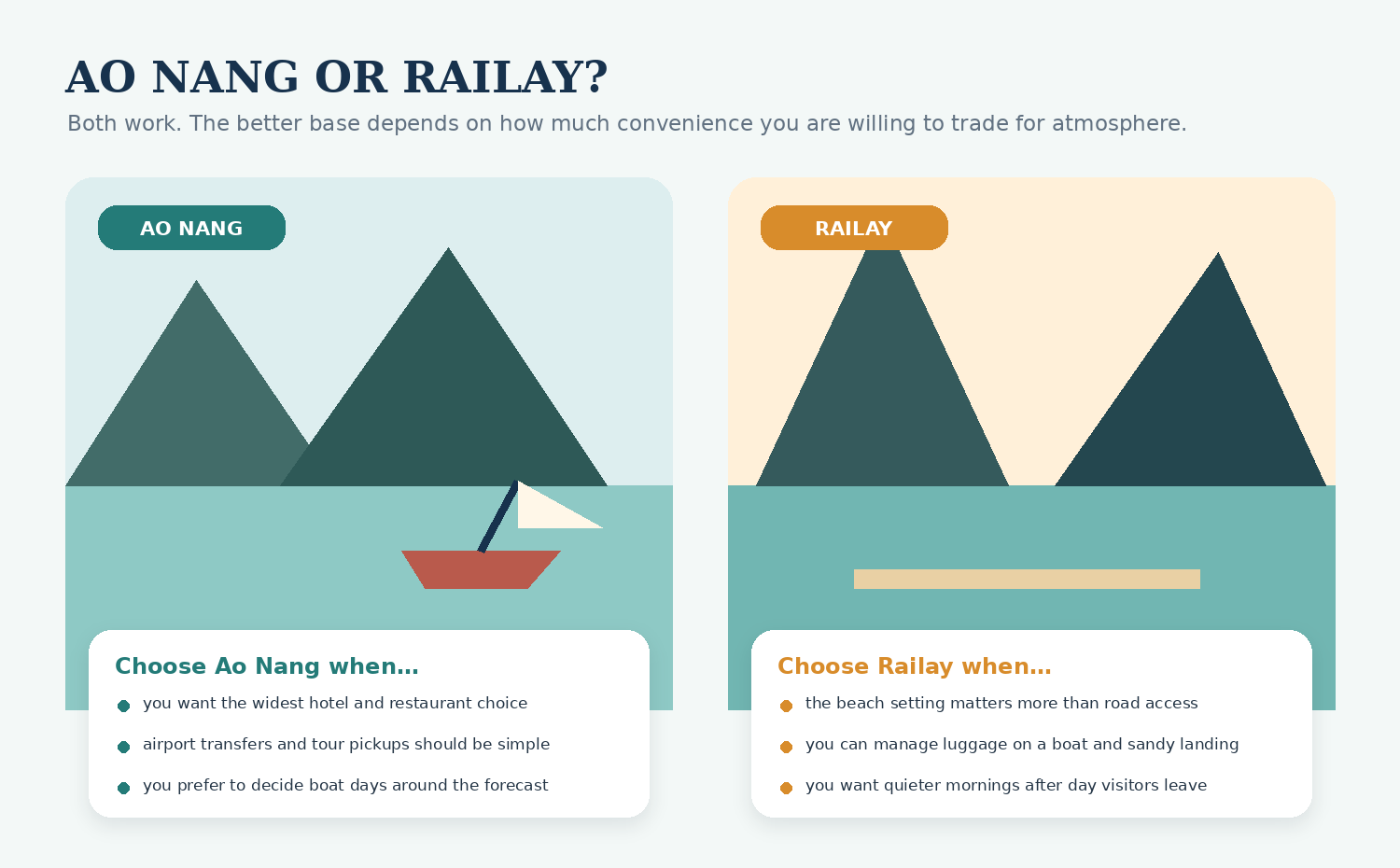
| Access | Road transfer from Krabi airport. | Boat access, often with a sandy or wet landing. |
| Hotel choice | Wide range from guesthouses to resorts. | Smaller selection and often higher scenic-location prices. |
| Food and services | Most convenient for restaurants, pharmacies and tour offices. | Enough for a short stay, but less variety. |
| Atmosphere | Busy, practical and tour-oriented. | Dramatic cliffs and quieter mornings/evenings. |
| Best for | First-timers, families and weather-flexible planning. | Couples, climbers and travellers prioritising scenery. |
| Luggage | Easy with a suitcase. | A smaller soft bag is noticeably easier. |
TAT describes Ao Nang as a major launching point for nearby islands and the beaches around Phra Nang Cape, while Railay remains isolated by its limestone geography and boat access.[14] For a first visit with uncertain weather, Ao Nang is the more forgiving base.
Day 9: Railay and Phra Nang
First, check the tide, wind and return-boat arrangements before leaving. Walk between Railay West, Railay East and Phra Nang, then give yourself time to sit rather than treating the peninsula as a photo stop. However, the viewpoint trail can be steep, muddy and unsuitable after rain, so decide on the ground rather than from an old social-media clip.
Day 10: choose one island day
Hong Islands and Four Islands are common choices. Select between them by departure point, sea conditions, the number of stops and how much time is actually spent swimming. A crowded itinerary with six brief stops may sound better than a slower four-stop trip, yet the slower version can be more enjoyable.
Shared tour or private boat?
| Option | Pros | Cons | Best for |
|---|---|---|---|
| Shared long-tail boat | Lower cost and local character. | Slower, weather-exposed and fixed to the group pace. | Budget travellers with a flexible day. |
| Shared speedboat | Faster between distant stops. | Bumpier ride, larger groups and less relaxed boarding. | Travellers prioritising coverage. |
| Private long-tail boat | Flexible timing and fewer people. | Higher cost and still weather-dependent. | Couples, families or a carefully planned sunrise start. |
| Mainland alternative | No marine risk and easy to arrange late. | Misses the island scenery. | Rough-sea days or travellers who need a rest. |
Days 11 and 12: protect one free day
Keep one day for the beach, pool, spa, climbing, Krabi Town or simple rest. The other can hold a second island outing or the boat trip moved from Day 10. This pair of days is what makes the southern section resilient rather than over-planned.
When the marine forecast is poor, do not pressure an operator to run. Move the trip, choose a mainland plan or accept a slow day. A holiday schedule never outranks a safety decision.
Days 13-14: return to Bangkok and protect the flight home
Day 13: fly from Krabi to Bangkok
Choose the final hotel from the departure time and airport, not from a generic list of popular neighbourhoods. A central Bangkok stay works for a late flight home and a final dinner. A hotel near Suvarnabhumi or on the Airport Rail Link corridor is more sensible for an early departure.
Check whether the domestic flight arrives at BKK or DMK. Crossing Bangkok between airports can take a large part of a layover, especially in traffic. A self-transfer is only reasonable when the connection is deliberately long and the savings are substantial.
Day 14: fly home
No ferry, island transfer or separate cross-country flight belongs before the long-haul departure on this day. The final-night buffer has already done its job. Do not give it back to squeeze in one more beach.
Thailand transport guide for this route
Bangkok to Chiang Mai: flight vs sleeper train
| Choice | Headline time | Door-to-door reality | Advantages | Drawbacks |
|---|---|---|---|---|
| Flight | About 1 hr 10-25 min in the air. | Usually 4-5 hours with airports and baggage. | Fast, frequent and protects sightseeing time. | Add-on fees, transfers and possible airport confusion. |
| Train 9 sleeper | 18:40-07:15 scheduled. | Overnight journey from station to station. | Memorable and can replace a hotel night. | Variable sleep; popular berths sell. |
| Day train | Most of a day. | A full travel day. | Scenery and an unhurried rail experience. | Uses too much of a short first trip for most travellers. |
When to use 12Go and when to book direct
| Planning task | Useful first step | Final check |
|---|---|---|
| Compare trains, buses and flights on one route. | Use 12Go to see broad options and departure points. | Read the operator, collection and cancellation terms. |
| Book a Thai railway sleeper. | Compare times and classes. | Also check the official SRT D-Ticket channel and station details. |
| Buy a low-cost flight. | Compare schedules and airports. | Price the operating airline after baggage and seats. |
| Arrange a weather-sensitive ferry. | Check current departures. | Reconfirm locally and monitor the marine forecast. |
The transfer-time calculation that prevents bad itineraries
For a domestic flight, add hotel-to-airport travel, the airline’s check-in requirement, security, baggage delivery and the destination transfer. For a ferry, add pier transport, check-in, loading, possible weather delay and the final road or boat leg. The advertised moving time is only one part of the journey.
Realistic budget for two weeks in Thailand
The ranges below are per person, exclude international flights and assume two travellers share a room. Solo travellers should raise the accommodation allowance. Families should price the actual room configuration rather than multiplying a couple’s figure.
Bank of Thailand tourism indicators reported June 2026 average room rates of about 1,825 baht nationally, about 2,097 baht in the central region including Bangkok, about 1,332 baht in the North and about 2,310 baht in the South. Tourist hotels on popular dates can sit far above those averages, but the data helps explain why the beach section often becomes the largest accommodation cost.[15]
Two-week budget by travel style
| Category | Budget | Mid-range | Comfortable |
|---|---|---|---|
| Accommodation share | 10,000-18,000 THB | 22,000-44,000 THB | 55,000-115,000 THB |
| Domestic transport | 5,000-10,000 THB | 8,000-19,000 THB | 15,000-32,000 THB |
| Food and drinks | 7,000-12,000 THB | 14,000-26,000 THB | 28,000-52,000 THB |
| Activities and entry | 5,000-10,000 THB | 10,000-21,000 THB | 20,000-48,000 THB |
| Local transport and extras | 5,000-8,000 THB | 8,000-15,000 THB | 15,000-30,000 THB |
| Working trip total | 32,000-58,000 THB | 65,000-110,000 THB | 135,000-277,000 THB |
Example mid-range calculation
A couple sharing 13 nights at an average of 3,800 baht spends 24,700 baht each on accommodation. Add roughly 13,000 baht for domestic transport, 20,000 baht for food and drinks, 15,000 baht for entries and activities, then 10,000 baht for taxis, laundry, data and contingencies. The resulting working total is about 82,700 baht per person before international flights.
Where to save without damaging the route
- Stay one or two rail stops outside Bangkok’s most expensive hotel cluster, but remain within an easy walk of a station.
- Use a well-located Chiang Mai guesthouse or boutique hotel; the northern room budget often stretches further.
- Book one shared island trip instead of several private boats.
- Compare flight totals after baggage rather than chasing the lowest headline fare.
- Keep the final-night buffer. Missing a long-haul flight is not a sensible saving.
For broader planning, see the site’s Thailand budget travel tips.
What to pack for Bangkok, Chiang Mai and Krabi
Use one manageable bag
This route includes airports, station platforms, taxis, hotel steps and possibly a long-tail boat. A 30-40 litre soft travel bag is easier than a huge suitcase when you reach Railay, while a small wheeled case is perfectly workable if you stay in Ao Nang and use road transfers.
| Bag type | Advantages | Drawbacks | Best fit |
|---|---|---|---|
| 30-40L travel backpack | Hands free, easy on stairs and boats, compact for transfers. | Needs a comfortable harness and disciplined packing. | Railay, sleeper train and multi-stop travel. |
| Cabin-size wheeled case | Easy on smooth floors and simple to organise. | Awkward on sand, steps and wet boat landings. | Ao Nang, city hotels and road-based transfers. |
| Large checked suitcase | Room for specialist gear and shopping. | Higher baggage costs and harder transfers. | Longer stays with few hotel changes. |
Core packing list
- Breathable clothes plus one temple-ready outfit covering shoulders and knees.
- A light layer for air-conditioned transport and cooler northern mornings.
- Comfortable walking sandals or trainers with grip.
- Compact rain shell or umbrella, especially outside the driest months.
- Reef-safe sun protection where available, hat and reusable water bottle.
- Small dry bag or waterproof pouch for boat days.
- Medication in original packaging and enough for delays.
- A well-fitting particulate mask when travelling north during possible haze periods.
Monsoon-season additions
Use quick-drying clothes, protect electronics inside the bag and choose shoes that remain safe on wet steps. A lightweight dry layer matters more than a heavy jacket. Most importantly, pack enough flexibility to cancel a boat day without feeling the trip has failed.
Alternative Thailand two-week itineraries
Island-heavy route
Use Bangkok for 3 nights, Chiang Mai for 3, Ao Nang or Railay for 3, Koh Lanta for 3 and Bangkok for 1 final night. This works best in reliable ferry conditions. It adds variety, although it also introduces another checkout and transfer.
Slow-travel route
Use Bangkok for 3 nights, Chiang Mai for 4, one Krabi-area base for 5 and the final Bangkok night. Keep Day 12 completely free rather than planning a second excursion. This is the version I would choose for anyone who dislikes early starts or needs recovery time in the heat.
No-flight route
Take the sleeper train to Chiang Mai, return south by rail through Bangkok, then continue toward Surat Thani before a road connection to the coast. The journey can be rewarding, but it uses more of the two weeks. Choose it because you enjoy rail travel, not because it looks simpler on a map.
Family route
Use Bangkok for 2-3 nights, Chiang Mai for 4, one southern resort base for 6 and a final airport night. Replace multiple island tours with pool time, one carefully selected excursion and flexible meal plans. Family routes improve when the number of checkouts falls.
March-April air-quality alternative
Replace Chiang Mai with Khao Sok, an extra southern base or a longer Bangkok-plus-beach trip when northern readings are poor. This is a genuine route change rather than an indoor-day workaround. Mountain views are not the only reason to take air quality seriously.
Gulf-coast alternative
Keep Bangkok and Chiang Mai, then swap the Krabi block for Koh Samui, Koh Phangan or Koh Tao when the Gulf forecast and transport pattern are stronger for your dates. Check the full airport, ferry and island-transfer chain before deciding which island fits five nights.
Pros, cons and common mistakes
Pros and cons of the Bangkok-Chiang Mai-Krabi route
| What works well | Trade-off |
|---|---|
| Three distinct regions without constant moving. | It deliberately skips Phuket, Pai, Chiang Rai and the Gulf islands. |
| Enough full days for headline sights and slower time. | Two domestic flight legs can cost more than an all-overland route. |
| A southern weather buffer is built in. | Ao Nang is practical rather than secluded. |
| The final Bangkok night protects the long-haul departure. | Some travellers would rather spend that night on the beach. |
| The coast can be replaced without rebuilding the whole trip. | Direct flight patterns can change seasonally. |
Mistake 1: adding destinations instead of replacing them
Phi Phi, Koh Lanta, Phuket and Koh Samui are not free additions. Every new base creates a checkout, transfer and orientation period. Replace part of the Krabi block with another beach; do not stack every island into the same five nights.
Mistake 2: joining a ferry to the international flight
Even in good weather, pier queues, road traffic and delayed departures create uncertainty. Keep the last night on the mainland or in Bangkok.
Mistake 3: comparing only the headline fare
Add checked baggage, seat selection, payment fees, airport transfer and the value of the departure time. A modest saving disappears quickly after a second taxi and a 05:00 wake-up.
Mistake 4: treating transfer days as sightseeing days
Days 1, 4, 8 and 13 contain meaningful travel. Build the strongest experiences around the days that are genuinely free.
Mistake 5: prepaying every boat trip
Reserve a must-do private boat in peak season when necessary, but keep ordinary shared trips movable when the cancellation terms allow. The weather has no obligation to follow your spreadsheet.
Thailand 2-week itinerary FAQs
Is two weeks enough for Thailand?
Yes. Two weeks is enough for Bangkok, one northern base and one southern beach base at a comfortable pace. It is not enough to cover every famous city and island without spending too much time in transit.
What is the best Thailand itinerary for first-time visitors?
A dependable first route is 3 nights in Bangkok, 4 in Chiang Mai, 5 around Krabi or Ao Nang and 1 final night in Bangkok before departure.
How many places should I visit in 14 days?
Three main bases plus a final airport-protection night is a sensible limit. Four bases can work, but only when the transfers are short and one stop replaces nights elsewhere.
Should I visit Phuket or Krabi?
Choose Krabi for limestone scenery, Railay and straightforward island day trips. Choose Phuket for a larger resort island, more nightlife and a wider direct-flight network. Do not try to give both equal time in a short first trip.
Should I fly or take the sleeper train to Chiang Mai?
Fly when protecting sightseeing time matters most. Take the sleeper when the train experience appeals, you can accept variable sleep and a suitable berth is available.
How much money do I need for two weeks in Thailand?
A working mid-range budget is about 65,000-110,000 baht per person excluding international flights, assuming two people share rooms. Peak beach hotels, private tours and last-minute flights can push the total higher.
Do I need to return to Bangkok before flying home?
Usually, yes, unless the international ticket departs directly from Phuket or another southern airport. Keep the final night on the mainland rather than relying on a same-day ferry-to-long-haul connection.
Can I add Koh Lanta or Phi Phi?
Yes, but replace Krabi nights rather than adding another stop on top. Koh Lanta suits slower beach time; Phi Phi suits a shorter and busier island stay.
What should I book in advance?
Book the international flight, first and final hotels, sleeper train or domestic flights and any fixed peak-season beach stay first. Keep routine weather-dependent boat trips flexible where possible.
What entry form do I need for Thailand?
Foreign travellers should check the official Thailand Digital Arrival Card rules and complete the online registration through the Immigration Bureau website within the permitted pre-arrival period.
Is Chiang Mai a good idea in March or April?
It can be affected by heat, smoke and elevated PM2.5. Check Air4Thai before committing, use refundable accommodation and replace the northern section when conditions are poor or respiratory health is a concern.
Where should I stay in Krabi for a first trip?
Ao Nang is the easiest all-round base because road transfers, restaurants and boat departures are straightforward. Railay is more atmospheric but requires boat access and easier-to-handle luggage.
The route I would choose
For a first visit, I would keep Bangkok, Chiang Mai and Krabi, then protect the final night in Bangkok. I would fly the long Chiang Mai-Krabi leg, use the sleeper train north only if the rail journey genuinely appeals, and leave one beach day unbooked until the forecast becomes useful.
The quality of a two-week itinerary is not measured by the number of map pins. It is measured by how many mornings begin in a place you have enough time to enjoy.
Sources and methodology
Research checked 16 August 2026. Official Thai government, railway, tourism, attraction, weather and pollution-control sources are prioritised. Live fares are dated snapshots, while the budget ranges are transparent editorial estimates rather than quoted packages.
- Thailand Digital Arrival Card overview – Thailand.go.th / Immigration Bureau.
- TDAC registration timing – Thailand.go.th.
- Airport Rail Link route, fares and timing – Thailand.go.th.
- Grand Palace practical information – Bureau of the Royal Household.
- Wat Pho visitor plan – Wat Pho.
- Chiang Mai destination guide – Tourism Authority of Thailand.
- Air4Thai air-quality reporting and 2026 regional PM2.5 updates – Pollution Control Department.
- Special Express Train 9/10 – State Railway of Thailand.
- SRT Bangkok-Chiang Mai timetable – State Railway of Thailand.
- Bangkok-Chiang Mai live fare and availability snapshot – 12Go, checked August 2026; compare against the official SRT timetable before purchase.
- Chiang Mai-Krabi direct route information – Bangkok Airways.
- Thailand climate and weather – Tourism Authority of Thailand.
- Current forecasts and weather warnings – Thai Meteorological Department.
- Krabi destination guide – Tourism Authority of Thailand.
- Tourism indicators and average room rates – Bank of Thailand.
- Thailand travel advice – UK Foreign, Commonwealth & Development Office; check before travel.
Image credits
Illustrations in this article were created for Taylor’s Trailblazing Travels. Third-party photographs, where used, are credited beside the image or in the source list.