A first-timer guide to neighbourhoods, temples, transport, food, airports, budgets, day trips and the planning details that save time on the ground.
Planning Bangkok without wasting time
Bangkok is often described as chaotic, but that is not the part that causes most first visits to go wrong. The real problem is treating a city of more than one useful centre as if it were compact. A hotel can look close to the Grand Palace, Siam and Sukhumvit on a map, yet every journey may still involve heat, traffic, a river crossing or two different rail systems.
The easiest first trip is built around three decisions: choose a base near the transport you will actually use, group sights into sensible neighbourhoods, and leave enough room for meals, rain and recovery. Once those pieces are right, Bangkok becomes far more manageable. You can move from royal temples to modern malls, local markets and riverside evenings without spending half the day in a taxi.
This Bangkok travel guide adds the details visitors need before booking: current opening information, how BTS and MRT differ, realistic airport choices, daily costs, mobile data, packing, onward travel and which tours are genuinely useful rather than merely convenient to sell.
Three full days is the best fit for many first-time visitors. Keep the first day deliberately light after arrival. Use the second day for the Grand Palace, Wat Pho, Wat Arun and Yaowarat. On the third day, choose Chatuchak, Siam, a park, a museum, a food tour or a neighbourhood that matches your interests. Add a fourth day for Ayutthaya or another substantial day trip.
Current details in this guide were checked against official sources on 22 August 2026. Opening arrangements, transport timetables, fares and entry rules can still change, especially around royal ceremonies, public holidays, severe weather and special events. Use the linked official pages for a final check shortly before you travel.
How should a first-time visitor plan Bangkok?
Allow three full days, stay near BTS or MRT, and plan one area per half-day. Group the Grand Palace, Wat Pho and Wat Arun together; keep a separate day for modern Bangkok or markets; and add Ayutthaya only when you have a fourth day. Use rail for long city journeys, then walk, take a boat or use a short taxi for the final leg.
Bangkok at a glance
Temples, food, markets, shopping, nightlife, museums and easy onward travel.
Three full days for a balanced first visit; four when adding Ayutthaya or another day trip.
Asok, Phrom Phong, Silom, Sathorn or Siam when rail convenience matters most.
Riverside, Rattanakosin or Chinatown, provided you accept more boats, taxis or walking.
Officially 500 THB for foreign visitors; open daily 08:30-16:30, with tickets sold until 15:30.
Official visitor information lists 300 THB and 08:00-19:30.
BTS lists 05:00-01:00 service hours; the MRT Blue Line lists 06:00-midnight.
Suvarnabhumi lists service from Level B1 between 05:30 and midnight.
Choose the hotel area before the hotel. A slightly plainer room five minutes from the correct station is often more useful than a better-looking room that turns every outing into a taxi journey.
Check the official attraction schedule, live rail or airport information, weather warnings and your tour inclusions close to the day of travel.
In this guide
How many days should you spend in Bangkok?
Is Bangkok worth visiting on a first trip?
Yes, Bangkok is worth visiting for most first-time Thailand travellers, even if your main goal is beaches or islands. It is the easiest place to understand Thailand’s transport system, see major temples, try food, adjust to the heat, and start the trip without immediately rushing onto another plane, train or ferry.
That does not mean every traveller needs a full week in Bangkok. Some people love the energy and could happily spend five or six days exploring neighbourhoods, food courts, rooftop bars, galleries, parks, malls, markets and day trips. Other travellers just want a soft landing before heading north or south. Both approaches are fine.
The most common mistake is not staying too long. It is staying in Bangkok with no plan, booking a hotel in the wrong area, and then wasting the first day in traffic because everything looked “nearby” on a map.
Bangkok rewards simple planning. Choose one main area per half-day, add breaks, and accept that heat and traffic will slow you down.
One day in Bangkok
One day in Bangkok is possible, but it is tight. This works best for a layover, a one-night stop before flying to Phuket or Chiang Mai, or a final day before leaving Thailand.
A realistic one-day Bangkok plan could be:
This gives you Bangkok’s classic temple-and-food experience. It is not relaxing, and you will need to start early. The Grand Palace official schedule should be checked before visiting because opening details can change for royal or ceremonial reasons, and the site itself notes that schedules may change.
One day is not enough if you want Chatuchak Weekend Market, malls, modern Bangkok, river cruises, cooking classes or day trips.
Two days in Bangkok
Two days is the minimum comfortable amount for most first-timers.
With two days, you can do:
Two days works well if Bangkok is one stop in a bigger Thailand itinerary. For example, a classic first-time route might be Bangkok for two nights, Chiang Mai for four nights, then Phuket/Krabi or another island area for the rest of the trip.
The downside of two days is that arrival timing matters. If your international flight lands late at night, your first “day” may not really count. In that case, either add one more night or keep the itinerary very light.
Three days in Bangkok
Three days is the sweet spot for many first-time visitors. It gives you enough time to see the headline sights without rushing, plus one extra layer of Bangkok beyond temples.
A balanced 3-day Bangkok itinerary could look like this:
Or, if you arrive early:
Three days is also enough time to recover from jet lag. That matters more than people think. Bangkok is not the place to schedule five paid activities on your first full day if you have just flown long-haul.
Four days in Bangkok
Four days is ideal if you want Bangkok plus a day trip. You can see the major sights, explore food areas, shop, and still take a day out to Ayutthaya, Kanchanaburi, Damnoen Saduak Floating Market, Maeklong Railway Market or Khao Yai.
A simple 4-day version could be:
Four days is also a good option if you are not used to big cities, because you can build in downtime.
Five or more days in Bangkok
Five or more days is great if you are a slow traveller, digital nomad, food-focused traveller or using Bangkok as a base for multiple day trips. It is also useful if you are travelling with children or older relatives and want less pressure each day.
With five days, you can add:
- Ayutthaya
- Kanchanaburi
- Floating markets
- A cooking class
- A food tour
- Bang Krachao
- Museum/gallery time
- More local neighbourhoods
- Massage/spa time
- Shopping without rushing
But for a first Thailand trip, do not let Bangkok eat the whole itinerary unless you genuinely enjoy cities. Thailand is very varied, and Bangkok is just one part of the picture.
Best time to visit Bangkok
Bangkok is a year-round city, but the same itinerary feels very different in January, April and September. The most comfortable conditions are usually found from November to February, when humidity is often easier and rainfall is generally lower. Those months are also popular, so well-located hotels and sought-after tours can cost more.
March to May is the hottest period. That does not make Bangkok impossible, although it changes how you should organise the day. Start outdoor temples early, use an air-conditioned museum or mall during the hottest hours, and keep the evening flexible. A plan that looks relaxed on paper can feel demanding when the sun is high and there is little shade.
The wetter months are commonly associated with May to October. Rain often arrives in heavy bursts rather than lasting all day, but a downpour can slow roads, make pavements awkward and push more passengers onto rail. Build a rain alternative into each day instead of abandoning the whole trip at the first dark cloud.
| Period | What it usually feels like | Main advantage | Planning adjustment |
|---|---|---|---|
| November-February | Generally cooler and drier by Bangkok standards | Most comfortable for walking and temples | Book popular accommodation earlier and check seasonal air quality |
| March-May | Very hot, with April often especially demanding | Long daylight and lively festival periods | Start early, schedule indoor breaks and drink more water than you expect |
| May-October | Hot, humid and wetter, with short intense storms common | Often better accommodation value and fewer peak-season crowds | Carry rain protection and avoid tight road-transfer connections |
Weather is a routing question, not just a packing question
In hotter or wetter months, place the most exposed sight first. Save Siam, a museum, a spa, a food court or your hotel pool for the middle of the day. River and road journeys can be affected by storms, so do not plan a fixed airport transfer immediately after a distant attraction.
Check air quality as well as rain
Bangkok can experience poor PM2.5 conditions, particularly during parts of the cooler season. Travellers with asthma or other respiratory conditions should check live local information, carry prescribed medication and be prepared to move strenuous outdoor plans. The weather and air-quality picture can change faster than a monthly climate chart suggests.
For a national month-by-month comparison, read the Best Time to Visit Thailand guide. Before a specific Bangkok day, check the Thai Meteorological Department forecast and warnings.
Where to stay in Bangkok: the best areas for first-time visitors
Choosing where to stay in Bangkok is probably the most important first-timer decision. It affects how stressful your arrival feels, how often you need taxis, how easy it is to reach temples, and whether you can get around without sitting in traffic for half the trip.
For most first-time travellers, the easiest rule is:
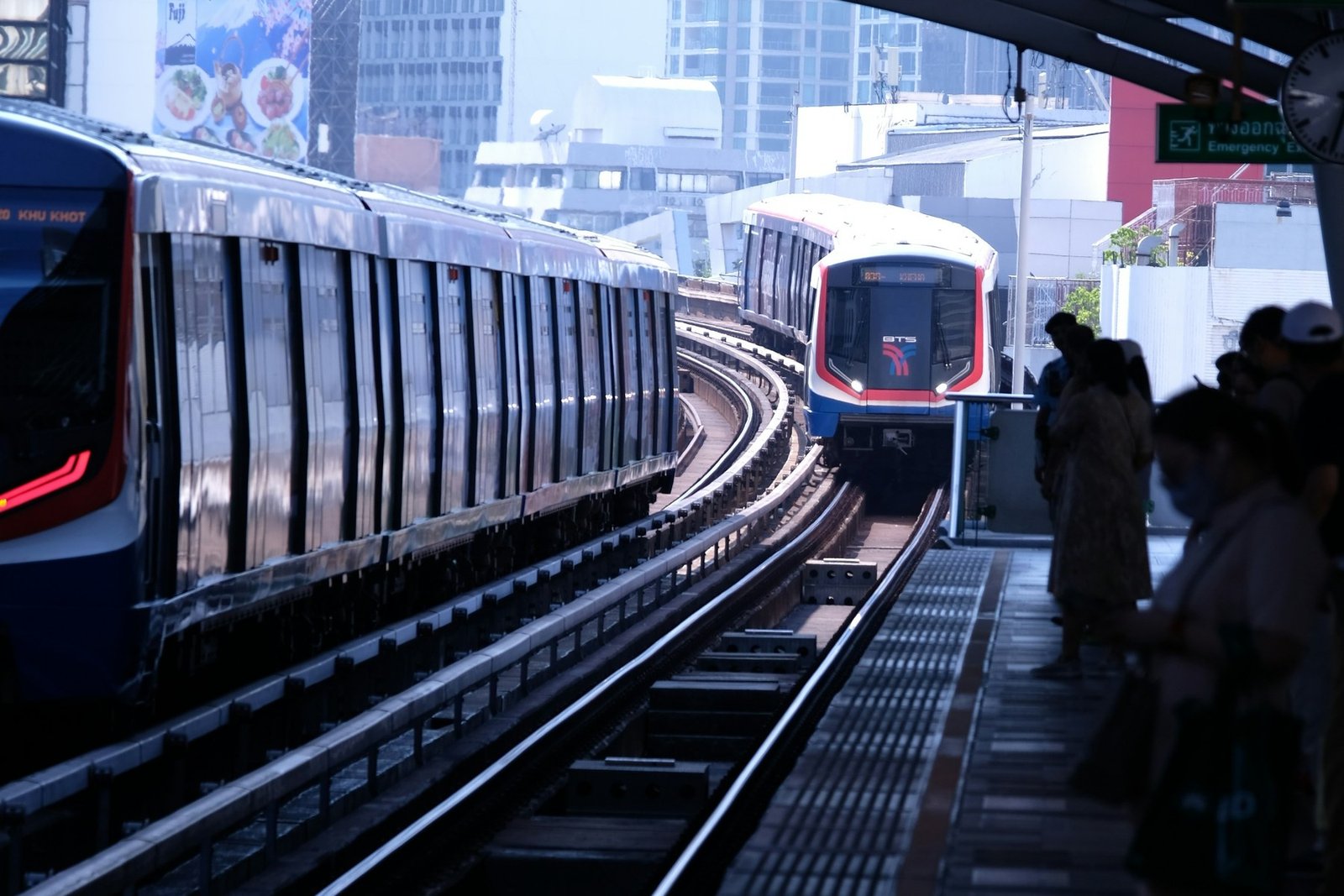
BTS and MRT do not cover every part of Bangkok, but they are much more predictable than road traffic. Thailand’s official public transport guide lists BTS fares by distance, MRT fares by distance, Airport Rail Link connections and Chao Phraya river boat options, which is why rail and river access should shape your hotel choice.
Bangkok neighbourhood comparison
Central and rail-friendly bases
| Area | Best for and transport | Why it works – and the trade-offs |
|---|---|---|
| Sukhumvit | First-timers who want restaurants, nightlife, malls and easy BTS accessTransport: Excellent BTS access; MRT connection at Asok/Sukhumvit | Easy base, lots of hotels, food, nightlife, malls, simple airport connection via Airport Rail Link + BTS/MRTWatch out for: Busy, traffic-heavy, can feel less “old Bangkok” |
| Asok / Phrom Phong / Nana | First-timers who want maximum convenienceTransport: BTS Sukhumvit Line; MRT at Sukhumvit/Asok | Very convenient, lots of eating options, easy to move aroundWatch out for: Nana nightlife area may not suit everyone; prices vary a lot |
| Silom / Sathorn | Couples, food lovers, business travellers, balanced city accessTransport: BTS Silom Line; MRT Silom/Lumphini; river access from Saphan Taksin | Good transport, food, rooftop bars, less chaotic than some Sukhumvit areasWatch out for: Some streets are business-focused and quieter at weekends |
| Riverside | Couples, families, scenic stays, slower luxury tripsTransport: River boats; some BTS access near Saphan Taksin; hotel shuttles | Beautiful views, calmer atmosphere, great for river and templesWatch out for: Can be expensive; not always convenient for BTS/MRT |
| Siam / Chit Lom / Phloen Chit | Shopping, malls, families, easy city movementTransport: Excellent BTS access | Very central for malls, easy BTS transfers, good for short staysWatch out for: Less local-feeling, hotel prices can be high |
Historic, food-focused and quieter bases
| Area | Best for and transport | Why it works – and the trade-offs |
|---|---|---|
| Old City / Rattanakosin | Temples, Grand Palace, historic BangkokTransport: Limited BTS; MRT Sanam Chai helps; taxis/boats common | Closest to Grand Palace, Wat Pho, old Bangkok sightsWatch out for: Less convenient for modern nightlife and BTS; evening transport needs planning |
| Khao San / Banglamphu | Backpackers, budget travellers, nightlifeTransport: Limited rail; taxis, buses and boats | Budget hotels, social scene, easy for backpacker routesWatch out for: Noisy in parts, not ideal for quiet couples/families |
| Chinatown / Yaowarat | Food lovers, photographers, short stays focused on street foodTransport: MRT Wat Mangkon nearby | Amazing food, character, markets, evening buzzWatch out for: Busy pavements, limited hotel choice compared with Sukhumvit/Silom |
| Ari | Repeat visitors, café lovers, quieter local feelTransport: BTS Ari | Cafés, local food, less touristy, good valueWatch out for: Farther from classic temple sights |
| Thong Lor / Ekkamai | Food, nightlife, stylish hotels, repeat visitorsTransport: BTS Thong Lor/Ekkamai | Restaurants, bars, cafés, nightlife, modern BangkokWatch out for: Can be pricey; taxis often needed within side streets |
Sukhumvit: the easiest all-round base for many first-time visitors
Sukhumvit is one of the easiest areas to recommend for first-time visitors because it has lots of hotels, restaurants, malls, bars, cafés and BTS stations. It is not the most traditional-looking area of Bangkok, but it is practical.
The best part of Sukhumvit for first-timers is usually around Asok, Phrom Phong, Nana, Thong Lor or Ekkamai, depending on budget and travel style.
Asok is very convenient because it connects BTS Asok with MRT Sukhumvit. Phrom Phong has malls, restaurants and a slightly more polished feel. Nana is lively and central, but it is also nightlife-heavy, so it will not suit everyone. Thong Lor and Ekkamai are popular for restaurants, cafés and nightlife, but hotels can be more expensive and some places are tucked away from the BTS.
Stay in Sukhumvit if you want convenience and do not mind being in a modern, busy part of the city. Avoid it if your dream Bangkok stay is all river views, temples and old lanes.
Silom and Sathorn: the best balanced base
Silom and Sathorn are strong choices if you want a slightly more balanced stay. You get access to BTS, MRT, restaurants, business-district convenience, rooftop bars, Lumphini Park, and relatively straightforward connections to the river via Saphan Taksin.
Silom works especially well for first-timers who want to explore temples by day and still have easy evening food options. It also suits travellers who do not want to be right in the middle of Sukhumvit nightlife.
Sathorn is more business-focused, but it has good hotels and transport. It can feel quieter outside office hours, which some travellers like and others find a little too calm.
Stay here if you want a practical base with good transport and a slightly less touristy feel than central Sukhumvit.
Riverside: best for views and a slower stay
Riverside Bangkok is the city’s scenic option. This is where Bangkok feels grand: river traffic, hotel boats, temple views, dinner cruises and slower evenings by the Chao Phraya.
It is a great choice for couples, honeymooners, families who want a calmer hotel environment, and anyone who wants Bangkok to feel more like a special trip than a quick stopover.
The trade-off is transport. Some riverside hotels have shuttle boats to BTS Saphan Taksin or nearby piers, which helps, but you are not always as mobile as you would be in Sukhumvit or Silom. Riverside hotels can also be expensive, though there are mid-range options.
Stay by the river if atmosphere matters more than speed. Avoid it if you want to hop around the city all day by BTS/MRT.
Siam, Chit Lom and Phloen Chit: best for shopping and short stays
Siam is the heart of modern Bangkok shopping. It is surrounded by big malls, BTS access and easy connections across the city. Chit Lom and Phloen Chit are nearby and often feel a little more polished.
This area is good for families, shoppers, first-timers on a short stay, and anyone who wants a central base with lots of indoor options. That matters in Bangkok because the heat and rain can make air-conditioned malls genuinely useful, not just “shopping”.
The downside is that Siam can feel commercial. If you want tiny lanes, street food atmosphere and historic sights right outside your hotel, this may not be your dream base. But for convenience, it is excellent.
Old City and Rattanakosin: best for temples and historic sights
Old City/Rattanakosin is the area around the Grand Palace, Wat Phra Kaew, Wat Pho and other historic sights. If your Bangkok priority is temples, royal architecture and old city atmosphere, staying nearby can make sense.
The big advantage is obvious: you can get to the Grand Palace area early, before the worst of the heat and crowds. Official Grand Palace information also gives boat and MRT options for getting there, including BTS to Saphan Taksin plus Chao Phraya Express Boat, or MRT Sanam Chai with onward transport.
A trade-off is that Old City is not as connected by BTS as Sukhumvit or Silom. MRT Sanam Chai helps, and boats are useful, but evenings can require more planning. This area is best if you are temple-focused or want a quieter historic base.
Khao San and Banglamphu: best for backpackers and budget nightlife
Khao San is famous with backpackers. It is good for cheap stays, social energy, budget food, bars, tour desks and meeting other travellers.
It is not the best choice for everyone. Parts of the area can be noisy, touristy and nightlife-heavy. It is also less convenient for BTS/MRT than Sukhumvit, Silom or Siam.
Choose Khao San if you want a backpacker scene, budget guesthouses and a social atmosphere. Skip it if you want quiet nights, easy rail access or a polished hotel area.
Chinatown and Yaowarat: best for food
Chinatown/Yaowarat is one of Bangkok’s best food areas. Tourism Authority of Thailand describes Yaowarat as a food and market area with savoury dishes, desserts, fresh food and Chinese festival energy, and its street-food atmosphere becomes especially lively after business hours.
For first-timers, Chinatown works best if food is a major reason you are visiting Bangkok. MRT Wat Mangkon makes access easier than it used to be, and the area has a lot of character.
The trade-off is that pavements can be crowded, traffic can be intense, and hotel choice is more limited than Sukhumvit or Silom.
Ari: best for a quieter local feel
Ari is a good choice for travellers who want cafés, local restaurants, a neighbourhood feel and BTS access without staying right in the main tourist zones.
It is not the most obvious first-timer base because it is farther from the Grand Palace and riverside sights. But for repeat visitors, digital nomads or people who want a calmer Bangkok stay, it can work well.
Which Bangkok area suits your trip?
Sukhumvit or Silom
Old City/Rattanakosin or Riverside
Siam, Chit Lom or Phloen Chit
Sukhumvit, Thong Lor, Ekkamai or parts of Silom
Chinatown, Silom, Ari, Sukhumvit
Riverside, Siam, Phrom Phong, Sathorn
Khao San/Banglamphu, parts of Sukhumvit, Chinatown
Riverside, Sathorn, Phrom Phong, Ari
Phaya Thai, Ratchaprarop, Asok/Sukhumvit, Silom/Sathorn depending on airport and transport plan
Getting around Bangkok without wasting half the day
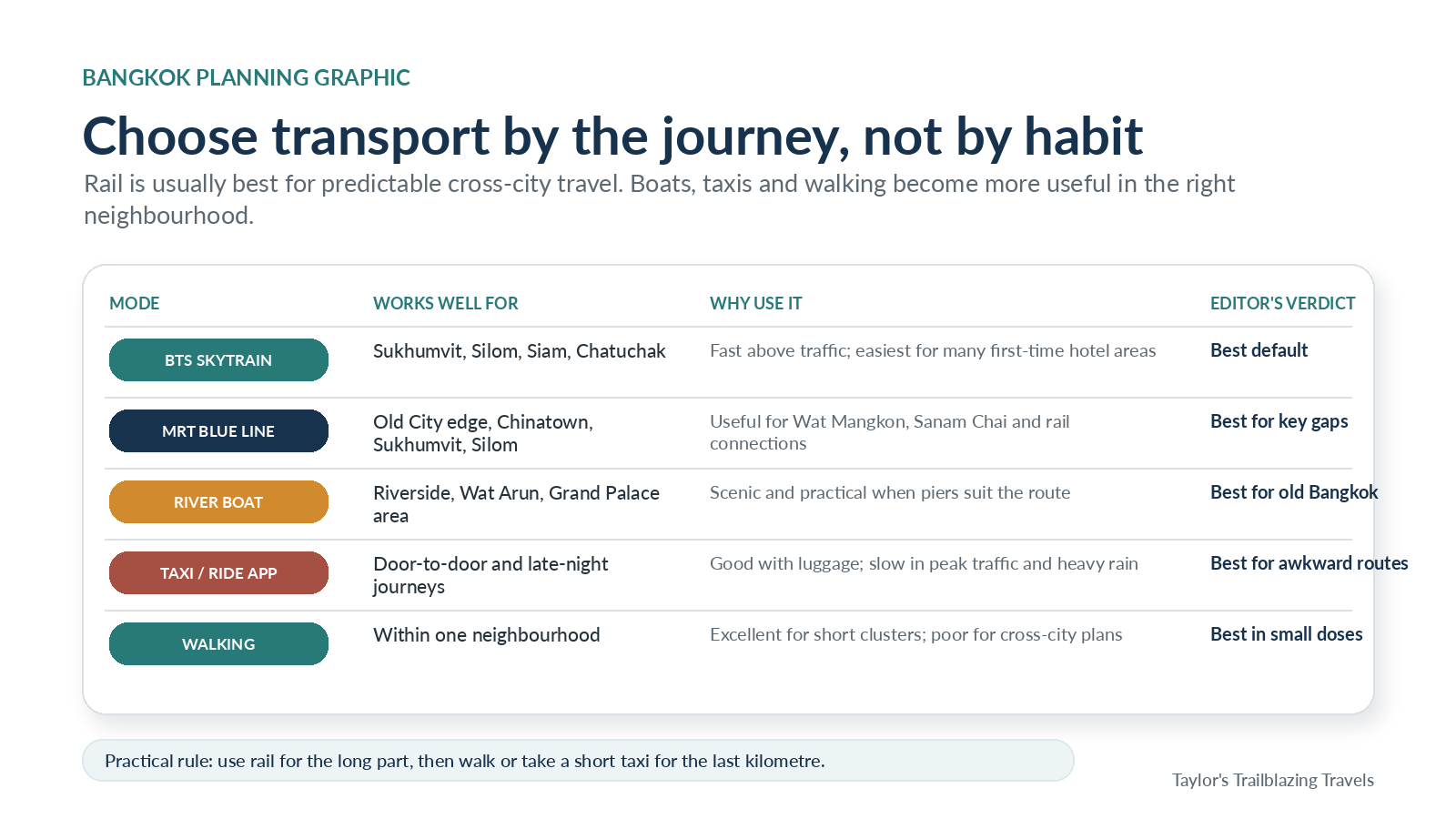
The best Bangkok transport system is not one system. BTS, MRT, boats, taxis, ride-hailing apps and walking solve different problems. First-time visitors save time when they use rail for the predictable middle of a journey, then switch to a short walk, boat or road transfer for the final section.
| Mode | Best for | Current operating information | Main limitation |
|---|---|---|---|
| BTS Skytrain | Sukhumvit, Siam, Silom, Saphan Taksin and Chatuchak connections | Official timetable lists service hours of 05:00-01:00; ticket offices operate 06:00-24:00 | Does not directly serve the Grand Palace area |
| MRT Blue Line | Chinatown, Sanam Chai, Sukhumvit, Silom, Hua Lamphong and Chatuchak links | Official BEM information lists Blue Line service from 06:00 to midnight | Separate ticketing from BTS for ordinary single journeys |
| River boats | Riverside, Wat Arun and old-city sightseeing when the correct piers align | Services and fares vary by boat type and route | Pier names, flags and stopping patterns can confuse first-time users |
| Metered taxi or ride app | Door-to-door travel, luggage, late evenings and awkward last kilometres | Availability is broad, but prices and travel times vary with demand and traffic | Road congestion can make a short distance unexpectedly slow |
| Tuk-tuk | A short experience rather than essential transport | Negotiate the full price before boarding | Often poor value for long journeys and vulnerable to tourist detours |
| Walking | Exploring within Chinatown, the old city, Siam or one riverside cluster | Free, flexible and often faster over very short distances | Heat, uneven pavements and major roads make cross-city walking unrealistic |
Using the BTS Skytrain
BTS is usually the easiest system for first-time visitors staying along Sukhumvit, around Siam or in Silom. Siam is the principal interchange between the Sukhumvit and Silom lines. Asok connects on foot with MRT Sukhumvit, while Sala Daeng connects with MRT Silom. Saphan Taksin is useful for Sathorn Pier and river travel.
The official 2026 timetable lists service hours from 05:00 until 01:00, although the last useful train for your exact route may leave earlier. Ticket-office hours are shorter, and the last connection can depend on where you change lines. Check the live journey rather than assuming every station remains equally useful until 01:00.
Using the MRT Blue Line
MRT fills several gaps that matter to visitors. Wat Mangkon is convenient for Chinatown, Sanam Chai is useful for Wat Pho and the old-city edge, Sukhumvit connects to BTS Asok, and Silom connects to BTS Sala Daeng. The line also serves Chatuchak Park and rail-related stations.
BEM lists Blue Line service daily from 06:00 until midnight, with more frequent trains during peak periods. Keep in mind that BTS and MRT are separate systems for most ordinary ticketing. A route that crosses from one to the other involves leaving one paid area and entering another.
Using boats on the Chao Phraya
Boats can be both transport and sightseeing. They work especially well between Sathorn Pier, riverside hotels and the old-city temple area. However, not every service stops at every pier, and tourist boats, local express boats and cross-river ferries are different products.
Before boarding, confirm the pier, direction and boat type. Ask staff rather than relying on the colour of a flag seen from a distance. For Wat Arun, the short cross-river ferry is often the practical final step after Wat Pho or Tha Tien.
Taxis, ride apps and traffic
A taxi is not automatically a mistake. It is often the sensible option after a late dinner, with children, during heavy rain or when a hotel sits far inside a side street. The mistake is choosing a road journey across central Bangkok at the busiest time when rail covers most of the same route.
For a street taxi, ask for the meter. For a ride app, check the pickup point and registration before entering. At airports, use the official queue or designated app area. During storms or peak hours, allow more time than the app first suggests.
When a tuk-tuk makes sense
A tuk-tuk is best treated as a short Bangkok experience, not a transport strategy. Agree the complete price before boarding and decline any journey involving unrequested tailor shops, jewellery stores or extra stops. For a longer distance, a metered taxi or rail journey is usually calmer and easier to price.
Accessibility and limited mobility
Many BTS and MRT stations have lifts, but the route between street, concourse, platform and final destination is not always direct. Pavements can be uneven or blocked, and some river piers involve steps or moving pontoons. Travellers with limited mobility should check the exact station exit, ask accommodation about step-free access and consider a pre-arranged vehicle for temple days.
A relaxed 3-day Bangkok itinerary
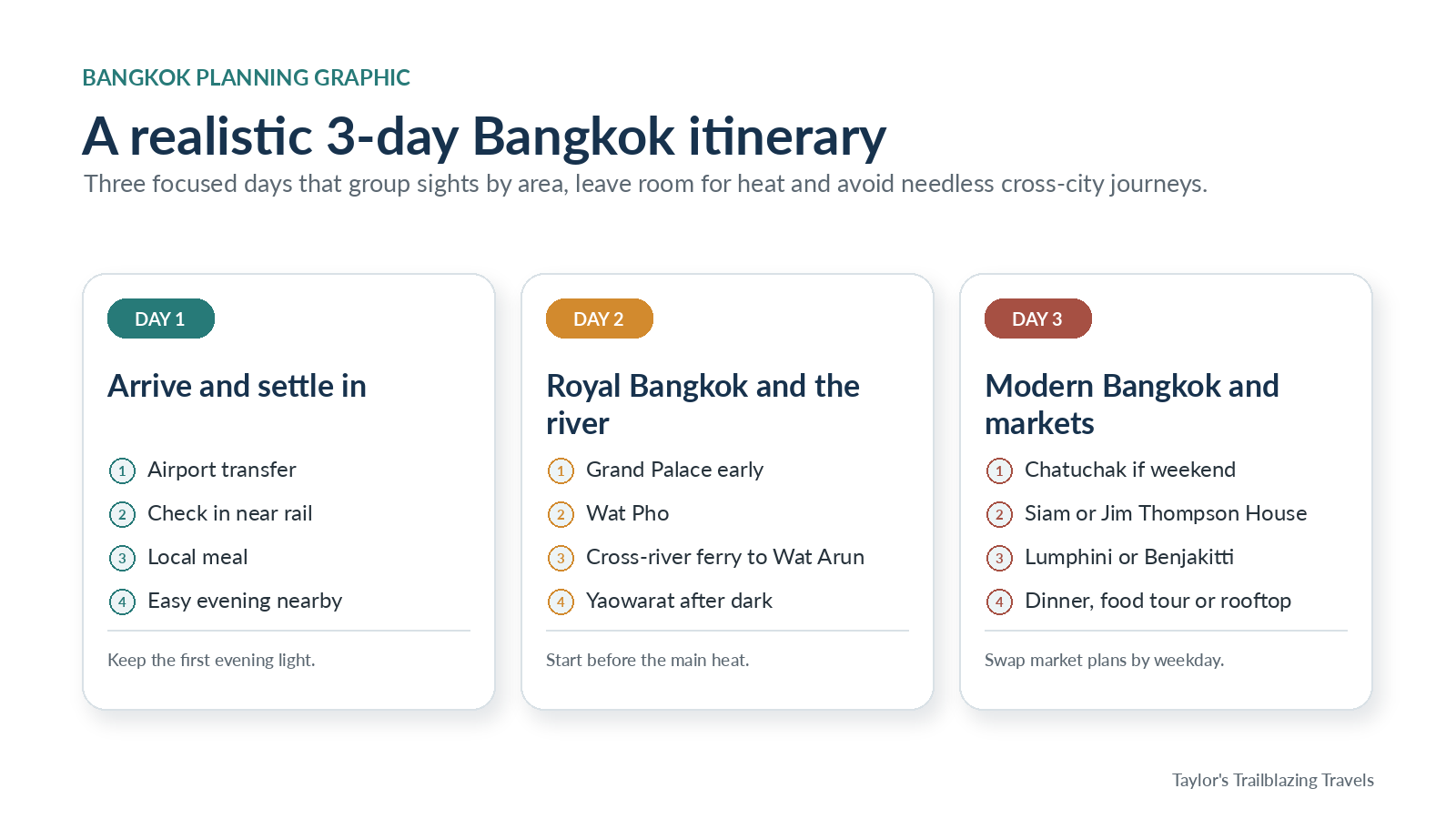
This three-day plan balances temples, food, markets and straightforward logistics without filling every hour.
Use it as a framework, not a strict schedule. Bangkok heat, traffic and jet lag can make a packed itinerary feel miserable. It is better to do fewer things properly than rush through six stops and remember only taxis and sweat.
3-day itinerary at a glance
| Day | Morning | Afternoon | Evening |
|---|---|---|---|
| Day 1Jet lag and soft landing | Arrive, check in, stay local | Easy mall/café/park depending on hotel area | Local dinner, early night or rooftop drink |
| Day 2Classic Bangkok | Grand Palace and Wat Phra Kaew | Wat Pho and Wat Arun | Chinatown/Yaowarat or riverside dinner |
| Day 3Modern Bangkok and food | Chatuchak, Jim Thompson House, or local market | Siam/Sukhumvit/Silom exploring | Food tour, rooftop bar, night market or relaxed dinner |
Day 1: arrive, settle in and stay local
The first day in Bangkok should be easier than you think. Even if you land in the morning, immigration, luggage, transport, hotel check-in, heat and jet lag can take more out of you than expected.
If you arrive at Suvarnabhumi Airport, decide between Airport Rail Link, taxi and private transfer based on your hotel location and luggage. Suvarnabhumi Airport’s official transport page lists taxis, GRAB, AOT Limousine, public buses, vans, shuttle buses and Airport Rail Link among the available options, with taxi services available 24 hours at Passenger Terminal Level 1 between Gates 4 and 7.
If your hotel is near BTS or MRT and you are travelling light, the Airport Rail Link can be the smoothest option. If you are landing late, travelling with children or carrying lots of luggage, a taxi or pre-booked transfer is usually easier.
Once you reach your hotel, do not schedule a big temple day unless you genuinely have the energy. Instead, stay close to your area:
This is also the day to sort basics: cash, water, sunscreen, temple clothes, data, transport apps and your rough plan for the next morning.
Day 2: the Grand Palace, Wat Pho, Wat Arun and Chinatown
Day 2 is the classic Bangkok day. Start early, dress properly, carry water, and group the sights together so you are not crossing the city unnecessarily.
Morning: Grand Palace and Wat Phra Kaew
The Grand Palace and Wat Phra Kaew are the big-ticket Bangkok sights. The Grand Palace complex has been associated with the Thai monarchy since 1782, and the official site describes it as a complex of buildings at the heart of Bangkok.
For first-timers, this is the place where Bangkok’s royal and temple architecture feels most intense. It is also one of the places where planning matters. Dress code is strict. The Grand Palace official practical information lists clothing that is not allowed, including sleeveless shirts, vests, short tops, see-through tops, short pants, torn pants, tight pants, bike pants and mini skirts.
A safe outfit is:
- Lightweight long trousers or a long skirt
- T-shirt or shirt covering shoulders
- Comfortable shoes or sandals
- Scarf or light layer if needed
- No see-through fabric
- No tiny shorts or tank tops
Go early if possible. Bangkok gets hot quickly, and the Grand Palace is much more enjoyable when you are not rushing under midday sun.
Late morning: Wat Pho
Wat Pho is next to the Grand Palace area and is one of the easiest temples to pair with it. Wat Pho’s official visitor information lists its location next to the Grand Palace, opening hours of 08:00-19:30, admission for foreign visitors at 300 baht, and polite dress expectations.
Wat Pho is famous for the Reclining Buddha and traditional Thai massage school. It is also a good place to slow down after the Grand Palace because the grounds can feel calmer.
The main rule is temple respect: dress politely, remove shoes when required, keep voices low, and do not treat Buddha images or sacred spaces as photo props. Wat Pho’s official visitor tips ask visitors to remain calm and polite in temple precincts, remove shoes before entering religious buildings, and treat Buddha images respectfully.
Afternoon: Wat Arun
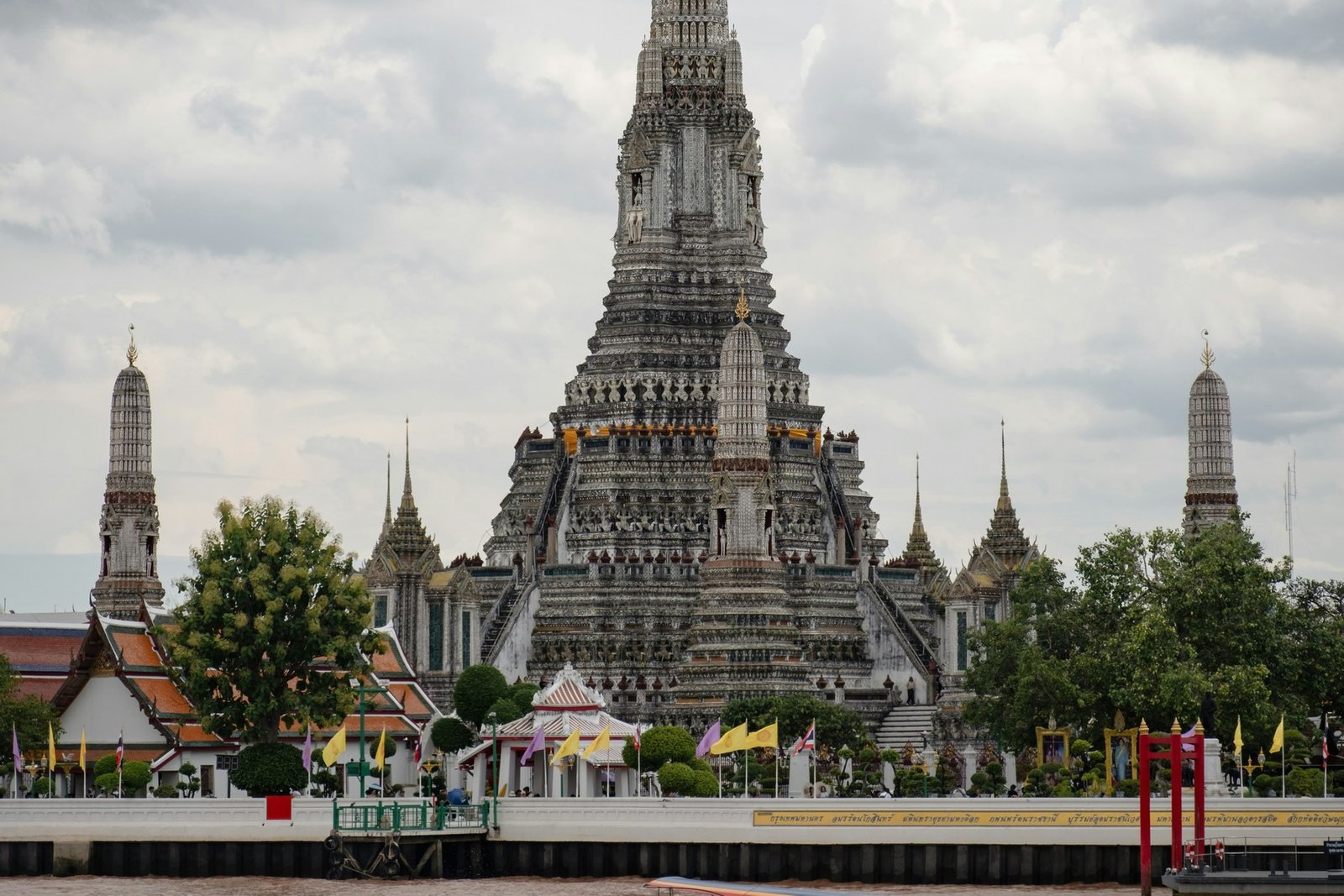
From Wat Pho, it is easy to cross the river to Wat Arun. Wat Arun, also called the Temple of Dawn, sits on the west bank of the Chao Phraya River in Bangkok Yai district, and Tourism Authority of Thailand describes it as one of Thailand’s famous landmarks and photographed icons.
Wat Arun is especially good for photos, river views and a sense of Bangkok’s older riverside layout. It pairs well with Grand Palace and Wat Pho because you are keeping the day focused around the river and old city rather than jumping across town.
After Wat Arun, you have a few options:
Do not underestimate the value of a hotel break. Bangkok temple days can be tiring.
Evening: Chinatown/Yaowarat
For dinner, Chinatown is one of the best classic Bangkok evening choices. TAT describes Chinatown/Yaowarat as an area with savoury dishes, desserts, markets and festival energy, and another TAT article notes that after business hours Yaowarat becomes more vivid as street-food vendors set up.
Go hungry and keep it flexible. This is not the place where you need a complicated restaurant reservation unless you are aiming for a specific venue. Walk, browse, queue where it looks busy, and try a few small things rather than committing to one huge meal.
Good beginner-friendly options often include noodles, grilled seafood, dumplings, mango sticky rice, Thai-Chinese desserts, fruit shakes and roasted meats. Street food can be amazing, but use common sense: choose busy stalls, avoid food that looks like it has been sitting around too long, and be careful with ice or raw items if you have a sensitive stomach.
Day 3: markets, modern Bangkok and food
Day 3 depends on your interests and the day of the week.
Option A: Chatuchak Weekend Market
If your Day 3 falls on a weekend, Chatuchak Weekend Market is a strong choice. Tourism Authority of Thailand says Chatuchak is divided into 27 projects with over 8,000 retail stalls, selling products such as clothing, bags, decorations, handicrafts, souvenirs, food and beverages. TAT also lists plant market hours on Tuesday-Thursday and broader market activity Friday to Sunday.
Chatuchak is big, hot and easy to get lost in, so do not treat it like a quick shopping stop. Go earlier in the day, wear comfortable shoes, carry cash, and agree on a meeting point if travelling with others.
Good things to look for include:
- Clothes
- Homeware
- Ceramics
- Handicrafts
- Souvenirs
- Bags
- Local snacks
- Plants and flowers, if you are not flying onward with restrictions
Skip the animal sections. Apart from ethical concerns, they are not relevant to most travellers and were the subject of serious criticism after a 2024 fire in the pet section killed caged animals, according to international reporting.
Option B: Jim Thompson House and Siam
If markets are not your thing, choose a cultural stop plus Siam shopping.
A simple plan:
Siam is practical because it is central on the BTS and easy to navigate. It is not the most “hidden gem” area, but for first-timers it is useful, especially in hot weather or rainy season.
Option C: Silom, Lumphini Park and rooftop bar
If you want a less shopping-heavy day, head to Silom/Sathorn.
A relaxed plan:
This is a good plan if you have already done temples and want a slower urban day.
Option D: food tour or cooking class
A food tour can be a great first-timer choice because Bangkok food can be overwhelming if you do not know what to order. A guided food tour can help with neighbourhoods, dishes, ordering and basic food confidence.
A cooking class is better if you want a hands-on experience and are interested in Thai ingredients. It is not necessary for everyone, but it can be a good break from sightseeing.
Bangkok’s best temples and cultural sights
Bangkok has a lot of temples and cultural sights, but first-timers do not need to see all of them. Start with the big three around the river and old city, then add one or two extras if you have time.
Grand Palace and Wat Phra Kaew
first-time visitors, royal architecture, major Bangkok landmark
1.5-3 hours
early morning
strict
Wat Pho and Wat Arun
The Grand Palace and Wat Phra Kaew are the most famous cultural sights in Bangkok. They are also among the most formal, so dress properly and check the official schedule before going.
The Grand Palace official site lists standard opening hours as daily 8:30 a.m.-4:30 p.m., ticket sales from 8:30 a.m.-3:30 p.m., and foreigner tickets at 500 baht. It also notes that the schedule may change, so check before visiting.
This is one of the few Bangkok sights where it is worth being extra careful about scams outside. If someone tells you “the palace is closed” and tries to redirect you to a tour, shop or tuk-tuk route, check the official schedule yourself.
Wat Pho
Reclining Buddha, temple atmosphere, pairing with Grand Palace
1-2 hours
late morning or early afternoon
Grand Palace and Wat Arun
Wat Pho is one of the easiest major temples to visit because it sits close to the Grand Palace. The official Wat Pho visitor information lists opening hours of 08:00-19:30 and a 300-baht admission fee for foreign visitors.
Wat Pho is also connected with traditional Thai massage. The official visitor information lists Thai massage services and rates at the temple’s traditional medical school, though availability and details should be checked on the day.
This is a good place to slow down and learn temple etiquette. Remove shoes where required, dress respectfully and avoid climbing or touching sacred objects.
Wat Arun
riverside views, photos, classic Bangkok skyline
45 minutes-1.5 hours
morning, late afternoon or sunset views from across the river
Wat Pho
Wat Arun sits across the river from the Wat Pho/Grand Palace side. Tourism Authority of Thailand describes Wat Arun as a Buddhist temple on the west bank of the Chao Phraya River and one of Thailand’s most famous landmarks.
For first-timers, Wat Arun is a great example of why the river matters in Bangkok. The city is not just roads and malls. The Chao Phraya is part of the sightseeing experience, and taking a short ferry or river boat makes the day feel more connected.
Wat Traimit
Chinatown pairing, Golden Buddha, shorter visit
45 minutes-1 hour
Chinatown/Yaowarat
Wat Traimit is usually paired with Chinatown. If you are already visiting Yaowarat, it can be a good cultural stop before food. It is especially useful if you are building a Chinatown afternoon/evening route.
Wat Saket and the Golden Mount
views, old city atmosphere, less intense than Grand Palace
1-1.5 hours
Old City, Khao San/Banglamphu, Democracy Monument area
Wat Saket, also known as the Golden Mount, is good if you want a viewpoint and a less formal temple stop. It involves steps, so go earlier in the day or later in the afternoon to avoid the worst heat.
Jim Thompson House
culture, design, rainy day, shopping nearby
1-2 hours
Siam/MBK/National Stadium
Jim Thompson House is a useful non-temple cultural stop. It works well if you are staying around Siam or want something easier than a long temple route. It is also a good rainy-day option.
Bangkok National Museum
history lovers, cultural context, slower travellers
1.5-3 hours
Old City/Grand Palace area
Bangkok National Museum can help make the temples and historical sights feel more meaningful, especially if you like context rather than just photos.
Museum of Contemporary Art or galleries
repeat visitors, art lovers, rainy day
1.5-3 hours
depends on location
Bangkok has modern galleries and art spaces too. These are not essential for a first visit, but they are worth considering if you have more than three days or want a break from temples and markets.
Temple etiquette for first timers
For Bangkok temples, keep the basics simple:
- Cover shoulders and knees.
- Remove shoes where required.
- Keep your voice down.
- Do not touch Buddha images.
- Do not point your feet at Buddha images or monks.
- Ask before photographing people.
- Avoid standing in prayer areas just to take photos.
- Be extra respectful around monks and sacred spaces.
Wat Pho’s official visitor tips specifically ask visitors to be calm and polite in temple areas, remove shoes before entering religious buildings, and treat Buddha images respectfully.
Where to eat in Bangkok: markets and food areas
Bangkok is one of Asia’s easiest cities in which to eat well at almost any budget. The challenge is not finding food; it is deciding where to start.
For a first trip, mix these four food experiences:
- Chinatown/Yaowarat
- A local market or food court
- One street-food-focused area
- One more comfortable restaurant, mall food court or guided food tour
This gives you variety without making every meal a research project.
Chinatown/Yaowarat
evening food, street-food atmosphere, Thai-Chinese dishes
MRT Wat Mangkon or taxi/ride app
evening
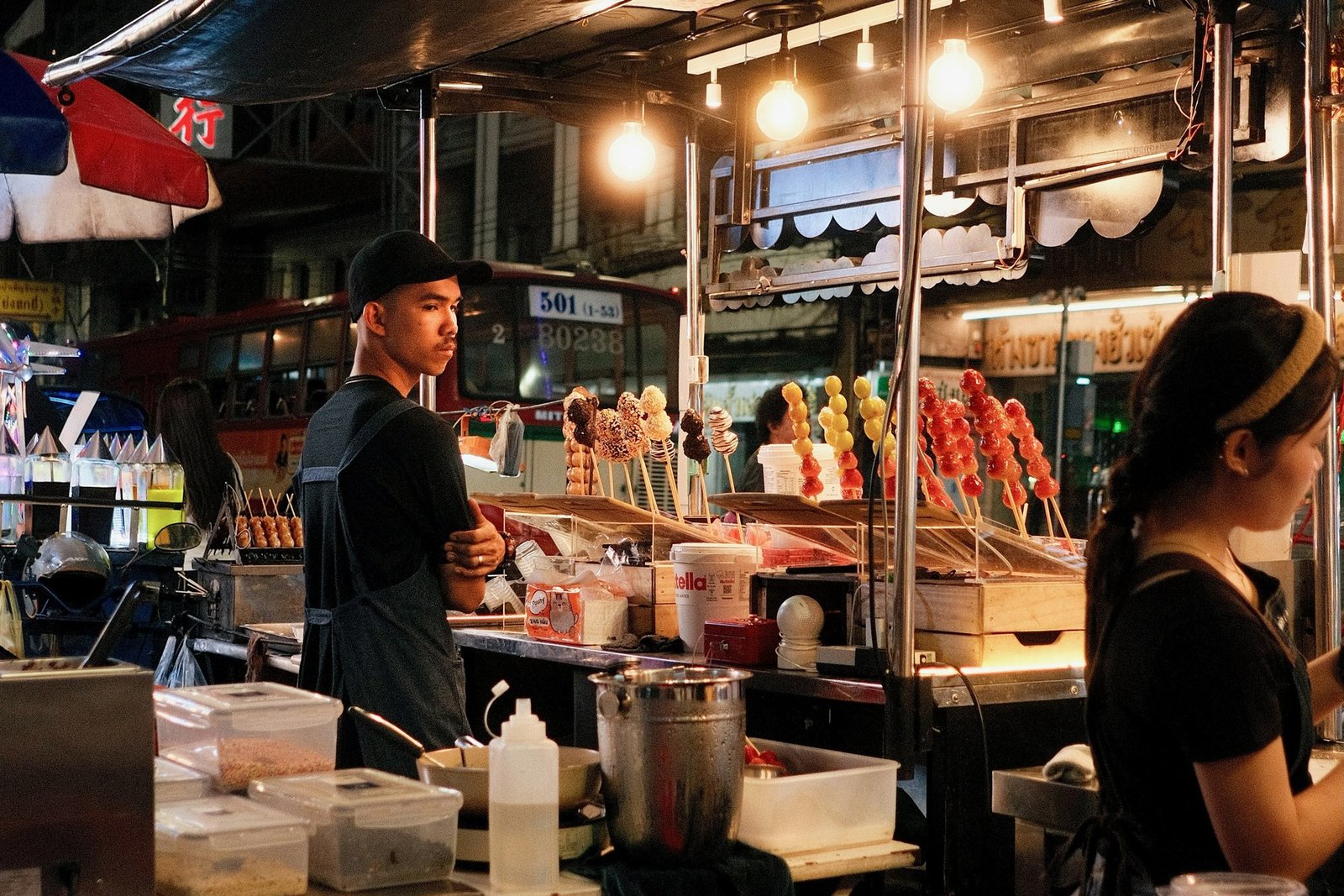
Chinatown is one of the top food areas for first-timers. It is busy, bright, crowded and full of choice. TAT describes Yaowarat as having savoury dishes, desserts, fresh food markets and colourful Chinese festival energy, and notes that the area becomes more vivid after business hours when street-food vendors set up.
Go with a flexible mindset. Rather than trying to “find the best stall”, walk, look for busy places, and order small portions so you can try more.
Beginner-friendly things to try:
- Noodle soups
- Grilled seafood
- Dumplings
- Thai-Chinese desserts
- Mango sticky rice
- Roast meats
- Fruit shakes
- Oyster omelette
- Satay or skewers
If you are nervous about ordering, a food tour can be worth it. It removes decision stress and gives you a better chance of understanding what you are eating.
Chatuchak Weekend Market
shopping, snacks, souvenirs, weekend exploring
BTS Mo Chit or MRT Chatuchak Park/Kamphaeng Phet
morning
Chatuchak is huge. Tourism Authority of Thailand lists more than 8,000 retail stalls across 27 projects, with goods including clothing, bags, decorations, handicrafts, souvenirs, food and beverages.
It is best on a weekend, although some sections open at other times. Go early, wear comfortable shoes, and do not plan a fancy dinner immediately after unless you know you will have energy. Chatuchak can be fun, but it is also tiring.
A good first-timer plan is to spend 2-3 hours there, have snacks, buy a few small items, then leave before you become hot and overwhelmed.
Or Tor Kor Market
cleaner, more organised food-market experience
MRT Kamphaeng Phet
Chatuchak
Or Tor Kor Market is near Chatuchak and works well if you want food in a more structured setting. It is generally easier than wandering random street stalls, so it can be a good first Bangkok food stop.
Wang Lang Market
local food, daytime wandering, river pairing
boat/taxi depending on route
lunch
Wang Lang is a good daytime market for local snacks and lunch. It is less polished than a mall food court and more local than many tourist-heavy areas, so go with patience and curiosity.
Silom food areas
convenient city food, office-worker lunches, dinner options
BTS/MRT
lunch or evening
Silom has everything from street food and local restaurants to rooftop bars and hotel dining. It is a good area if you want food without committing to the chaos of Chinatown every night.
Sukhumvit food areas
variety, international food, nightlife, easy hotel access
BTS
lunch, dinner, late evening
Sukhumvit is not just one food area. It includes many neighbourhoods and side streets. Asok, Phrom Phong, Thong Lor and Ekkamai all have plenty of restaurants, cafés, Japanese food, Thai food, bars and hotel dining.
For first-timers staying nearby, Sukhumvit is easy because you can eat well without crossing the city.
Siam and mall food courts
first meal, families, rainy days, heat breaks
BTS Siam
lunch or early dinner
Mall food courts are underrated for first-time Bangkok visitors. They are air-conditioned, easy, often clean, and good for trying multiple dishes without language stress.
This is especially useful on arrival day, rainy days, or when travelling with children.
Night markets
Bangkok night markets change over time, so check current opening days before building a whole evening around one. Instead of treating one night market as essential, think of night markets as flexible extras.
Good night-market-style experiences for first-timers include:
- Jodd Fairs-style food and shopping markets, when operating
- Train-market-style night markets, depending on current location and opening
- Local neighbourhood markets near your hotel
- Asiatique for a more polished riverside evening
Always check current hours before going because markets can move, rebrand or change schedules.
Beginner Bangkok dishes to try
Here are easy dishes to start with:
- Pad Thai
- Pad see ew
- Green curry
- Massaman curry
- Tom yum
- Mango sticky rice
- Khao man gai
- Boat noodles
- Som tam
- Moo ping
- Thai omelette
- Fried rice
- Coconut ice cream
For spicy dishes, learn one phrase or use a translation app to ask for mild. “Thai mild” can still be spicy if you are not used to chilli.
Food safety tips
Bangkok food is a highlight, but first-timers should still be sensible:
- Choose busy stalls with high turnover.
- Watch whether food is cooked fresh.
- Be cautious with raw seafood or lukewarm dishes.
- Carry hand sanitiser.
- Drink bottled or filtered water.
- Be careful with ice if you have a sensitive stomach, although many established places use commercial ice.
- Do not plan adventurous street food right before a long flight or bus journey.
Food should be fun, not stressful. Start simple, build confidence, and do not feel guilty about using food courts or restaurants alongside street food.
Bangkok costs and a realistic daily budget
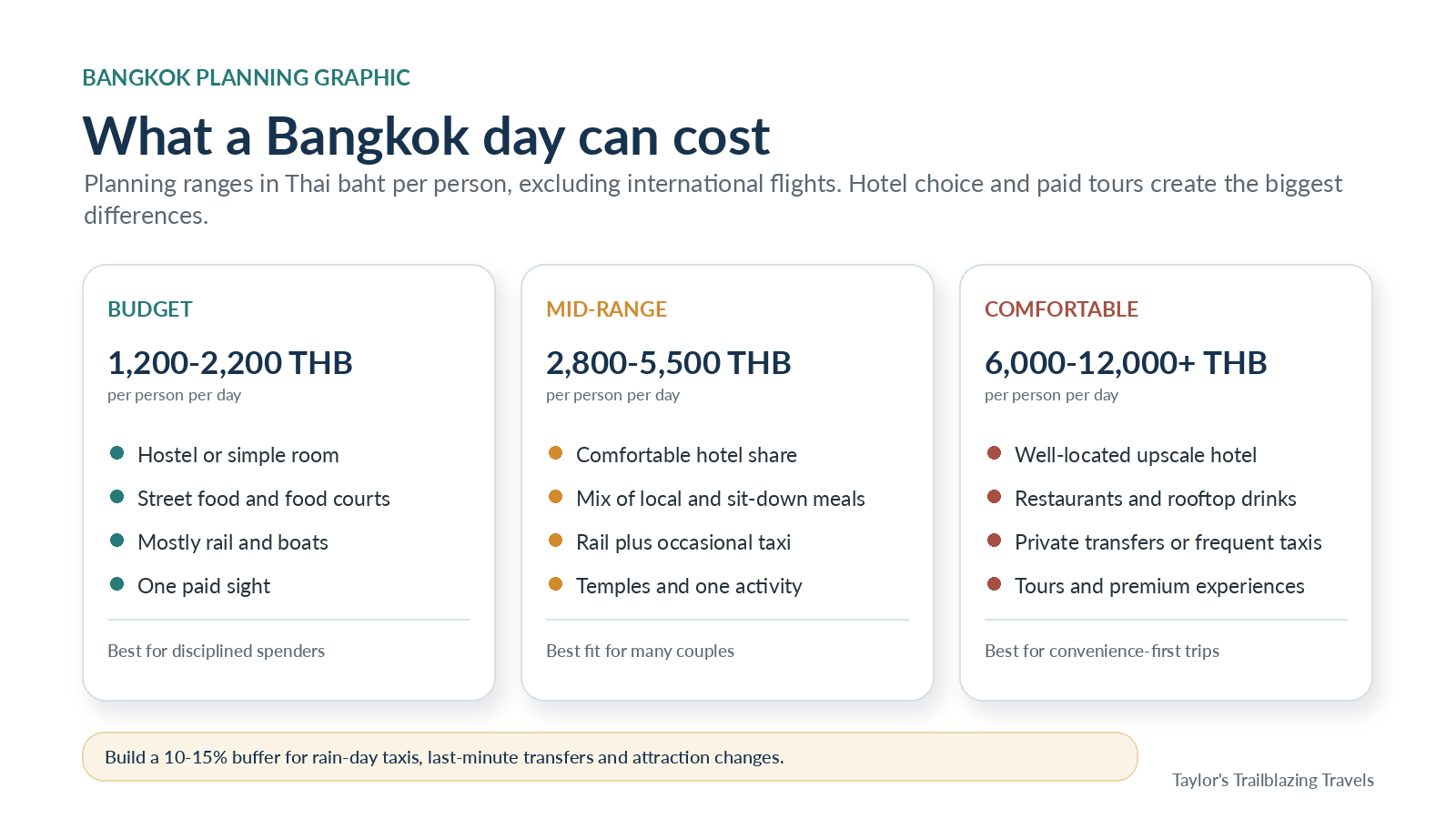
Bangkok can still be affordable, but the word affordable hides very different trips. A visitor using rail, food courts and a simple guesthouse may spend less in a full day than another traveller spends on one riverside dinner. Hotel location, alcohol, rooftop venues, private transfers and guided activities create the largest jumps.
The ranges below are planning figures per person, excluding international flights. Couples sharing a room may spend less per person on accommodation, while solo travellers often carry the full room cost. Peak dates, major events and last-minute bookings can push the numbers higher.
| Style | Accommodation | Food and local transport | Paid sights and activities | Practical daily range |
|---|---|---|---|---|
| Budget | Hostel or simple private room | Street food, food courts, BTS/MRT and boats | One major paid sight, mostly independent | About 1,200-2,200 THB |
| Mid-range | Comfortable, well-located hotel shared by two | Mix of local meals, cafes and occasional taxis | Several temples, a museum or one organised activity | About 2,800-5,500 THB |
| Comfortable | Upscale hotel or riverside stay | Restaurants, taxis, drinks and convenience spending | Tours, premium dining or private transfers | About 6,000-12,000+ THB |
Sample three-day spending plan
| Cost area | Budget approach | Mid-range approach | Where overspending usually happens |
|---|---|---|---|
| Hotel | Simple room near rail rather than in the most fashionable lane | Comfortable hotel close to BTS/MRT with breakfast optional | Choosing views or luxury while still paying for taxis into the areas you visit |
| Meals | Local restaurants, markets and food courts | Local lunch plus a stronger dinner or food tour | Rooftop drinks, hotel dining and imported alcohol |
| Transport | Rail and boats with occasional taxi | Rail for long journeys and taxis for convenience | Road travel at peak time, airport limousines and repeated short app rides |
| Activities | Grand Palace, Wat Pho and independent neighbourhoods | Add a food tour, museum or organised day trip | Booking several overlapping city tours |
Cash, cards and ATMs
Cards are widely accepted in hotels, malls and larger restaurants, but cash remains useful for small food stalls, local ferries, markets and some taxis. Avoid carrying your entire trip budget. Use an ATM in a secure, well-lit location, check the displayed fee before confirming, and keep one backup card separate from the card you use daily.
Build a small disruption buffer
Add roughly 10-15% to the amount you think you will spend. That buffer covers a rain-day taxi, a changed attraction plan, a late airport transfer or the simple decision to stop somewhere air-conditioned rather than continue walking in extreme heat.
For broader accommodation, food and transport estimates, use the Thailand Travel Budget guide. Treat all prices as planning anchors and check live costs before paying.
Getting from Bangkok’s airports to the city
Bangkok has two main airports:
major international airport, common for long-haul arrivals.
common for domestic flights and low-cost regional airlines.
The best airport transfer depends on your airport, arrival time, luggage, hotel area and comfort level.
Airport transfer options at a glance
| Option | Best for | How it works and advantages | Things to know |
|---|---|---|---|
| Airport Rail Link from Suvarnabhumi | Solo travellers, light luggage, hotels near BTS/MRT | Airport to Makkasan/Phaya Thai, then transferAdvantages: Cheap, avoids traffic, predictable | Not ideal with heavy luggage or hotels far from railUse if hotel is near BTS/MRT |
| Metered taxi from Suvarnabhumi | Luggage, families, late arrivals | Official taxi queue, fare + airport surcharge/tollsAdvantages: Door-to-door, 24-hour availability | Traffic, possible queuesUse official queue only |
| Private transfer | Late arrivals, families, nervous first-timers | Driver meets you or pre-arranged pickupAdvantages: Low stress, fixed plan | Costs moreGood first-night splurge |
| Ride app / GRAB | Travellers comfortable with apps | Pickup point variesAdvantages: Convenient, price shown in app | Surge pricing, pickup confusionCheck airport pickup rules |
| Don Mueang taxi | Most DMK arrivals | Taxi queue, fare + surcharge/tollsAdvantages: Simple and direct | TrafficGood if not near rail |
| SRT Red Line from Don Mueang | Light luggage, rail-connected travellers | Rail to central/interchange pointsAdvantages: Avoids some traffic | Requires transfersBest for confident travellers |
Suvarnabhumi Airport to Bangkok
Suvarnabhumi is the easier airport for rail because of the Airport Rail Link. Thailand’s official information says the Airport Rail Link runs from Suvarnabhumi to Phaya Thai, connects with MRT at Makkasan/Phetchaburi and BTS at Phaya Thai, takes no more than about 30 minutes along the route, operates daily from 5:30 a.m. to midnight, and fares start at 15 baht and go to 45 baht.
Choose the Airport Rail Link if:
- You land during the day or evening before service ends.
- You have manageable luggage.
- Your hotel is near BTS/MRT.
- You want to avoid traffic.
- You are comfortable making a transfer.
Do not choose it if:
- You arrive after a long-haul flight and are exhausted.
- You have multiple big bags.
- You are travelling with young children.
- Your hotel is far from rail.
- You land very late at night.
For taxis, Suvarnabhumi’s official airport transport page says taxi services are available 24 hours at Passenger Terminal Level 1 between Gates 4 and 7, passengers need a queue ticket, and the fare includes a base fare plus distance-based charges and a 50-baht surcharge.
A taxi is often the best first-arrival choice if you want simplicity. It may not be fastest in traffic, but it is direct.
Don Mueang Airport to Bangkok
Don Mueang is often used for domestic and low-cost regional flights. It does not have the same simple Airport Rail Link setup as Suvarnabhumi, but you still have taxis, ride apps, buses and rail options.
Thailand’s official public transport guide lists the Red Line commuter rail between Bang Sue Central Station and Rangsit, with fares based on distance and daily operating hours from 5:30 a.m. to midnight. Don Mueang sits on that northern corridor, so the Red Line can be useful for travellers who are comfortable transferring.
For many first-timers arriving at Don Mueang, a taxi or pre-booked transfer will be easiest, especially with luggage.
Should you use a tuk-tuk from the airport?
No. Tuk-tuks are not an airport transfer solution. Use train, taxi, ride app or private transfer.
Tuk-tuks can be fun for very short city hops, but they are not comfortable for luggage, not always cheaper, and not ideal for long distances or airport roads.
Should you pre-book an airport transfer?
Pre-booking is worth considering if:
- You arrive late at night.
- It is your first time in Thailand.
- Children are travelling with you.
- Your group has a lot of luggage.
- A low-stress arrival matters more than saving the final few baht.
- Your hotel is not near BTS/MRT.
- You are landing after a long-haul flight.
It is not essential if you are confident, travelling light, landing during the day and staying near rail.
Best airport option by hotel area
Mobile data and useful apps in Bangkok
Mobile data is not essential for every minute in Bangkok, although it removes several small stresses: locating the correct station exit, showing a driver your hotel, checking a changed flight, messaging a tour guide and translating an address. The most important step is completing setup before you are standing in a crowded arrivals hall.
| Option | Best for | Advantages | Check before buying |
|---|---|---|---|
| Travel eSIM before departure | Unlocked, eSIM-compatible phones | Can be installed before the flight and activated on arrival | Phone compatibility, data allowance, validity, hotspot rules and whether calls are included |
| Local tourist SIM/eSIM | Travellers wanting a Thai number or local network package | In-person support and a choice of local plans | Passport registration, plan duration, speed limits and renewal conditions |
| Home-network roaming | Very short trips or travellers whose plan includes Thailand | No SIM change and existing number remains primary | Daily charges, fair-use limits and accidental background data |
| Wi-Fi only | Visitors comfortable planning offline | No additional package cost | Limited usefulness for pickups, maps and last-minute changes away from the hotel |
Set up data before landing
Download offline maps, save the hotel address in English and Thai, and keep the booking reference somewhere available without a connection. With dual-SIM phones, label each line clearly, turn off data roaming on the home line unless it is included, and decide which number should handle calls and messages.
Useful app categories
- Maps with offline areas saved for your hotel and key neighbourhoods.
- A licensed ride-hailing app for awkward routes and late evenings.
- Your airline and accommodation apps for changes and messages.
- A translation app with Thai downloaded for offline use.
- A secure banking app and a separate method for two-factor authentication.
What to pack for Bangkok
Bangkok packing is mostly about heat management, temple clothing and carrying less during the day. A large backpack filled for every possible outcome becomes uncomfortable quickly. Leave non-essential items at the hotel and build one compact day kit that works for rail, markets and temples.
| Item | Why it earns space | Common mistake |
|---|---|---|
| Breathable temple outfit | Covers shoulders and knees without relying on a last-minute clothing stall | Wearing tight, torn or unsuitable clothing at the Grand Palace |
| Comfortable closed or secure shoes | Useful for long days, rough pavements and wet surfaces | New shoes that become painful after several kilometres |
| Compact rain protection | Helps during sudden showers and the walk between station and hotel | Carrying a heavy full-size umbrella all day |
| Refillable bottle | Encourages regular hydration in heat | Waiting until thirst is obvious |
| Small power bank | Supports maps, tickets and driver communication | Packing it in checked baggage rather than hand luggage |
| Secure day bag | Keeps phone, wallet and passport copy close in crowded areas | Using an open tote in markets and stations |
| Medication and sun protection | Reduces avoidable disruption | Assuming every familiar brand will be easy to find immediately |
A sensible temple-day bag
Carry water, sun protection, a small amount of cash, a charged phone, your accommodation details and a light layer if your normal outfit does not meet the dress code. Keep the bag small enough to handle easily when removing shoes and moving through busy entrances.
Optional products worth comparing
As an Amazon Associate I earn from qualifying purchases.
Compact travel umbrella
Useful for both intense sun and sudden showers. Look for a model that closes securely, fits inside your day bag and is not so light that it turns inside out immediately.
Clearly labelled 10,000mAh power bank
A modest-capacity power bank is usually enough for maps, tickets and messages. Check your airline rules and keep lithium batteries in hand luggage.
Lightweight crossbody day bag
A compact zipped bag can be easier than a large backpack in markets, temples and crowded trains. Choose comfort and secure closures over unnecessary compartments.
For clothing quantities, monsoon variations, medication and luggage guidance, use the full Thailand Packing List.
The best day trips from Bangkok
Bangkok is a strong base for day trips. The best choice depends on whether you want history, markets, nature, waterfalls or a more unusual local experience.
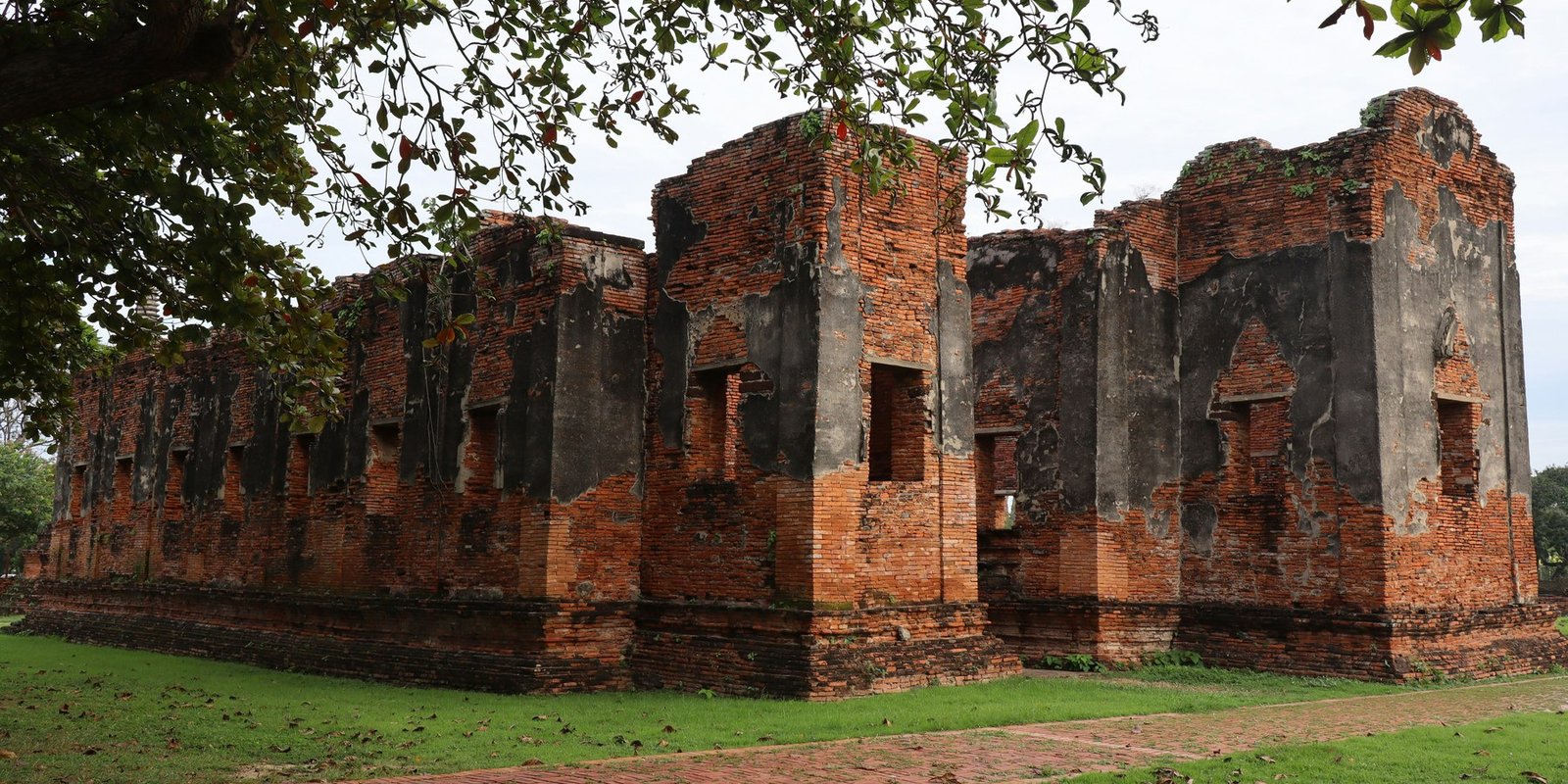
For a first trip, Ayutthaya is usually the best day trip if you only choose one. It is historic, culturally important and close enough to work as a day trip. TAT describes Phra Nakhon Si Ayutthaya as only 86 km north of Bangkok and notes that its Historical Park is a UNESCO World Heritage site.
Bangkok day trips compared
| Day trip | Best for | Travel time and style | Why go – and the trade-offs |
|---|---|---|---|
| Ayutthaya | History, temples, ruins | Full dayTrain, tour, private driver | Classic, meaningful, not too farTrade-off: Hot, spread out once there |
| Damnoen Saduak + Maeklong | Floating market, railway market | Half to full dayTour/private driver | Iconic, easy with a tourTrade-off: Tourist-heavy, early start |
| Kanchanaburi | History, River Kwai, nature | Long full day or overnightTrain, tour, private driver | History + sceneryTrade-off: Better with overnight if adding Erawan |
| Erawan Falls | Nature, waterfalls | Very long day or overnightTour/private driver | Beautiful swimming areasTrade-off: Too rushed for some as a day trip |
| Khao Yai | Wildlife, national park, nature | Long day or overnightPrivate car/tour | Nature break from BangkokTrade-off: Best with overnight |
| Bang Krachao | Easy green escape | Half dayTaxi/boat/bike | Close and differentTrade-off: Weather-dependent |
Ayutthaya
first-time day trip, history, temples, ruins
full day
guided tour, train plus local transport, or private driver
Ayutthaya is the easiest major cultural day trip from Bangkok. The old capital has temple ruins, rivers, historical sites and food. TAT says Ayutthaya was a major historical capital for 417 years and that visitors can explore temples and ruins concentrated around the old city.
A guided tour is simplest if you want context and transport handled. Independent travellers can take a train and then use local tuk-tuks/bikes once there, but the sights are spread out and heat can be a challenge.
A good Ayutthaya day includes:
- Wat Mahathat
- Wat Phra Si Sanphet
- Wat Chaiwatthanaram
- Local lunch
- River or sunset stop if timing works
This is the best first Bangkok day trip for most travellers.
Damnoen Saduak Floating Market and Maeklong Railway Market
iconic photos, market experience, easy tour
half to full day
early guided tour or private driver
Damnoen Saduak is one of Thailand’s most famous floating markets. Tourism Authority of Thailand describes it as one of the most popular floating markets in Thailand, with Thai and foreign tourists visiting to shop, eat and experience the atmosphere of traditional water markets.
Maeklong Railway Market is often paired with it. TAT describes Mae Klong Railway Market as a local market near Mae Klong Railway Station, around 100 metres long, where vendors sell fresh produce and goods beside the railway and move their umbrellas/products when the train comes through.
This is a very touristy day trip, but it is easy and memorable if you know what you are booking. Go early and do not expect a peaceful local secret.
Kanchanaburi
history, river scenery, war history, slower overnight trip
long day or 1-2 nights
tour, train, private driver
Kanchanaburi is possible as a day trip but works better with at least one night if you want to add waterfalls or slower sightseeing. TAT describes Kanchanaburi as only about two hours from Bangkok by road or rail and notes weekend sightseeing day trips by train.
Common sights include the Bridge over the River Kwai, Death Railway-related history, museums, river scenery and nearby waterfalls.
Choose Kanchanaburi if you are interested in history and nature. Choose Ayutthaya instead if you want the easiest first-time cultural day trip.
Erawan National Park
waterfalls, swimming, nature
long full day or overnight
tour/private driver, often combined with Kanchanaburi overnight
Erawan National Park is in Kanchanaburi province. TAT describes Erawan Waterfall as a major waterfall with seven tiers and safe swimming areas.
It is beautiful but not the easiest quick day trip from central Bangkok. If you try to do it in one day, expect a long journey. It is better as part of a Kanchanaburi overnight plan.
Khao Yai National Park
nature, wildlife, national park scenery
long day or overnight
private car or tour
Khao Yai is Thailand’s first national park, and TAT says it covers 2,168 sq km across several provinces, with jungle, streams, waterfalls and diverse flora and fauna. It is also listed as part of a UNESCO World Heritage site.
Khao Yai is doable from Bangkok, but it is not a casual half-day trip. If nature is a priority, consider staying overnight near the park.
Bang Krachao
easy green escape, bikes, slower half-day
half day
taxi/boat/bike
Bang Krachao is often called Bangkok’s green lung. It is close enough for a half-day escape and works well if you want a change from traffic, temples and malls.
This is a good option if you have already seen the major sights and want something calmer without leaving the Bangkok area completely.
Onward travel from Bangkok
Bangkok is not simply a place to visit; it is the point where many Thailand itineraries change transport type. The key is identifying the real departure point before booking. A flight may use Suvarnabhumi or Don Mueang, a train may leave Krung Thep Aphiwat rather than Hua Lamphong, and buses or vans can use different terminals depending on the route and operator.
| Next stop | Common choices | Planning point that matters |
|---|---|---|
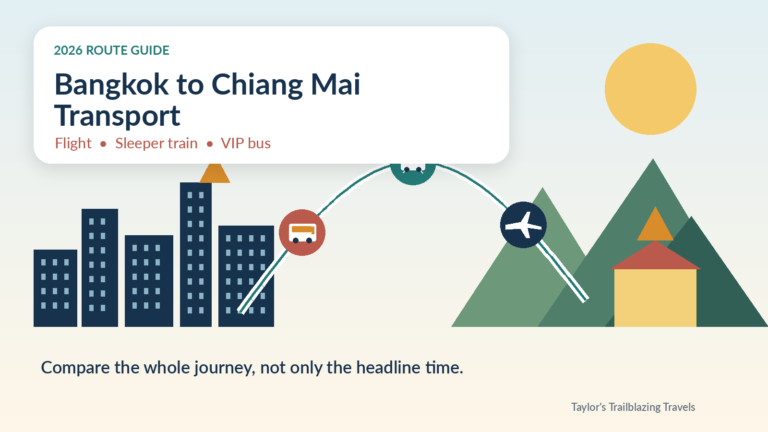
| Chiang Mai | Flight, overnight sleeper train or long-distance bus | Compare door-to-door time, berth availability, baggage and the airport used |
| Ayutthaya | Train, van, private vehicle or guided day trip | Decide whether it is a day trip or an overnight stop before choosing transport |
| Kanchanaburi | Train, bus, van, private transfer or tour | Local station and terminal locations affect the total journey |
| Phuket or Krabi | Flight, overnight bus or longer train-and-road combination | Low headline airfare can exclude baggage and airport transfers |
| Koh Samui, Koh Phangan or Koh Tao | Flight, rail-and-ferry, bus-and-ferry or joint ticket | Check every transfer, pier and weather-sensitive connection |
| Cambodia or Laos | Flight, bus or rail/road combinations depending on destination | Check current entry rules and border arrangements separately |
Do not book the headline time only
A one-hour flight is not a one-hour journey. Add hotel checkout, airport travel, check-in, security, baggage collection and transfer at the other end. The same principle applies to overnight trains and joint ferry tickets. A slightly slower option can be better when it leaves from the station nearest your hotel or arrives at a useful time.
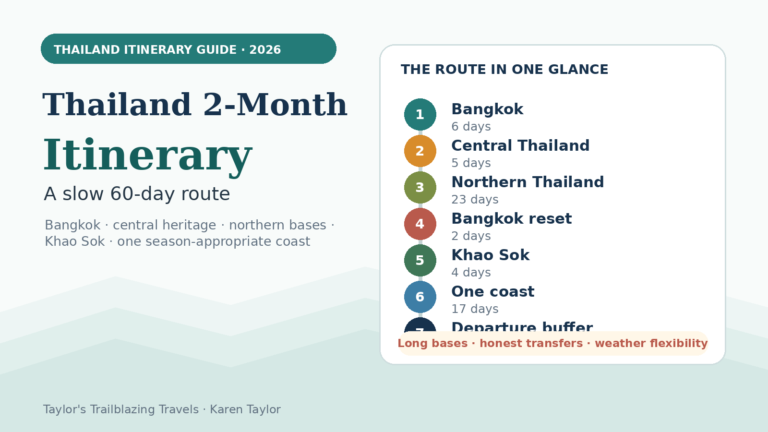
Building a longer route? The Thailand 2-Week Itinerary explains how Bangkok can connect with northern Thailand and the south without turning every second day into a transfer day.
Bangkok safety, scams and etiquette
Bangkok is manageable for most visitors who use normal big-city awareness, but the risks are not limited to theft. Traffic, heat, alcohol, unfamiliar laws and rushed transport decisions cause many preventable problems. The aim is not to travel nervously; it is to remove the obvious weak points.
Protecting belongings
Keep your phone and wallet secure on crowded trains, in markets and when travelling in open vehicles. Do not leave a bag loosely beside you in a tuk-tuk. Use hotel storage for valuables you do not need that day, and keep a backup payment method separate.
The palace is closed and detour scams
Ignore unsolicited claims that a major sight is closed, that foreigners cannot enter or that a special event requires you to visit a shop first. Check the official schedule yourself and continue to the proper entrance. A genuine closure does not require a stranger to arrange a discounted tuk-tuk tour.
Road and motorcycle risk
Road crossings deserve more attention than they often receive. Use pedestrian bridges or controlled crossings where practical, look in both directions and do not assume a green signal removes every turning vehicle. Motorcycle taxis can be fast, but speed and exposure increase risk; use them only when you understand the trade-off and have an appropriate helmet.
Local laws, vapes and alcohol
Do not bring or use an e-cigarette or vape. Current UK government travel advice states that possession and use are illegal in Thailand and can lead to confiscation, fines, detention and court proceedings. Laws around drugs and cannabis are also strict and changeable; never rely on a casual social-media summary.
Entry documents before the city
British travellers should check the current passport, visa and Thailand Digital Arrival Card requirements before departure. Rules depend on nationality and purpose of travel, so non-UK visitors should use their own government advice and the relevant Thai authority.
Common Bangkok mistakes to avoid
Mistake 1: booking a hotel far from BTS/MRT
This is the big one. A hotel can look cheap and central online but become annoying if every trip needs a taxi. Bangkok traffic can turn short distances into long journeys, especially during rush hour or rain.
For first-timers, being near BTS or MRT is usually worth paying slightly more. Even if you use taxis sometimes, rail gives you options.
Mistake 2: trying to see too much in one day
Bangkok punishes overpacked itineraries. Heat, traffic, temple dress codes, queues, meal stops and transport transfers all take time.
A better plan is one major morning activity, one afternoon area, and one evening food plan.
Mistake 3: visiting temples in the wrong clothes
Temple dress codes are not optional. The Grand Palace has strict clothing rules, and Wat Pho also asks visitors to dress politely.
Pack at least one temple outfit:
- Covered shoulders
- Covered knees
- Breathable fabric
- Comfortable shoes/sandals
- No see-through clothing
- No tight gym shorts or tiny tops
Mistake 4: believing “the palace is closed” from random people outside
This is a classic tourist problem. If someone outside a major sight tells you it is closed and offers an alternative route, check the official website or ticket office.
The Grand Palace does have schedule changes, but that does not mean you should trust a random street pitch.
Mistake 5: taking taxis without checking the meter or price
Thailand’s public transport guide states that taxi fares start at 35 baht and that drivers turning off the meter and demanding a fixed price is illegal. It also lists an additional 50-baht service charge when using taxi services from Don Mueang and Suvarnabhumi airports.
Use official taxi queues at airports, ride apps when useful, and agree on tuk-tuk prices before getting in.
Mistake 6: assuming tuk-tuks are always cheaper
Tuk-tuks can be fun for a short ride, but they are often not cheaper than taxis or ride apps. They can also be hot, noisy and exposed to traffic.
Use them for the experience, not because you think they are automatically the budget option.
Mistake 7: skipping Bangkok completely
Some travellers skip Bangkok because they only want beaches. That can work, but it often makes the trip more rushed. Bangkok is useful for arrival, temples, food, shopping and onward transport.
Even two nights can make a Thailand itinerary smoother.
Mistake 8: staying only one night after a long-haul flight
If you land late and leave the next morning, you may spend your first Thailand day exhausted and stressed. Consider at least two nights in Bangkok if arriving internationally.
Mistake 9: planning outdoor markets in the hottest part of the day
Markets are fun, but they can be brutally hot. Go early, drink water, and plan a mall/café/hotel break afterwards.
Mistake 10: not checking opening days and hours
Temples, markets, museums, restaurants and tours can change hours. Markets especially can shift schedules or locations. Check current information before building your day around one place.
Mistake 11: choosing a day trip that is too far for your schedule
Khao Yai, Erawan and some Kanchanaburi routes are better with an overnight stay. If you only have three days in Bangkok, Ayutthaya is usually a better fit than a very long nature day.
Mistake 12: eating too adventurously before travel days
Bangkok food is amazing, but do not test your stomach with lots of spicy street food the night before a long bus, ferry, flight or early tour.
Save adventurous meals for evenings when the next morning is flexible.
Bangkok pros and cons for a first Thailand trip
Reasons to include Bangkok
- Excellent international and domestic transport connections.
- A strong mix of temples, food, markets, museums, parks, shopping and nightlife.
- Useful place to recover from a long flight before a more complex transfer.
- Accommodation at almost every budget level.
- Easy access to Ayutthaya and other central Thailand trips.
- Rail systems make many major areas predictable to reach.
Reasons some travellers limit the stay
- Heat, humidity and traffic can make overpacked days exhausting.
- The city is spread out and does not have one obvious tourist centre.
- Road transfers become unreliable during peak traffic and storms.
- Some famous markets and sights are crowded or highly commercial.
- Pavements, stairs and pier access can be difficult for limited mobility.
- A beach-focused traveller with very little time may prefer only a short stop.
The sensible answer is rarely to skip Bangkok completely or stay a week by default. Match the number of days to the experiences you genuinely want, then choose a base that reduces the transport burden.
Bangkok frequently asked questions
Is Bangkok good for first-time Thailand travellers?
Yes. Bangkok is good for first-time Thailand travellers because it gives you temples, food, markets, shopping, transport connections and a soft landing before heading north or south. It can be intense, but with the right hotel area and a simple itinerary, it is one of the most useful places to start a Thailand trip.
How many days should I spend in Bangkok for the first time?
Most first-time visitors should spend 2 to 4 days in Bangkok. Two days is enough for the main temples and Chinatown. Three days gives you a better balance of temples, markets, food and modern Bangkok. Four days lets you add a day trip such as Ayutthaya.
Is 2 days enough in Bangkok?
Two days is enough if Bangkok is only part of a larger Thailand itinerary. Prioritise the Grand Palace, Wat Pho, Wat Arun, Chinatown, and either Chatuchak, Siam, Silom or a food tour. If you arrive late at night, add an extra night if possible.
Is 3 days enough in Bangkok?
Yes, 3 days is a strong first-timer plan. You can use one day for arrival and easy exploring, one day for temples and Chinatown, and one day for markets, shopping, food or a day trip.
Where should first-timers stay in Bangkok?
First-timers should usually stay in Sukhumvit, Silom/Sathorn, Siam or Riverside. Sukhumvit is best for convenience and BTS access. Silom/Sathorn is best for balanced transport and food. Siam is best for shopping and short stays. Riverside is best for views and a calmer hotel experience.
Is Sukhumvit a good area to stay in Bangkok?
Yes, Sukhumvit is a good area for many first-time visitors because it has BTS access, restaurants, nightlife, malls and lots of hotels. It is busy and modern, so it may not suit travellers who want old-city atmosphere, but it is very practical.
Is Khao San Road good for first timers?
Khao San is good for backpackers, budget travellers and nightlife. It is not the best area for everyone because it can be noisy and is not as convenient for BTS/MRT. Choose it for social travel, not for a quiet or polished first stay.
Should I stay near the Grand Palace?
Staying near the Grand Palace is useful if temples and old Bangkok are your top priority. It is less convenient for BTS/MRT, nightlife and modern shopping. For most first-timers, Sukhumvit or Silom gives more flexibility, while Old City/Rattanakosin works best for temple-focused stays.
What is the best way to get around Bangkok?
The best way to get around Bangkok is usually a mix of BTS, MRT, river boats, taxis and walking short distances. BTS and MRT are best for avoiding traffic. Taxis are useful for areas not covered by rail. River boats are useful for old-city and riverside sightseeing. Thailand’s official public transport guide lists BTS, MRT, Airport Rail Link, Red Line, taxis and Chao Phraya river boats as key transport options.
Is Bangkok walkable?
Bangkok is walkable only in small areas. Do not plan to walk across the city. Heat, traffic, large roads and limited pavements can make long walks uncomfortable. Stay near BTS/MRT and walk within neighbourhoods.
Is Bangkok safe for tourists?
Bangkok is generally manageable for tourists who use normal city awareness, but first-timers should watch for traffic, scams around major sights, overcharging, pickpockets in crowded places and food/heat issues. Use official taxis or ride apps, keep valuables secure, and be cautious if someone approaches you with unsolicited advice near tourist attractions.
What should I wear in Bangkok?
Wear light, breathable clothes, comfortable shoes and sun protection. For temples, cover shoulders and knees. The Grand Palace and Wat Pho both have dress expectations, and the Grand Palace official information lists several types of clothing that are not allowed.
Can I wear shorts in Bangkok?
Yes, you can wear shorts around the city, malls and casual areas, but not all temple or royal sites allow them. Pack long trousers or a long skirt for temple days.
What is the best Bangkok temple route?
The best first-timer temple route is Grand Palace and Wat Phra Kaew > Wat Pho > Wat Arun > Chinatown or riverside dinner. This keeps the day focused around the old city and river rather than wasting time crossing Bangkok.
Is the Grand Palace worth it?
Yes, the Grand Palace is worth it for most first-time visitors because it is one of Bangkok’s major cultural sights. It is also busy, formal and more expensive than many temples, so go early, dress properly and check the official schedule.
How much does the Grand Palace cost?
The Grand Palace official information lists foreigner tickets at 500 baht, including access to Wat Phra Kaew and Queen Sirikit Museum of Textiles within the compound. Ticket details can change, so check the official site before visiting.
How much does Wat Pho cost?
Wat Pho’s official visitor information lists admission for foreign visitors at 300 baht and opening hours of 08:00-19:30. Check the official site before visiting in case details change.
What is the best airport transfer from Suvarnabhumi to Bangkok?
The Airport Rail Link is usually best when you travel light and stay near a useful rail connection. A taxi or private transfer is often easier for late arrivals, families, heavy luggage or hotels far from rail. Suvarnabhumi currently lists Airport Rail Link service from 05:30 to midnight.
Should I take a taxi from Bangkok airport?
A taxi is a good choice if you have luggage, arrive late, travel with family or stay somewhere not near rail. Use the official airport taxi queue. Suvarnabhumi Airport states that taxi services are available 24 hours at Level 1 between Gates 4 and 7, with a queue ticket system, distance-based fare and 50-baht surcharge.
Is Bangkok expensive?
Bangkok can be budget-friendly or expensive depending on your choices. Street food, local transport and simple hotels can be affordable. Riverside hotels, rooftop bars, private transfers, luxury malls and guided tours can increase costs quickly.
What is the best day trip from Bangkok?
Ayutthaya is the best day trip for most first-time visitors because it is close enough for a full-day trip and has major historical value. TAT describes Ayutthaya as 86 km north of Bangkok and notes that its Historical Park is a UNESCO World Heritage site.
Is Ayutthaya worth a day trip from Bangkok?
Yes, Ayutthaya is worth a day trip if you enjoy history, temples and ruins. Take a guided tour for simplicity or travel independently if you are comfortable arranging local transport once there.
Are floating markets near Bangkok worth it?
Floating markets can be worth it if you understand that the famous ones are touristy. Damnoen Saduak is one of Thailand’s most popular floating markets, according to Tourism Authority of Thailand, but it is not a hidden local secret. Go early and consider pairing it with Maeklong Railway Market.
Can I visit Kanchanaburi as a day trip from Bangkok?
Yes, Kanchanaburi can be visited as a long day trip, but it is better with at least one night if you want to include Erawan Falls or explore more slowly. TAT describes Kanchanaburi as about two hours from Bangkok by road or rail.
Final Bangkok planning checklist
Use this checklist before booking Bangkok.
Before booking your hotel
- Decide how many nights you actually have, not including a late arrival.
- Choose your area before choosing your hotel.
- Prioritise BTS/MRT access unless staying Riverside or Old City for a specific reason.
- Check recent reviews for noise, cleanliness and transport convenience.
- Look at the walking route to the nearest station, not just the distance.
- Avoid booking only because the hotel looks cheap on a map.
- Check whether breakfast is useful or whether you prefer local cafés/food courts.
Before arriving in Bangkok
- Check which airport you arrive at: Suvarnabhumi or Don Mueang.
- Decide your airport transfer before landing.
- Save your hotel name and address in Thai if possible.
- Download offline maps or make sure your eSIM/SIM is ready.
- Carry some Thai baht for transport, snacks and small purchases.
- Check your first-day plan and keep it light.
- Pack a temple outfit in your hand luggage if visiting temples the next morning.
For temple day
- Wear covered shoulders and knees.
- Avoid see-through, torn or tight clothing for Grand Palace.
- Start early to avoid heat and crowds.
- Carry water.
- Bring sun protection.
- Remove shoes where required.
- Keep voices low.
- Do Grand Palace, Wat Pho and Wat Arun as one grouped route.
- Check official opening hours before leaving the hotel.
For food and markets
- Choose busy food stalls with high turnover.
- Start with beginner-friendly dishes if nervous.
- Carry tissues/hand sanitiser.
- Use mall food courts when you want an easy, air-conditioned meal.
- Go to Chatuchak early if visiting on a weekend.
- Do not overplan exact stalls unless you are joining a food tour.
- Avoid risky food before flights, ferries or long bus journeys.
For transport
- Use BTS/MRT where practical.
- Use taxis or ride apps for awkward routes.
- Avoid tuk-tuks for long journeys.
- Agree tuk-tuk prices before riding.
- Use official taxi queues at airports.
- Allow extra time during rush hour and rain.
- Use river boats for old-city/riverside sightseeing when convenient.
The simplest first-time Bangkok plan
Bangkok is not a city you need to conquer. Treat it as your Thailand launchpad: arrive, settle in, see the temples, eat well, learn the transport and leave enough energy for the rest of the trip.
Image credits
Wat Arun beside the Chao Phraya River. Photo by Teodor Kuduschiev on Unsplash, used under the Unsplash License.
BTS Skytrain at an elevated Bangkok station. Photo by Marco J Haenssgen on Unsplash, used under the Unsplash License.
Yaowarat night-time street-food stall. Photo by Kaden Taylor on Unsplash, used under the Unsplash License.
Ayutthaya temple ruins. Photo by Noppon Meenuch on Unsplash, used under the Unsplash License.
Three-day itinerary planner, Bangkok transport planner and Bangkok daily-budget planner are original editorial graphics created for Karen Taylor and Taylor’s Trailblazing Travels.