Thailand travel planning – updated 22 August 2026
A practical packing guide for Bangkok, northern Thailand, temples, islands, monsoon travel, domestic flights and multi-stop routes.
Affiliate disclosure
This guide contains carefully selected affiliate links. Taylor’s Trailblazing Travels may earn a commission when a reader buys or books through one of them, at no extra cost to the reader. As an Amazon Associate I earn from qualifying purchases. Commercial links are included only where the product or service helps with a genuine packing decision.
Packing for Thailand sounds simple until one journey combines a humid Bangkok afternoon, an early temple visit, a cool air-conditioned train, a rainy island transfer and a domestic flight with a strict baggage allowance. The answer is not a huge suitcase. It is a small, adaptable wardrobe and a carefully organised cabin bag.
This Thailand packing list is designed for first-time visitors, couples, families, backpackers and travellers moving between several regions. It covers what to wear, what to place in hand luggage, what to buy before departure, what is easy to buy locally and which items create more weight than value.
Thailand’s official tourism website describes a climate influenced by both summer and winter monsoons, with an average national temperature range of 18-38C. That broad figure explains why one generic weather icon is not enough: Bangkok, Chiang Mai, mountain viewpoints and the two southern coasts can require different additions to the same core bag.[1]
The most reliable approach is to pack for seven or eight days, arrange laundry during the trip and add only the specialist items your actual route needs. A two-week holiday rarely requires two weeks of different clothes.
What should you pack for Thailand?
Pack lightweight, breathable clothes for seven days, one proper temple outfit that covers shoulders and knees, two sets of swimwear, a thin layer for air-conditioning, a compact rain layer, walking shoes, sandals, sun protection, insect repellent, a universal adapter, a clearly labelled power bank, medication, travel documents and a small waterproof pouch. Keep your passport, medicine, valuables, batteries and one change of clothes in hand luggage.
Best bag
A carry-on backpack, soft-sided case or medium suitcase you can lift without help. Let the route decide.
Core wardrobe
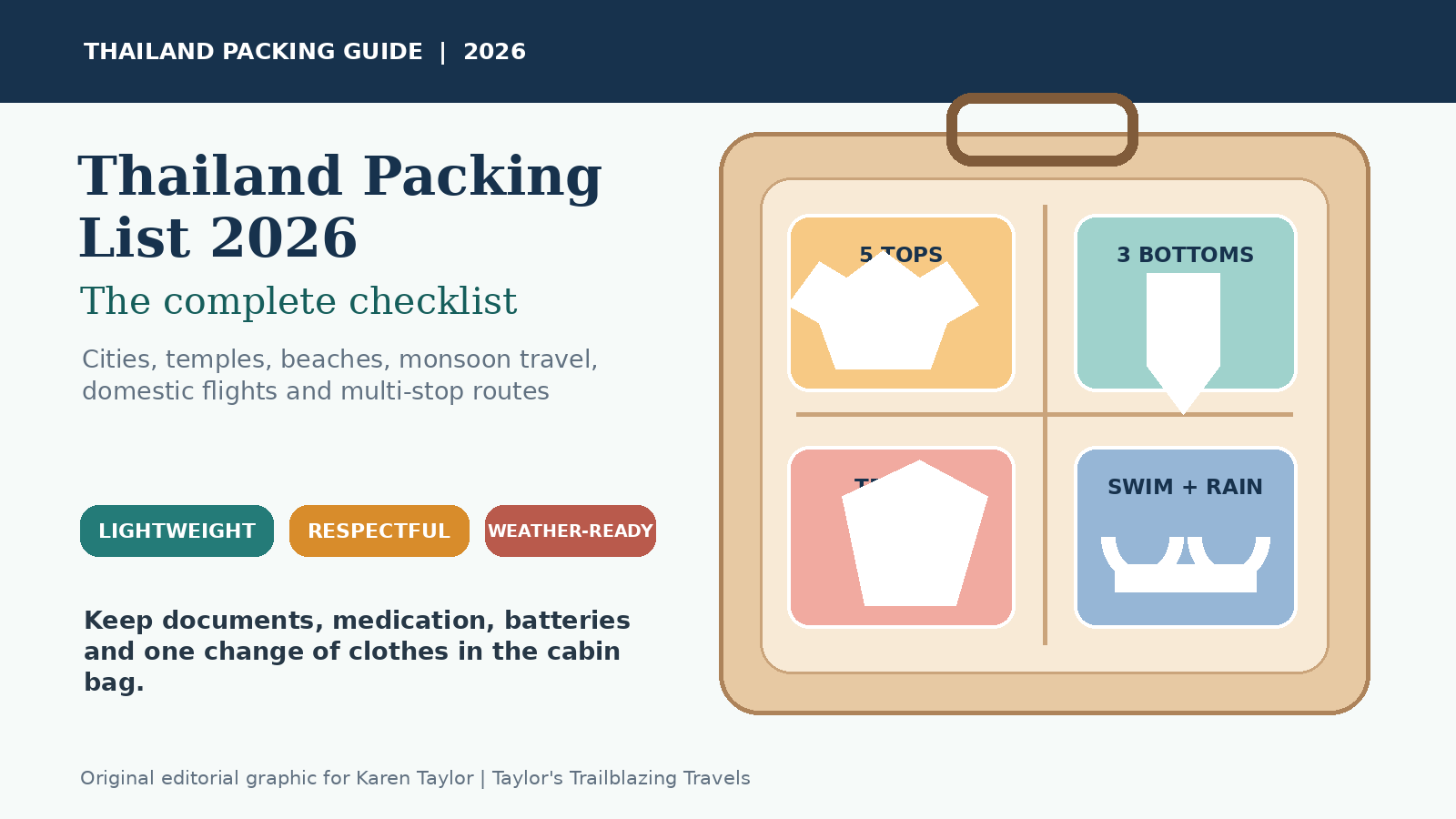
Five tops, three bottoms, one temple outfit, one light layer, sleepwear and two sets of swimwear.
Shoes
One broken-in walking pair and one pair of sandals or flip-flops. Add more only for a specific activity.
Temple essential
A loose sleeved top with lightweight trousers or a long skirt that covers the knees.
Monsoon addition
A compact rain shell, dry bag or waterproof pouch, fast-drying clothes and shoes with dependable grip.
Cabin-bag priority
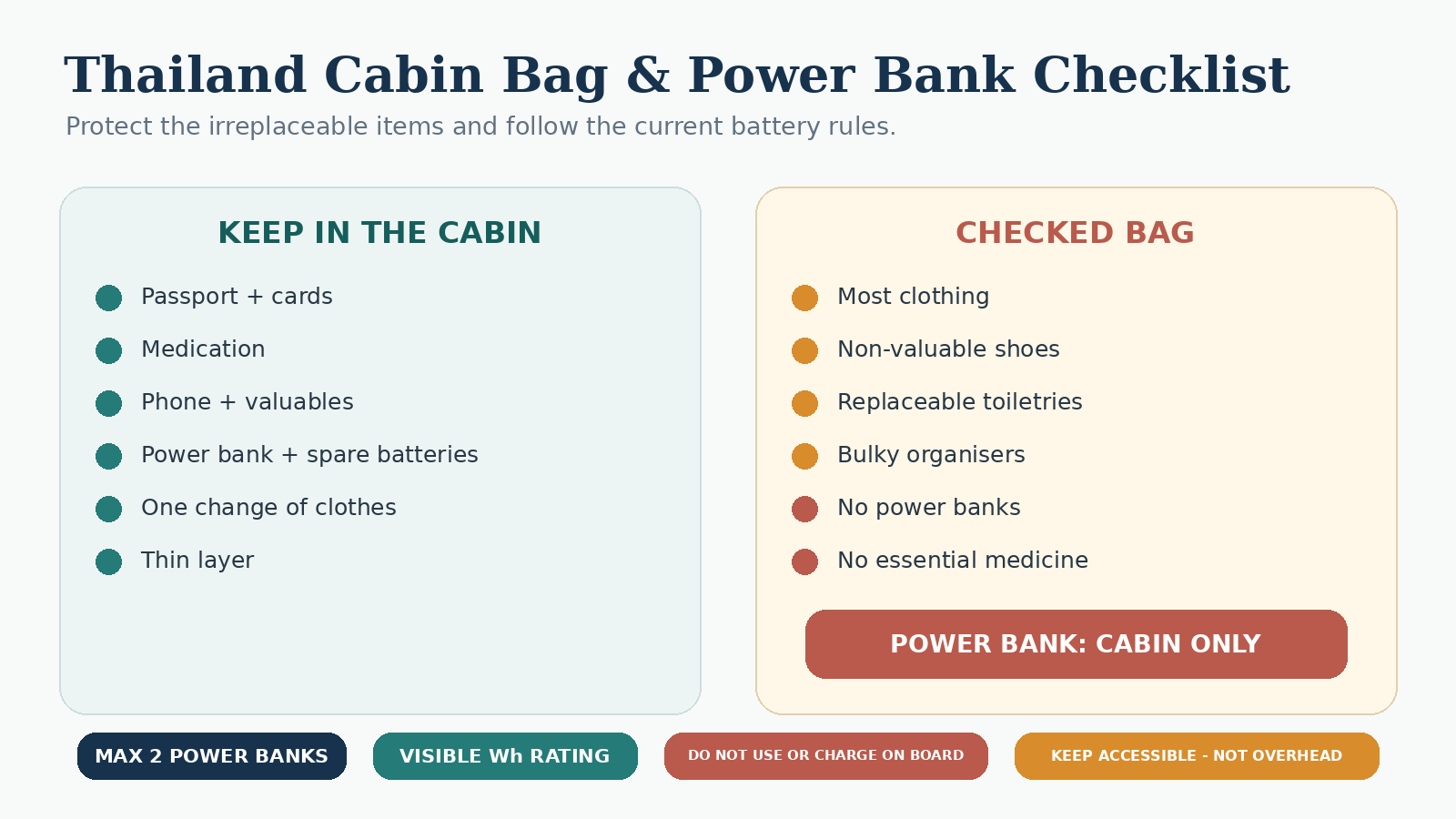
Documents, medication, phone, chargers, power bank, valuables and enough clothing to manage a delayed case.
In this Thailand packing list
- The four packing principles
- Master packing checklist
- Clothes and capsule wardrobe
- Temple clothing and dress rules
- Shoes for Thailand
- Packing by season and region
- Packing by trip style
- Suitcase, backpack or carry-on
- Hand luggage checklist
- Health, toiletries and medication
- Electronics, adapters and batteries
- Useful products worth comparing
- What to buy in Thailand
- Packing for transport days
- Packing for families
- What not to pack
- Common packing mistakes
- Minimalist versus prepared packing
- Frequently asked questions
- Final 48-hour checklist
The four packing principles that make Thailand easier
1. Pack for the route, not the country name
A Bangkok-and-Phuket holiday needs a different bag from a Bangkok-Chiang Mai-Pai route. The first may involve hotels, airport transfers and beach days; the second may include stairs, minivans, cooler mornings and several check-ins. Start with the itinerary and count how many times you will move accommodation.
Frequent transfers favour a bag you can carry over broken pavements, boat ramps and station stairs. A resort-based holiday can justify a structured suitcase because the bag moves only a few times. Neither choice is universally better.
2. Pack for one laundry cycle
Seven or eight days of clothing is enough for most two-, three- and four-week trips. Laundry services are widely available in tourist areas, while hotels often offer a more expensive per-item service. A small laundry bag and one planned wash day save more space than an extra week of clothes.
Choose fabrics that tolerate repeated washing. Lightweight cotton, linen blends and modern quick-dry materials usually feel better in humidity than heavy denim. Test anything new before departure because a shirt that looks ideal online may cling, crease or become transparent when damp.
3. Separate irreplaceable items from replaceable items
Your passport, prescription medication, bank cards, phone, glasses and travel documents deserve space in the cabin bag. Shampoo, an umbrella, a basic T-shirt and ordinary toiletries can be replaced after arrival. This distinction keeps the hand luggage useful rather than full of low-priority objects.
4. Leave working space inside the bag
A bag packed to the zip on departure becomes frustrating after the first hotel change. Clothes will not be folded as neatly, damp swimwear needs separation and small purchases accumulate. Aim to leave roughly 10-15% of the main compartment empty.
Master Thailand packing checklist
The table below is the complete starting point. It is intentionally practical rather than exhaustive. Add specialist equipment only after checking your route, accommodation and booked activities.
| Category | Pack | Why it earns space | Where to keep it |
|---|---|---|---|
| Documents | Passport, travel insurance, booking confirmations, emergency contacts, payment cards and secure copies | These are difficult or expensive to replace | Cabin bag, with digital copies stored separately |
| Clothing | Five tops, three bottoms, temple outfit, underwear, sleepwear, swimwear, light layer and rain layer | Covers cities, temples, beaches and transport without a heavy wardrobe | Main bag, with one change in hand luggage |
| Footwear | Walking trainers or secure sandals, plus flip-flops or simple sandals | Two reliable pairs cover most itineraries | Wear the bulkiest pair while travelling |
| Sun and weather | Hat, sunglasses, high-factor sunscreen, insect repellent, refillable bottle and compact rain protection | Thailand can be hot, humid and suddenly wet | Day bag once in Thailand |
| Health | Prescription medicine, basic first-aid items, oral rehydration sachets and personal medical supplies | Specialist or prescription items should not depend on local availability | Cabin bag in original packaging where possible |
| Technology | Phone, charging cable, adapter, headphones, clearly labelled power bank and eSIM or SIM plan | Supports maps, bookings, translation and communication | Cabin bag; batteries never in checked baggage |
| Organisation | Packing cubes, laundry bag, waterproof pouch, luggage tag and foldable tote | Keeps wet, clean, dirty and valuable items separate | Split between main and cabin bags |
| Activity-specific | Only equipment not supplied by the operator or accommodation | Avoids carrying duplicate towels, snorkels, helmets or hiking gear | Confirm inclusions before buying or packing |
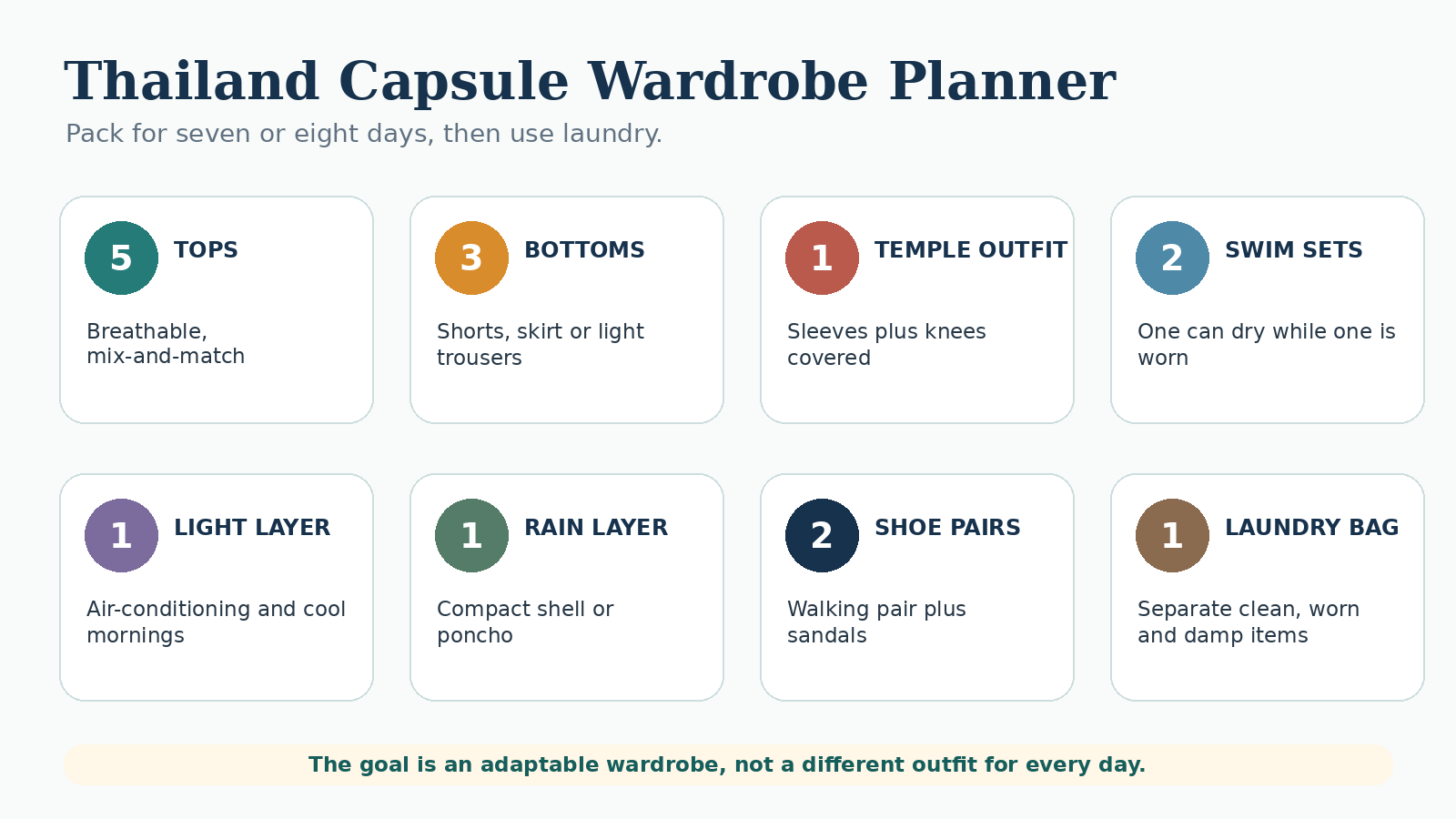
How much to pack for different trip lengths
| Trip length | Tops | Bottoms | Underwear | Laundry plan |
|---|---|---|---|---|
| 5-7 days | 4-5 | 3 | 6-7 sets | Usually none, although a quick wash may help in humid weather |
| 8-14 days | 5 | 3 | 7-8 sets | One wash around the middle |
| 15-30 days | 5-6 | 3-4 | 7-8 sets | Weekly laundry |
| More than one month | 6-7 | 4 | 8-10 sets | Regular laundry; add specialist clothing only for work or climate |
What clothes should you pack for Thailand?
Everyday clothing for heat and humidity
Loose, breathable clothing is usually more comfortable than tight clothing, even when both are made from a light fabric. A relaxed T-shirt, airy shirt, simple dress or loose pair of shorts lets air circulate and is less likely to chafe after several hours outside.
Heavy jeans are rarely the best default. One pair may be useful for flights, evenings or cooler northern weather, but several pairs take space and dry slowly. Lightweight trousers provide more flexibility because they work for temples, travel days and evenings without the same weight.
Light colours reflect heat, while darker patterns can hide travel marks. Either can work. The better test is whether the fabric remains comfortable after ten minutes of walking in humid conditions.
A realistic capsule wardrobe
- Two or three lightweight T-shirts.
- Add one loose short-sleeved shirt or blouse.
- Include a sleeved temple-friendly top.
- Keep one extra top that can look slightly smarter in the evening.
- Two pairs of shorts or lightweight skirts.
- Choose loose long trousers or a long skirt.
- Optionally add quick-dry travel trousers for hiking, rain or long transport days.
- Two sets of swimwear so one can dry while the other is worn.
- Pack one beach cover-up that is not being relied on as the only temple outfit.
- Add a thin cardigan, overshirt or light jumper for air-conditioning.
- Choose a compact rain shell or poncho suited to the route.
Underwear, sleepwear and socks
Pack underwear for roughly one week plus a spare. Fast-drying options are useful, but comfort matters more than a marketing label. A simple laundry bag prevents clean clothing from becoming mixed with damp or worn items.
Sleepwear should be light enough for warm rooms but respectable enough for a shared hostel corridor or an unexpected hotel evacuation. Travellers using trainers will usually want several pairs of breathable socks; sandals-only travellers need fewer.
What to wear on long travel days
Choose a comfortable outfit that handles air-conditioning and modesty. Loose trousers, a breathable top, a thin layer and closed shoes work well for airports, trains and overnight buses. Keep a fresh T-shirt and underwear in the cabin bag, especially when a flight or checked bag could be delayed.
Temple clothing and respectful dress
Thailand’s temples are active religious places, not costume sets. Rules vary, but shoulders and knees should be covered at important temples and royal sites. The official Grand Palace guidance specifically prohibits sleeveless shirts, vests, short tops, see-through clothing, short trousers, torn trousers, tight trousers and mini skirts.[2]
A dependable temple outfit is therefore more useful than relying on a scarf to fix an unsuitable outfit at the entrance. Pack one loose sleeved top and one pair of lightweight full-length trousers or a long skirt. The outfit should be comfortable enough to wear for several hours in the heat.
The same official page currently lists foreign admission at 500 baht, opening from 8:30am to 4:30pm and ticket sales until 3:30pm. Because a refused outfit can waste a timed sightseeing morning, keep the proper temple clothes near the top of the day bag rather than buried in the hotel case.[2]
Temple outfit checklist
| Item | Good choice | Less reliable choice | Reason |
|---|---|---|---|
| Top | Loose T-shirt, blouse or shirt with sleeves | Vest with a thin scarf thrown over the shoulders | A fixed sleeve is simpler and less likely to slip |
| Bottom | Loose full-length trousers or long skirt | Very short shorts, ripped jeans or tight leggings | Important sites may refuse entry |
| Fabric | Opaque and breathable | See-through fabric when backlit or wet | Modesty and comfort both matter |
| Shoes | Easy to remove and secure enough for walking | Complicated boots or loose shoes that rub | Footwear is often removed before entering buildings |
| Backup | Foldable temple trousers or a long wrap skirt in the day bag | A tiny beach sarong used as the only plan | A proper backup covers the knees and stays in place |
Footwear and behaviour at temples
Choose shoes that can be removed without a long struggle. Socks are useful when floors are hot or when you prefer not to walk barefoot, although local instructions always take priority. Keep hats off inside sacred buildings and avoid climbing on monuments or posing in ways that treat religious objects as props.
Royal sites and formal venues
Royal sites can apply stricter rules than a small neighbourhood temple. Smart-casual restaurants, rooftop bars and high-end hotels may also reject beachwear. One clean, modest outfit covers all three situations without requiring a separate evening wardrobe.
How many pairs of shoes do you need?
Two pairs are enough for most holidays: one secure walking pair and one easy sandal or flip-flop. The walking pair should already be broken in. Thailand is not the place to discover that new trainers rub after three kilometres.
| Footwear | Best for | Advantages | Disadvantages |
|---|---|---|---|
| Breathable trainers | City walking, airports, longer travel days and light trails | Supportive and secure | Can feel hot and dry slowly after heavy rain |
| Secure walking sandals | Hot-weather sightseeing, boat days and casual walking | Cooler and often quicker to dry | Less protection on rough paths and busy streets |
| Flip-flops | Pool, beach, showers and short local walks | Light, cheap and easy to remove | Poor support and grip for long days |
| Smart shoes | Specific restaurant, wedding or work plans | Useful when a venue has a dress code | Often unnecessary for an ordinary holiday |
| Trail shoes | Serious hiking or wet national-park routes | Better grip and protection | Bulky when the itinerary contains only easy sightseeing |
For monsoon travel, grip matters more than waterproof marketing. Fully waterproof shoes can trap heat and take a long time to dry. A quick-drying shoe with a dependable sole may be more practical unless the route includes sustained hiking.
How the packing list changes by season and region
Thailand does not follow one simple wet-and-dry calendar. Broad seasons are useful for planning, but the exact conditions vary by province and coast. Check the Thai Meteorological Department’s provincial forecast and warnings shortly before departure rather than packing from an old monthly chart.[3]
Hot-season and city packing
Prioritise breathable clothes, a hat, sunglasses, sunscreen and a refillable bottle. A small face cloth or hand towel can be useful, although it should not replace drinking water and regular shade. Dark, heavy fabrics may feel uncomfortable after a long walk, while very thin pale clothing can become transparent with sweat.
Air-conditioning can be intense in shopping centres, airports and long-distance transport, so keep one thin layer in the day bag. It should pack down small rather than becoming a bulky jacket carried all afternoon.
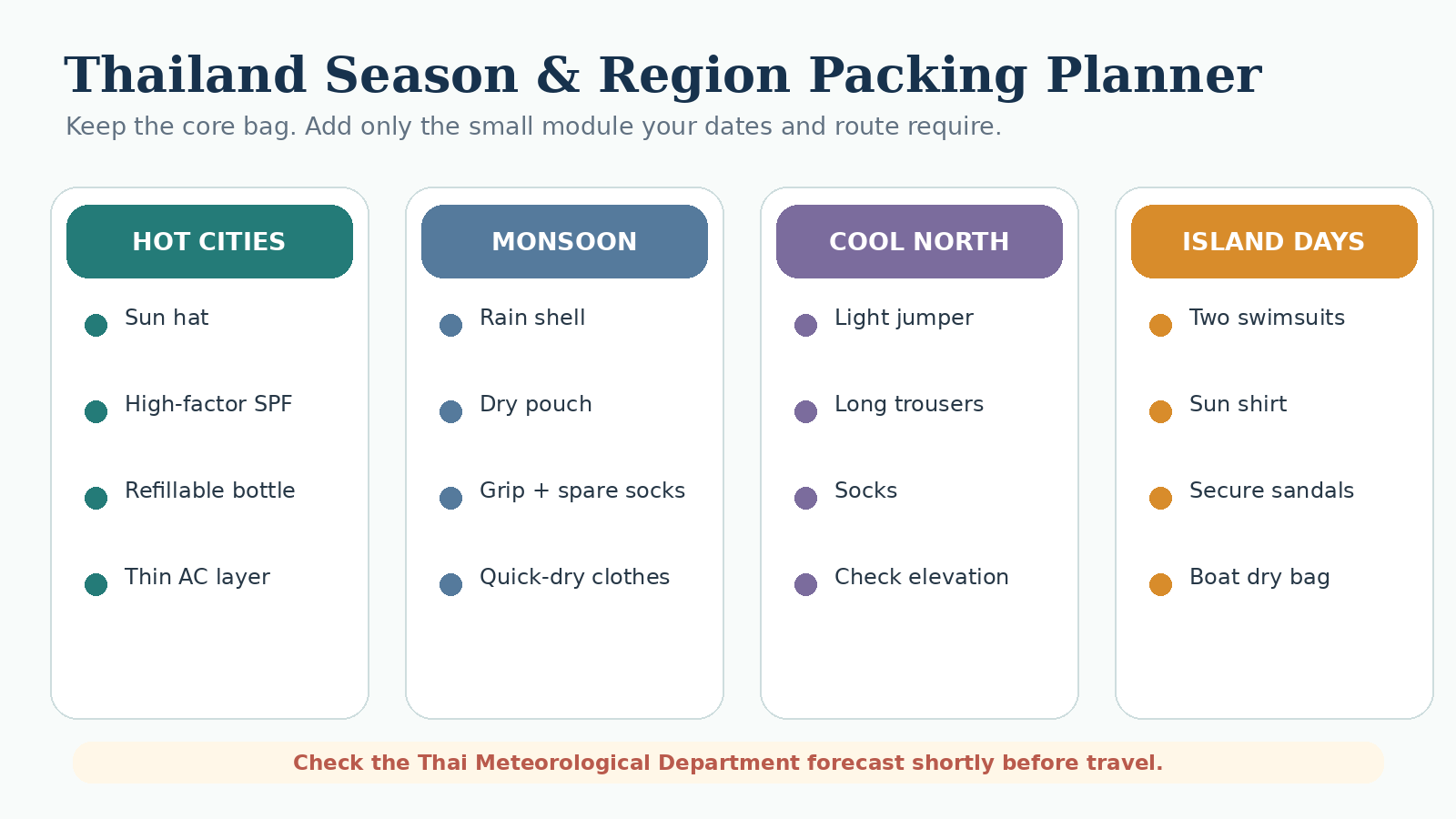
Thailand packing list for monsoon season
Monsoon packing is about quick recovery, not trying to make the entire body permanently waterproof. Add a compact rain shell or poncho, a dry bag or waterproof pouch, spare socks, a small umbrella and footwear with good grip. Put electronics and documents inside an inner waterproof layer rather than trusting the outside of the day bag.
Quick-drying shorts and tops are easier to manage than thick denim. A packable laundry line can help in accommodation without enough hanging space, but do not drape wet clothing over electrical equipment or delicate furniture.
For boat transfers, place the phone, passport and medication inside separate zip pouches within the dry bag. Redundancy matters because one closure can be left open in a rush.
Cooler northern Thailand and mountain mornings
Chiang Mai city is often warm during the day, yet early mornings, higher viewpoints and the cooler season can justify a light jumper, thin trousers and socks. Travellers visiting Doi Inthanon, Chiang Rai highlands or mountain homestays should check the specific forecast rather than assuming tropical heat at every elevation.
A compact warm layer is enough for most itineraries. A heavy UK winter coat usually consumes far more space than it earns unless the trip continues to a genuinely cold country.
Andaman and Gulf island packing
Both coasts require sun protection, swimwear, sandals and a waterproof pouch. Boat schedules, sea conditions and rainfall patterns differ, so check the relevant forecast and operator instructions. A loose long-sleeved shirt is useful for sun exposure, evening insects and modest travel between the beach and local communities.
Snorkel equipment, beach towels and life jackets are often supplied by tours or hotels. Confirm what is included before buying bulky gear.
Season and route add-on table
| Route or condition | Add | Leave out unless specifically needed |
|---|---|---|
| Bangkok and central cities | Sun hat, breathable daywear, temple outfit, light air-conditioning layer | Large hiking equipment and several heavy layers |
| Northern cool season | Light jumper, long trousers, socks and optional thin scarf | Full winter coat for an ordinary city itinerary |
| Monsoon travel | Rain shell, waterproof pouch, dry bag, spare socks and quick-dry clothing | Heavy waterproof boots unless the activity requires them |
| Island hopping | Two swimsuits, cover-up, secure sandals, dry pouch and seasickness plan if appropriate | Large beach towel when accommodation supplies one |
| National parks | Grip, insect protection, refillable water bottle and activity-specific clothing | Specialist equipment that the operator supplies |
| Long-stay or remote work | Backup payment card, laptop protection, cable organiser and one work-appropriate outfit | Large office setup that cannot be moved easily |
Packing by trip style
Bangkok, temples and food-focused city trips
Build the bag around breathable city clothes, a proper temple outfit, comfortable walking shoes and a small day bag. A compact umbrella works for rain and shade. Smarter evening clothing is optional unless a particular rooftop venue, restaurant or event has a stated dress code.
Beach and resort holidays
Two swimsuits, a cover-up, sandals, sun protection and one respectable outfit usually matter more than a large casual wardrobe. Keep a dry pouch for phones and room keys. Resorts normally provide towels, toiletries and hairdryers, so check the room details before packing duplicates.
Backpacking and frequent transfers
Every item should survive repeated packing and be easy to carry. Choose a bag that fits minivans, ferries and hostel storage. Packing cubes, a laundry bag and a separate electronics pouch reduce the time spent reorganising at each stop.
Limit footwear to two pairs unless the route includes serious trekking. A backpack rain cover protects the outside, while an internal dry liner protects the items that matter when water reaches the zips.
Luxury hotels and special occasions
A structured case may be easier when transport is private and luggage handling is included. Add one or two smarter outfits, but keep fabrics light. Confirm dress codes before carrying formal shoes that will be worn once.
Long stays and remote work
Long trips do not require a wardrobe multiplied by four. Add redundancy where failure would affect work: a backup charging cable, secure cloud copies, a protective laptop sleeve and possibly a compact mouse. Clothing can still follow a weekly laundry cycle.
Remote workers should also consider the weight of electronics when booking domestic flights. A laptop, charger, power bank and camera equipment can use much of a small cabin allowance before clothing is added.
Check activity inclusions before packing specialist gear
Tour listings often state whether towels, snorkels, helmets, meals, waterproof bags or hotel transfers are included. Reading those details before departure can prevent unnecessary purchases.
Compare Thailand activities on GetYourGuide
Use the activity page to check what is supplied, what clothing is required and whether pickup changes the bag you need for the day.
Cross-check Thailand tours on Viator
Comparing a second marketplace can be useful when the activity description on one listing is vague about equipment, footwear or luggage.
Suitcase, backpack or carry-on?
The correct bag is the one that matches the route and can be moved without help. Wheels are excellent on airport floors and hotel corridors; they are less impressive on sand, steep steps and uneven ferry piers.
| Bag type | Best for | Advantages | Trade-offs |
|---|---|---|---|
| Carry-on backpack | Short trips, backpacking and frequent transfers | Mobile, hands-free and no checked-bag wait | Easy to overfill; liquids and weight limits matter |
| Soft-sided carry-on case | City and hotel trips with light packing | Organised and easy on smooth surfaces | Wheels struggle on rough ground and stairs |
| Medium checked suitcase | Families, resorts, special events and longer stays | More space and easier access | Extra baggage fees and more difficult transfers |
| Travel backpack 40-55L | Multi-stop routes with trains, ferries and stairs | Better mobility and flexible shape | Can become heavy; fit and back support matter |
| Large suitcase | Very specific long-stay, family or equipment needs | Maximum capacity | Often excessive for an ordinary Thailand holiday |
Carry-on only: when it works
Carry-on only works well for one or two weeks when you accept a laundry stop, use compact toiletries and wear the bulkiest shoes in transit. It is also useful when the route contains several domestic flights.
However, cabin-only travel is not automatically cheaper. Some fares include only a small personal item, while a standard cabin case may cost extra. Check the dimensions and combined weight for every flight, not just the international journey.
Checked luggage: when the extra space is worthwhile
A checked bag can make sense for families, diving equipment, medical supplies, formal events or a long stay. Keep valuables, essential medication, batteries, documents and one change of clothing in the cabin because a checked bag can be delayed.
Map the route before choosing the bag
Use the transport search to see whether your itinerary relies on flights, trains, minivans or ferries. A bag that is easy on one airport transfer may be awkward across six mixed-transport days.
What belongs in your hand luggage?
Hand luggage should protect the first 24 hours of the trip and every item that cannot safely go in the hold. It should not become a second main suitcase.
| Keep in hand luggage | Usually suitable for checked luggage | Check before packing |
|---|---|---|
| Passport, cards, cash, insurance details and bookings | Most clothing and non-valuable footwear | Liquids, gels and aerosols |
| Prescription medication and essential medical equipment | Full-size ordinary toiletries when allowed | Scissors, tools and sports equipment |
| Phone, laptop, camera and valuables | Non-fragile packing organisers | Airline-specific cabin dimensions and weight |
| Power bank and spare lithium batteries | Items that can be replaced after arrival | Smart luggage with an installed battery |
| One change of clothes and basic toiletries | Bulky clothing not required during the journey | Food, supplements and regulated products |
Cabin-bag essentials
- Passport and any required visa or supporting documents.
- Travel insurance and emergency contact details.
- Phone, charging cable, headphones and power bank.
- Prescription medication in its original labelled packaging where possible.
- Glasses, contact-lens supplies and other difficult-to-replace personal items.
- One clean top, underwear and essential toiletries.
- A thin layer for air-conditioning.
- Accommodation address and transfer details available offline.
- Reusable bottle to fill after security.
Travel documents and the Thailand Digital Arrival Card
British citizen passport holders should check the current official entry requirements before travel. At the time of this update, GOV.UK states that the passport should expire at least six months after arrival and contain at least one blank page. It also states that foreign nationals must complete the Thailand Digital Arrival Card online within three days before arrival.[4]
Entry rules depend on nationality and can change. Save the confirmation offline and keep the accommodation address, flight details and emergency contacts accessible if the phone has no data on arrival.
Gate-check reminder
Toiletries, health and medication
Toiletries to bring from home
Bring products that are specialist, prescription-based or known to suit sensitive skin. Decant ordinary shampoo, conditioner and cleanser into travel-size containers when flying with hand luggage. Full-size everyday toiletries can usually be bought after arrival.
High-factor sunscreen is worth packing if you have a preferred formula or need a specialist product. Insect repellent should be appropriate for the destination and personal medical needs. A small amount is enough for the first days; replacements are available in tourist areas.
TravelHealthPro confirms a dengue risk in Thailand and advises avoiding mosquito bites, particularly during daytime hours. Use a repellent that suits the traveller, follow the label, and combine it with loose clothing and accommodation screens rather than treating the spray as the only defence.[11]
Useful health items
- Prescription medication plus a sensible contingency supply.
- Copy of the prescription or a doctor’s letter when appropriate.
- Plasters and blister treatment.
- Oral rehydration sachets.
- Simple pain relief and any personally suitable travel-sickness treatment.
- Hand sanitiser and tissues.
- Insect repellent and after-bite treatment suitable for you.
- High-factor sunscreen and lip protection.
- Any allergy, asthma or diabetes supplies that cannot be replaced easily.
Travelling with medication
The legal status of a medicine can differ between the UK and Thailand. GOV.UK advises travellers to check the rules and notes that medication regulation may be different abroad.[5]
Thailand’s Food and Drug Administration provides an official permit portal for travellers carrying narcotic medicines into or out of the country.[6] Check the exact medicine, quantity and documentation well before departure. Do not rely on a forum post that discusses a different drug or an old rule.
Carry essential medicine in the cabin, preferably in original packaging with the pharmacy label. Split a contingency supply only when the medicine can be stored safely and the relevant rules allow it.
Do not depend on street-bought medicine
Use reputable pharmacies or medical facilities. The FCDO warns that medicine sold on the street may not be genuine or may have been stolen. Travel insurance and accessible emergency details are more important than a large improvised medical kit.
Electronics, travel adapters and power banks
Electricity and plug compatibility
Thailand uses 220V AC at 50Hz. The Tourism Authority of Thailand notes that sockets commonly accept flat parallel prongs and two round pins, while some properties also have three-pin outlets.[7]
A universal travel adapter is the simplest option for a multi-device trip. Check the input label on every charger. Most modern phone and laptop chargers accept a wide voltage range such as 100-240V, but an adapter changes the plug shape rather than converting voltage.
Power-bank rules in Thailand in 2026
Thailand’s Civil Aviation Authority currently states that power banks must be carried on the person or in cabin baggage, not in checked baggage. A power bank up to 100Wh is permitted under the general rule; 100-160Wh requires operator approval. The rating must be clearly marked, no more than two power banks may be carried per person, and they must be protected from short circuit.[8]
The same CAAT guidance prohibits charging a power bank or using it to charge another device while on board. It also advises keeping power banks readily accessible, such as in the seat pocket or on the person, rather than in the overhead compartment. Airlines may impose additional conditions, so check every carrier on the itinerary.
IATA also advises that spare batteries and power banks belong in hand baggage, with terminals protected. Batteries up to 100Wh are generally allowed, 100-160Wh may require airline approval and larger batteries are usually not permitted on passenger aircraft.[9]
Power-bank capacity in practical terms
Many ordinary 10,000mAh power banks fall below 100Wh, but capacity alone should not be guessed. Buy a reputable model with the Wh rating printed clearly on the casing. A worn label, swollen casing or damaged cable is a reason to replace the device rather than pack it.
Useful electronics without gadget overload
- Phone with offline maps and important documents saved locally.
- One multi-port charger rather than several bulky plugs.
- Universal adapter suitable for 220V supply and your devices.
- Power bank with a visible Wh rating.
- Short spare charging cable.
- Headphones for flights and long journeys.
- Compact cable pouch.
- Optional e-reader or tablet when it will genuinely be used.
Optional arrival-day eSIM
An eSIM can provide data for maps, hotel messages and transport apps before you find a local SIM. Check phone compatibility, whether the device is unlocked and the live package terms before paying.
Useful packing products worth comparing
The best products solve a clear problem: organisation, electrical compatibility, battery safety, waterproofing, weight control or mosquito-bite prevention. The links below go directly to Amazon UK. Prices, availability and product details can change, so check the listing before buying.
| Product | Problem solved | Look for | When it is worth buying |
|---|---|---|---|
| Compare packing cubes on Amazon UK | Organisation | Lightweight fabric, robust zips and a small set of useful sizes | Multi-stop trips, families and shared luggage |
| Compare universal travel adapter on Amazon UK | Electrical compatibility | Safety shutters, recognised markings, USB-C output and adequate total wattage | UK travellers carrying phones, tablets or laptops |
| Compare 10,000mah power bank on Amazon UK | Travel-day battery backup | A clearly printed Wh rating, protected ports, reputable maker and no swelling or damage | Long journeys, maps, ride apps and heavy phone use |
| Compare small dry bag or waterproof pouch on Amazon UK | Water protection | Reliable roll-top closure, taped seams and a size that fits inside the day bag | Island transfers, kayaking, monsoon travel and beach days |
| Compare digital luggage scale on Amazon UK | Weight control | Clear display, secure strap and a replaceable battery | Trips with several airlines or strict cabin limits |
| Compare quick-dry travel towel on Amazon UK | Accommodation backup | Medium size, hanging loop and a breathable storage pouch | Hostels, basic bungalows and hikes where towels are not supplied |
| Compare travel insect repellent on Amazon UK | Mosquito-bite prevention | An active ingredient and concentration suitable for the traveller, clear instructions and a practical bottle size | City, rural and island trips where daytime and evening bite prevention matters |
Buying advice that matters more than the brand name
Check measurements and weight before ordering. A large packing-cube set can weigh more than the clothes it organises, while a powerful adapter may be too bulky for a loose or recessed socket. Read the lowest reviews as well as the highest because repeated complaints about overheating, weak zips or false capacity are more useful than a glossy product image.
For batteries and electrical products, favour reputable manufacturers and clear technical markings. A cheap power bank with no readable Wh rating can create trouble at the airport even when the advertised mAh number appears acceptable.
Products you probably do not need
A travel clothes steamer, full snorkel set, oversized first-aid kit, large portable safe and multiple single-purpose gadgets rarely justify their weight on an ordinary holiday. Check what the accommodation and activity operator already supply.
What is easy to buy in Thailand?
Basic toiletries, umbrellas, simple clothing, flip-flops, laundry detergent and everyday snacks are widely available in cities and tourist areas. Buying locally can save baggage space, but do not assume a specific specialist brand, size or prescription item will be easy to find.
| Usually bring from home | Often easy to buy locally | Check before deciding |
|---|---|---|
| Prescription medication and documentation | Basic shampoo, soap and toothpaste | Specialist sunscreen or sensitive-skin products |
| Comfortable broken-in shoes | Umbrella, simple poncho and flip-flops | Larger clothing or shoe sizes |
| Glasses, contact-lens prescription and spares | Everyday T-shirts and casual clothing | Specific contact-lens solution |
| Reputable adapter and power bank | Charging cables from established retailers | Electrical products from market stalls |
| Specialist hair or skincare products | Laundry service and basic detergent | Products that must be fragrance-free |
Laundry in Thailand
Self-service machines, local wash-and-fold shops and hotel services are common in tourist areas. Hotel per-item laundry is usually the most convenient and the most expensive. Local services may price by weight, while delicate or urgent items can cost more.
Keep one lightweight outfit available while the rest is being washed. Do not send irreplaceable, expensive or colour-sensitive clothing through an unknown service without asking how it will be handled.
Packing for domestic flights, trains, buses and ferries
Domestic flights
Check the exact fare, not just the airline. The cheapest ticket may include only a small personal item, while cabin and checked luggage can be separate add-ons. Weigh the packed bag at home and again before the return flight if shopping is likely.
Batteries, medication, documents and valuables stay in the cabin. Liquids and sharp items should be packed according to current airport and airline rules.
Overnight trains
Keep a small sleep kit accessible: thin layer, eye mask, earplugs, tissues, toothbrush, water and valuables. Large luggage may be stored away from the berth, so use a small pouch for anything needed during the night.
A soft bag is easier to position than a rigid oversized case. Secure valuables and do not leave a passport or phone visible while sleeping.
Long-distance buses and minivans
Air-conditioning can feel cold, so keep a layer in the cabin. Medication, documents and electronics should not be placed in an external luggage hold. Minivans may have limited luggage space; a very large suitcase can require a separate seat or create last-minute problems.
Ferries and speedboats
Use a waterproof inner layer even when the main case is hard-sided. Put the phone, passport and medicine in a smaller pouch that stays with you. Wear shoes that are secure on wet surfaces and clothes that allow safe movement over steps or boat edges.
Transport-day mini checklist
- Check the exact terminal, station or pier.
- Confirm baggage size, weight and number of pieces.
- Move batteries, medication and valuables into the personal bag.
- Protect documents and electronics from rain or spray.
- Keep one layer and a small amount of food or water accessible where permitted.
- Photograph the bag and luggage tag before handing it over.
Thailand packing list for families
Families need more redundancy, but not a full duplicate of every household item. Split essential clothing, medication and child supplies across the adults’ cabin bags so one delayed case does not remove everything for one person.
Useful family additions
- Small familiar snacks for the journey, within airline and customs rules.
- Reusable water bottles and a compact cleaning method.
- Sun hats and rash vests in the correct sizes.
- Child-safe insect protection recommended for the child’s age.
- One lightweight comfort item rather than several bulky toys.
- Compact entertainment downloaded for offline use.
- Copies of prescriptions and medical details.
- Wet bag or waterproof pouch for swimwear and accidents.
- Lightweight stroller only when it suits the route.
Stroller, carrier or neither?
A stroller works well in airports, shopping centres and smoother city areas. Pavements, temple steps, boats and rough lanes can make a carrier more practical. Families moving frequently may prefer a compact stroller plus a lightweight carrier rather than a large travel system.
Nappies, formula and specialist food
Common brands may be available, but sizes, ingredients and packaging can differ. Bring enough for the journey and the first few days, then buy locally if the child can use available products. Specialist formula or medically required food deserves a more cautious plan and documentation where needed.
What not to pack for Thailand
| Leave at home | Why it creates more weight than value | Better alternative |
|---|---|---|
| Four or five pairs of shoes | They take space and are rarely all worn | One walking pair plus sandals |
| Several pairs of thick jeans | Heavy, hot and slow to dry | One optional pair plus lightweight trousers |
| Full-size ordinary toiletries | Easy to replace and awkward in hand luggage | Travel sizes plus local replacements |
| Large bath towel | Bulky and normally supplied by accommodation | Small quick-dry towel only when needed |
| Expensive jewellery | Adds worry and theft risk | Simple low-value accessories |
| Large umbrella | Awkward on transport and easy to replace | Compact umbrella or light rain shell |
| Every possible medicine | Can create legal, storage and safety problems | Personal essentials plus professional advice |
| Unregistered drone | Thailand applies registration rules and restricted flying areas | Research permissions before packing the drone |
| Vape or e-cigarette | Possession and use are illegal in Thailand according to current UK travel advice | Leave it at home and check current law before travel |
Thailand also has strict customs and product rules. GOV.UK advises that goods may be prohibited or subject to tax or duty, and current safety guidance warns that vapes and e-cigarettes are illegal to possess or use.[10] Check official rules for unusual food, supplements, drones, tobacco, medication and specialist equipment.
Common Thailand packing mistakes
Packing a different outfit for every day
Humidity, rain and laundry make a fixed day-by-day wardrobe unrealistic. A smaller mix-and-match selection is easier to wash and reorganise.
Relying on one scarf as the temple plan
A scarf may not satisfy the dress rules at a strict royal site, and it can slip in the heat. Pack one proper sleeved top and a knee-covering bottom.
Buying new shoes immediately before departure
Even excellent shoes can cause blisters before they are broken in. Wear them on several long walks at home.
Putting medication or power banks in checked luggage
Essential medicine can be unavailable during delays, while power banks are not permitted in checked baggage under current CAAT guidance.
Ignoring domestic baggage limits
The international allowance may be much larger than the domestic allowance. Check every sector before choosing the bag.
Packing for a social-media stereotype
Thailand includes cities, mountains, national parks, temples, islands and formal venues. A bag containing only beachwear is as unbalanced as a bag filled with heavy trekking clothing for a resort holiday.
Taking specialist gear without checking inclusions
Tour operators and hotels often provide towels, snorkels, helmets, umbrellas or basic toiletries. Confirm first, then pack only the gaps.
Minimalist packing versus a more prepared bag
Carry-on minimalist
Advantages
- Fast airport movement
- Easier ferries and stairs
- Less lost-luggage risk
Trade-offs
- Requires laundry
- Strict liquids and weight limits
- Little room for specialist equipment
Balanced medium bag
Advantages
- Comfortable wardrobe without excess
- Room for weather and family additions
- Works for most multi-stop trips
Trade-offs
- May require checked-bag fees
- Less convenient on boats and stairs
Large prepared case
Advantages
- Space for formal wear, work or medical supplies
- Useful for families and long stays
Trade-offs
- Harder transfers
- More fees
- Encourages unnecessary packing
The balanced option suits the widest range of travellers. Minimalist packing is excellent when it is deliberate; it becomes stressful when essential medication, weather protection or respectful clothing has been removed simply to meet an arbitrary bag size.
Thailand packing FAQs
Can you wear shorts in Thailand?
Yes. Shorts are normal in casual city, beach and resort settings. Carry a knee-covering option for temples, royal sites and smarter venues.
Do women need to cover their shoulders in Thailand?
Not for every ordinary street or beach setting. Shoulders should be covered at important temples and royal sites, and a sleeved top is the most reliable option.
Do men need long trousers for temples?
Strict sites can refuse short trousers. Lightweight full-length trousers are safer than assuming tailored shorts will be accepted everywhere.
Do you need a jumper in Thailand?
A thin layer is useful for air-conditioning, overnight transport and cooler northern or mountain mornings. A heavy winter coat is rarely needed for a standard Thailand-only holiday.
What should you pack for Thailand in rainy season?
Add a compact rain shell, waterproof pouch, dry bag, spare socks, quick-drying clothes and shoes with reliable grip. Protect electronics inside the day bag rather than relying only on an outer cover.
Is a suitcase or backpack better for Thailand?
A suitcase is convenient for hotels and airport transfers. A backpack is easier for stairs, boats and frequent moves. Choose according to the route and your ability to carry it safely.
Can you travel around Thailand with carry-on only?
Yes, especially for one or two weeks with one laundry stop. Check every airline’s dimensions, weight and fare conditions because a standard cabin case is not included in every ticket.
How many pairs of shoes should you take?
Two pairs are enough for most trips: a secure walking pair and sandals or flip-flops. Add trail or formal shoes only for a specific confirmed plan.
Do you need a travel adapter for Thailand?
A universal adapter is sensible because socket designs vary. Thailand uses 220V at 50Hz, so also confirm that each appliance accepts the voltage.
Can a power bank go in checked luggage?
No. Current CAAT guidance requires power banks to be carried on the person or in cabin baggage. Check the Wh rating and airline rules before travel.
Can you use a power bank on a Thai flight?
Current CAAT guidance prohibits charging the power bank or using it to charge another device while on board. Airlines can impose additional restrictions.
Should you bring a beach towel?
Most hotels and resorts supply towels. Bring a small quick-dry towel only when staying in hostels, basic accommodation or places that confirm towels are not included.
Can you buy sunscreen in Thailand?
Yes, but preferred brands, specialist formulas and large sizes may cost more or be harder to find. Bring enough for the first days when your skin depends on a particular product.
Can you buy larger clothing sizes in Thailand?
Options exist, particularly in shopping centres and international retailers, but the fit and range may differ. Travellers who rely on a specific size should bring the core wardrobe from home.
Should medication go in hand luggage?
Essential medication should stay in hand luggage, with documents and original packaging where possible. Check Thai FDA requirements for controlled medicines well before departure.
Do you need an eSIM before arriving?
No, but it can make arrival easier by providing data for maps and messages. A local physical SIM is another practical option. Check compatibility and live terms before choosing.
How much empty space should you leave?
Leave roughly 10-15% of the main bag free. That space absorbs damp clothing, imperfect repacking and small purchases.
Final 48-hour Thailand packing checklist
| When | Check | Done when |
|---|---|---|
| 48 hours before | Weather and warnings for every province or island | Rain, heat and cool-weather additions match the actual route |
| 48 hours before | Passport, entry rules and TDAC timing | Documents are valid and confirmations are saved offline |
| 36 hours before | Medication and permits | Medicine is labelled, documented and in the cabin plan |
| 24 hours before | Every airline baggage allowance | The bag fits the smallest allowance on the itinerary |
| 24 hours before | Power bank and batteries | Wh rating is visible, device is undamaged and it is in hand luggage |
| 12 hours before | Temple outfit and first-day clothing | One respectful outfit is easy to reach |
| Before leaving home | Phone, cards, documents, medicine and valuables | All are in the personal bag, not the checked case |
| At the airport | Gate-check risk | Batteries and essentials can be removed quickly if required |
The best Thailand packing list leaves room for the journey to change. Take clothing that mixes easily, shoes that have already proved themselves, one proper temple outfit and a cabin bag that protects the essentials. Laundry, ordinary toiletries and simple clothing can be arranged locally; your passport, medication, safe battery setup and practical judgement cannot.
Authoritative sources and update notes
- Tourism Authority of Thailand: Thailand climate and weather.
- The Grand Palace: practical information and dress code.
- Thai Meteorological Department: forecasts and warnings.
- GOV.UK Thailand entry requirements.
- GOV.UK Thailand health and medication advice.
- Thai FDA permit portal for travellers carrying narcotic medicines.
- Tourism Authority of Thailand: electricity and sockets.
- Civil Aviation Authority of Thailand: dangerous goods and power banks.
- IATA: safe travel with lithium batteries.
- GOV.UK Thailand safety, cultural rules, drones and e-cigarettes.
- TravelHealthPro: Thailand country health guide, including dengue and insect-bite prevention.
- Amazon.co.uk Associates Programme Policies: direct Special Links, redirect restrictions, price and availability rules.
- GetYourGuide: current Thailand activity listings checked for packing inclusions and relevance.
- Viator: current Thailand tour listings checked for equipment, clothing and inclusion relevance.
Image credits
All four images in this article are original editorial graphics created for Karen Taylor and Taylor’s Trailblazing Travels. No third-party photographer attribution is required.
Article by Karen Taylor for Taylor’s Trailblazing Travels. Last researched and updated 22 August 2026.