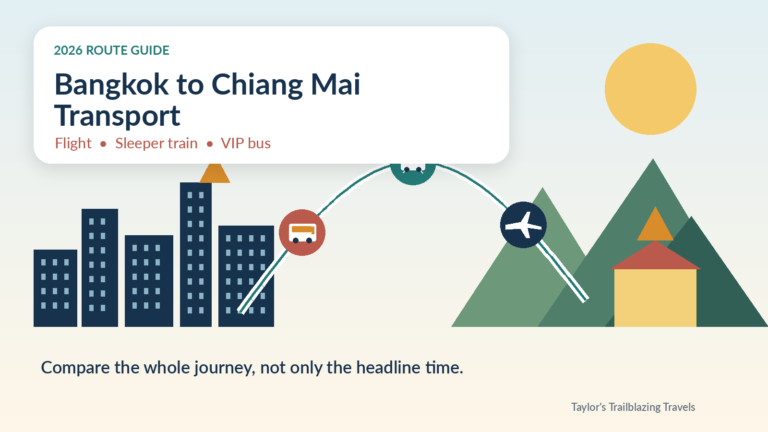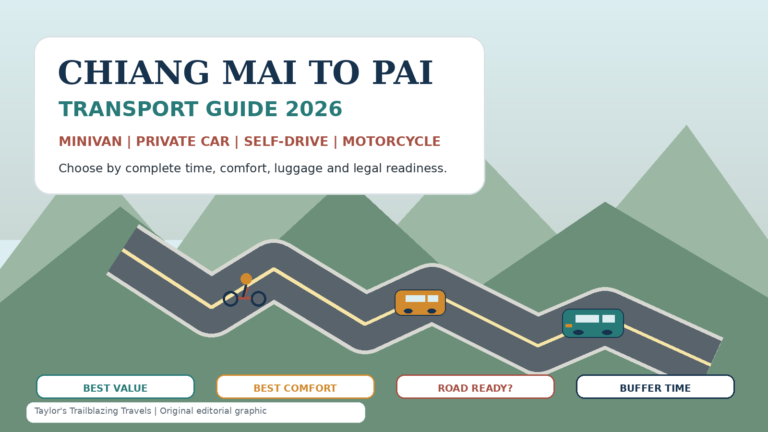
Thailand travel planning
A practical 2026 guide to Bangkok rail, sleeper trains, buses, domestic flights, ferries, taxis and island transfers – with real timings, current price anchors and route comparisons.
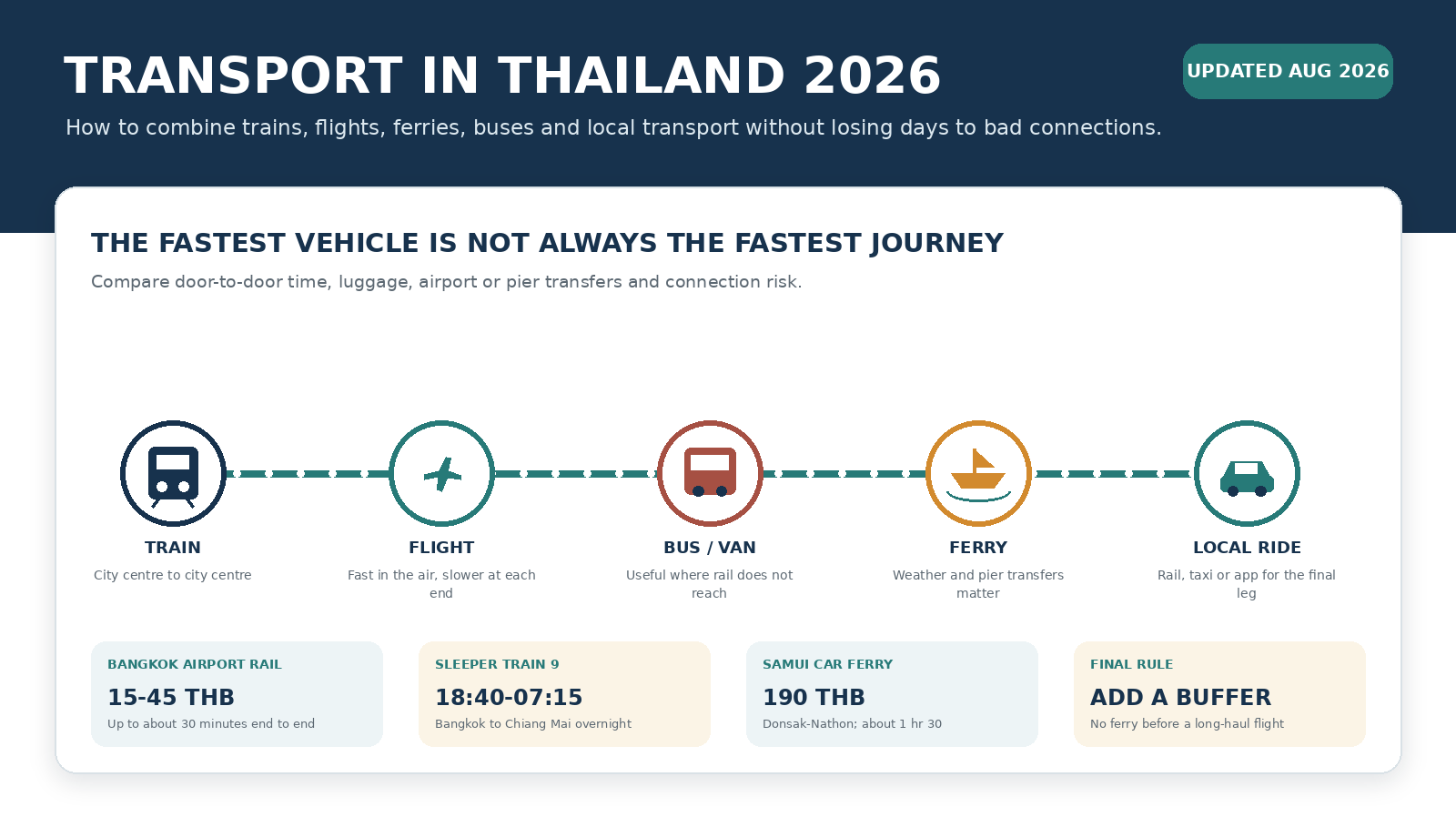
Affiliate disclosure
Readers support Taylor’s Trailblazing Travels by using selected links in this guide. I may receive a commission when a qualifying booking is made, at no extra cost to you. Links appear only where a comparison or pre-booked transfer can genuinely simplify the journey.
Transport in Thailand looks complicated on a map because the country uses almost every kind of passenger travel: city rail, long-distance trains, domestic flights, overnight coaches, minivans, car ferries, speedboats, songthaews and ride-hailing apps. On the ground, however, the system becomes manageable once each journey is treated as a chain rather than a single ticket.
The trap is comparing only the time printed beside the vehicle. A 75-minute flight can occupy five hours after hotel checkout, airport travel, baggage drop, security and the arrival transfer. Meanwhile, an overnight train may take twelve hours yet save a hotel night and deliver you close to the centre of Chiang Mai. Therefore, neither option is automatically better; the route and the traveller decide.
My planning rule is simple: write the hotel checkout time on the left, the next realistic check-in time on the right, and price everything between them. That includes luggage, tolls, pier transfers and the last taxi. For that reason, this guide uses that door-to-door test throughout, with official 2026 timings and fares where they are available.
Best way to get around Thailand:
The best way to get around Thailand is to combine transport types. Use BTS, MRT, Airport Rail Link and the Red Line in Bangkok; fly long north-south routes when time is limited; choose the sleeper train when the journey is part of the experience; use established buses or minivans where rail does not reach; and book matched road-and-ferry connections for islands. Keep the final night on the mainland before a long-haul flight.
Transport in Thailand: quick answers
Best for Bangkok
BTS and MRT for long cross-city trips, boats for selected riverside journeys, then a taxi or walk for the final leg.
Best for long distances
Flights protect holiday time; overnight trains trade speed for experience and a saved hotel night.
Airport Rail Link
Suvarnabhumi to Phaya Thai costs 15-45 baht, operates 05:30-midnight and takes no more than about 30 minutes end to end. [4]
Don Mueang rail
The Red Line fare from Don Mueang to Krung Thep Aphiwat is 33 baht in the official July 2026 table. [5]
Bangkok-Chiang Mai train
Train 9 leaves Krung Thep Aphiwat at 18:40; check the live SRT timetable before travel. [10] [11]
Train booking window
Eligible SRT express and rapid services can be reserved from three hours up to 180 days ahead. [12]
Donsak-Samui ferry
Seatran lists 190 baht for a passenger and about 1 hour 30 minutes to Nathon when checked. [15]
Final connection rule
Do not combine an island departure with an unprotected long-haul flight on the same day.
How to choose the right transport in Thailand
Start with four filters: door-to-door time, connection risk, luggage and total price. Comfort matters too, although it comes after the basics. For example, a luxurious coach is still a poor choice when it arrives at an out-of-town terminal at 04:30 and the hotel will not accept luggage for another five hours.
Best transport by journey type
| Journey | Usually best | Why it works | Choose something else when |
|---|---|---|---|
| Inside central Bangkok | BTS, MRT or river boat | Predictable timing and less exposure to road traffic | You have heavy luggage, several passengers or an awkward final address |
| BKK to a rail-connected hotel | Airport Rail Link plus BTS or MRT | Low fare and reliable journey time | You arrive late, travel as a family or stay far from rail |
| Bangkok-Chiang Mai | Flight or sleeper train | Fastest overall or a memorable overnight journey | A VIP coach suits the budget, terminal or remaining availability better |
| Bangkok to the southern mainland | Flight or overnight train | Time versus experience | A direct bus reaches a town without a convenient rail or air link |
| Mainland to an island | Through-ticket or matched road and ferry | Fewer unprotected hand-offs | You know the piers, have a generous buffer and want more control |
| Rural north or national parks | Driver, tour or rental car | Sights are spread out and public links can be infrequent | You have a simple fixed transfer or an established local bus route |
The door-to-door test
For every option, add the time from the hotel to the terminal, a realistic check-in buffer, the scheduled journey, baggage collection and the final transfer. Then add the hidden costs. A flight that appears cheaper can lose its advantage after checked baggage and two airport taxis, while a train may become competitive when the station is close to both hotels.
Protect the hardest hand-off
The weakest connection controls the whole route. For example, on an island journey, that is often the final ferry. On a two-airport connection, it is the road between BKK and DMK. When a route contains three or more hand-offs, either buy a coordinated through-ticket or build enough time to recover from one delay.
Bangkok airports and airport transfers
Bangkok has two major airports, and the codes matter. In practice, Suvarnabhumi is BKK; Don Mueang is DMK. Consequently, a cheap domestic flight from the wrong airport can turn a sensible itinerary into a cross-city transfer with separate-ticket risk.
Suvarnabhumi Airport (BKK)
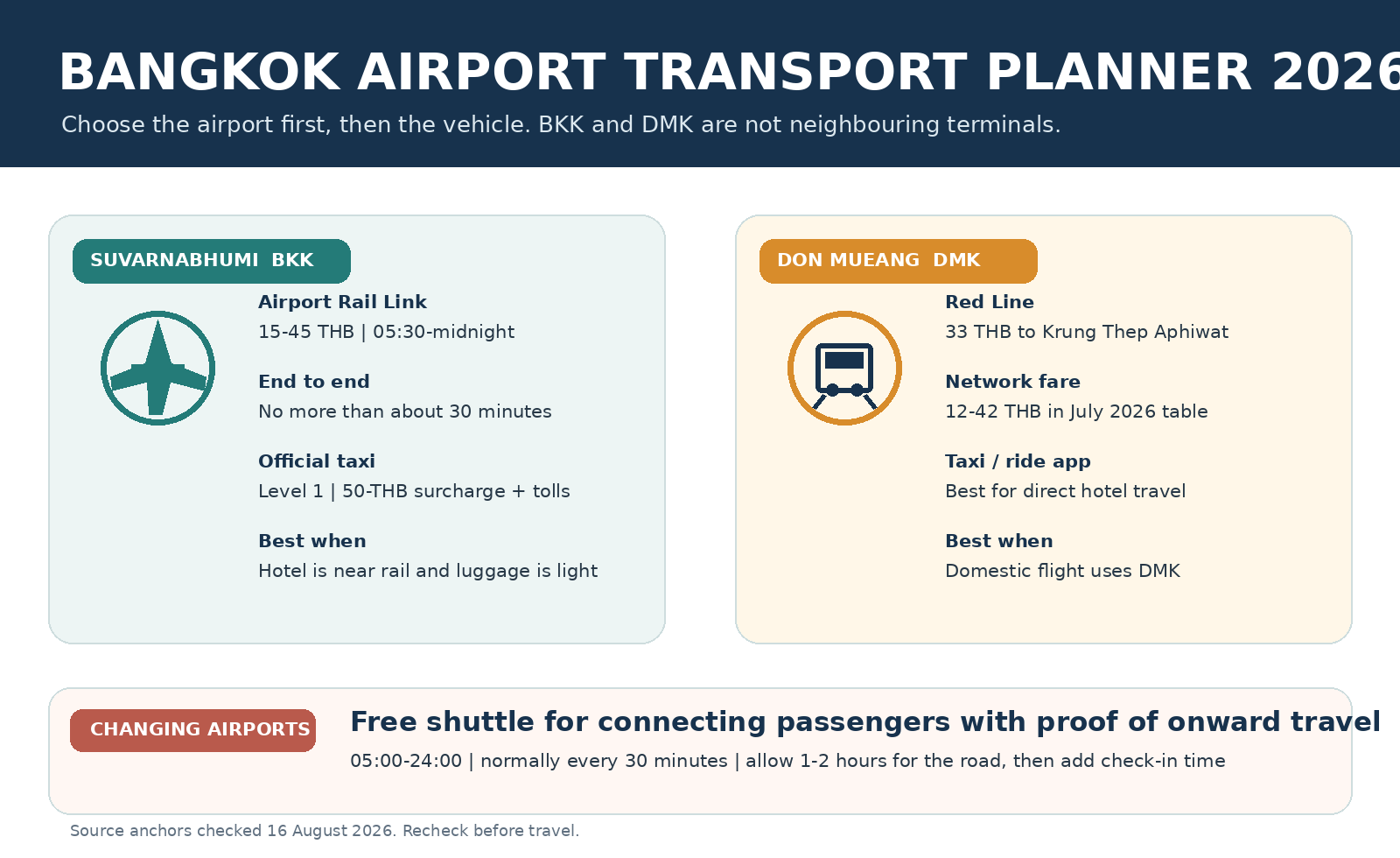
Suvarnabhumi handles most long-haul services and has the simplest rail connection. At BKK, the Airport Rail Link station is on Level B1. From there, the line operates from 05:30 to midnight, costs 15-45 baht and runs to Phaya Thai, with an MRT interchange via Makkasan and Phetchaburi. As a result, the end-to-end ride takes no more than about 30 minutes. [1] [4]
In practice, rail is excellent with one manageable bag and a hotel near BTS or MRT. By contrast, the official taxi queue is usually easier for families, late arrivals or riverside and Old City hotels. Meanwhile, AOT places public taxis on Level 1 between Gates 4 and 7. In addition, the metered fare is supplemented by a 50-baht airport charge, passenger-paid tolls and any regulated luggage charge. [1] [23]
Don Mueang Airport (DMK)
By contrast, Don Mueang serves many domestic and regional low-cost flights. Therefore, the Red Line is the traffic-proof option for travellers who are comfortable changing at Krung Thep Aphiwat or connecting onwards. The official 28 July 2026 fare table lists 33 baht between Don Mueang and Krung Thep Aphiwat, while taxis and ride-hailing services remain more convenient for door-to-door travel. [2] [5]
Changing between BKK and DMK
The free AOT shuttle is only for genuine flight transfers and requires proof of onward travel. In addition, current airport guidance lists a 05:00-24:00 service, normally every 30 minutes. Even so, traffic makes the duration unpredictable. Allow at least one to two hours for the road itself, then add immigration, baggage and the receiving airline’s check-in deadline. [1] [2] [3]
Getting around Bangkok in 2026
In practice, Bangkok becomes much easier when sightseeing is grouped into clusters. Use rail for long cross-city movement, boats for selected riverside and Old City journeys, then walk or take a short taxi for the last section. By contrast, crossing the city repeatedly for one attraction wastes more time than almost any fare difference.
Bangkok transport comparison
| Mode | Current price or payment anchor | Best for | Main weakness |
|---|---|---|---|
| BTS Skytrain | Distance based; official calculator. For example, relevant Green Line journeys can reach 65 baht including listed extensions. [6] [7] | Sukhumvit, Siam, Silom and predictable timing | Does not reach the historic Old City directly |
| MRT | Line and station based; official ticket information. EMV contactless expanded across four MRTA lines from June 2026. [8] [9] | Chinatown, Sanam Chai, Sukhumvit interchange and wider network links | Interchanges and separate operators can confuse first-time visitors |
| Airport Rail Link | 15-45 baht. [4] | Suvarnabhumi to Makkasan or Phaya Thai | Busy trains and onward luggage handling |
| Red Line | 12-42 baht in the official July 2026 table. [5] | Don Mueang, Krung Thep Aphiwat and northern suburban corridor | Usually requires another transfer for central hotels |
| River boat | Route and boat type vary | Riverside temples, selected Old City stops and traffic-free views | Pier names, step access and operating windows require attention |
| Metered taxi | Meter plus applicable airport charge and tolls | Door-to-door travel outside rail coverage | Traffic and pickup friction at busy times |
| Ride app | Price shown before booking | Pickup confidence, location sharing and cashless payment | Surge pricing and designated airport pickup areas |
BTS and MRT are not one universal system
The networks connect at selected stations, yet the ticketing experience is not identical. In June 2026, MRTA announced full EMV contactless support across its four supervised lines, which is helpful for visitors with a compatible bank card. Nevertheless, do not assume that the same card or fare product works on every Bangkok rail operator. Nevertheless, keep a small cash reserve and check the gate signage. [8] [9]
Rush hour, rain and hotel location
Rail becomes more valuable when roads slow down. At the same time, uncovered walkways, crowded platforms and station stairs can make a suitcase unpleasant. For that reason, a hotel that is genuinely five minutes from a station often saves more time than a cheaper room hidden twenty minutes down a side street.
Boats are useful, but only on the right day
The Chao Phraya can link riverside sights efficiently and add a memorable view. Still, boats are not a universal shortcut. Before boarding, check the flag, direction, pier name and final sailing time. Travellers with limited mobility should also ask about step height, floating pontoons and assistance before relying on a particular pier.
Trains and sleeper services
Thailand’s railway is most useful when the station locations and overnight timing work in your favour. It is rarely the quickest way to cover a long distance, although it can be the most satisfying. The north, northeast and southern mainland are all served, while islands and several beach destinations still require road or boat connections.
Bangkok to Chiang Mai sleeper train
Special Express Train 9 is the best-known first-timer service. SRT lists an 18:40 departure from Krung Thep Aphiwat on an all-air-conditioned train with first- and second-class accommodation. The live timetable should always be checked because operational times can change. [10] [11]
A second-class lower berth is wider and normally sells before the upper berths. First class gives a two-berth compartment, which improves privacy but does not guarantee silence or perfect sleep. Bring a light layer, keep valuables in the small overnight bag beside you and treat the train as an experience rather than a moving hotel.
How early can SRT tickets be booked?
Official D-Ticket terms state that eligible express, special express, CNR, rapid and tourist trains can be reserved from three hours up to 180 days before departure. That long window does not mean every service is released or available in exactly the same way, so search the official system and confirm the train number, station, date, class and berth. [12]
- Search the exact origin and destination in the official SRT system.
- Confirm that the Bangkok station is Krung Thep Aphiwat, Hua Lamphong or Thonburi as appropriate.
- Check whether the result is a seat, an upper berth or a lower berth.
- Save the PDF or D-Ticket in a form that can be scanned at the station gate.
- Arrive early enough to find the correct entrance and platform without rushing.
Southern trains and island connections
Southern trains suit travellers heading towards Surat Thani, Chumphon, Trang, Hat Yai and mainland stops along the route. However, the railway station is not the island. A Koh Samui journey still needs road transport to Donsak and a ferry; Phuket and Krabi need a bus, van or car after the rail leg.
Who should avoid the sleeper train?
Light sleepers, travellers with a fixed early-morning tour and anyone who needs guaranteed step-free handling may prefer a flight. Families can enjoy the train, but adjoining berths or a first-class compartment should be secured early. If the overnight journey will ruin the following day, the saved hotel night is false economy.
Buses and minivans
Buses fill many of the gaps left by rail. They reach provincial capitals, national-park gateways and cross-country routes without an airport. The difficulty is variation: terminal, seat layout, toilet, stops, luggage handling and driving style differ between operators and vehicle classes.
A current Bangkok-Chiang Mai price anchor
The Transport Company promoted a 2026 VIP 24-seat express from Bangkok’s Mo Chit 2 at 20:20. The published fare was 924 baht and the planned journey about 9.5 hours, roughly one to one and a half hours faster than the normal service. That is a useful official comparison point, not proof that every overnight coach offers the same experience. [13]
Where buses make the most sense
- Bangkok to a destination without a convenient railway station.
- Regional links such as Phuket-Krabi and Krabi-Koh Lanta.
- Isaan and secondary cities with established BKS or reputable private routes.
- Short intercity journeys where airport processing would take longer than the drive.
- Overnight travel when trains are sold out and the operator, seat and terminal are clearly identified.
Minivan buying advice
Minivans are frequent and often faster than large coaches, but a full vehicle leaves little room for large luggage. Before paying, check whether a suitcase needs a separate seat, whether the ticket finishes at a bus terminal or hotel, and whether the advertised departure is the actual vehicle or a feeder pickup.
Safety and operator choice
Use established channels, check that a seatbelt is available and keep important medication with you. BKS reported a 2026 Q-Bus assessment programme on routes including Bangkok-Chiang Mai and southern services, which is a useful reminder to compare the operator and vehicle standard rather than selecting only the earliest departure. [14]
Domestic flights
Flights are most valuable between distant regions: Bangkok-Chiang Mai, Chiang Mai-southern Thailand, Bangkok-Phuket and Bangkok-Krabi. They are less persuasive for nearby cities once airport time is counted. A route that looks fast in the air may still consume most of a day.
When flying is worth it
| Route type | Flight advantage | Hidden time or cost | Practical verdict |
|---|---|---|---|
| Bangkok-Chiang Mai | Protects most of a sightseeing day | Airport transfers, check-in and baggage | Usually best for a short first trip |
| Chiang Mai-Krabi or Phuket | Avoids backtracking through Bangkok by land | Direct services may not run every day or season | Excellent when the flight is direct |
| Bangkok-Koh Samui | Arrives on the island | Often costs more than Surat Thani plus ferry | Best when time is more valuable than fare |
| Bangkok-Phuket or Krabi | Fast long-distance leg | Road transfer is still needed at the destination | Usually worthwhile |
| Phuket-Krabi | Little practical advantage | Airport processes exceed the simple road journey | Go by road |
The low-cost fare checklist
- Operating airport: BKK or DMK.
- Checked-baggage and cabin-baggage allowance.
- Seat-selection, payment and change fees.
- Airport transport at both ends.
- Arrival time relative to the last ferry or hotel reception.
- Whether the connection is on one ticket or separate tickets.
A working planning range for a domestic flight is often about 1,000-4,500 baht one way before or after extras, although peak dates and Koh Samui can be substantially higher. That range is an editorial budgeting tool, not a quoted fare. Always compare the final checkout total and both airport transfers.
How early should you arrive?
Follow the airline’s published deadline. For a first-time visitor with checked baggage, a practical planning buffer is normally 90-120 minutes before a domestic departure, with more time during holiday peaks or when the airport is unfamiliar. The buffer belongs before the scheduled departure, not before the gate closes.
Ferries and island transfers
A ferry timetable describes the boat, not the journey. A trip to Koh Samui can include baggage collection at Surat Thani Airport, a two-hour road transfer, pier check-in, the ferry to Nathon and another vehicle to the hotel. Missing one hand-off can strand the traveller on the mainland.
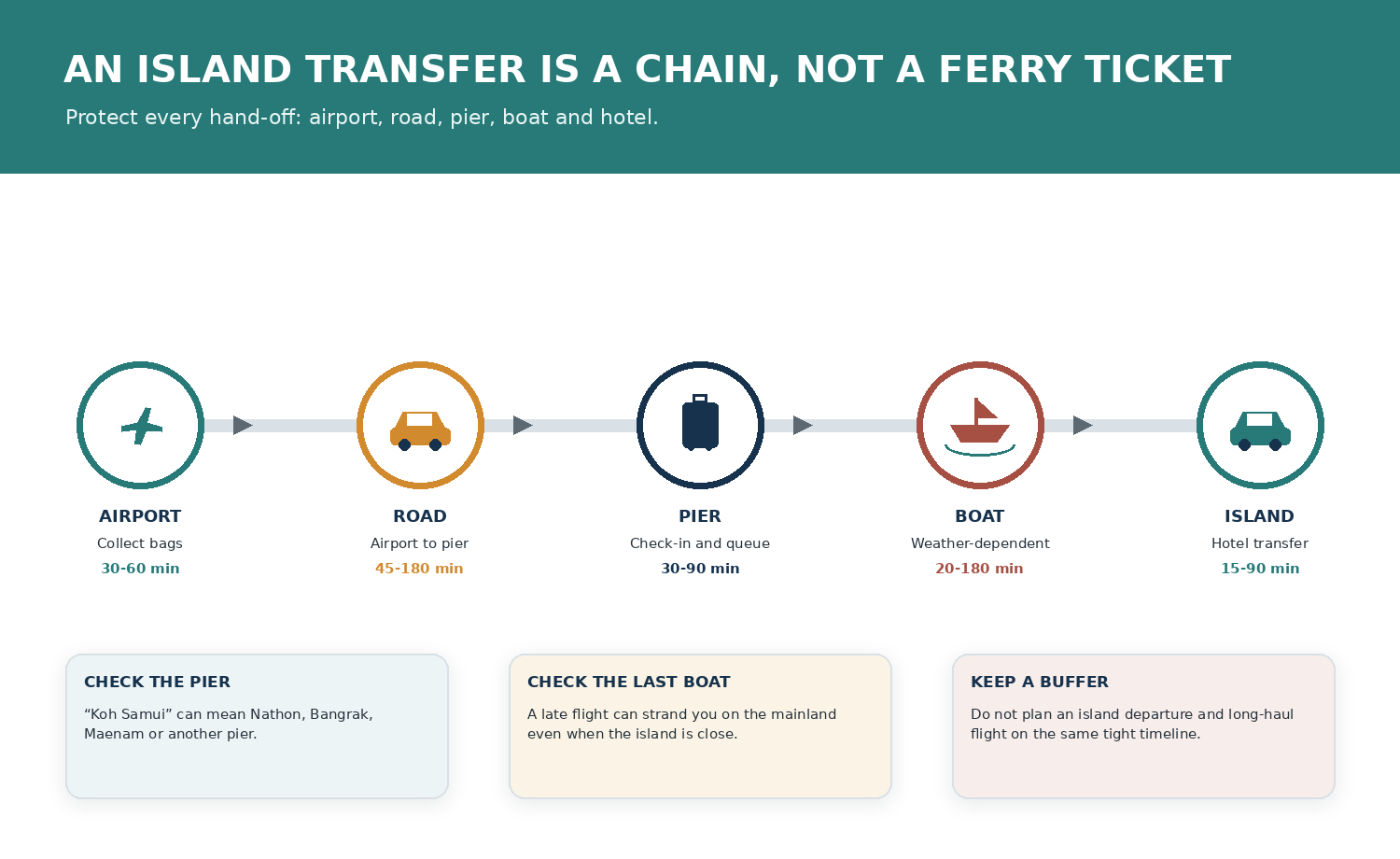
Donsak to Koh Samui: a current price anchor
Seatran’s official booking page lists 190 baht for a foot passenger and about 1 hour 30 minutes between Donsak and Nathon when checked. A car, a different pier, a hotel transfer or a combined ticket changes the total. [15]
Gulf routes: Samui, Phangan and Tao
Lomprayah links Chumphon and Gulf islands including Koh Tao, Koh Phangan and Koh Samui. High-speed catamarans can shorten the sea section, although rough conditions affect comfort and operation. Confirm the exact island pier, not simply the island name, because the final hotel transfer can vary dramatically. [16]
Andaman routes: Phuket, Krabi, Railay and Lanta
Railay is reached by boat, so luggage, tide and boarding point matter. Long-tail boarding may involve shallow water or uneven steps. Koh Lanta can be reached by road-and-vehicle-ferry combinations, seasonal passenger ferries or private transfers depending on the route and date. [17]
Through-ticket or separate tickets?
| Booking style | Advantages | Disadvantages | Best for |
|---|---|---|---|
| Through-ticket | One provider coordinates road and boat | Less flexibility and sometimes an early pickup | First-time visitors and tight hand-offs |
| Separate direct tickets | More control and transparent components | You own every missed connection | Experienced travellers with a generous buffer |
| Private transfer plus public ferry | Easy airport-to-pier leg and luggage handling | Higher cost for one person | Families, groups and late arrivals |
| Private boat | Flexible timing and route | Cost, weather and operator checks | Groups in suitable conditions |
Weather and the last connection
Thailand’s southwest and northeast monsoons affect the coasts differently, while local marine conditions can change during any month. For that reason, the final ferry should never feed directly into an unprotected long-haul flight. Return to the mainland or departure city the day before. [18] [19]
Taxis, ride apps, songthaews and tuk-tuks
Metered taxis
At airports, use the official queue or designated ride-app pickup. In Bangkok, ordinary city journeys should normally use the meter, while tolls are paid separately. For longer provincial trips, a clearly agreed total can be legitimate; write the destination and price down before departure. [1] [23]
Ride-hailing apps
Ride apps reduce language and price uncertainty because the pickup, destination and estimated fare are recorded. Nevertheless, surge pricing, airport zones and driver availability vary. Save the hotel name in Thai, check the licence plate and wait at the stated pickup point rather than asking the driver to stop in a prohibited lane.
Songthaews
Shared pickup trucks work differently by destination. Chiang Mai’s red songthaews can operate flexibly, while island and beach-town routes may have clearer corridors and fixed-ish fares. Ask the destination and price before boarding. If the vehicle is being hired privately, make that distinction explicit.
Tuk-tuks and motorcycle taxis
A tuk-tuk can be fun for a short agreed-price ride, but it is not automatically cheap. Avoid shopping-stop or “free tour” offers. Motorcycle taxis are useful for short urban hops, yet they are a poor match for luggage and carry obvious road risk. Use the provided helmet and choose another mode when conditions feel unsafe.
Renting a car or scooter
A rental car can transform Khao Yai, parts of the north, Isaan and a slow island stay. A scooter appears convenient in beach towns, although it brings the highest legal and safety burden in this guide. Easy rental does not equal legal entitlement or insurance cover.
Licence, IDP and insurance
UK government travel advice says UK visitors need the 1968 International Driving Permit alongside the UK licence. It also stresses the correct entitlement for the vehicle and engine size, because an invalid licence can invalidate insurance. Travellers from other countries should check their own licensing authority and Thai requirements. [20]
Road-risk context
WHO reports a road-death rate of 25.4 per 100,000 population for 2021 and says motorcyclists accounted for 83.8% of road deaths. Those figures explain why “everyone rents one” is not a safety argument. [21]
- Photograph every side of the vehicle and record existing damage.
- Confirm the insurance excess and what is excluded.
- Inspect tyres, lights, brakes and helmet condition.
- Do not leave a passport as collateral when a safer deposit process is available.
- Do not learn to ride in tourist traffic or on mountain roads.
- Never ride after drinking, without a helmet or in weather beyond your skill.
Car, driver or organised transfer?
A private driver can be better value than a rental car when the route is one-way, parking is difficult or nobody wants to drive after a long flight. A self-drive car works best for a multi-stop rural loop. For children, heavy luggage or unfamiliar mountain roads, the less glamorous option is often the safer and easier one.
Seven real Thailand route examples
1. Bangkok to Chiang Mai: flight, train or bus?
For a two-week first trip, I would usually fly if sightseeing time is the priority. I would choose Train 9 when the overnight journey itself is part of the holiday. The VIP bus becomes attractive when rail is sold out, the terminal is convenient or price matters more than sleep quality.
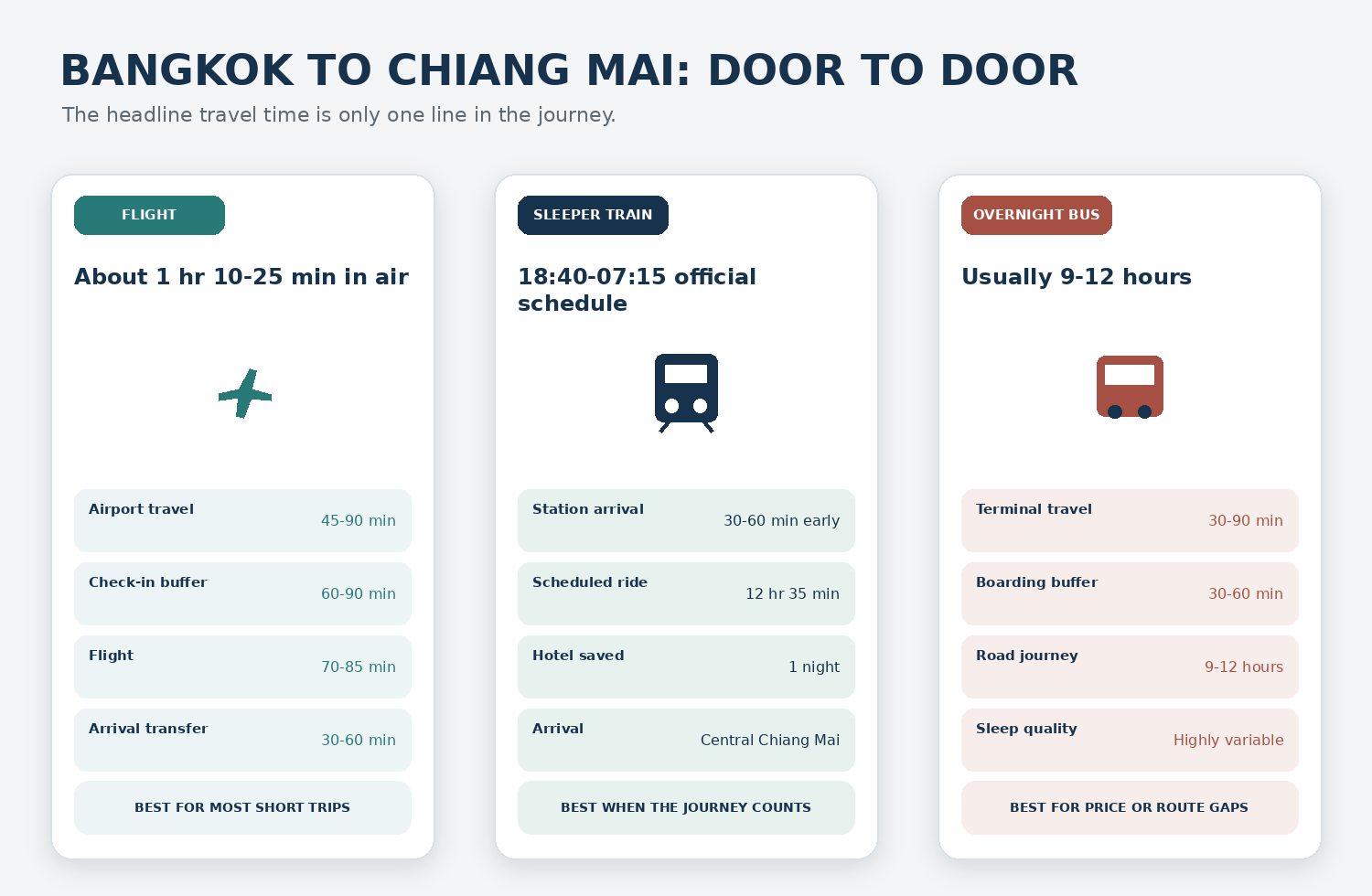
| Option | Vehicle time | Realistic door-to-door block | Working price | Best for |
|---|---|---|---|---|
| Flight | About 1 hour 10-25 minutes in the air | About 4.5-6 hours | Often 1,000-4,500+ baht after extras | Short trips and daytime protection |
| Train 9 | Official 18:40 departure; check live arrival | Overnight plus station transfers | Class and berth dependent | Travellers who value the experience |
| VIP bus | Official example about 9.5 hours | About 10.5-12 hours | 924 baht in the cited 2026 example | Price, availability and route gaps |
2. Bangkok to Koh Samui
The fastest route is a direct flight to Samui, followed by the hotel transfer. A lower-cost route uses a flight or train to Surat Thani, road transport to Donsak and a ferry. That second choice can take most of a day, although it may save a meaningful amount for a family or flexible traveller.
3. Chiang Mai to Krabi or Phuket
A direct flight is the cleanest option when it runs on the required day. Otherwise, a Bangkok connection can still be faster than going overland, although separate tickets need a large buffer. Check whether the fare includes baggage and whether arrival is early enough for the final hotel or ferry transfer.
4. Krabi Airport to Railay
The journey normally combines a road transfer to the relevant pier, a boat to Railay and a walk or hotel-assisted luggage transfer. Confirm which side of Railay receives the boat and whether tide or weather changes the boarding point. Travellers with mobility needs should contact the hotel before booking.
5. Phuket to Krabi
Go by road. A shared van is economical, while a private car gives a cleaner hotel-to-hotel journey for two or more people. A ferry can be scenic in suitable conditions, but it is more seasonal and pier-dependent. Flying adds airport processes without solving a relatively short regional journey.
6. Krabi to Koh Lanta
Shared minivans often provide hotel-to-hotel transport using the road and vehicle-ferry route. A private transfer costs more but handles luggage and waiting more smoothly. Seasonal passenger ferries may also operate, so the best option depends on weather, hotel location and arrival time.
7. Bangkok to Ayutthaya or Kanchanaburi
Ayutthaya is straightforward by train, minivan, driver or organised day trip. Kanchanaburi requires more attention to the Bangkok departure station and the location of the accommodation. For either destination, an early start and one clear return plan beat a collection of improvised tickets at the end of a hot day.
How and when to book transport in Thailand
Book direct when the operator’s system is clear
Direct booking is ideal for SRT trains, airlines and major ferry operators when the website accepts your payment and the terms are understandable. It gives the cleanest relationship with the operator during a change. Save the confirmation offline and make sure the passenger name matches the travel document.
Use a comparison platform when the route has many operators
A comparison platform adds value for buses, vans, mixed train-and-ferry journeys and regional routes where operators use different terminals. The useful information is not the number of results; it is the exact departure point, vehicle class, luggage rule, arrival point and whether the ticket protects a connection.
Book the scarce item first
- Secure the long-haul flight and first-night accommodation.
- Book any fixed sleeper berth, peak-season domestic flight or holiday bus.
- Reserve the island hotel and the transfer that reaches it before the last check-in.
- Leave weather-dependent day boats flexible where cancellation terms permit.
- Recheck every fixed departure 24-48 hours before travel.
Holiday and weather pressure
Songkran, New Year, long weekends and school holidays can tighten availability. Marine weather can change ferry operations with much less notice. Therefore, refundable accommodation and a mainland buffer are often more valuable than squeezing the lowest possible fare from every leg.
Thailand transport budget planner
The figures below are planning ranges for August 2026, not quoted prices. They help compare the scale of each decision. Peak dates, baggage, private vehicles, hotel location and late bookings can move the total considerably.
| Journey or mode | Working budget per person | What usually changes the price |
|---|---|---|
| Central Bangkok rail trip | About 17-65 baht | Line, distance, extensions and interchange |
| Suvarnabhumi Airport Rail Link | 15-45 baht | Boarding and exit station |
| Don Mueang to Krung Thep Aphiwat Red Line | 33 baht | Exact Red Line origin and destination |
| Bangkok airport taxi | Often 300-600+ baht to central areas | Traffic, distance, 50-baht airport charge, tolls and luggage |
| Bangkok-Chiang Mai domestic flight | Often 1,000-4,500+ baht | Date, airport, baggage and booking timing |
| Bangkok-Chiang Mai VIP bus example | 924 baht | Operator, seat class and service |
| Donsak-Nathon foot passenger ferry | 190 baht | Vehicle, pier and combined land transfer |
| Regional shared minivan | About 250-900 baht | Distance, luggage and hotel delivery |
| Private regional transfer | About 1,500-4,500+ baht per vehicle | Distance, vehicle size, tolls and waiting |
Three hidden costs that change the decision
First, baggage can erase a low-cost flight advantage. Second, airport or pier transport at both ends can exceed the headline ticket. Third, a badly timed arrival may force an extra hotel night. Compare the whole chain, not the smallest number on the booking screen.
When paying more is sensible
A private transfer is often worth the difference after a late flight, for four people, with child seats or when the hotel is far from a shared drop-off. Conversely, paying for a private car across central Bangkok at rush hour may buy comfort but not speed. Spend on the fragile hand-off rather than every leg.
Families, luggage and accessibility
Travelling with children
For a family, the cheapest per-person ticket may not be the lowest total. Four minivan seats plus luggage can approach the price of a private vehicle. Ask about child seats before booking; do not assume they are supplied. Overnight trains can be enjoyable, although adjoining berths need early reservation.
Travelling with large luggage
One medium wheeled case and a small day bag are easier than several rigid suitcases on boats, station stairs and shared vans. Keep medication, documents, electronics and one change of clothes in a bag that stays with you. On an island transfer, use a waterproof inner bag even when the main case is hard-sided.
Mobility and step-free travel
Modern airports and much of the urban rail network have lifts, yet access can fail at the next hand-off. Long-tail boats, floating piers, older station gaps, sandy paths and hotel jetties vary. Contact the operator and accommodation with the exact mobility requirement, wheelchair dimensions and need for physical assistance before payment.
Safety and disruption planning
Seatbelts, helmets and operator choice
Use seatbelts where they are fitted, reject a visibly damaged motorcycle helmet and avoid pressuring a boat operator to sail in conditions they consider unsafe. Road and sea travel deserve more attention than a star rating on a booking platform. [20] [21]
Build a recovery plan
- Keep screenshots of the original schedule, ticket and cancellation notice.
- Contact the operating carrier first, then the booking platform if they are different.
- Call the insurer before paying a large replacement cost when practical.
- Keep one payment card and emergency cash separate from the main wallet.
- Know the last acceptable arrival time at the next hotel or pier.
Emergency and tourist assistance
Thailand Tourist Police lists 1155 for tourist assistance. General police is 191, medical emergency is 1669 and fire is 199. Save the numbers offline and keep the hotel address in Thai. [22]
Weather disruption
When a ferry is cancelled, the safest response is rarely to hunt for a smaller boat willing to leave. Rebook the next supported service, inform the hotel and preserve evidence for insurance. A mainland night is inconvenient; an unsafe crossing is not a reasonable alternative.
Pros and cons of transport in Thailand
| What works well | What needs planning |
|---|---|
| Strong network of flights, trains, buses and ferries between major visitor destinations | Different operators, ticket systems, terminals and airport codes |
| Low-cost urban rail and useful official booking channels | Last-mile transfers can cost more time than the main vehicle |
| Overnight trains and coaches can save daytime and accommodation | Sleep quality and arrival times vary |
| Through-tickets simplify island hand-offs | Weather and seasonal schedules still affect boats |
| Private transfers can be excellent value for groups | Vehicle size, waiting time and inclusions must be checked |
| Tourist routes are possible without renting a vehicle | Rural areas and national parks may need a driver or car |
The system rewards travellers who read the terminal name and protect the hand-offs. It punishes those who book every component at the minimum connection time. A slightly slower itinerary with fewer fragile transfers usually feels much faster on holiday.
Transport in Thailand FAQs
What is the easiest way to get around Thailand?
Use a mix: urban rail in Bangkok, flights or sleeper trains between distant regions, established buses and vans for gaps, and coordinated road-and-ferry tickets for islands.
Is Thailand easy to travel without a car?
Yes. The main visitor route is well connected by flights, trains, buses, ferries, taxis and shared transfers. A car is most useful for rural loops, national parks and dispersed attractions.
Should I fly or take the train from Bangkok to Chiang Mai?
Fly when protecting sightseeing time matters most. Take the sleeper train when the overnight experience appeals and you can accept variable sleep quality.
How far ahead can I book Thai trains?
Official SRT terms allow eligible express, special express, rapid and tourist services to be reserved up to 180 days ahead, with a minimum of three hours before departure. Availability still depends on the specific train. [12]
Does Bangkok public transport accept contactless cards?
MRTA announced full EMV contactless support across its four supervised MRT lines from 1 June 2026. Do not assume the same card works on every rail operator, and keep a cash backup. [9]
Can I transfer between BKK and DMK airports?
Yes. The free AOT shuttle is for passengers with onward flights and proof of travel. It operates 05:00-24:00 according to current airport guidance, but road time can still be one to two hours. [1] [3]
Are ferries in Thailand reliable?
Major routes operate regularly, yet weather, seasonal timetables, pier changes and road connections matter. Never rely on the last ferry before an international flight.
Is 12Go useful in Thailand?
It can be useful for comparing operators, terminals and mixed transport on routes with buses, vans or ferries. For a single airline, train or ferry operator, direct booking may give the clearest support relationship.
Are buses safe in Thailand?
Standards vary. Use established operators, check the vehicle class and terminal, wear the seatbelt where fitted and avoid treating every overnight or minivan service as equivalent.
Can tourists rent scooters in Thailand?
Rental is easy, but legal entitlement, the correct IDP, insurance and a helmet still matter. A rental agreement does not prove that a traveller is licensed or insured.
How early should I arrive for a domestic flight?
Follow the airline’s rule. A practical first-timer buffer is commonly 90-120 minutes before departure, with longer at holiday peaks or when checking baggage.
What is the most important ferry-booking detail?
The exact pier and included land transfer. An island name alone does not show where the boat arrives or how far the hotel is from that pier.
What emergency number should tourists use?
Tourist Police is 1155. General police is 191, medical emergency is 1669 and fire is 199. [22]
The transport plan I would use for a first Thailand trip
I would take Airport Rail Link or an official taxi into Bangkok, then fly or use Train 9 to Chiang Mai. From the north, I would fly directly south when the route operates. For the beach section, I would buy one matched road-and-boat transfer rather than stitching together the final hand-offs under time pressure.
Most importantly, I would return to the mainland or Bangkok the day before the international departure. Transport in Thailand is not difficult because there are too few options. It becomes difficult when a route contains too many options, too many hand-offs and no recovery time. Fewer, better-connected stops nearly always produce the better trip.
Sources and methodology
Official airport, rail, bus, ferry, tourism, weather and safety sources were checked on 16 August 2026. Dynamic flight prices and uncited budget ranges are clearly labelled as editorial planning estimates rather than guarantees. Recheck every fixed departure before travel.
- Ways to transport to and from Suvarnabhumi Airport – Airports of Thailand / Suvarnabhumi Airport. Official taxi, Grab, bus, inter-airport shuttle and Airport Rail Link information.
- Special assistance, transport and airport facilities at Don Mueang – Airports of Thailand / Don Mueang Airport. Official DMK taxi points, Red Line reference and transfer-only BKK shuttle information.
- Airport shuttle bus between BKK and DMK – Airports of Thailand / Suvarnabhumi Airport. Official transfer-only shuttle service; current airport guidance lists 05:00-24:00 operation and 30-minute frequency.
- Where the Airport Rail Link can take you – Thailand.go.th. Official station list, 15-45 baht fare, 05:30-midnight operating window and journey of no more than about 30 minutes.
- Red Line fare information – SRT Electrified Train Company. Official fare table dated 28 July 2026, including 33 baht between Don Mueang and Krung Thep Aphiwat.
- BTS routes and fares – BTS Skytrain. Official route, fare and journey-time calculator.
- BTS 2026-27 trip packages and extension fares – BTS Skytrain. Official package rules and Green Line extension-fare information, including the listed 65-baht maximum for relevant adult journeys.
- MRT ticket information – Mass Rapid Transit Authority of Thailand. Official fare regulations, ticket types and payment information.
- MRT EMV contactless upgrade from 1 June 2026 – Mass Rapid Transit Authority of Thailand. Official announcement that EMV contactless payment would be supported across all four MRTA-supervised lines from 1 June 2026.
- Special Express Train No. 9/10 Bangkok-Chiang Mai – State Railway of Thailand. Official description of the all-air-conditioned train and its 18:40 departure from Krung Thep Aphiwat.
- SRT Modern Timetable 2026 – State Railway of Thailand. Official live timetable and fare-checking system.
- SRT D-Ticket terms – State Railway of Thailand. Official terms stating eligible express, special express, rapid and tourist trains can be reserved from three hours up to 180 days ahead.
- Bangkok-Chiang Mai special express bus – The Transport Company Limited. Official 2026 VIP 24-seat example: 924 baht, 20:20 departure and about 9.5 hours.
- BKS public-bus quality programme – The Transport Company Limited. Official July 2026 update covering Q-Bus assessment on routes including Bangkok-Chiang Mai and southern services.
- Donsak to Koh Samui ferry timetable and fare – Seatran Ferry. Official booking page showing 190 baht for a passenger and about 1 hour 30 minutes between Donsak and Nathon when checked.
- About Lomprayah high-speed catamarans – Lomprayah. Operator information for Gulf links among Chumphon, Koh Tao, Koh Phangan and Koh Samui.
- Railay visitor context – Tourism Authority of Thailand. Official visitor context for the boat-access peninsula and its limestone geography.
- Thailand weather overview – Tourism Authority of Thailand. Official climate overview used for seasonal route and marine-weather planning.
- Thailand monsoon systems – Thai Meteorological Department. Official explanation of the southwest and northeast monsoon systems.
- Thailand safety and security: road travel and sea travel – UK Foreign, Commonwealth & Development Office. Current guidance on driving licences, the 1968 IDP for UK visitors, helmets, insurance and sea-travel risk.
- Road safety in Thailand – World Health Organization. WHO road-safety data and the high proportion of motorcyclists among road deaths.
- Thailand Tourist Police – Thailand Tourist Police. Official Tourist Police information and the 1155 assistance number.
- Public taxi at Suvarnabhumi Airport – Airports of Thailand / Suvarnabhumi Airport. Official public-taxi queue, 50-baht airport surcharge and passenger-paid toll information.
Image credits
Illustrations in this article were created for Taylor’s Trailblazing Travels. Third-party photographs, where used, are credited beside the image or in the source list.